• Ancient Digger teaches Archaeology and History to all Ages!

Tuesday, January 28, 2020

ARCHAEOLOGY NEWS: 1/28/2019


ARCHAEOLOGY NEWS – Ancient Digger brings you the latest archaeology news and headlines everyday of the week!

Underwater archaeologists have discovered a huge, centuries-old shipwreck and a destroyed World War II bridge in a river in Poland.

Vesuvius victims died slower than believed

3,000-year-old teeth solve Pacific banana mystery

Archaeology news: Archaeologists recreate the voice of 3,000-year-old Egyptian mummy

By 3D printing an electronic larynx which is an exact replica of the mummified priest, experts have been able to recreate the voice of a person who has been dead for 3,000 years. A team from Royal Holloway, University of London, Leeds Museum and the University of York placed the mummified remains of Nesyamun inside a Computed Tomography (CT) scanning machine to analyse whether the structure of the larynx had remained intact.

Witch’s bottle found in US Civil War fort.
A glass bottle filled with rusty nails discovered in Virginia could be a rare ‘witch’ bottle used by soldiers in the US civil war to fend off evil spirits. The bottle stands at a height of five inches (13 centimetres) tall and three inches (eight cm) wide and was discovered near a civil war fort known as Redoubt 9.


Sunday, December 30, 2012

The Return of Hopi Artifacts Causes Controversy


On an unknown date at an unidentified location, the U.S. government turned over a collection of undisclosed Sinagua artifacts to anonymous members of the Hopi Tribe for unspecified disposition.

The mysterious proceedings this fall involved an archaeological treasure trove and a substantial expenditure of tax dollars. Yet virtually everything about it remains secret under a federal law known as the Native American Graves Protection and Repatriation Act, or NAGPRA.

The 1990 law enables Indian tribes to reclaim ancestral remains and sacred objects that were unearthed from native burial sites by scientists or looters. Along with supplemental statutes, it also authorizes U.S. agencies to conceal virtually all details of those transactions.

The recent Hopi event involved archaeological digs from Coconino National Forest near Flagstaff. When The Arizona Republic sought a description of the repatriated items and an accounting of federal money spent, the government repeatedly answered, "Our intent is to honor the tribe's request, made in consultation, not to disclose information."

The secrecy and phrasing hint at an underlying controversy that has festered since the repatriation act was adopted.

For Native Americans, the repatriation of remains and funerary objects is a matter of justice — the return of sacred possessions that were dug up, defiled and displayed for decades in violation of tribal beliefs and human rights. To this day, activists are pushing to expand the law in the name of privacy, religious freedom and tribal sovereignty.

Conversely, for some archaeologists and anthropologists, the loss of ancient artifacts represents a scientific sacrilege — disposal of objects that may be irreplaceable in understanding human history and cultures.

Most researchers no longer defend the excavation of Indian burial sites, and few will publicly criticize the repatriation act because to do so would jeopardize their professional careers. But, privately, the repatriation of relics that were unearthed decades ago continues to raise questions of academic freedom, political correctness and the public's right to know.

Officials at the Museum of Northern Arizona, which housed at least some of the bones and artifacts returned to the Hopis this year, cooperated with the repatriation and declined to discuss the Sinagua collection. The non-profit museum sponsored many of the area archaeological digs years ago and remains a repository for artifacts.

Kelley Hays-Gilpin, anthropology curator, said that those items were the property of the federal government and that only a fraction of the museum's collection was lost. "It's not like we're getting emptied out," she said.

Still, records and sources indicate that items claimed by the Hopis included one of the most scientifically important burial subjects ever found in the Southwest — and perhaps one of the most sacred of Hopi ancestors.

He is known as the Magician, and his remains were accompanied by a unique archaeological bounty.

Swallower of Sticks

The man was buried at a place known as the Ridge Ruin, about 20 miles outside Flagstaff, in an unremarkable house of stone and clay. He remained there, undisturbed, for 800 years.

Then, in the late 1930s, John C. McGregor, an archaeologist at the Museum of Northern Arizona, uncovered the skeleton, along with more than 600 carefully placed funerary objects: ornate jewelry, baskets, cutting blades, mountain-lion teeth, shells, a pointy cap made of beads and, as a final offering, 420 arrows.

McGregor found what he called "the most outstanding decorative basket that has ever been found in the Southwest," featuring 1,500 carefully cut pieces of turquoise as well as rows of other stones and rodent teeth.

Many items, such as an exotic macaw corpse, were from distant lands. Some researchers suggested that the man of about 40 was a traveling Aztec merchant, or pochteca.

But Hopis who assisted and consulted McGregor said many of the objects were associated with ancient tribal skills such as shape-shifting, combating witchcraft and controlling weather or warfare. For example, they said 13 wooden pointers, laid over the remains, were used in a sort of sword-swallowing feat of magic by members of a warrior society. They called the man Moochiwimi, or Swallower of Sticks.

In a 1943 article for the American Philosophical Society, McGregor wrote that the Magician comprised "the richest burial ever reported in the Southwest." Others described it as "The King Tut of Northern Arizona."

To this day, the Magician remains a subject of research and conjecture.

Michael O'Hara, a professor at Arizona State University's School of Human Evolution and Social Change, wrote about him last year in a paper for the Society for American Archaeology.

O'Hara disputed the theory that ceremonial items reflected wealth, suggesting instead that the interment of ritual objects helped mourners reorder their social unit after the loss of a key figure.

O'Hara, who did not respond to interview requests, wrote that the Magician represents a "spectacular and wholly unique" archaeological find that provides "unparalleled insights into the social roles present in Sinagua society."

The Hopi way

Even today, Hopi tribal structure is based on a network of social groups, each with specialized responsibilities, skills and secret rituals stemming from spiritual beliefs.

Religious practices are considered so sacred that the secrets are not even shared among various societies. No Hopi who was contacted for this story would comment.

That deep sense of privacy is exemplified in a "Protocol for Research and Publication" posted on the Hopi Cultural Preservation Office website.

The protocol prohibits archaeological, anthropological or historical work — even news stories — without permission, and authorizes censorship of information deemed sensitive or thought to misrepresent the Hopi way.

Twenty-two years ago, Congress adopted the repatriation act with support from most major archaeology and anthropology associations. The Heard Museum in Phoenix spearheaded recommendations.

The law established a process for Native Americans to reclaim bones, burial relics and other items of "cultural patrimony" that were collected by scientists or stolen by looters. Scores of museums and federal agencies are required to create lists of remains or sacred objects and determine whether those items are affiliated with modern indigenous groups. Inventories are supposed to be published in the Federal Register.

Nationwide, nearly 179,000 whole or partial corpses have been identified, with nearly 13,000 of those returned to tribes. More than two-thirds of the remains have not been linked to modern tribes.

In addition, museums and federal agencies have listed about 2 million funerary or sacred objects. Roughly 176,000 of those have been turned over to tribes.

Since 1996, the National NAGPRA Program has issued more than $500,000 in grants to the Hopi Tribe for repatriation.

The federal program is managed by Sherry Hutt, who served for years as a Maricopa County Superior Court judge. Hutt, who also prosecuted artifact looters as an assistant U.S. attorney in Phoenix, said the law gives indigenous people a tool to regain items that were rightfully theirs. To put it in context, she said, imagine if someone wanted to dig up your parents for a new roadway: Who should decide what is done with the remains?

"Really, what NAGPRA says is Native Americans are just like everybody else — no more, no less," Hutt said. "It does not say you can't do science. What it says is: 'These are not your personal property.'"

Destroying history?

Resistance from some scientists is hardly new. In an essay published 15 years ago, Grinnell College (Iowa) anthropologist John Whittaker discussed a great divide between researchers and Native Americans.

Whittaker opened with a stanza from the Indian protest song, "Here Come the Anthros," by the late Sioux musician Floyd Red Crow Westerman:

The Anthros keep on digging our sacred ceremonial sites

As if there's nothing wrong and education gives them the right.

But the more they keep on digging, the less they really see,

'Cause they got no respect, for you or for me.

Whittaker offered a response, without rhymes:

"He wants me to leave it alone; I want to excavate it and learn from it. He wants control to be in Indian hands; I regard it as a human heritage that belongs to all. … I am interested in his opinions about the past; he doesn't think I have anything to say to him."

Whittaker, who declined to comment for this story, argued in his essay that science honors the dead by studying their lives and adding historical understanding to present-day cultures. He wrote that NAGPRA is "subtly racist" and "disastrous for archaeology" because it makes research politically incorrect while wiping out the chance to learn from previous finds.

"The laws have resulted in the destruction by reburial of vast amounts of archaeological evidence," he said.

Other prominent researchers have made similar points in litigation against NAGPRA, arguing that ancient remains in North America go back 11,000 years or more and, in some cases, have no cultural or genetic ties with modern Indians.

In a famous suit known as the Kennewick Man case, two archaeologists at the Smithsonian Institution and a University of Arizona professor were among eight plaintiffs who blocked the transfer of a 9,000-year-old skeleton to tribes in Washington state. A federal judge ruled there was no evidence tying the remains to contemporary cultures or people, so scientists were entitled to conduct research under another law, the Archaeological Resources Protection Act.

C. Vance Haynes Jr., a professor emeritus of anthropology and geology at the University of Arizona, said he consulted with a Hopi colleague before signing on as plaintiff in the Kennewick case. "He told me, 'You know, Vance, we're not all one Indian. There are a lot of us who want to know where we came from, and about our past.'"

Haynes specializes in the roughly 13,000-year-old Clovis culture, among the earliest humans in North America. "NAGPRA is a very important law," he said. "But, when it comes to sites more than 4,000 years old, we need to be able to study. ... Our whole mission is to increase knowledge."

Cleone Hawkinson, an anthropologist and president of a group known as Friends of America's Past, said federal policy discriminates in favor of Native Americans and thwarts the quest to fathom human development.

"NAGPRA is a narrow law, unfairly administered," said Hawkinson, who assisted plaintiffs in the Kennewick case. "Factual understanding of the past is distorted when a limited group is singled out as rightful 'owners' of all of prehistory and scientific inquiry is prohibited to evaluate their claims."

Stolen remains

James Riding In, an American Indian studies scholar at Arizona State University, said indigenous people of the Western Hemisphere were victimized by grave-digging in the name of science and are only now able to let forebears rest in peace.

"The dead are not resources belonging to an invading culture," he said. "The problem is that archaeologists and anthropologists stole those remains and created those issues."

There is not a homogeneous Indian perspective on death or afterlife but scores of different beliefs, Riding In said. Some may welcome archaeological inquiry, he said, but many view the excavation and removal of corpses as taboo.

Riding In said his people, the Pawnees, are among the latter: "There's still a spirit associated with those remains. The only purpose for disturbing the dead (in Pawnee culture) is to do harm to the living through witchcraft."

Riding In, who has participated in a number of repatriation events, said bones and artifacts are usually reburied either where they were unearthed or in an ancestral homeland. He said that archaeology and anthropology sometimes help Native people learn about the past or verify sacred sites or objects but that modern science also denigrates their beliefs as fairy tales.

Tribes have a right to privacy in reclaiming the ancients, regardless of tax dollars expended, Riding In and others said. "It is a sovereignty issue that allows Indians to determine what happens to their deceased. … It should be respected," he said.

Since NAGPRA was adopted, remains from more than 1,200 humans have been claimed by Arizona tribes in about 40 repatriation events.

John McClelland, NAGPRA coordinator at the Arizona State Museum in Tucson, said he got no official word that Hopis took possession of the Magician, but there were rumors. He added that the event apparently included additional Sinagua items that had been housed at the museum in Tucson.

McClelland said that NAGPRA is a fact of life and that most contemporary archaeologists respect the sensitivity of living people even if they regret the vanishing of scientific materials that might yield new information about their forebears. "It's true, there is a loss," he said. "Basically, that's the reality these days. ... The bottom line is it's a matter of human rights and Native American rights."

Source: Dennis Wagner, The Arizona Republic

Sunday, July 29, 2012

Top Stories for the Week: July 29, 2012


Find out what archaeology news and articles visitors are sharing every week on Ancient Digger by visiting every Sunday morning. Grab a cup of espresso or tea and settle in.

In the next coming weeks I will periodically be adding more articles concerning history and linguistics. Since Ancient Digger teaches history to everyone, I thought it would be helpful to add more of a mix of topics, since my graduate work will focus on Linguistic Anthropology/Indian Cultures and Language

Best Graduate Schools, Universities, and Colleges for Archaeology and Anthropology
I have compiled several lists in order to help you determine the top graduate colleges and universities with the best programs for anthropology and archaeology, as well as the top undergraduate colleges, universities and school programs for anthropology and archaeology.

Pompeii: Erotic Art and Roman Sexuality
Pompeii is an archaeological site, which was destroyed around AD 79 by Mount Vesuvius. It was a town full of aristocrats and artisans. Artisans who were previously slaves, who gained freedom in Pompeii and became wealthy merchants. Pompeii was a place for the super-rich! The Palm Beach of the Roman world. It was a place known for sexual indiscretions.

Classical archaeology is a deeply interesting subject that has enchanted researchers and students for ages. Quite simply, it is the study of archaeological excavations from Ancient Greece and Rome. However, some only consider it to be the study of the Roman and Athenian civilizations, but it can include other subjects such as Minoan and Crete civilizations.

Typically nautical, maritime, and underwater archaeologists study artifacts in ocean or sea environments. However, specialization usually doesn't occur until graduate school after the student has received a BS in Anthropology.

The Contributions and Legacy of the Hebrews
The law would not exist without Moses, who leads the Jews out of Egypt and a 40 year tradition of slavery. Moses walks into the mountains of Sinai and then returns with the Ten Commandments, presenting them to the Israelites.

A stone masonry deck and old artifacts unearthed during excavation for the Subhash Park Metro station have led to speculation among locals that these could be the remains of Akbarabadi Masjid that was razed by the British after the 1857 uprising.

Planes and Weapons used during the Korean War
The Korean War lasted from June 25, 1950 until the signing of an armistice on July 27, 1953. Although the fighting only lasted three years, the events leading up to the war in Korea go back several decades earlier.

Mona Lisa's remains found in Florence? 
Scientists claim that they might have found the skeleton of the woman who posed for Leonardo Da Vinci’s most famous painting.

30 Reasons Why You Should Become An Archaeologist Sometimes it’s not about the school, money, or where you’ll move your family after you graduate. It takes a special individual to do what archaeologists do, and there are some perks and not so nice aspects of the field, but you have to be willing to sacrifice.

Snakes and Mythology: Some Interesting Facts 
The symbolism of snakes in past history and present is mixed with uncertainties. Many associate the snake as a messenger for the bringer of death and there are countless cultures that believe the serpent is a symbol of fertility, honor, knowledge, and truth.

    Thursday, July 12, 2012

    Top Archaeology News: June 12, 2012


    Archaeologists and engineers from the University of Southampton are collaborating with the British Museum to examine buried Roman coins using the latest X-ray imaging technology.

    Originally designed for the analysis of substantial engineering parts, such as jet turbine blades, the powerful scanning equipment at Southampton's u-VIS Centre for Computed Tomography is being used to examine Roman coins buried in three archaeological artefacts from three UK hoards.

    Archaeologists have discovered what may be among the oldest remains at the ancient site of Selinunte: an ancient temple.

    Inside, fragments have been found that help explain the site's significance: an offering to Demeter, the goddess of grain and agriculture; a small flute, made of bone and dating to 570 BC; a small Corinthian vase. These findings are critically important in helping archeologists to date the temple where they were found, to around the 6th century BC - possibly the oldest in the archaeological area of Selinunte in Sicily.

    If you want to find your own dinosaur fossils, Schenectady County Community College is offering a program that will give you some archaeology experience. The school is offering a certificate of proficiency in archaeology. Students can enroll in individual courses or complete the full curriculum. This summer the school is offering hands-on experiences for both adults and kids.

    For more information, click here.

    Shengavit District, Yerevan–Work is progressing on much-needed repairs and maintenance at the Shengavit Historical and Archaeological Culture Preserve in Yerevan. Thanks to support from the Cambridge Yerevan Sister City Association (CYSCA) and members of the U.S. Armenian community, Shengavit’s director, Vladimir Tshagharyan, is implementing critically needed maintenance and repairs at the site. Tshagharyan was appointed Shengavit’s director about two years ago.

    Scientists have found that Native American populations -- from Canada to the southern tip of Chile -- arose from at least three migrations, with the majority descended entirely from a single group of First American migrants that crossed over through Beringia, a land bridge between Asia and America that existed during the ice ages, more than 15,000 years ago.

    n the 1920s archaeologists discovered more than 1,000 cattle skulls buried at an early Iron Age stock enclosure at Harrow Hill in Sussex, while a huge Iron Age midden (rubbish heap) covering at least 2.5 hectares has been found at East Chisenbury in Wiltshire. Each is thought to represent the remains of vast annual feasts on grasslands shared between local communities, perhaps during the annual round-ups of their collective herds.


    Tuesday, July 10, 2012

    Top Archaeology News for June 10, 2012


    Monastery Deir Mar Musa (Robert Mason)
    In 2009, Dr Mason was at work at the monastery when, walking nearby, he came across a series of rock formations: lines of stone, stone circles, and what appeared to be tombs. “Much more detailed examinations are needed to understand the structures,” said Dr Mason, who talked about the finds and about archaeology at the monastery at Harvard’s Semitic Museum. But that he isn’t sure when he will be able to return to Syria, if ever.


    The origins of Jewish dietary or kosher laws (kashrut) have long been the subject of scholarly research and debate. Regardless of their origins, however, these age-old laws continue to have a significant impact on the way many observant Jews go about their daily lives.

    Mike Foller hard at work.
    The grove of trees obscured signs of civilization, but Michael Roller searched anyway. Soon he and fellow archaeologist Paul Shackel noticed depressions where foundations had settled from houses that once stood at the end of a path off Canal Street in Lattimer.

    Roller, a graduate student from the University of Maryland, and students working with him this summer began digging test pits. Soon they started marking off 5-foot squares with string and scraping into the past. While sifting the dirt from each layer that they excavated, they found children's marbles, glass shards, pottery chips, buttons and bits from pipes favored by tobacco smokers.

    As they dug deeper, they hit the rock foundations of homes built by coal miners as many as 120 years ago. The houses started collapsing in the 1940s and '50s. Locals remember one standing into the 1960s. Nowadays, people, if they give the grove a second look, would think nothing ever existed there.

    Hernando De Soto's route through Florida is as elusive to modern archaeologists as the gold the famed Spanish explorer sought throughout the southeastern United States.

    Ever since De Soto's 600 men set foot on the shores of Tampa Bay, arriving from Cuba almost 500 years ago, historians have debated the exact direction of his failed treasure-hunting expeditions as far north as Tennessee and North Carolina.

    The Archaeological Survey of India (ASI) has begun restoration of Shore Temple at Mamallapuram, about 60 km south of Chennai, after the Pallava-era temple was hit by huge waves and inundated on June 19.

    Archaeologists said restoration was required as cracks had appeared on the monument, which dates back to 7th century AD. Salt content in the sea water led to formation of cracks in the granite structure and they were being sealed using paper pulp as it absorbs salt from the structure and prevents it from becoming brittle.

    Persistent rain failed to deter two budding archaeologists at the weekend as they carried out a sophisticated survey of ancient Kinloss Abbey.

    Archaeologists from ORCA (Orkney Research Centre for Archaeology) taught local youngsters Owen Wheelton and Charlotte Johnson how to use specialist equipment in the hope they might unearth some of the 12th century building’s long-forgotten secrets.


    Could an invasion of Ireland by Napoleon's French forces have succeeded and triggered Irish independence more than century earlier than it was actually won?

    A team of experts -- led by Rubicon Archaeology -- has discovered a near pristine gun emplacement on Bere Island in west Cork.

    They have also revealed tantalising hints that Britain's coastal defensive network was much more formidable than first thought -- and would have left the French facing their own 19th Century version of D-Day and Germany's Atlantic Wall.

    Archaeologist Prof. Nikolay Ovcharov speaking against a backdrop
     showing people dressed as Mongol warriors. Photo by BGNES
    Bulgaria should seriously consider inviting Mongolian shamans to "enliven" its ancient archeological sites, argues leading Bulgarian archeologist Prof. Nikolay Ovcharov.

    At a press conference presenting the results of a recent expetition to Mongolia, Ovcharov said he and his team met and talked to local shamans to discuss the novel idea.

    "I now have this as my cause and most probably in April and May next year we will have true shamanic rituals here in Bulgaria," said he.

    Gold coins (illustrative)
    Flash 90
    One of the largest gold treasures ever to be discovered in Israel was uncovered last week at an archaeological dig near Herzliya. The treasure, more than 100 gold pieces and weighing approximately 400 grams (nearly one pound), is estimated at a worth of more than $100,000.

    The coins were found hidden in a partly broken pottery vessel at the Appollonia National Park, where archaeologists say the former Crusader town of Apollonia-Arsuf once thrived. The dig is being carried out under the joint auspices of Tel Aviv University and the Nature and Parks Authority.

    Latest Archaeology News On Ancient Digger

    Wednesday, June 27, 2012

    Top Archaeology Stories for June 27, 2012


    AN exciting find of an intact Bronze Age burial urn has been made by a team of archaeological experts working on the site of a new link road under construction at Lynn. The team had already unearthed Iron Age timber posts beside the route of the road which will take traffic from the A149 Queen Elizabeth Way to Scania Way on the Hardwick Industrial Estate, where the new Sainsbury’s superstore is being built.


    Archaeologists from a Belgian university have uncovered a mass burial tomb containing the remains of 80 individuals at the Pachacamac ruins in Peru. The site, situated 20 miles south of Lima, is currently under review for UNESCO World Heritage status, and is one of the largest and most important pre-Hispanic sites in South America. Photo: Alamy

    Archaeologists in Greece's second-largest city have uncovered a 70-meter (230-foot) section of an ancient road built by the Romans that was city's main travel artery nearly 2,000 years ago.

    Most local residents are familiar with the massacre and burning of the Pequot Indian fort in 1637 by English forces and their Native American allies. What is lesser known is that as the surviving 75 British soldiers and 200 allies retreated toward ships on the Thames River, they had to fight off fierce attacks from 300 Pequots and at one point may have burned a smaller Indian village they came across.


    The icon of Rome's foundation, a life-size bronze statue of a she-wolf with two human infants suckling her, is about 1,700 years younger than its city, Rome's officials admitted on Saturday. The official announcement, made at the Capitoline Museums, where the 30 inch-high bronze is the centerpiece of a dedicated room, quashes the belief that the sculpture was adopted by the earliest Romans as a symbol for their city. Photo: Wikipedia

    Archaeologists have unearthed the foundation of what appears to have been a massive, ancient structure, possibly a bridge leading to an artificial island, in what is now southeast Wales. The strange ruin, its discoverers say, is unlike anything found before in the United Kingdom and possibly all of Europe.

    The remains of John Robert Godley's home have been uncovered after demolition work at the site of the former Lyttelton Plunket building. The home, built in 1850, was one of Lyttelton's earliest dwellings. Godley was a key figure in the settlement of Canterbury.

    After the Egyptian revolution, the lack of protection for many archaeological sites throughout the country has caused an increase in the looting and robbery of Egypt's most ancient and treasured artifacts. U.C. Berkeley archaeologist Carol Redmount, who has been excavating and studying ancient sites in Egypt for over 20 years, showed NBC News' Richard Engel the scope of the problem. She works 180 miles south of Cairo in a town called Al-Heba. Her site was completely destroyed by looters in the year and a half since the revolution.

    Archaeologist Cho Mi-soon said Wednesday that the agency has found the remains of a farming field from the Neolithic period on South Korea’s east coast. The site may be up to 5,600 years old. That’s more than 2,000 years older than what is now the second-oldest known site, which also is in South Korea.

    Archaeologists excavating an Anglo-Saxon cemetery in Cambridgeshire say the discovery of a woman buried with a cow is a "genuinely bizarre" find. The grave was uncovered in Oakington by students from Manchester Metropolitan University and the University of Central Lancashire.

    Where backhoes and bulldozers now rumble, soldiers once slept, ate, marched — maybe even did a little bowling. The 50-acre military base that gave Fort Myers its name held almost 60 buildings during its mid-1800s lifetime, and about five of those acres will become Lee County’s newest library.

    Sunday, November 27, 2011

    Top 10 Posts: Week of November 26


    Find out what archaeology news and articles visitors are sharing every week on Ancient Digger. These posts are the most popular and read articles for the week, starting on Sunday and ending on Saturday.

    Best Graduate Schools, Universities, and Colleges for Archaeology and Anthropology
    I have compiled several lists in order to help you determine the top graduate colleges and universities with the best programs for archaeology, as well as the top undergraduate colleges, universities and school programs for anthropology and archaeology.

    The Best Schools For Nautical, Maritime, and Underwater Archaeology in the US
    Education Portal has compiled an extensive list of Nautical, Maritime, and Underwater Archaeology schools for any student looking to break into the field. One of my professors is an expert in Caribbean Piracy, receiving his Ph.D from the University of Florida, which has a highly competitive department for Underwater Archaeology. I know many of the institutions here in Florida have fascinating, ongoing research in the field, so by all means, have a look when you can.

    Monday Ground Up: The Mystery of the Pyramids Revealed in Coral Castle
    The architecture of the pyramids is a combination of revolutionary masonry work and a focus on the heavens, in which the structures face the sky in an attempt to possibly appease the gods. So what do the pyramids have to do with Coral Castle in Homestead Florida?

    Monday Ground Up: Greek Architecture
    Initially, there was a borrowing of Asian ideals which evoked structures that were both wholly and represented simplicity; moreover, the specific design spread from Sicily to India, making the Greeks cultural exporters.

    Archaeology News: November 21, 2011

    Best Graduate Schools for Classical Archaeology
    Classical archaeology is a deeply interesting subject that has enchanted researchers and students for ages. Quite simply, it is the study of archaeological excavations from Ancient Greece and Rome. However, some only consider it to be the study of the Roman and Athenian civilizations, but it can include other subjects such as Minoan and Crete civilizations. This field involves not only excavations in the Mediterranean, but the analysis and research into the artifacts, deciphering the ancient texts, and learning about the history of the region. Completion of graduate programs for classical archaeology can mean careers in teaching and writing at major research universities, working at a museum as a curator, or even doing research and excavations.

    Planes used during World War I
    Although Kitty Hawk North Carolina would become home to the first manned flight of human kind, the Germans would take these physical parameters into a whole new realm. As the skies offered another battlefield in which to kill and mame, countries that did not embrace this new arena were quickly left behind. During the first world war, the Germans would gain an early edge over most of the Allies as concerned with WWI aircraft. Planes used during World War I became designed around the many German models, which would help the Allies win many later battles of the global war. There are many WW1 planes that were important during the war although some played far greater roles than others.

    Leoninus and Perotinus: The First Polyphonic Music
    In the central portion of Paris, France there lies an island in the middle of the river Seine. There you will find the huge Cathedral at Notre Dame which was built around 1200. NotreDame is one of the most magnificently architectural locations in all of Europe.

    Monday Ground Up: Roman Achievements in Law and Engineering
    Although the Romans had depended greatly on the ideals of the Greeks when adopting their art and literature, they themselves developed some of the most innovative of inventions that succeeded Western Civilization. The evolution of Roman law which brought about the idea of a systematic principle for justification, the invention of roads allowed for easier transit for soldiers and citizens, as well as the construction of Roman bridges that still stand today.

    What happened to the U-boats after World War II?
    Near the end of World War II, Germany took a direct approach to hide and even completely destroy its fleet of U-boats before their surrender to the allies. Operation Deadlight was the code name for the destruction of more than 121 U-boats in abysmal water off Lisahally, Northern Ireland or Loch Ryan, Scotland in late 1945 and early 1946. The remaining 145 U- boats were surrendered to the allies.

    Friday, November 18, 2011

    Best Archaeology Projects and News Feeds on Twitter


    Guess what? Twitter is not just for those obsessed with modern technology. For the lovers or students of history, and especially archaeology, there are plenty of places on the web that you can explore the latest news, theories and discoveries. As well as learning about the old ones that you might not know about.

    See? The Internet isn't just spam and Lolcats.

    twitter feeds

    But one rather unexpected place to find information is Twitter, the social networking 160-character site that everyone seems to use. There are a number of news pages, organization accounts and more for you to check out. Here are some of the best that are must follows for any archaeology lover.

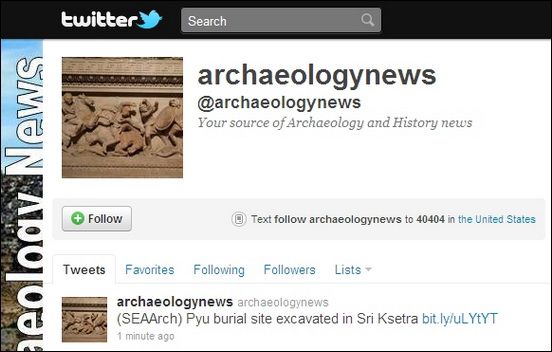
    Archaeology News

    archaeology news twitter

    This is Twitter's home for archaeology and history news. They update often, usually every few hours and sometimes even sooner. They provide a ton of links to interesting stories in the news, often from sources like Topix and EurekaAlert about the latest discoveries and theories.

    ArchaeologyDaily

    A wider science news source, they provide headlines on archaeology, paleontology, anthropology and fossils. They only update every few days, but when they do they provide a large list of updates through that day. They have a tendency to find more obscure news not usually in the main journals.

    Rosella Lorenzi

    You might know Rosella from her place on the Discovery News correspondent team. She specializes in archaeology, and provides links to her own stories on Discovery News, among others. She hasn't updated in a few weeks, which is unfortunate. But she is worth a follow.

    Talking Pyramids

    talking pyramids twitter

    Videos, photos and links related to ancient Egypt are regularly shared here. They are big updaters, so you will often get four or five links in a single hour. You can also find some decent reblogs, which give you more information from well known institutes and experts in the field of the Egyptians.

    David Connolly

    Famous archeologist (who often refers to himself as a "loose canon") David Connolly is very well known for his work in the field. He has his own Twitter account, which he updates almost obsessively with a ton of information from himself and others. He has some great comments on current projects that he keeps people current on. Plus, he occasionally follows.

    Culture 24

    For a more focused look on overall culture, including museums, galleries and heritage sites, this UK based organization is great to watch. Their updates are a little random, as they will post a dozen links on day and then nothing for a few days. But they have some great information through here.

    Campus Archaeology

    This is the official Twitter of Michigan State Universities archaeology department. They comment on current projects and studies, recent news, what is going on at MSU and general comments on the field of study.

    The Gabii Project

    A smallish project based on ancient Gabii in Central Italy, this group of archeologists don't get nearly enough exposure. You can help change that by becoming their Twitter follower. They have a collection of updates on the project itself, while informing of others that need support.

    NE Asia Archaeology

    These Harvard affiliated archeologists cover NE Asia, specifically China, Japan, Korea, Russian Far East, Eastern Siberia and Mongolia. They update semi regularly with relevant and interesting bits of news in the region, such as the recent uncovering of the oldest known human remains in Japan.

    The Archaeological Box

    This networking hot spot for archaeological foundations and projects covers news, profiles, events, field schools and study programs, which is aiming to connect people for easier information sharing. They update a lot, and they have some news I haven't seen anywhere else. It is like a hub for various societies.

    Conclusion

    Twitter

    Twitter is an unexpected place to find the latest Twitter news and connect with others who have the same interests. What are some of your favorite social hotspots for archaeology chat? Let us know in the comments.

    Jessy is a creative guest blogger for Life Insurance Finder, the free resource on finding best insurance plans. We create lots of educational material as well like this article on Sickness and Accident Insurance.

    Image credits: 1, 2.

    Wednesday, November 9, 2011

    Top Archaeology News: November 9, 2011


    New evidence of a lost civilization in an area of the Sahara in Libya has emerged from images taken by satellites. Using satellites and air photographs to identify the remains in one of the most inhospitable parts of the desert, a team from the University of Leicester in England has discovered more than 100 fortified farms and villages with castle-like structures and several towns, most dating between AD 1 to 500.

    The site of what is now Rotterdam’s Yangtzehaven was inhabited by humans in the Middle Stone Age. At a depth of 20 metres, in the sea bed, unique underwater archaeological investigation found traces of bone, flint and charcoal from around 7000 BC.

    It is prehistoric mystery that has baffled scientists for decades and sparked a long-running debate with archaeologists. But new DNA evidence from ancient horse bones has proved the horses depicted in prehistoric cave paintings actually existed 25,000 years ago.

    The colorful history of Minneapolis’ Tangletown area, including the remnants of a long-gone mill, is influencing construction and prep work for a new Lyndale Avenue bridge over Minnehaha Creek.

    More than four centuries after English adventurer Sir Francis Drake went to his watery grave off Panama's coast, archaeologists believe they have found two of the last ships he commanded.
    In emerald Caribbean waters where the privateer is said to lie buried in a lead coffin, explorers using deep sea oil technology found three large ship sections offering strong clues that they belonged to Drake's Elizabeth and Delight.

    Larry Grantham, an archaeologist with the Missouri Department of Transportation's Environmental Studies and Historic Preservation department, said his team has discovered a pair of Native American archaeological sites bookending the Mo. 168 bridge over the North River just west of Palmyra.

    In a new examination of Laetoli in northern Tanzania, where a 3.6-million-year-old track of footprints of the bipedal human ancestor Australopithecus is preserved, researchers now argue that the classic understanding of this site is mistaken. The footprints have been buried since the mid-1990s for preservation, but a section recently opened for study as Tanzanian officials make plans for a museum on the site.

    The University of Salford has announced a four year archaeology project which will see 9,000 people involved in digs. Dig Greater Manchester, which will also include a study in Blackburn, will see volunteers work alongside experts at 11 sites.

    Utah Archaeology Week, to be held May 5-12, 2012, celebrates Utah's rich archaeological and cultural resources with a special week of statewide lectures, programs, activities, demonstrations and tours.

    A rare stone sculpture depicting a bullock cart has been found by professor and students of Government First Grade College, HD Kote. The sculpture is assumed to be of the Punnata era.

    Wednesday, September 21, 2011

    Archaeology News: September 21, 2011


    The Ice Mummy: Little-Known Facts
    Exactly 20 years ago, on Sept. 19, 1991, German hikers Erika and Helmut Simon spotted something brown while walking near a melting glacier in the Ötztal Alps in South Tyrol.

    Archaeologist's website dig deep at Tamworth's history
    A Tamworth archaeology and community heritage worker has launched a new website focusing on the history of the town and surrounding areas.

    Discovery, Archaeology and Fiddling: Paisley Hagood – When to start and when to quit
    James Paisley Hagood (1905- 1977) was a wage-earning farmer and fiddler in the Southwestern part of the county. With a son-in-law who also enjoyed good old-time music, Paisley was encouraged to rediscover the fiddle after a long spell of not even owning one.

    Caithness events featured in new Highland Archaeology Festival
    Over one hundred events, most of which are free, are included in the two-week programme which celebrates the archaeology, history, landscape and culture of the North. There is something for everyone – with events ranging from guided walks, family events, self-guided trails, evening lectures and exhibitions.

    Israel Trip Enriches Ministry in Trexlertown
    Walking in the footsteps of Jesus brought the Bible to life for a Trexlertown pastor who is now using that experience to enrich her ministry.

    Monumental Debates: What are the “Temples” of Neolithic Göbekli Tepe
    Over the last 15 years, Klaus Schmidt of the German Archaeological Institute and colleagues from the Åžanlıurfa Museum in Turkey have been making remarkable finds at the site of Göbekli Tepe, a barren hilltop northeast of the city of Urfa. Schmidt has interpreted the buildings with enormous pillars, some engraved with pictures of animals, as the world’s first temples, some 11,000 years old, and has suggested that this large site was covered with such temples, rather than houses.

    Delisting historical structures
    As a university-based archaeologist with a research specialisation in the archaeology of the post-medieval period, I wish to express my extreme dismay over the recent proposal by the Government to remove all post-1700 archaeological monuments from the Record of Monuments and Places, thereby removing any chance of protection from a significant class of monuments that have already been recognised under law as worthy of record.

    Excavation of islands around Britain to establish origins of neolithic period
    Archaeologists at the University of Liverpool are investigating three island groups around Britain to further understanding of why, in approximately 4,000 BC, humans altered their lifestyle from hunting and gathering to farming the land.

    With a wide variety of artifacts that shed light on the history of Anatolia, the Edirne Archaeology and Ethnography Museum makes for an informative and enjoyable visit a short trip away from İstanbul. The museum hosts excavated pieces from sites nearby as well as valuables caught at customs as they were being smuggled out of the country.

    Caithness events featured in new Highland Archaeology Festival
    A NEW programme of special events has been launched for the 18th Highland Archaeology Festival which gets under way on October 1.


    Wednesday, September 14, 2011

    Archaeology News: September 14, 2011


    Rich Armenian archaeological heritage to be exhibited in Yerevan

    The Armenian archaeological legacy—primarily household ceramics and metal items—that was unearthed from medieval Hostun village will be displayed at Erebuni Reserve-Museum, in Yerevan, from September 17 to October 17. Afterwards, the artifacts will be permanently kept at the Geological Museum of Yeghegnadzor.


    Israeli lifeguard rescues sunken treasure

    Israeli lifeguards plunged into the Mediterranean sea this month on an unusual rescue mission: to pull out an ancient ship's anchor. Lifeguard Avi Afia first spotted the tip of the anchor on a daily swim five years ago. It was peeking out from the sandy ocean floor about 150 feet (60 meters) from the coast.

    Mystery boat discovered in Lake Monroe

    Archaeologist Jeff Moates had zero visibility as he dived into the brown water of Lake Monroe in search of a submerged shipwreck. It was difficult to spot as he couldn't even see his hand an inch away from his face.

    UAE seeks ICCROM's assistance to restore archaeological sites

    Under the proposed agreement, Al Muhairi explained, the UAE will tap the expertise of Rome-based ICCROM in restoration of national historic and archaeological sites.

    Ancient straw dress found

    Archaeologists in Armenia said on Wednesday that they had found parts of a woman's multicoloured straw dress that they believe was made around 5 900 years ago.

    Pictish beast intrigues experts

    A Pictish symbol stone built into the wall of a Highland farm building has been recorded by archaeologists.The markings show a beast, crescent, comb and mirror. Archaeologist Cait McCullagh said it was a mystery how it had taken until this year for the stone to be officially recorded.

    Archaeology: Mausoleum of Ottoman conqueror found at Perperikon

    Archaeologists working at Bulgaria's ancient sacred site of Perperikon have found a mausoleum, with a sarcophagus inside containing a human skeleton believed to be that of a 14th century Ottoman conqueror, Bulgarian National Radio reported.

    Lake Victoria bones likely part of bison kill site in Alexandria

    Bison bones estimated to be between 200 and 6,000 years old have been recovered from Minnesota’s Lake Victoria. The bones carry the marks of tools. “There are not that many kill sites in Minnesota,” said archaeologist David Mather.

    Visible Only From Above, Mystifying 'Nazca Lines' Discovered in Mideast

    They are the Middle East's own version of the Nazca Lines — ancient "geolyphs," or drawings, that span deserts in southern Peru — and now, thanks to new satellite-mapping technologies, and an aerial photography program in Jordan, researchers are discovering more of them than ever before. They number well into the thousands.

    Relics of a Tribe’s Eviction Are Unearthed in Montana

    For the Crow tribe, the events of March 1880, on which Mr. Aaberg has focused his research, proved devastating. That was when a draft agreement from Washington was read aloud to tribal leaders for the first time here, at a compound that served as the arm of the federal government on the reservation.

    Monday, September 12, 2011

    Archaeology News: September 12, 2011


    The former bassist for rock'n'roll's most legendary band is anything but retired.

    A rolling stone, to coin a phrase, gathers no moss--it’s certainly true of Bill Wyman. The renowned bassist and original member of rock’s most enduring band no longer tours with the Stones, partly because he has interests that extend beyond pop stardom: He’s an amateur archaeologist, author, restaurateur, inventor, and wicked table tennis player.

    Understanding underground Jerusalem

    Experts and hundreds of visitors attended the 12th annual City of David Archaeology Conference dedicated to research on Jerusalem and the city of David.

    Smugglers rob KP of archaeological wealth

    Recently, a probe team, headed by Museums and Archaeology Director Nidaullah Sehrai and comprising members of Tourism Corporation Khyber Pakhtunkhwa (TCKP) and archaeology department officials, visited various archaeological sites in Mardan and Swabi districts to substantiate reports that relic hunters were engaged in unlawful digging at Gandharan Buddhist sites in these antiquity rich districts.

    Petrified Forest National Park Expands by 26,000 Acres

    The federal government is gaining control over an even larger expanse of rainbow-colored petrified wood, fossils from the dawning age of dinosaurs and petroglyphs left by American Indian tribes who once lived in eastern Arizona.

    Georgian architecture: examples from the era

    The Georgian era reveled in the classical form, applying it liberally to terraces, bridges and crescents

    Lanyon vault baffles experts

    The 2sqm brick vault, hidden for decades, was recently uncovered by gardeners clearing a thick tangle of vines.The materials for the bricks and mortar structure are thought to have been sourced locally and resemble other brickwork on the site dating from the 1800s.

    Exhibition marks end of archaeology stint

    SHEFFIELD photographic artist Bill Bevan is marking the end of his residency at the University of Sheffield’s Department of Archaeology with an exhibition entitled Diggers.

    Experts hail Pictish royal monastery find

    AERIAL photographs showing a faint line in fields around a village in Highland Perthshire have mystified archaeologists for decades. Crop marks in the village of Fortingall, famous for its 5,000-year-old yew tree, seem to indicate an ancient boundary long since buried and forgotten.

    History brought to life as Battle of Marathon re-enacted

    Sweating beneath heavy armour, a group of die-hard archaeology fans brought the Battle of Marathon to life this weekend on the coastal plain where the fate of Europe dramatically changed 2,500 years ago.

    Work on new village hall to start

    BUILDING work on a new village hall for Holy Island is finally about to start - nearly a decade since the project was first mooted. Hall trustees have had to jump numerous hurdles to reach this stage, not least the archaeological concerns which have taken eight years to overcome.

    Exhibition of ancient coins to open on 27th

    The Directorate of Archaeology and Museums, Khyber Pakhtunkhwa, in collaboration with Tourism Corporation will hold a four-day international historical coins exhibition from September 27 at Gor Gathri Archaeological Complex.

    Lewis Moody: I always wanted to be an archaeologist - I think I watched too many Indiana Jones films!

    The unlikely interest that engages your curiosity… Archaeology. As a boy I’d spend hours digging holes in our garden and get really buzzed finding clay pipes and old bottles. I watch Time Team with Tony Robinson religiously.

    Lee University Contributes To Archaeology Dig

    This summer Lee University faculty, students and alumni participated in a rare archaeological excavation. The field work included exploring a Central Western Colorado rock shelter and compiling documentation of Native American rock art.

    Malla-era archaeological marvel retrieved after two years

    KATHMANDU: Art lovers and historians have something to cheer about, for the country has got back one of its lost treasures — a beautiful idol of Laxmi-Narayan dating to the 1640s — which ‘vanished’ during the renovation of the Sundari Chowk, a part of the Patan Durbar, on November 5, 2009.

    Va history museum curator to study tavern food

    The curator of archaeology at the Virginia Museum of Natural History in Martinsville is studying the food eaten by guests visiting an 18th century tavern. Elizabeth Moore will study the Golden Ball Tavern in Petersburg. It served as an important meeting venue for America's founding fathers and later British officers during the American Revolution.

    Forgotten archaeological gems: The ancient turquoise mines of South Sinai

    Rock inscriptions left by ancient Egyptian miners in South Sinai are rich with details of working conditions and weather, as well as praise for the pharaoh and the gods. They present a lively narrative of daily life that can be easily compared to modern business reports, or even a diary.

    Tuesday, August 30, 2011

    Archaeology News: August 30, 2011


    Israeli Archaeologists Confirm Ossuary's Authenticity
    Two Israeli archaeologists confirmed the authenticity of a 2000-year-old ossuary and its inscription believed to have belonged to the family of Caiaphas, the high priest during Jesus' time.

    The Mystery of the Roman Jar
    The Roman jar discovered measures 40 centimeters tall and was found shattered into an unrecognizable 180 pieces. Even if the jar is fully restored, scientists still have nothing comparable to the artifact to even venture a guess about its history or significance.

    Neanderthal survival story revealed in Jersey caves
    "The site is the most exceptional long-term record of Neanderthal behaviour in North West Europe," says Dr Matt Pope from the Institute of Archaeology at University College London. "

    A special day at the museum
    Dr. Willet Boyer describes some of the displays that are set up in the Marion County Museum of History and Archaeology in the McPherson Governmental Complex in Ocala, Fla.

    Anastasia Island to be archaeology group topic
    The St. Augustine Archaeological Association will present a lecture by the director of the St. Augustine Historical Society, Susan Parker. She will discuss "A History of Anastasia Island”.

    Excavated remains finally heading back to first nations community
    The 1000 to 6000-year-old bones and artifacts were first dug up, with the approval of the Heiltsuk Tribal Council, by a Simon Fraser University archaeology team back in 1969. The excavation took place in Namu, a small island near Bella Bella.

    Event Celebrates Celtic Coin Index
    The theme of the conference will be “Between archaeology and history: new research on Iron Age coinage.”

    Indiana Jones Archaeology and Hollywood History Exhibit Opens
    To celebrate that milestone, a touring exhibition has been created spotlighting famous props from the Indiana Jones films, putting them side-by-side with real archaeological artifacts.

    Volunteers needed to sort artifacts from local sites
    Volunteers of all ages are invited to help rough sort artifacts recovered from local archaeological sites at the Florida Public Archaeology Network lab, 207 E. Main St., in downtown Pensacola.

    Friday, August 26, 2011

    Archaeology News: August 25, 2011


    Archaeologist, volunteers dig up old Saginaw home
    For Jeff Sommer, curator of archaeology at the Castle Museum of Saginaw County History, when Cheetos happen to pop up at his dig sites, they sometimes tell him stories other artifacts can't.

    Archaelogists move in at ancient Highland Perthshire site
    The archaeology project is being supported by a grant from the Society of Antiquaries of Scotland, and the permission of Glen Lyon Estate. Both archaeologists and local volunteers will be at Fortingall until the end of the month.

    Eye in the sky giving new insight into St Andrews' past
    "This technique will undoubtedly revolutionize the practice of commercial archaeology and I expect that surveying drones hovering over urban building sites will become a common sight in the years to come."

    Buy a slice of history at house with a past
    Led by the late Peter Scott, who wrote a book about the archaeology of Piercebridge, the Durham University students also excavated a site at the back of the property, revealing a Roman fort dating back to 270 AD.

    'Indiana Jones and the Adventure of Archaeology' Heads to Museums
    by Ethan Anderton Though you may have been disappointed with Indiana Jones and the Kingdom of the Crystal Skull, a new event centered around everyone's favorite archaeologist should deliver the goods.

    Archaeology Cafe serves up food, facts
    Eat, drink and absorb ancient knowledge at Archaeology Cafe. The Destination Archaeology Resource Center (DARC) and the Leisure Club are hosting the new event at 5 pm Sept. 8.

    University of Wisconsin - La Crosse
    UW-La Crosse offers the UW System's only nuclear medicine technology program and the Midwest's only undergraduate archaeology major. The University of Wisconsin-La Crosse was founded in 1909 as La Crosse Normal School.

    Second Kilwinning archeaological dig starts
    The project costing £90000 is funded equally by the Heritage Lottery Fund and Irvine Bay, and with other support from North Ayrshire Council, Historic Scotland and West of Scotland Archaeology Service.

    The Museum of Self-Archaeology takes visitors into an underground world of abandoned train stations

    His project takes the form of a "Museum of Self-Archaeology," where museum visitors would be guided on a tour of individual and collective self-reflection — allowing them to re-live their pasts by exposing the history of their city's underground.

    Sunday, August 21, 2011

    Top 10 Posts: August 21, 2011


    Find out what archaeology news and articles visitors are sharing every week on Ancient Digger. These posts are the most popular and read articles for the week, starting on Sunday and ending on Saturday.

    1. The Wilderness and Scenery of Fossil Springs in Arizona--This video of Fossil Springs in Arizona has a whole Journey to the Center of the Earth vibe. Diving off the rocky cliffs and swimming up and under this amazing geological wonder makes me really appreciate the natural processes of the earth.
    2. Top Graduate Schools, Universities, and Colleges for Archaeology and Anthropology --I have compiled several lists in order to help you determine the best archaeology colleges and universities with the best programs for archaeology, as well as the top undergraduate colleges, universities and school programs for anthropology and archaeology.
    3. Mysterious Roman Jar Presents a Riddle For Archaeologists--The Roman jar discovered measures 40 centimeters tall and was found shattered into an unrecognizable 180 pieces. Even if the jar is fully restored, scientists still have nothing comparable to the artifact to even venture a guess about its history or significance.
    4. The Mystery of the Pyramids--Edward charged visitors 10 cents to tour the property, and while he guided them along their journey, allowed them to ask him questions about his Coral Castle. On many occasions, he would tell tourists that his castle was easy to build, if you know how to do it. His answers were vague and his demeanor bizarre, believing that he held the secrets to the pyramids and he would bring them to his deathbed.
    5. Best Schools For Nautical, Maritime, and Underwater Archaeology in the US--Typically nautical, maritime, and underwater archaeologists study artifacts in ocean or sea environments. However, specialization usually doesn't occur until graduate school after the student has received a BS in Anthropology.
    6. Profit motive, Exchanges, and Kapauku society--Kapauku society is heavily influenced by a singular need for power and recognition. A sense of individualism which ultimately sets each member, mostly the males, of Kapauku society apart.
    7. Unveiling the Kings of Israel Review--Unveiling the Kings of Israel by David Down is clearly written in an unbiased fashion. Although contemporaries may argue this notion, it seems abundantly clear in the introduction. Down explains that when “Correctly interpreted, the historical records of Egypt and Israel show a remarkable consistency with the Bible records which we can accept as not only inspiring but entirely reliable”.
    8. Jericho Unearthed - Bible Confirmed Once Again--Can archaeology prove the accuracy of the Bible? In this video, we hear from archaeologists about what is required to make an honest and intelligent assessment about the accuracy about the Bible. The video begins in Jericho.
    9. Greek Architecture--The Greeks were gifted, being situated in an area with the highest quality stone. Of course the buildings that were derived from these stones were free of bronzed sculptures, polished monuments, and shrines painted with vivid colors.
    10. Brother-Sister and Father-Daughter Marriage in Ancient Egypt--Anthropologists recognize that marrying one’s sister, brother, father, or mother was quite common in Ancient Egypt. Marriage of kin functioned "to preserve the purity of the royal blood line," to keep privilege and rank rigidly within the group.

    Like Ancient Digger? Why Not Follow Us?


    Subscribe Via RSS Feed Follow Ancient Digger on Facebook Follow Ancient Digger on Twitter Subscribe to Ancient Digger Via Email

    Get widget

    Search


    Ancient Digger Archaeology Copyright © 2015 LKart Theme is Designed by Lasantha