• Ancient Digger teaches Archaeology and History to all Ages!

Monday, June 18, 2012

The Destructive Nature of Eros


So the topic of sex and gender and erotic sicknesses continues as I work through a semester's worth of explicit material. I hope you are enjoying this textual romp through the world of ancient sex and erotica. As always, Ancient Digger intends to share all facets of history, even though the topics may border on the obscene, according to many.

Eros is the son of Aphrodite who essentially meddles in the affairs of gods and mortals, causing bonds of love to form, often illicitly. In early Greek art, Eros is depicted as a adult male with sexual prowess, but becomes cupid, the blindfolded and childlike boy who flies around, shooting his arrows at unsuspecting individuals destined for love. Eros draws one thing to another by attraction or even gravity. Hesiod explained that Eros existed long before the goddess of love, Aphrodite. According to many philosophers, Eros was an awe-inspiring universal force.

Eros is the fairest among the deathless gods, who unnerves later the limbs and overcomes the mind, and counsels of all gods and all men within them. Pre-Socratic philosophers believed Eros was a natural force responsible for creation. It wasn’t just good or bad, but destructive. Eros was vital because it operated as a social concept, yet it had moral implications. It was hard to control because in many cases, individuals would become slaves to it.


This destructive force was the root of the evil. However, while the destructive impulses are thus being satisfied, such satisfaction cannot stabilize their energy in the service of Eros. Their destructive force must drive them beyond this servitude and sublimation, for their aim is, not matter, not nature, not any object, but life itself1 . Greek literature depicts the forces of eros as frightening, socially destructive and physically, emotionally and mentally debilitating. In this sense, the separation of the wife and children from the sexual activities of the slave-quarters, the brothels and the male drinking parties or symposia, ensured that the oikos and its most important members were protected from the potentially damaging forces of uninhibited sexual expression2 .

The numerous examples of the destructive force of eros are not always mythological or legendary in orientation. Eros reaches into the minds of some of the most famous and notorious of emperors and also notable philosophers and writers, who sought to tell tales of legend, though the stories almost always embraced some truth. Eros could be accessed through the eyes, or “the gaze”, as 19th century scholars called it. The ancients could be seen as passive victims who allowed objects to intrude upon them. This could be artistic objects, theatrical events, or even natural elements.

The fact was that looking at things that were attractive and desirable was dangerous; therefore the act of looking could invoke emotion, arousal, lust, and desire. Eros was driven by men. Men would compel an object of desire to submit to them. In this aspect, eros is cured by reciprocity. If the object would not submit, spells would sometimes be utilized. These spells would be inflicted at night in isolation using agents that were not commonly acquirable. You had to put in the effort in order for the spells to take hold.


One spell was used to induce dreams of a desired object. The person, most likely a woman, would go through a suffering and longing process for the person they wanted. There was a certain degree of violence in this because control and victimization are inverted throughout the dream, and one cannot control their actions and impulses in their dreams. Using magic the man would get control. The same spell was not invoked on men because men tend to dream while they are awake-they daydream. Therefore a spell of desire would have to be altered somewhat if the woman was in control.

It is clear that eros drove women to madness, but men were just as vulnerable to the power of eros. A prime example would be Nero. Nero was free with his mind, money, and body. He had issues with boundaries and he was addicted to eros. This addiction ran much deeper than just for carnal pleasure, however. Nero was also addicted to the theater, where themes of the real world were often inverted to create an imaginary one. Nero lived his life in excess, violating customary expressions of pleasure to the point he forgoes imperial responsibilities. He embraces popularity and the love of the populace. The love of the people is where eros goes wrong. The people loved him so much that they created a monster and his general obsessions were driven by his libido and desire. Libido without restraint becomes worse. He is the very opposite of an epicurean, who typically partakes in simple pleasures, yet they also abstain from bodily desires such as sex and appetites verging on denial.

The Rape of Lucretia is another excellent example of eros gone wrong, as it pertains to the hyper sexuality of man. Lucretia, an object of desire put forth by her own husband, is the ultimate undertaking of any man looking to overcome the innocence of a pious woman. When the men arrived, they were all impressed by Lucretia's chaste honor, but it was Tarquinius who was “seized by the desire (hyper sexuality) to violate Lucretia's chastity, seduced both by her beauty and by her exemplary virtue”3 . He threatened her with death, raped her, and he left, having taken away her honor. Her beauty and virtue not only drove Tarquinius to desire her, but it created an innate violence in a powerful man, put into a position where he could control submission. It was no different than war, as men seek honor on the field, they seek the same type of acknowledgement in the bedroom.

The History of Appius and Virginia by Livy is another key example of a virtuous woman who tempts, unintentionally, man’s desire to the point of violence. Appius Claudius lusts after the daughter of a centurion, Virginia. Virginia was already promised to Lucius Icilius, a former tribune of the plebs, and when she rejected Claudius, he gave instructions to Marcus Claudius, one of his clients, that he should claim the young woman as his slave, and not submit to any demand which should be made, of her being left at liberty until the decision of the suit, thinking that the absence of the damsel's father afforded the fittest opportunity for the injury which be meditated4.

After Marcus Claudius had successfully abducted her, the decemviri, led by Appius Claudius himself, demanded he bring the case to court. Virginia’s father Verginius was recalled from the field to defend his daughter, and Icilius, after threats of violence, succeeded in having Virginia returned to her house while the court waited for her father to appear. When Verginius finally arrived, his supporters left the forum so not to cause further violence. Questioning whether her virtue would be preserved if he acted in haste, Verginius grabbed a knife and stabbed Virginia. Verginius and Icilius were arrested, and their followers returned to attack the lictors and destroy their fasces. This led to the overthrow of the decemviri and the re-establishment of the Roman Republic4 .

The very last place we would expect the humiliation of women to occur would be in the Symposium, but the presence of the hetaerai may have only fueled the natural hunger of man’s desire to dominate the opposite sex. Hetaerai were the only women who actively took part in the symposium where their opinion was welcomed and respected by men. They drank and partied, but the drinking usually took a completely different turn near the end of the evening. The Symposium is a social function for young men to integrate into their status group, and as part of this, the men engage in ritualized violence with the hetaerai as a rite of passage. Men would force them to have anal sex and beat them with a staff, rod or shoe. Hetaerai were essentially integrated into a ritual for the sake of man’s inability to restrain his primal urges.

Eros is instilled with a deep-seated tension that manifests itself in various guises, which, however, have a common structure based on the fact that eros is a striving for the reversal of eros, and that therefore the existence of eros is incompatible with its telos. The highest goal of eros is the destruction of eros, the transformation of the lovers into an existence that no longer needs eros. According to Diotomo’s speech at the Symposium, Eros is “a great spirit (daimon)” that is situated between mortals and gods, and oscillates between the two; it is by virtue of its origin an intermediate being, that nevertheless strives towards the better5.


You may also like


The Sickness of Eros
Ancient Sex and Love Magic
Ovid's Art of Love 
Erotic Art and Roman Sexuality
Eroticism, Eros, and Sex in Pompeii


References

  1. Herbert Marcuse, Eros and Civilization: a philosophical inquiry into fraud, (Abingdon: Routledge and Kegan Paul Ltd, 1956), 86.
  2. Terry Ryan, and Marguerite Johnson, Sexuality in Greek and Roman Society and Literature, (New York: Routledge, 2005), 3-4.
  3. "Tite-Live: Histoire Romaine," 1, Vol. 1, ed. Jean Bayet and Gaston Baillet (Paris: Societé d'Édition "les belles-lettres, 1995).
  4. Livy. The History of Appius and Virginia, History of Rome. English Translation by Rev. Canon Roberts. New York. E. P. Dutton and Co, New York, 1912.
  5. Benjamin Jowett, trans., Plato’s Symposium, (Penguin Books Limited, London, 1956).

Sunday, June 10, 2012

Sorry this page has been removed


Removed


Ovid's Art of Love


Ovid’s narrative often highlights the thrill of fear; as if it is an attractive quality to have, to inflict fear on the innocent. 


Ovid was the last of the great poets of the golden age. He belonged to a privilege group of Roman youths who liked to ridicule old Roman values. In keeping with the spirit of this group Ovid wrote a frivolous series of love poems known as the Amores, intended to entertain and shock. They ultimately achieved their goal. Another of Ovid's works was The Art of Love. This was essentially a takeoff on didactic poems. Whereas authors of earlier didactic poems had written guides to farming, hunting, or some such subject, Ovid's work was a handbook on the seduction of women.


Read the entire article: Ovid: Art of Love and Rape By Ancient Digger Via Knoji

Friday, June 8, 2012

Sophrosyne: The Simple Meaning of Moderation


Sophrosyne was the goddess of moderation, self-control, temperance, restraint, and discretion. She was one of the good spirits who escaped Pandora's box when the woman first lifted the lid and fled back to Olympus, abandoning mankind. Her Roman equivalents were Continentia and Sobrietas. Sophrosyne was one of the cardinal virtues, consisting in a harmonious state of rational control of one's desires. In Aristotle the temperate person is one who can abstain or indulge appetites to the right degree without a severe effort of will; the person who needs the effort of will is not temperate, and needs to be content.


We see several examples of sophrosyne in literature including the story of Cupid and Psyche. Aphrodite was furious about her son Cupid-Eros’ affair with (Psyche exclaims:] “But what am I to do, now that I'm becoming a laughing-stock? Where shall I go, how shall I curb in this scoundrel? Should I beg the assistance of my enemy Sobrietas (Sobriety, Temperance)? So often alienated from me through this fellow's loose living.”

Plato’s Symposium is another perfect example of sophrosyne, as Socrates talks about moderation of one’s actions and the honor in doing so. Socrates also asserts that the highest purpose of love is to become a philosopher or, literally, a lover of wisdom. A lover of wisdom often accompanied better judgment and temperance for other’s ideas. Consequently, the symposium was a drinking party, but according to Aristophanes, “ we should, by all means, avoid hard drinking, for I was myself one of those who were yesterday drowned in drink” .

The epicureans also practiced sophrosyne, as they also abstain from bodily desires such as sex and appetites verging on denial. Epicurus argued that when eating one should not eat too heavily, for it could lead to disappointment later, such as the grim realization that one could not afford such delicacies in the future. Likewise, sex could lead to increased lust and dissatisfaction with the sexual partner.


"Cupid and Psyche Sculptural Wall Frieze in Antique Stone"
"Cupid and Psyche Bonded Marble Bust"
Cupid and Psyche and Other Tales from the Golden Ass

Wednesday, June 6, 2012

The Sickness of Eros


The sickness of eros is often described in the context of the seasons. The idea of polar opposites, hot and cold, moist and dry, allow for a blend in temperance and harmony, they bring to men, animals, and plants health and plenty, and do them no harm; whereas the wanton love, getting the upper hand and affecting the seasons of the year, is very destructive and injurious, being the source of pestilence, and bringing many other kinds of diseases on animals and plants; for hoar-frost and hail and blight spring from the excesses and disorders of these elements of love, which to know in relation to the revolutions of the heavenly bodies and the seasons of the year is termed astronomy. However, the sickness of eros can also be observed in many forms and in many sources of literature. We see this illness of love in Euripides’ Medea, Chloe and Daphnis, and also in the tyrannical rule of governors as well as their ill rebutted affairs and love of youths, described by Socrates as “a disease of the soul” in the Symposium by Plato.

Lingus' tale of Chloe and Daphnis is an attempt to portray a woman in her most un-desirous form. As a creature of lust and prone to the pathetic notions of admiring someone from a far she might not deserve. However, the ultimate theme or resolution to this romantic obstacle course is marriage, and the consummation of that union. The entire plot is wreaked with longing and love sickness, as Chloe admires and lusts for Daphnis. Yet, she is in the beginning of womanhood and she is not well versed in the sexual exploits of men. As the story unfolds, Daphnis sleeps with older women and gains worldly experience as opposed to Chloe who has the opportunity to experiment, but doesn’t. She must remain virginal until her wedding night, which is the stereotypical idea of women and the same for men. The intrigue and unbearable nature of the story explains the notion of eros. You will succumb to diseases of love if you don’t satisfy it, and in Chloe and Daphnis’s case, love is death unless consummated.

We also see the concept of eros as a sickness in Medea. If eros had not inspired Medea to fall in love with Jason, and be cast aside, her lust would have never drove her to act in such a violent way. She murdered her brother and essentially hacked him up into little pieces like a serial murderer; killed her children with Jason; murdered Jason’s new wife with a crown and robe laced with poison, which burned the skin off her body. After which, her father King Creon died holding her lifeless body. She later tried to trick her husband into poisoning his son Theseus. The idea here is that not only is eros destructive, but for some like Medea, it is a love illness. She never acts with moderation and never just accepts the fact the love can be fleeting. Her approach to her husband was not much different than a young girl with an innocent crush on an older man. They are often delirious with hope or resentment, and see no woman as a match to herself.

Plato’s Symposium is a drinking party held essentially to explain love using a sequence of speeches. The party is for Agathon to celebrate his prize for his first tragedy at the Lenaia in 416 B.C.. Each man must deliver an encomium (praise of a person or thing), a speech in praise of Eros. Love is the supreme god and only the young can enjoy it. Socrates in his speech asserts that the highest purpose of love is to become a philosopher, or literally, a lover of wisdom. However he also speaks of the sickness of eros, which is hidden behind the lines of the speeches and conversation. Socrates experiences difficulty in explaining what the sickness of tyrannical eros is. He evidently does associate it with desire, but is that not the same as eros? Socrates declares that it is a human madness, a disease of the soul.

There are several manifestations and types of the sickness of tyrannical eros, but typically it is directed simultaneously at individual persons and would be a tyrant's polity. The diseased eros variously desires to use its beloveds not only as agents of sexual pleasure but also as slavish sources of wealth, position, and honor. The sick eros hopes to convert its polity into an instrument of world conquest that improves its domestic status; a guarantee of its illicit sexual and social interests; a tool that facilitates a tyrannical technician's conquest of nature; an engine that co-opts all mankind into its metaphysical revolt; a vast association organized to worship its metaphysical revolt; a vast association organized to worship the man who incarnates it; and the slavish power base that deifies the tyrant by making him ruler of the world . In all these forms, the diseased eros employs "moving logoi" that transfer the emotional effects of beauty from beautiful realities to itself in order to seduce the intended slaves, charming them into embracing the tyrant and the tyranny as beautiful.

Eryximachus explains that there two kinds of love in the human body. One love is healthy and the other is diseased. Their desires are unlike one another, and as Pausanias stated prior to this speech, to indulge good men is honorable, and bad men dishonorable, so too in the body the good and healthy elements are to be indulged, and the bad elements and the elements of disease are not to be indulged, but discouraged . On the other hand, Phaedrus articulated that eros could be a public expression if the cities rules for love permitted lovers to openly walk about like average citizens. Aristophanes thought Phaedrus was wrong to believe that one could let eros go public and still retain a private good: there is no non-lover; eros is definitive of the human and, as essentially political, rules our any transpolitical life defined by a transpolitical good available to man as man. The city is a world of falsehood from which there is no ascent and man is not merely suffering from a sickness, he is a sickness and this sickness has no cure .

Socrates battles with himself throughout the Symposium about the cures that could possibly heal or cure the aristocratic forms of the sickness, and the Phaedrus depicts them working to defeat his attempt to heal the democratic prototype of the disease. However, we might be able to apply Socrates' therapies to our own would-be tyrants with better results, if we catch their illnesses in time. According to Aristophanes, the only cure to the illness of love, plutonic love, or however these men may define it, is through eros. This is because Eros is not the chief attribute of human beings or the most prominent symptom of our illness, but a god or a divine physician who is able to overcome our suffering and heal our affliction .

Therefore love, or the sickness of love, was not only about inhibited love or desire, but the way in which one acted upon their desires. Medea believed in violence and revenge, not only because her honor had been put at stake, but also because the love that she professed for Jason was so great, thus turning to obsession. Chloe and Daphnis was merely a case of unrequited love, and love unconsummated until marriage. In Plato’s Symposium, the speeches touch on plutonic love and the acceptance of eros between two men, as long as it was behind closed doors. Yet, an underlying theme existed in the Symposium, which allowed the speech givers to understand the sickness of love expressed between two men, which only eros could be the cure.


Work's Cited
  • Berg, Steven. Eros and the intoxications of enlightenment: on Plato's Symposium. Albany: State University of New York Press, 2010.
  • Rhodes, James M. Eros, Wisdom, and Silence: Plato's erotic dialogues. Columbia: University of Missouri Press, 2003.
  • Jowett, Benjamin trans.Plato’s Symposium. Penguin Books Limited, London, 1956.

Thursday, December 22, 2011

History 101: Who Was Epicurus and the Epicureans?


The Epicureans believed that the key to happiness was the enjoyment of pleasure, although they did not advise the life of wine, women, and song that is today associated with the term “Epicurean”.

An epicurean typically partakes in simple pleasures, yet they also abstain from bodily desires such as sex and appetites verging on denial. Epicurus argued that when eating one should not eat too heavily, for it could lead to disappointment later, such as the grim realization that one could not afford such delicacies in the future. Likewise, sex could lead to increased lust and dissatisfaction with the sexual partner.

Epicurus established his philosophy based on the foundation of his ethical system in the material world, which he said was made up of tiny atoms moving through space in accordance with natural law. Epicurus, as well as all of the epicureans, believed in the existence of the gods. However, he did declare that Gods have no place in worldly affairs. It was thought that the gods were too far away from the earth to have any interest in what man was doing; so it did not do any good to pray or to sacrifice to them. The gods, they believed, did not create the universe, nor did they inflict punishment or bestow blessings on anyone, but they were supremely happy; this was the goal to strive for during one’s own human life.

Epicurus taught that oracles, omens, and dreams have no significance and he rejected all ideals of immortality and mysticism. He believed in the soul and even suggested that the soul is as mortal as the body. Epicurus rejected any possibility of an afterlife, while still contending that one need not fear death:

“Death is nothing to us; for that which is dissolved, is without sensation, and that which lacks sensation is nothing to us.”

Bertrand Russell describes the reception of Epicureanism’s conception of death:

[T]he fear of death is so deeply rooted in instinct that the gospel of Epicurus could not, at any time, make a wide popular appeal; it remained always the creed of a cultivated minority. Even among philosophers, after the time of Augustus, it was, as a rule, rejected in favour of Stoicism. It survived, it is true, though with diminishing vigour, for six hundred years after the death of Epicurus; but as men became increasingly oppressed by the miseries of our terrestrial existence, they demanded continually stronger medicine from philosophy or religion. The philosophers took refuge, with few exceptions, in Neoplatonism; the uneducated turned to various Eastern superstitions, and then, in continually increasing numbers, to Christianity, which, in its early form, placed all good in life beyond the grave, thus offering men a gospel which was the exact opposite of that of Epicurus.

Epicurus had no regard for politial and social life. The state to him was more of a convenience and the wise man should not participate in public life. Additionally, for Epicurus and his epicureans, happiness consisted primarily of freedom from physical pain and worldly cares and fears. One can not rid themselves of the evil in this world and thus should withdraw from philosophy, enjoy the fellowship of a few friends, and savor the serenity of your mind.

Although the ideals of Epicurus and the Epicureans stressed that overindulgence in all aspects of the world was frowned upon, it was not easily avoided for some. Even today, we experience the need to partake in petty privileges to feel satisfied. Not much as changed.

Also check out:


Monday, November 22, 2010

The Unseen World


In an unseen world, I believe nature is in full control and nature is clearly a phenomenon which was originally derived from the supernatural to the galactic universe. The supernatural is almost impossible to investigate outside of empirical thinking. The idea immediately caused the term “supernatural” to be placed with the context of “cults”, as many individuals may belief mystical thinking means we can control nature. Instead, nature controls us.

From: Anthropology Study: Do You Believe In The Unseen World?

Friday, May 21, 2010

Rene Descartes: I Think, Therefore I am


Joachim and Jeanne Brochard lived in La Haye, in the Touraine region of France. Jeanne gave birth to Rene Descartes on March 31, 1596. Unfortunately, Jeanne died a few days later of tuberculosis. Rene Descartes inherited the disease from his mother, exhibiting pale skin and weak behavior. The physician gave Descartes no chance for survival.

Fortunately for the world, Rene Descartes lived. Descartes received a Jesuit education at Jesuit College of La Fleche. At age seventeen Descartes went to the University of Poitiers. Descartes received degrees in civil and canon law. In 1618, Descartes became healthy enough to enlist in the army of Prince Maurice of Nassau. Read the entire article about Rene Descartes on Factoidz

Image Source 

Saturday, February 27, 2010

What Do You Believe?


In a recent Religion class, I was asked to take a quiz on the site Belief.net. The idea was to compare and contrast one of the top five and one of the bottom five religions assigned to me by the quiz. To be quite honest, I was a bit surprised at the results. I wasn’t expecting my religious beliefs to be packaged up in one perfect little box, however this site claims to do it with only 20 questions.

In accordance with the religious aspects of our personal lives, we tend to use simple reasoning and empirical thought to arrive at ideals that define us. However, the true nature of religion lies within its doctrines and how those fit within our personal creed. Every religion may share some similar values in which we can relate, however in most instances we choose a religion because of its differences. Read my entire comparison on the religions that were assigned to me by Belief.Net

Monday, August 17, 2009

The Monday Ground Up: Ancient Symbols of the Theosophical Society


The Theosophical Society was originally formed in 1875 by Helena Blavatsky, Henry Steel Olcott, William Quan Judge and others to seek the truth using investigation, study and explanation of certain phenomena and ancient symbols. Several years after the society was formed, Blavatsky and Olcott moved to India to establish the International Headquarters at Adyar, Madras (Chennai). While in India, they became exceedingly interested in eastern religions so they were also included in the societies agenda.

After several iterations the Society's objectives have evolved to be:

  1. to form a nucleus of the universal brotherhood of humanity without distinction of race, creed, sex, caste, or colour.
  2. to encourage the study of comparative religion, philosophy, and science.
  3. to investigate the unexplained laws of nature and the powers latent in man.
The leaders of the Theosophical society did not preach superiority towards any certain race. They felt that spreading the idea of the common origin and destiny of all humanity, and establishing the principle of universal brotherhood which would unite people in harmony. Unfortunately, these ideologies were completely mixed up by Guido von Lizst who included nationalistic and fascist ideas with Blavatsky's ideals; this system of thought became known as Ariosophy.
Unlike Theosophists (whose first objective was "to form the nucleus of a Universal Brotherhood of Humanity without distinction of race, colour, or creed"[1]), "The Thule Society preached Aryan supremacy and acted to achieve it. It provides the final link between occult racial theories and the racial ideology of Hitler, who skewed the fundamental principles of and understandings for sociological and economic control by the emerging Nazi party."[2]

Theosophical Society symbol

Thanks to the historians, professors, and scholars over at Historum, I was able to to decipher the meaning and relationship of the star of David included on this emblem. However, the truth is, this star doesn't represent what everyone thinks it does.


Star of David

star of David

Here are some of the insights provided:

"Well put it this way, the six-pointed star is NOT a Jewish symbol since it's totally absent from the Torah-- not found in there. This symbol re-appears within the religion in the Medieval era. It's generally known to be an occultic symbol of pagan origins, much like the rest of most mainstream symbols." Oracle_of_Truth

"Well the hexagram, or, star of david as it is called when in a Jewish context, was actually a common symbol used by Christians as well (as well as many other religious, such as Islam and Hinduism), so in that emblem it does not necessarily have to denote any sort of connection to Judaism. Actually the symbol frequently has no connection at all to Judaism and is one of the most ancient recorded symbols we have. It has also frequently been associated with occultism in general, and was a very common symbol in many emblems of the Freemasons and is on nearly every Masonic temple or structure that exists." Alex III

"The Shield of David (magen David - not star, but shield) as it is called by the Jews, is actually not a star at all or a hexagram - but two triangles intertwined. It was USED by David as his emblem, no one ever claimed he INVENTED it, and was indeed a symbol already in his time. Has philosophy behind it, like every other symbol. There is NO connection between it and the bible, but it was adopted by Judaism as one of its symbols because of its meaning to kind David (one of the most revered figures in Judaism). Just as the cross was not a Christian invention, the crescent was not an Arab invention, the swastika was not a Nazi invention..." Vera

"And the sign above the swastika is "OM" written in devanagari ...... OM stands for Brahman ........ You probably know it from the mantra : om mani padme hum ........" Merlin

Brahman(OM)

symbol of Brahman
Brahman is an awe-inspiring reality which is the Divine Ground of all matter, energy, time, space, being, and everything beyond in accordance with the Hindu religion.


Maharishi Mahesh Yogi's view on Brahman

In his writings on the Bhagavad Gita, Maharishi Mahesh Yogi defines Brahman as follows:[14]

Brahman, which is an all-pervading mass of bliss, does not exhibit any quality of bliss. It may be likened to a mass of energy- matter - which does not exhibit any quality of energy... Brahman is that which cannot be expressed into words, even thought the Upanishads use words to educate about Its nature. In the field of speech, Brahman lies between two contrary statements. It is absolute and relative at the same time. It is the eternal imperishable even while It is ever changing. It is said to be both This and That. It is spoken of as Sat-Chita-Ananda but includes what is not Sat, what is not Chit, and what is not Ananda. It is beyond speech and thought, yet the whole range of thought and speech lies within It. ‘Within It’ and ‘without It’ are just expressions, and like any other expressions about Brahman they do justice neither to Brahman nor to the speaker nor to the listener. Brahman is lived by man with ease but cannot be spoken of, in the sense that words are inadequate to encompass That which is the unlimited fullness of transcendental Being and the fullness of active life at the same time. Verse 29 of Chapter II (of the Bhagavad-Gita) speak of It as a “wonder”, for it is not anything that can be conceived of intellectually; it is not anything that can be appreciated by emotion…Brahman is the value of our life and the truth of it is that it is lived ‘with ease'.

Ankh

The Ankh is an Egyptian hieroglyphic that symbolizes eternal life. The origin of the symbol remains a mystery to Egyptologists, and no single hypothesis has been widely accepted. Some say that it represents the act of conception or a man and woman. Egyptians carried the symbols around their necks in a an attempt to maintain their health and strength of mind and body. It was a protector of life as well as death.

Swastika


The swastika dates back to the Neolithic period and is associated with religions including Hinduism, Buddhism and Jainism. Once used all over the world, this symbol was tainted by the Nazi Regime, so now it's actually outlawed in Germany. For centuries, the swastika has appeared on several shards in Iran and on pottery found in parts of Russia. Indian swastika symbols were found at Lothal and Harappa on Indus Valley seals. The most interesting aspect of the symbol is that it has appeared in so many cultures, suggesting that it did represent a unity of ideals.

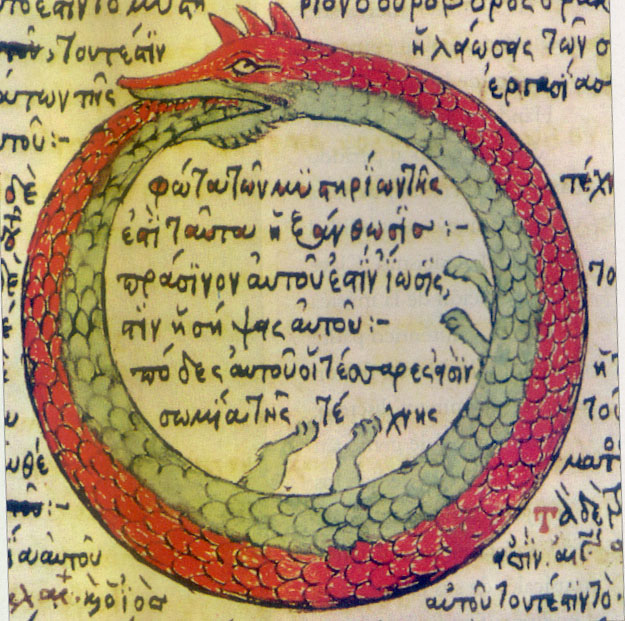
Ouroboros

The Ouroboros is a symbol that is associated with many different religions and customs and is also claimed to be related to Alchemy. The Ouroboros is a snake eating its own tail in the shape of a circle, representing demonstration of one's own life and resurrection, leading to immortality.

Artifacts Displaying the Symbols in Different Cultures

Sources

  1. lavatsky 1889 p. 306. Wheaton, Maryland: Theosophy Library Online. Blavatsky, Helena (1966). "Esoteric Instructions (EI): The Esoteric Section: Introduction by the Compiler". Collected Writings. Series. Volume XII. Wheaton, Illinois: Quest Books. pp. 478–511 [context at p. 492]. ISBN 978-0-8356-0228-0. Groningen, Netherlands: katinkahesselink.net. Links retrieved 2011-01-29.
  2. Washington, Peter (1995) [Originally published 1993]. "Boys and Gods". Madame Blavatsy's Baboon: A History of the Mystics, Mediums, and Misfits Who Brought Spiritualism to America. New York: Schocken Books. Hardcover. pp. 126–144. ISBN 978-0805241259.

Like Ancient Digger? Why Not Follow Us?


Subscribe Via RSS Feed Follow Ancient Digger on Facebook Follow Ancient Digger on Twitter Subscribe to Ancient Digger Via Email

Get widget

Search


Ancient Digger Archaeology Copyright © 2015 LKart Theme is Designed by Lasantha