• Ancient Digger teaches Archaeology and History to all Ages!

Friday, April 19, 2013

Sex and the Sun Temple in Konarak, India


Imagining the erotic images and sculptures that drape the ancient temples of India causes us to question the actual meaning and message behind them. Like the ancients in Pompeii, sex was never just sex. Sex  in Pompeii was a completely normal and fulfilling experiencing, much like India, and most of what we know about the eroticism that took place in both of these places was left on the walls.

What is the Sun Temple at Konarak?

© dracozlat
The Sun Temple is a 13th century Hindu temple, created to honor the deity Surya, the Sun God. The temple is a pristine example of Orisssan architecture, but unfortunately the temple continues to crumple. The Sun Temple was said to be created by King Narasimha of the Eastern Ganga dynasty. Although legend says that the temple was constructed by Samba, the son of Lord Krishna, there is more plausible evidence to support construction during Narasimha's reign. The reliefs on Konarak depict secular events, and one in particular, is a clear celebration of the military victory of Narasimha over the Muslims.

In 1931, the Earl of Ronaldshay remarked on the Sun Temple,

"One of the most stupendous building....a pile of overwhelming grandeur even in it's decay".

The Architecture of Konarak

Like many of the holy temples in India, Konarak is raised off the ground on a plinth. The superstructure and roof of the sanctuary collapsed sometime during the 19th century, however the main entrance still retains its pyramidal roof. Residents and tourists alike cannot enter the building regardless, as the entire structure was filled with sand and stone to keep it from collapsing.

In total, there are three sections that make up the Sun Temple. The main shrine connects to a prayer hall and the entrance to the temple. The pillared dance hall is separated from the main shrine, and is located in front of the main shrine. On of the most fascinating sections of the Sun Temple, in my opinion at least, are the twelve large wheels. It is said that the wheels are meant to represent the chariot of Surya.

Sculptures

Originally, there were seven horses that stood in front of the chariot, however only one remains intact. According to Hamshitha Acharya (2012) , "the spokes of these wheels serve as sundials, and the shadows formed by these can give the exact time of the day. Some says that the wheels represent the 24 hours of the day and others says the 12 months in its concept, where as the seven horses dragging the temple makes up the seven days of the week".

© India Mike
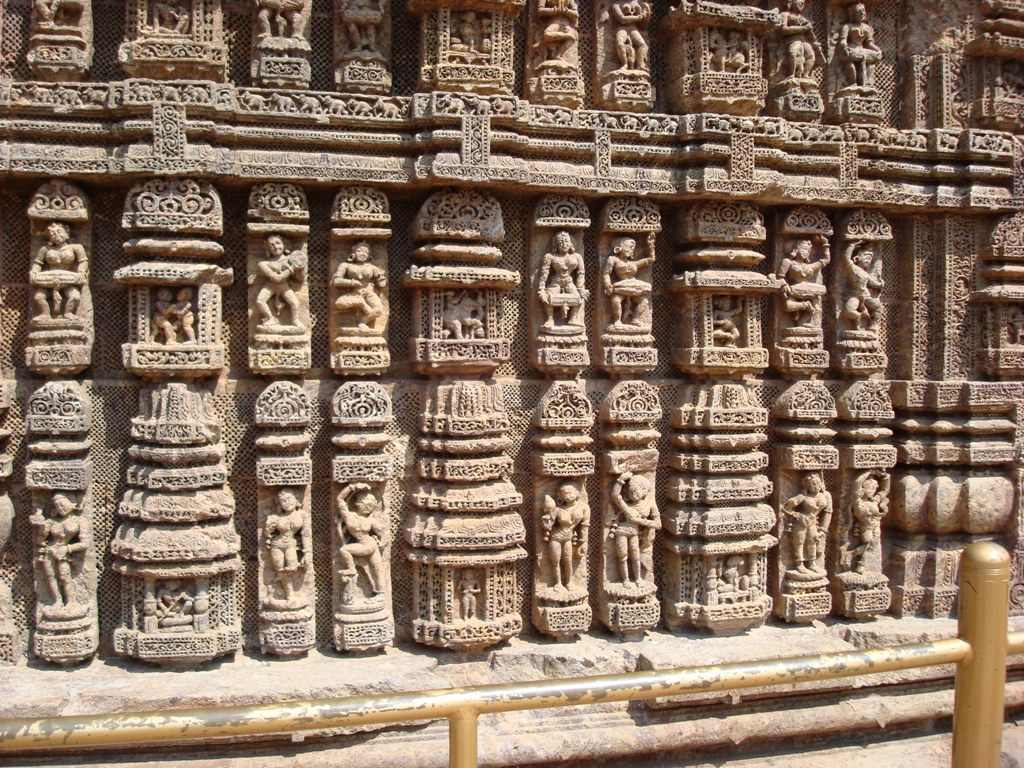
There are several friezes of couples between the wheels, and nymphs, deities, musicians, and also dancers that can be found on the lower section of the Sun Temple. Lively carvings of birds and animals, mythological creatures, and geometrical carvings can be found interspersed throughout the temple.

Erotic Sculptures

The temple is famous for its erotic sculptures, which can be found primarily on the second level of the porch structure. Although it's unclear as to what these erotic art forms represent, we can postulate that they could have been used as amulets to avert evil. Of course, I like to think that that they meant a great deal more than what most people assume. The sculptures on the Sun Temple are lyrical and romantic, majestic and serene, and they all represent a realism that reflects a revolving circle of life.

Source

Acharya, H. (2012 ). Sun temple – konark, a source of sculptural beauty . Retrieved from http://indianmonumentsattractions.wordpress.com/2012/08/31/sun-temple-konark-a-source-of-sculptural-beauty/

Tuesday, February 19, 2013

Major Roman Thermae Discovered by Bulgarian Archaeologists


Photo by Sozopol.Bulgaria
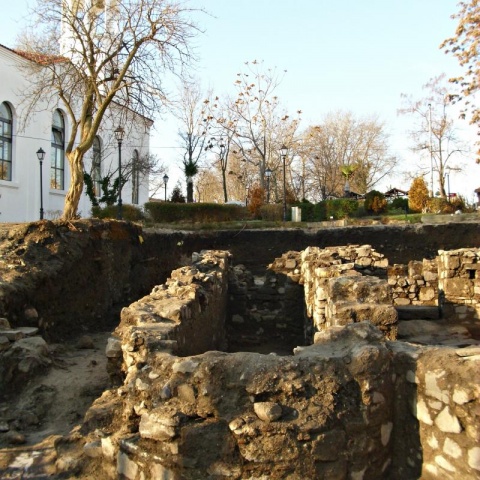
A Bulgarian team of archaeologists have discovered well-preserved remains of a Roman bath in the ancient Bulgarian town of Sozopol.

The news was revealed by National Museum of History director Bozhidar Dimitrov.

"The team, led by Sozopol Archaeology Museum director Dimitar Nedev has made the discovery as part of its digs in the area in front of Sozopol's fortress walls," said the historian.

According to Dimitrov, the thermae building is 18 meters long and features an intricate water supply systems as well as numerous pools of various sizes.

"Except for Roman baths in Hissarya and Varna, this is the best-preserved Roman bath in Bulgarian lands," added he.

Dimitrov expressed satisfaction at the string of discoveries made in Sozopol, which he said will make an attractive open-air exhibit once archaeological works are completed.

Sozopol, founded by Greek colonists in the 5th century BC on what is now Bulgaria's southern Black Sea coast, is now a popular resort town.

Source: Novinite

Wednesday, November 28, 2012

Experts inspect Baladevjew temple


Experts of State Archaeology and director of culture Sushil Kumar Das on Tuesday inspected the 400-year-old Baladevjew temple in the town to ascertain the cause of falling of stones from the ancient structure.

Archaeologist Aswini Kumar Satapathy said the temple would be examined thoroughly and necessary repairs taken up as per the advice of the statutory technical committee.

A stone slab weighing 50 kg had fallen from the temple on Saturday, leading to cracks on the main temple. This is not a lone incident.

Such cases have been reported earlier raising questions about the safety of the temple. Nrusingha Patri, a priest of the temple, attributed it to faulty conservation of the temple.

Dhiren Sahoo, chairman of Kendrapara Municipality, conveyed the apprehensions of the devotees about the damage to the aging stone blocks which formed the roof of the main temple and some small structures, including the kitchen room, to the director of culture.

A State Archaeology team had inspected the temple four months ago and found that seepage due to heavy rain had eroded the ground underneath the structure leading to loosening of stones at the temple top, Satapathy said. The team has already started the renovation works after the recent incidents, he added.

Source: Times of India

Tuesday, November 13, 2012

Construction Underway at Ephesus


A reconstruction plan for the protection of the ancient Greek city of Ephesus, lying 3 kilometers southwest of the town of Selçuk, has been approved during the town’s Municipality Assembly’s November meeting. Turks are expecting that Ephesus will be included to UNESCO’s World Heritage list. The plan has also been submitted to the İzmir General Directorate of Cultural and Natural Heritage for approval.

Ephesus is a declared 1st degree archaeological site. In the framework of the reconstruction plan, new entrances, retail stores and new walking lanes will be constructed within the ancient city. Areas of touristic interest, agricultural fields and parking lots will be clearly separated, and unplanned urbanization around the site prevented. “Also, transportation, trade, displays and other functions will be to modern standards. When the plan is put into effect, there will also be a field for camel wrestling and new entrance gates from the side of the Yedi Uyuyanlar Inn,” according to Selçuk Mayor Vefa Ülgür. On Mount Bülbül a terrace view is planned, which will be reached through a tunnel.

Turkish authorities further wish to underline the commercial character of the ancient city. In Antiquity Ephesus was an important center of commerce. The project the İzmir Culture and Tourism Provincial Director Abdülaziz Ediz announced is called “Ephesus Reunion with the Sea”, and aims to reviving history. The transportation from Ephesus Harbor to the Pamucak Coast will be possible by boats, says Ediz, adding that they want to make Ephesus more attractive to tourists.

Ephesus is currently on the Tentative List of UNESCO – an inventory of properties which are cultural heritage of outstanding universal value and will be considered for nomination to the World’s Heritage List at some point. To be included on the World Heritage List, sites must be of outstanding universal value and meet at least one out of ten selection criteria.

Famed for the Temple of Artemis (completed around 550 BC), one of the Seven Wonders of the World, Ephesus was one of the twelve cities of the Ionian League during the Classical Greek period, and later, in the Roman era, became the capital of proconsular Asia (which covered western Asia Minor) instead of Pergamum, entering an era of prosperity.

Source: Archaiologia

Wednesday, October 31, 2012

Europe's oldest prehistoric town unearthed in Bulgaria


The oldest prehistoric town found to date in Europe has been unearthed by Archaeologists in Bulgaria. The walled fortified settlement, near the modern town of Provadia, is thought to have been an important centre for salt production. Its discovery in north-east Bulgaria may explain the huge gold hoard found nearby 40 years ago.

Archaeologists believe that the town was home to some 350 people and dates back to between 4700 and 4200 BC. That is about 1,500 years before the start of ancient Greek civilisation.

The residents boiled water from a local spring and used it to create salt bricks, which were traded and used to preserve meat.

Salt was a hugely valuable commodity at the time, which experts say could help to explain the huge defensive stone walls which ringed the town.

Excavations at the site, beginning in 2005, have also uncovered the remains of two-storey houses, a series of pits used for rituals, as well as parts of a gate and bastion structures.

A small necropolis, or burial ground, was discovered at the site earlier this year and is still being studied by archaeologists.

"We are not talking about a town like the Greek city-states, ancient Rome or medieval settlements, but about what archaeologists agree constituted a town in the fifth millennium BC," Vasil Nikolov, a researcher with Bulgaria's National Institute of Archaeology, told the AFP news agency.

Archaeologist Krum Bachvarov from the institute said the latest find was "extremely interesting".

"The huge walls around the settlement, which were built very tall and with stone blocks... are also something unseen in excavations of prehistoric sites in south-east Europe so far," he told AFP.

Similar salt mines near Tuzla in Bosnia and Turda in Romania help prove the existence of a series of civilisations which also mined copper and gold in the Carpathian and Balkan mountains during the same period.

BBC Europe correspondent Nick Thorpe says this latest discovery almost certainly explains the treasure found exactly 40 years ago at a cemetery on the outskirts of Varna, 35km (21 miles) away, the oldest hoard of gold objects found anywhere in the world.

Source: BBC

Thursday, October 25, 2012

Largest Hindu Temple Discovered in Bali


Construction workers in Bali have discovered what is thought to be the biggest ancient Hindu temple ever found on the Indonesian island, archaeologists said.

The workers were digging a drain in the island's capital Denpasar at a Hindu study centre when they came across the remains of the stone temple.

They reported the discovery to the Bali archaeology office, which then unearthed substantial foundations of a structure that the excavation team believes dates from around the 13th to 15th centuries.

"We think this is the biggest ancient Hindu temple ever discovered in Bali," Wayan Suantika, the head of the team, said late Wednesday.

He said the excavation was still in progress and the team did not yet know whether enough stones would be unearthed to allow them to reconstruct the temple.

The construction workers on Sunday found the first stone one metre (yard) underground, which was one metre long, 40 centimetres (16 inches) deep and 40 wide, said Ida Resi Bujangga Wisnawa Ganda Kusuma, owner of the Hindu centre.

The excavation team then found what they believe is the foundation of the structure's 20-metre-long east wing, Suantika said.

The popular resort island is a pocket of Hindu culture in a country with the biggest Muslim population in the world.

Source: AFP

Monday, May 21, 2012

Pompeii: Erotic Art and Roman Sexuality


If you missed the documentary on eros and erotic art in Pompeii , make sure you do before taking a look at this in depth study into Pompeii's sexual past. 

Pompeii is an archaeological site, which was destroyed around AD 79 by Mount Vesuvius. It was a town full of aristocrats and artisans. Artisans who were previously slaves, who gained freedom in Pompeii and became wealthy merchants.

Pompeii was a place for the super-rich! The Palm Beach of the Roman world. It was a place known for sexual indiscretions. One could choose his or her desires from a list of murals, pointing in the direction of their sexual preference.

You would hang your belongings on a peg, a peg conveniently located near an erotic scene, a reminder of where you left your things. Then you would proceed with your indiscretions in secret rooms or bathhouses.

Sex was a completely normal and fulfilling experiencing in Pompeii, and most of what we know about the eroticism that took place there was left on the walls. For 1700 years, this Greco Roman town lay buried in a blanket of ash and pumice, until archaeologists unearthed a town home to 20000 people. Beginning excavations were haphazard and damaging, yet while methods of archaeology were more refined, more artifacts more discovered. Some of the most recognizable and erotic art and archaeological finds in Pompeii were statues, large pools, and several murals of Priapus.


It is important to remember that all of the artwork in Pompeii discovered thus far has a much deeper meaning for the people that lived there. The Pompeians were enamored with eros and this obsession drove them to experiment with love, take risks with questionably clean prostitutes, and often drove men to partake in lewd acts with anything with a pulse. Is this the reason for the amount of sex that took place at Pompeii? Possibly.
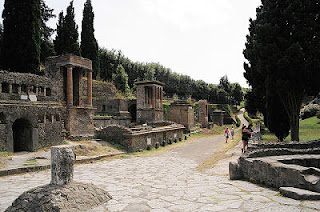
Sex and pornography in Pompeii were looked at as a completely normal aspect of human nature, and yet many modern cultures were ethnocentric in their own ideals and portrayals of what was sexually accepted out in the open. So what did the people of Pompeii think about the power of eros, sex, and pornography, what did modern cultures think, and why were sexually explicit items created?

Eros is the son of Aphrodite who essentially meddles in the affairs of gods and mortals, causing bonds of love to form, often illicitly. In early Greek art, Eros is depicted as a adult male with sexual prowess, but later becomes cupid, the blindfolded and childlike boy who flies around, shooting his arrows at unsuspecting individuals destined for love, with a little push of course. Eros draws one thing to another by attraction or even gravity. Hesiod, one of the earliest poets, writes a book called Theogony. He explains that Eros existed long before the goddess of love, Aphrodite. According to many philosophers, Eros was an awe-inspiring universal force. Eros (Love), is the fairest among the deathless gods, who unnerves the limbs and overcomes the mind, and counsels of all gods and all men within them. Pre-Socratic philosophers believed Eros was a natural force responsible for creation. It was not just good or bad, but destructive. Eros was vital because it operated as a social concept, yet it had moral implications. It was hard to control because in many cases, individuals would become slaves to it. This may have been the case in Pompeii.


Sex was less inhibited in Pompeii than it is today in most countries. There were few prohibitions and sex was just one aspect, albeit a very significant one, of human nature. The motto in Pompeii, which could be found on the erotic art and walls, drinking vessels, as well as plaques, read "enjoy life while you can for tomorrow is uncertain". Sex ranked as a great way to enjoy oneself and others, and while the stereotypical Roman orgies were most likely not part of daily life, certainly sex was acceptable, practiced, and celebrated.

Sarah Robinson writes:
There may have been a wide variety of sexual images on display in Pompeii, but it was incredibly unlikely that they were used to sexually excite spectators. Sexually explicit art was found among landscapes and other mythological art in rooms off kitchens, slave quarters, and other common areas. From the Roman point of view, the sex may have been noticeable, but it was not noteworthy and it did not set these pictures apart from landscapes and ordinary mythological depictions. The Romans seemed proud of their paintings, displaying them in full view of the public because of this pride. Sometimes the pictures were meant to give a sense of life’s pleasures1.
Loth notes that, “Among the ancients, sex was unashamedly joyous, in reading as in practice. The subjects carried no more taboos than food or sports, family quarrels or international wars.” These taboos were much more than modern cultures like the Victorians could endure, with their prudish ways and undeniable attitude of perfection. The Victorians believed the art at Pompeii was “obscene” by their own standards. There were depictions of sexual acts in almost every home and bathhouse, as well as many public spaces. There were other scenes on display in Pompeii depicting homosexuality, oral sex, and variety of sexual positions. The sexually explicit pictures found all over Pompeii were, “Proper pictures to have around your house. If you have a proper picture collection, you must have some really good pictures of people doing it, and if you don’t well you just don’t have any taste and don’t understand the proper values of your society”7.


One such sculpture dating to the 1st century AD caused quite a stir in the Victorian community. The Pompeian sculpture of Pan having sexual intercourse with a goat touched very deeply on the topic of bestiality. The intention of the Romans and Roman sexuality was to create an amusing sculpture that was admirable for its wit and skill, and it was most likely displayed in full public view. The irony behind the attitudes of the Victorians towards this particular piece of art is the fact that undeniably racy subjects engulfed in a heat of passion were just an example of how unlikely it was that this act could have happened. The fact of the matter is that modern individuals, or more specifically modern American cultures, believe that all thoughts pertaining to sex or sexual acts are inappropriate. Nudity is taboo and it is taught very early on that one’s body should only be used in a biological context and not for display, especially in sexually explicit images. These images go even further when the subject of those images is children and nudity. Showing a child in this form is considered as terribly offensive but the pictures make an impact. American culture does not like to admit to the impact of sexual imagery, but every time a conversation is started about pornography, it sparks an intense reaction, which continues to prove the power of sexuality.

The 1864 edition of Webster's dictionary defined pornography as "licentious painting employed to decorate the walls of rooms sacred to bacchanalian orgies, examples of which exist in Pompeii”4. These ideas of pornography were not so much the reflection of everyday Roman life but a way to show how sex was acceptable. No matter the amount of people who engaged in the activity or the object of those pleasures, sex was always conveyed as both a pleasurable and humorous act. This is certainly the reason why we see so many phalluses in Pompeii. Not only was the phallus a symbol of fertility, but also it was used in the form of an icon, its main purpose being to ward off evil. Today, the image of a phallus is completely taboo. The erect or semi-erect penis continues to be considered utterly unacceptable in any form of media other than pornography while female nudity in various forms is rapidly becoming acceptable even in media6 . The people of Pompeii displayed and revered the phallus and were not ashamed of its meaning, because the meaning was never to be perceived as only a sexual object. In the age of “size does matter”, many often prefer a larger penis. Was this the case for Pompeians? Hardly. In Pompeii, a smaller penis was considered more attractive. A larger penis, like the one we see on Priapus, was usually found on an individual with characteristics unusual to the Roman ideal, which was amusing and worthy of a good laugh. It was never meant to cause distaste, but it demonstrates how the Pompeians were able to laugh at themselves and not take things, such as the size of ones manhood, too seriously.

Robinson described the Pompeian’s ideas about the size and meaning behind the phallic symbol:
Laughter was one way to dispel the anguish of the evil eye. Humorous, erotic art displayed around town and in your household was one way to employ the protection of laughter, and was probably the reason behind its prevalence in Pompeii. Protection against the evil eye could also be found in the many images of the phallus commonly depicted in Roman art. These phallic images range from unobtrusive stone reliefs carved into paved walkways to winged and belled hanging phalluses. Power, status, and good fortune were expressed in terms of the phallus. Hence the presence of phallic imagery in almost unimaginable varieties all around the town . . . . There are phalluses greeting you in doorways, phalluses above bread ovens, phalluses carved into the surface of the street and plenty more phalluses with bells on-and wings6 .
There are several examples around every turn in Pompeii displaying the phallus, the most notable depiction, considered to be the most obscene, is located on a life-sized fresco in a doorway into the House of the Vettii. The god Priapus holds a set of scales that weighs his phallus while he looks outward, brazenly meeting the eyes of all who pass by. If you dare walk past him or even catch a glimpse at the relative size of his not insignificant maleness, you cannot help but be impressed. This portrayal would often spark laughter to the Romans, and mere shock to the Victorians, but the meaning is so much more significant. Priapus was thought to bring luck and plentiful harvests in the garden and the bedroom. He was also a protector of the flocks and the bees and he protected people from harm and evil. As with any phallic culture, anxieties were probably created as men tried to keep up with the strength society expected of them. Mary Beard explores how these sexual anxieties manifested themselves in homophobia, “In fact, many of the insults that scholars have sometimes taken as signs of Roman disapproval of homosexuality as such are directed only at those who played the passive part”1.

Check out: The Fires of Vesuvius: Pompeii Lost and Found

Continue Reading..................

One’s first impression of Pompeii upon arrival is mostly likely embarrassment. Perhaps your heart starts racing or the images of well-endowed males throws you into doubt about your own manhood. The streets of Pompeii are a clear detour from the 20th century ideas of standards and moralities, and for the most part, the erotic art and images of Pompeii have, since its rediscovery, caused both outrage and appreciation. It is important to remember, however, that the Pompeian artifacts are valuable since they provide a source of information, and the knowledge from that information requires dissemination. These artifacts might just hold a key to understanding not only the Pompeian citizens, but also ourselves. Therefore the archaeological artifacts need to be interpreted by someone besides an archaeologist or historian in order for their true importance to be realized. Even before the world stood still in Pompeii in AD 79, the inhabitants were using these objects routinely. There was not a person alive that did not have access to them, yet when the first obscene artifacts were finally unearthed, people recognized a collision of worlds. In order to truly understand these ancient relics, one had to dive into the world of Roman sexuality to understand why they were preserved.

It is easy to imagine a Victorian digger discarding an object considered obscene in their circle. However, thankfully they realized that these items could never be destroyed. Had they been of recent manufacture, this would have been the obvious expedient; but any relic of the ancient world possessed, merely thanks to its survival, a value that superseded the nature of the relic itself. The relics of Pompeii had no rivals, no copies, and their likeness could not be found in any surrounding areas. This added value accrued principally to two classes of relics, the trivial and the obscene. Though both kinds had presumably been distributed throughout the Roman Empire, trivial things had mostly vanished in centuries of neglect, while obscene ones had succumbed to the zealous progress of Christianity. When it came to obscene objects, the more obscene an object was, the more likely it would have been destroyed anywhere but at Pompeii. Thus Pompeian preservation became a necessary evil4.

Depending on their inclinations, early critics condemned the one as immoral or the other as prudish, but all agreed that the ancient system of organizing Pompeii’s images would never do in modern times. A new taxonomic classification system was born out of Pompeii's priceless obscenities. They were to be systematically named and placed, and the final name chosen for them was "pornography," and they were housed in the Secret Museum. No one was ever allowed access to the Secret Museums’ indelicate collection, except for the archaeologists, who created one of the first pornographic experiences, in which sexually explicit portrayals of Roman sexuality were separated from all social contexts.
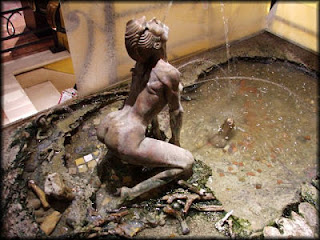
The Secret Museum, or the “secret chamber”, as many refer to it, is located in the Naples National Archaeological Museum, Naples, Italy, and contains some of the most erotic and unadulterated archaeological finds from Pompeii, too explicit and unsuitable for the general public. Most of what the public is allowed to see today was locked up in the beginning of the 19th century because it did not fit into the taxonomic classification of erotic. Instead, these pornographic materials were essentially locked behind a brick wall. The museum was temporally opened in the 60’s when free love laid a foundation for acceptable promiscuity, and then it was closed until 2000. Today it is open to the public. When you buy your ticket to the museum you have to ask about the secret chamber. You will then be assigned a visitation time, which is usually only 45 minutes. All tours are free and guided by someone who speaks your language but who is not necessarily knowledgeable about the artifacts.


The artifacts that are housed in the Secret Museum derived their characteristics from ritual and human nature, found to be open subjects in Pompeii. One such scene may have evolved from a location owned by Emperor Nero’s second wife, Poppaea Sabina. Poppaea owned a villa there, in which a large pool was constructed, and while her husband was away she indulged in orgies with females and males of all ages. The villa was discovered during excavations carried out by Francesco La Vega in the eighteenth century, however the swimming pool, which measures 60 by 15 meter, can only be imagined by the existence of some foundational walls, unearthed during the 1970s. This meeting place brought about a party that represented the many Bacchanalian Scenes displayed in the Secret Museum.

The abundant libations drunk in honor of the gods and the frenzy of the rituals freed the participants from moral restraint, and the ceremonies took on a licentious character2. These ceremonies of lust grew even more uncontrolled and lewd, but at the time of the Imperial period, and during the time of Christ and the early Christians, this behavior was seen as acceptable. Grant explores the modern views of sexual orgies and what exactly changed as far as acceptance of ritual, “Christian views on sex would definitely not support such iconography (and define it as the “worst” kind of evil), but Christians who chronologically lived closer to Christ did, and these were the Christians who emanated into the Catholic Church. So, something “changed.”2

If we think about this logically it is clear that Church leaders today would never admit than Christ allowed sexual orgies, but they would admit that the Early Church in Rome, and especially in Pompeii, did. When Christ began to teach his word and promote a life of servitude and morality instead of debauchery, supposedly he spoke against sexual orgies. Regardless of what initially changed in the church to dissolve these immortal ideas of what was acceptable in the bedroom or out in the open, we still have relics in the Secret Museum to prove that at one time sex was celebrated.

Not every relic in the Secret Museum is grounded in sexual indiscretions. At some point the artifacts started to reflect different ideas about gender. A ritual basin housed in the museum is a prime example of this notion. The basin is made of multiple layers of metal (bronze, copper, or sometimes tin). Archaeologists described this large ritual basin, or lebes, from Pompeii, as a representation of "Satyr and Nymph". The nymph has evident, even if a small, male genitalia, therefore the most likely sex of this individual is a hermaphrodite or more probably an adolescent male. This was hardly a sexually explicit piece; rather it was a representation of changing attitudes towards gender. Any artifacts depicting mixed sexual orientation, however, were always placed behind closed doors when they were first discovered. This was not a subject that modern individuals were ready to face, but nonetheless, in keeping with the tradition of preserving distinctive sexual relics, the basin found its home in the Secret Museum.
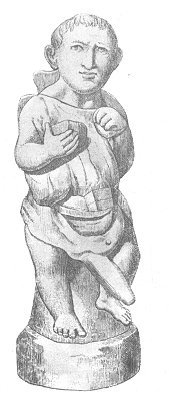

Several more fascinating statues were discovered at Pompeii, many in great number, most notable is the Drillopota. The Drillopota was a vessel, or obscene vase, used by the ancients to drink libations. Most undoubtedly they were used in honor of Venus, or perhaps Bacchus. Many of the vases depict men of little stature with a shaved head, shaved in fact to make them appear more ridiculous. The arms would sometimes hold tablets, which the children used at school. Some of these Drillopota are shown wearing a golden bulla around their necks, which distinguished the sons of the nobles and senators. The origin of this distinction dates from Tarquin the Elder, who awarded this mark of honor to his son for having conquered his opponent in single combat. The bulla could be opened at pleasure and was used to keep talismans in3.

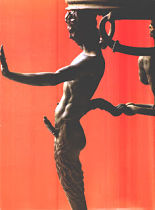
Another artifact housed in the Secret Museum is a Tripod with Ithyphallic Young Pans holding up a lebes, or basin, and it is made entirety out of bronze and stands 90 centimeters high. The tripod is a pristine example of Hellenistic art. The overt pornographic nature of these young pans with their phalluses in plain view was the main reason this object was never displayed to the public. The tripod is significant because it does represent a triad of three youths. In Roman history, we see the use of a triad with Caligula’s sisters on a silver sestertius representing Agrippina as Securitas, Drusilla as Concordia, and Julia as Fortuna 8. This trinity of deities is not only associated with the number three, but it is common knowledge throughout folklore; the number three has a long history of mythical associations. Therefore the classification of the Tripod with Ithyphallic Young Pans is more so ritually based than sexual in nature.
In closing, there are several more explicitly sexualized examples of Pompeian life in the Secret Museum including but not limited to erotic art and bas reliefs. Many of the bas-reliefs and paintings contained within the walls of the Secret Chamber offer no explanation as to their representations. The limits of pornographic explanation allow visitors to garner their own opinions about the nature of the art. One’s perception of sexual imagery is dependent on how that individual was socialized to perceive Roman sexuality. In today’s modern culture, sex and gender are not subjects perceived to be outside the realm of a person’s innate sexual nature. Roman sexuality was on display in the public realm and domestic spaces as well as a prominent part of Roman art, folk culture, superstitions, and humor. While the eruption of Mount Vesuvius may have destroyed this sophisticated Greco Roman town, it did not destroy the history. Pompeii not only provides us an eye opening and revolutionizing approach to gender studies in the ancient world, but also it tells us about our own human nature.

I wanted to take the time to thank the publishers for the recent mention of this article in their books. "Pompeii: Erotic Art and Roman Sexuality" was cited in Pornography and The Criminal Justice System, by Carmen M. Cusack, and The Roman Gaze: Vision, Power, and the Body (Arethusa Books) by David Frederick.


Also check out:


Works Cited
  1. Beard, Mary. Pompeii: The Life of a Roman Town. London: Profile Books, 2008.
  2. Grant, Michael. Eros in Pompeii-The Secret Rooms of the National Museum of Naples. New York: William Morrow & Company, Inc, 1975.
  3. Hare, John B. Sacred Texts, "Drillopota." Accessed February 11, 2012. http://www.sacred-texts.com/sex/rmn/rmn12.htm.
  4. Kendrick, Walter. The Secret Museum: Pornography in Modern Culture. London: University of California Press, Ltd, 1987.
  5. Loth, David. The Erotic in Literature: a historical survey of pornography as delightful as it is indiscreet. New York: Dorset Press, 1994.
  6. Robinson, Sarah L. "Defining Pornography." Social Sciences Journal. 10. no. 1 : 1-8.
  7. Rodley, Chris, Milgrom, Marilyn, Williams, Linda, and Camille Paglia. "Pornography – The Secret History of Civilisation." Koch Vision. 2000. DVD.
  8. Wood, Susan E. "Diva Drusilla Panthea and the Sisters of Caligula." American Journal of Archaeology. 99. no. 3 (1995).
Photos
  • Mary Harrsch
  • Wikipedia
  • The Golden Rule
  • The Naples Archaeological Museum
  • scruff monkey (flickr.com/photos/cathalm/)

Thursday, December 29, 2011

Archaeology News: Is the Colosseum Collapsing?


The Colosseum may be a fixer-upper but it’s not collapsing according to the department of the Culture Ministry responsible for Rome’s archaeological sites.  “Nothing has collapsed” at the Colosseum “since the 18th century”.

Under closer investigation, it appears that some masonry chunks and bits of plaster have
detached and fallen on Tuesday. On Christmas Day tourists found small fragments of tufo, the porous rock typical of ancient Roman monuments, on the ground. Anna Maria Moretti, the official responsible for the ancient sites, denied that any material had fallen Tuesday and noted that the tufo that detached on Dec. 25 came from a patch smaller than “five centimeters.”

The Colosseum is about to undergo an extensive 25-million euro restoration — about $33 million – sponsored by Diego Della Valle, owner of the Tod’s luxury goods brand. Work is scheduled to begin in March.

Source

Monday, August 29, 2011

Petra and the Bible


The highly publicized area of Petra has more significance than its modern-day use as a beautiful tourist location that many refer to as the rock-built “rose red” city. Although famously portrayed in such movies as Indiana Jones and the Last Crusade, Arabian Nights, and Sinbad and the Eye of the Tiger, the red city has deep roots in Biblical archaeology. Even so, it continues to be of high interest to many, including world travelers, Biblical Archaeologists and historians.

The city is known for its beautiful rock cut architecture that dates back to the BCE late century. As a semi-fortress, it was attractive to kings because it was easier to control and protect than other nearby geographic locations. The Edomites, Nabataeans and the Romans found it to be of significant economical and archaeological advantage, because of its close 80-kilometer proximity to the Dead Sea and narrow entrance.

The Edomites Run the Red City


Although some historians believe that the actual rose red city may not have been included within Edomite rule, the surrounding area of the city was called Edom, and was ruled by the Edomites beginning near 1200 BCE. The Edomites were a resourceful people and they controlled the majority of the spice trade from South Arabia to the northern area of Damascus. Their society was described as one of distinction and sophistication with creative outlets that included writing, textile production, ceramics and skilled-metal products.

Nabataeans Take Over and Rule


When an Arab tribe called the Nabataeans migrated to Edom in 312 BCE, this forced the wise Edomites into the southern Palestinian area. When this occurred, the Nabataeans began to increase the economic and archaeological advantages that the Edomites had begun. Working to create a flourishing capitol, the Nabataeans extended spice trade acquisition, by lengthening the route to include Northwest Gaza, Palmyra and the Syrian Desert, and the Aqaba area.

They also began to build some of the famous tourist monuments that are now protected as a UNESCO World Heritage Site. The Nabataens began to utilize the red rock as the main resource for territorial expansion. Today, tourist can see the evidence of Nabataen and Roman architecture, including the famous Colonnaded Street, the Temple of Winged Lions, and the great Treasury building.

Other famous sites that are connected to the planned complex include the famous East and West Propylaeum, the upper and lower Temenos and the Great Temple. Yet, one of their most significant advantages in their society was the development of a hydraulically engineered system that helped control winter water, and helped to provide an adequate means of water conservation.

Roman Empire Influences


General Pompey of the Roman Empire was the first in Roman succession to take over the rose red city and surrounding areas. Through his rule, the Romans began to expand the red city capital, and they made it official by calling the provincial area Arabia Petraea. It is estimated that the Roman takeover began between the years of 64 to 63 BCE.

The majority of monuments and tombstones within the red city were primarily made of limestone and sandstone. Although the Romans had their own cultural influences that they brought to the area, they added a mix of both Roman and Nabataean influences to renovate buildings and to add new architectural additions to enhance the city. The King’s Highway or Via Traiana is one of the most fascinating contributions to the rose red city that was left by the Romans.

Herod the Great and other Bible Connections


The red city has held both Christological influences from the Bible and pagan aristocratic influences. With the unearthing of rock-cut monuments and mosaics, these influences have become highly connected with biblical archaeology. Yet, many of the references to the Bible are obscure.

However, many historians of biblical archaeology have connected the red city with the biblical passages found in the 16th and 42nd chapters of the book of Isaiah. In these passages, historians believe these Biblical mention of Selah are actual references to the red city. Yet, there are similar references to the red city in the biblical books of Obadiah and Amos.

Herod the Great ran the Roman Empires and there was strong biblical reference that stated his desire to kill the baby Jesus. Even so, Herod I, as he was known, had familial roots in the red city. He was the second born son, and his father provided service under a high-ranking Nabataean public official. However, Herod's mother, Cypros, was the princess of the red city, Jordan and Nabatia.

Further still, his father was called Antipater the Idumaean, and the Idumaeans were historically considered a direct lineage of the Edomites, which were forced out of the area because of the Nabataeans. Ironically, the biblical passages that historians use to compare the rose red city and Selah as the same city, encouraged those that were persecuted to hide in the Siq, or the very same place where Herod I acquired his familial lineage.

Furthermore, biblical reference to the Siq, the entrance to the red city, describes the location as a dusty sand-prone area. Even today, the Siq is known for its loose sandstone and limestone deposits that are still of great value to archaeologists and scientists that hope to uncover more hidden treasures from Roman, Nabataean and Edomite culture.

Rose Red City Architecture


Rock architecture was the main way that Romans and other ancient societies built structures like Petra. Rock cut architecture is an ancient building process that uses existing rock formations to build living quarters, religious temples and specific-use buildings. Although some forms of this architectural process is still used today to build cliff-hanging houses, the Romans built theaters, cave dwellings and tombs using this method.

Besides the Great Temple and the Treasury building, they also lived among many other astonishing rock buildings as a part of the Colonnaded Street plan. Building construction along this street included the East Exedra with its famous niche of seating, the vaulted chambers and arches of the Theatron and the modern-like Roman-Byzantine Bathing House with its drainage pipes. The city building plan also included the creation of the Great Cistern, the East Triple Colonnade and the Baroque Room Complex. Influences from the Roman Empire and Nabataeans are often blurred within Petra, but what remains is a beautiful contribution to human creativity and perseverance in an area that was unlikely to support life.

All pictures © evkr

Author Bio:

Ms. Leah L. Logan enjoys all types of writing, including article writing, journalism, and ghostwriting. Ms. Logan is a two-time international author with the release of the co-authored books “Removing the Mask: Living an Authentic Life” and “Self Architect: Redesigning Your Life” both edited by Linda Ellis Eastman.

Related Article

Thursday, May 26, 2011

Raichle House in Serbia


I was in the campus library a few days ago searching for some archaeology articles and came across a lovely Art Nouveau building in Serbia called Raichle House. I searched and searched the internet trying to dig up any kind of history associated with this exquisite architectural feat, yet I fell quite short. I know that many of my readers are from Serbia and have a better understanding of this archaeological site and I’d like to hear more about it if you’d be so kind.

Subotica is a Serbian city with some 100,000 inhabitants located very close to the Hungarian border. The city experienced major growth during the Austro-Hungarian Empire, helped by the development from 1896 onwards of an important railway link, which encouraged many traders, artisans and financiers to settle in the city. Alongside this growth, various buildings were constructed following different neo-European and academic styles. But it was Vienna's Secession movement that marked the style of the city centre. With the arrival of Hungarian architects, the city underwent an urban renewal that, in accordance with the modernity of the day, transformed it into the main centre of Serbian Art Nouveau. ~~Subotica

Ferenc Raichle House was built in 1904 by Ferenc Raichle

The Ferenc Raichle House was built in 1904 by Ferenc Raichle. It’s located close to the railway station and it’s one of the best examples of Art Nouveau architecture in Subotica. Today, the building is home to the Artistic Encounter Gallery, or Likovni Susret. Laurence Mitchell notes that  Ferenc Raichle House came straight from the sketch pad of Gaudi and was designed as a dwelling house, yet it has found new life as a gallery of contemporary art. The Venetian mosaics and light palette of colors give this building a playful life, what with the light curves of the construction and welcoming facade.

So for all of my Serbian readers, what makes this place so special? Or, if you aren't from the area and you've visited Ferenc Raichle House, let us know about your experience there.

Related Articles

Skull Tower in Serbia

The Skull Tower archaeological site dates back to around 1809 during the first revolt in Serbia, and was an Ottoman monument intended to mark the empire's success in defeating the Serbian rebels close to Nis in May 1809.
The first Serbian Uprising began in 1804 when Serbia was under the control of the Ottoman empire for close to 350 years. The uprising fell short in 1813, however a second uprising began in 1815. The second Serbian attempt was successful, leading to independence of the country in 1829. Read More: Skull Tower in Serbia
  1. Subotica
  2. Serbia 2nd, Laurence Mitchell

Thursday, March 10, 2011

Archaeology Dig At Brisbane's City Hall Reveals Pioneering Treasure


Archaeologist Phillip Habgood explains his surprise, when excavating below the city hall in Brisbane, turned up some 19th century treasure. Evidence of horse stables and a street have been excavated at the archaeology site that date to the 1850's. The findings are being deemed the most significant archaeological find in the city's history.

At the present time, the city hall in Brisbane is undergoing restoration work so archaeologists were brought in as part of the $215 million refurbishment. Students from University of Queensland are assisting archaeologists with the excavation and have "uncovered an intact drain, building roofs, old horse shoes and bottles".

Archaeologist Phil Habgood said details of the city's past spanning as much as 80 years, up until City Hall was built in 1930, could lie underneath the historic building."We've got evidence of corrugated iron buildings [underneath City Hall]," he said."The buildings were made from porphyry [stone] then they added concrete and bitumen throughout the area. We think there's probably a large 1850-60s stone drain.

The Brisbane Lord Mayor, Campbell Newman, calls it "a sensational find".

Tuesday, March 8, 2011

Blarney Castle: The Legends and History


The Blarney Castle was constructed in 1446 by Cormac Laidhir MacCarthy, Lord of Muskerry. The tower, which measures 85 feet high, is above the river and curious dungeons and caves reside below. At the time of construction, the MacCarthy family was in power in Ireland. The third Earl of Clancarty and James II were exiled during the 17th century, ending the families hold on Blarney Castle.

Blarney House


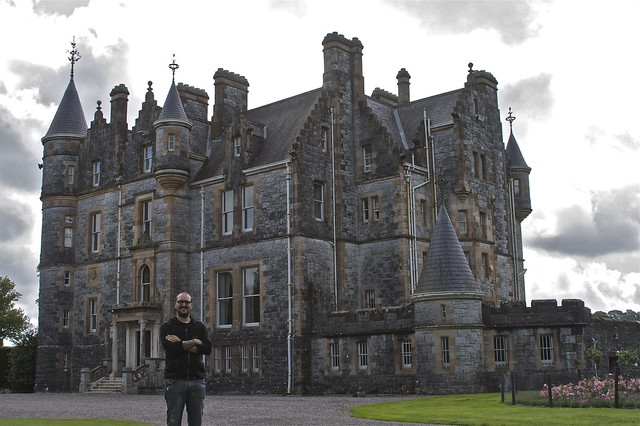
The Blarney House, situated 200 yards south of Blarney Castle, was constructed by the Colthurst family in 1874 in the Baronial style. Deterring from the cold and uncomfortable accommodations, the Colthurst family built the house to feel more at home. During the 19th century, wishing steps were created in the gardens. It’s been said in order for a wish to come true you had to negotiate your way down the steps with eyes closed in order for your dream to come true.

The Blarney Stone


The Blarney Castle is most famous for the
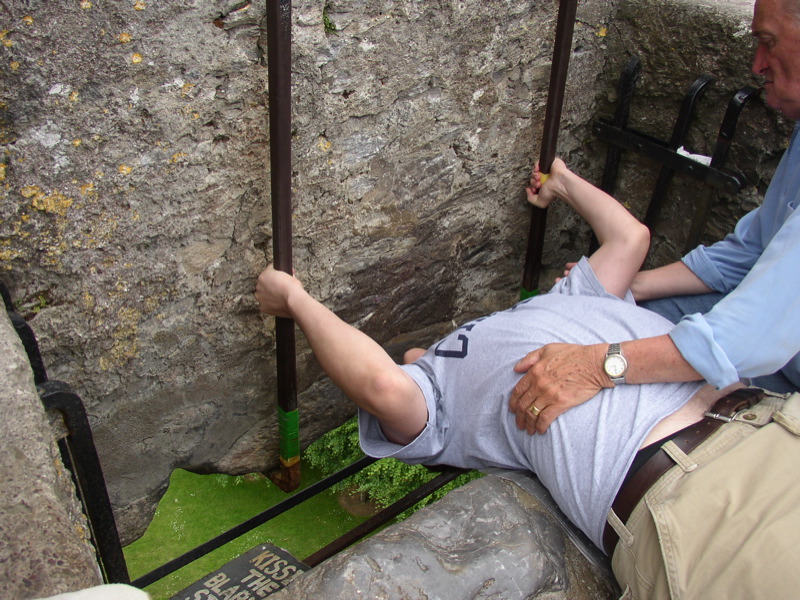
Blarney Stone. One would hang upside down from the battlements after climbing 100 steps to the top, and if a kissed was placed upon the stone, the gift of eloquence was conferred upon them. In 1912, in fact, Winston Churchill kissed the stone, and what came next was history.

“Wishing Steps” At Blarney Castle


The legend of the Blarney Stone is unknown, but folklore tells of Jacob in the Bible, who rested his head upon the stone when he saw angels ascending and descending a ladder to heaven. Some believe the wishing steps in the garden are reminiscent of the ladder as well.


During the Celtic revival, the term Lia Fail was used to describe the illustrious stone by enthusiasts. When High kings were crowned at Tara during Pagan times, the stone would scream when the rightful successor touched it.

Another legend describes a time between Elizabeth I’s reign and Cormac MacCarthy when the queen looked to destroy the power of the Irish lords. MacCarthy was evidently playing deception so the queen remarked that his protestations were “more blarney”.

Today, thousands of patrons walk the grounds of Blarney House and the famous gardens, trying to catch a glimpse of anything out of the ordinary.

Beautifully maintained gardens of lawns, shrubs, flower beds and trees, which gently slope towards the lake, providing a perfect setting for special occasions. Herds of cattle browse peacefully beneath ancient lime, oak, beech and gnarled walnut trees. ~Blarney Castle

Sunday, February 20, 2011

Fort Hoskins Reconstruction By Archaeologist David Brauner


Ancient Digger loves a great fort discovery, but how about a fort reconstruction?

For 35 years, archaeologist David Brauner has studied and reconstructed the history of Fort Hoskins, a Civil War-era Army outpost in the Oregon Coast Range that existed for less than a decade before it was decommissioned, dismantled and consigned to the past.

Since 1976, the Oregon State University professor has led five digs at the site 20 miles northwest of Corvallis, unearthing thousands of artifacts from buttons and belt buckles to brandy bottles and chamber pots.

He has mined nuggets of information from official correspondence, military maps, inspectors' reports and soldiers' diaries, patiently piling detail on detail to assemble an ever-clearer picture of the fort in his mind's eye.

With no surviving photographs to compare it to, he thought that mental image was as close as he would ever come to seeing what Fort Hoskins actually looked like - until he saw the painting.

Read the entire story at Gazette Times:  Portrait of the past

Picture © Oregon State

Monday, January 24, 2011

Monday Ground Up: Angkor Wat Is The Temple of Time


This article is contributed by Lima. 
 

For 800 years the temples and shrines of Angkor Wat have stood as a symbol of the nation of Cambodia. So much so that Angkor Wat appears on the Cambodian flag, its beauty and magnificence a source of national pride.
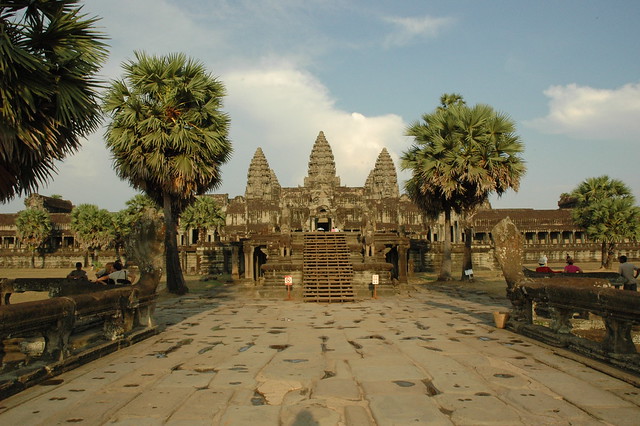
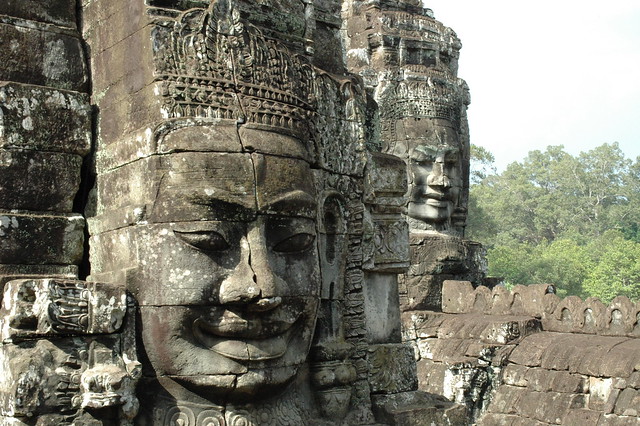
The temples at Angkor Wat, built in the early 12th century under the reign of King Suryavarman II, have been a center of religious worship continuously since its construction, making it the oldest site where religious activities have taken place uninterrupted.

Originally built as Suryavarman’s royal temple and center of the king’s court, Angkor Wat was constructed to honor the Hindu god, Vishnu. Angkor Wat was abandoned as the nation’s capital after it was attacked by an enemy clan within Cambodia at the time. A new capital was created and served as the royal center of power, leaving Angkor Wat to the local people who prayed in the temples that cover the 203 acres that comprise the whole of these magnificent structures built in the classic style of the Khmer.

In the 13th century, King Jayavarman VII was deposed by his son-in-law who had studied for 10 years in a Buddhist monastery and Cambodia quickly adopted Buddhism as the state religion. The Cambodian people were quick to accept this new religion that focused on the spiritual rather than material world. At this time, Angkor Wat became a shrine and a holy site for Buddhists throughout the region.

The original layout of the shrines and temples is clearly evident but construction at the site continued for almost four hundred years. As such, the complex is an architectural history showing change across four centuries – living history.

In that time, numerous buildings were added including decorative carved bas relief lines, many temple walls, representing the Hindu deities for which the temple was originally constructed. This centuries-long creation provides a trove of anthropologic information showing the evolution of the Cambodian culture and political structure. Even today, Angkor Wat continues to be one of the most researched sites on the planet. Its rich history is carved in the stone that makes up this mystical, awe-inspiring place.

The temples of Angkor Wat have remained sacred to the Theravada Buddhist sect into modern times and remain a place of great religious and spiritual power within the large segment of Buddhists that comprises the Cambodian population.

Over the centuries, the temples at Angkor Wat were gradually overtaken by the surrounding jungle and, in the early part of the 20th century, the site was in need of restoration. Recognizing the cultural significance of this remarkable series of shrines and spires, the world community came together to restore Angkor Wat to its former glory. Today, this holy place is not only a pilgrimage destination for Buddhists, it has become a major source of tourism revenue for Cambodia. The site is well-maintained and is, indeed, one of the wonders of architecture 800 years after work was begun.

The Significance of Design at the Site of Angkor Wat


Because Angkor Wat was built as a Hindu complex and center of state, the design of the complex is based on Hindu religious icons. The main temple is a representation of the home of Hindu gods, Mount Meru.

Surrounding the main temple are five spires that represent the five mountain peaks that surround Mount Meru. Angkor Wat was enclosed, the walls representing mountains. It was also surrounded by an immense moat, a representation of the sea. Thus, when the complex at Angkor Wat is taken as a whole, it becomes a representation of the world in miniature as it was known during the 1200s.


The walls of Angkor Wat are decorated, not only with bas relief depictions of Hindu deities, but also representations of the king and royal authority. However, archeologists suggest that many walls of the complex remain bare when work stopped on Angkor Wat upon the death of Suryavarman.

Many of these carved decorations depict known science at the time, particularly astronomical signs and symbols leading some anthropologists to suggest that Angkor Wat was more than a palace for Suryavarman and a private religious sanctuary for the king and his inner court.

Some anthropologists suggest that many of the bas reliefs that adorn the temple walls make a political statement as well as a religious one, pointing to a new era of learning, engagement and a contented populace, something that any monarch would desire.

The design and layout of Angkor Wat remain somewhat of a mystery. Khmer temples are built facing the east. The temples at Angkor Wat are oriented toward the west, the source of some controversy among the anthropology community. Some experts believe that the unusual alignment of the complex indicates that Angkor Wat was intended to serve as the burial site of its builder, Suryavarman.

Other anthropologists believe the alignment of Angkor Wat is more likely based on the deity to which it was originally constructed, Vishnu. In Hindu religious texts, Vishnu is associated with the west and, therefore, the western alignment of Angkor Wat makes sense despite its contrary positioning to other Cambodian temple sites.

Do the Features of Angkor Wat Suggest Engagement With Aztecs or Egyptians?


Using architecture and the advent of architectural innovation, anthropologists attempt to uncover connections between diverse cultures.

While there is no evidence to suggest that the design of Angkor Wat is imitative of the great pyramids of the Egyptians, Incans or Mayans, some within the anthropology community point to Angkor Wat as an example of cultural transference – the exchange of technology, linguistics and other elements that define diverse cultures.

Some experts point to the alignment question as an indicator that Angkor Wat was a Cambodian adaptation of either Egyptian or Mesoamerican civilizations. Others point to architectural innovations that appear in the design and construction of newer buildings over the 400-year span that construction was undertaken at Angkor Wat.

In fact, the buildings at Angkor Wat follow traditional building practices seen in other temple sites throughout the region. There’s no need to speculate how Cambodian architecture evolved. The evidence still stands, available for further study and analysis.


The Magic of Angkor Wat


However, this remarkable place is more than a collection of buildings. It is more than a site of archeological study. It is more than the cause for debate among anthropologists.

In today’s high-tech society, Angkor Wat stands as a true wonder. It has been described as mystical, magical and “almost surreal” – sentiments expressed by Westerners upon visiting the site for the first time. This is the true appeal of Angkor Wat.

Indeed, its history and construction are important to understand. However, it is the mysterious and the dynamic energy that emanates from this sacred spot that is the true story of this collection of holy buildings.
Angkor Wat is truly the world’s Temple of Time.

Also check out Lima’s article

Evolution of Culture, Genetic Anthropology, and the “Eve Theory”

For decades, anthropologists have debated “The Eve Theory” – the theory that world cultures migrated and evolved from a single source – Eve, a reference to Adam and Eve mentioned in the Bible’s Book of Genesis as the first man and woman and the progenitors of all human life.
Read more: Evolution of Culture, Genetic Anthropology, and the “Eve Theory”

This article is contributed by Lima, an avid traveler who owns a website offering high quality adjustable dumbbells for sale
Reference:
1st Photo © Adana Lima
Photo 2-4 © Cornstaruk

Monday, November 29, 2010

Monday Ground Up: Putna Monastery In Bukovina, Romania


Putna Monastery took three years to build on land bordering the Putna River in Bukovina River. Construction of the Romanian Orthodox monastery was overseen by Prince Stephen the Great, ruler of Moldavia from 1457 to 1504.

Prince Stephen the Great was the son of Bogdan the Second and was considered by many to be one of the best  army commanders of all times. Prince Stephen was a genius in politics and was a great promoter of Romanian culture.

Monday, November 15, 2010

Monday Ground Up: Archaeological Wonders Of Tunisia


Tunisia, officially the Tunisian Republic, is situated in northern Africa and is bordered by Algeria to the west, Libya to the southeast, and the Mediterranean Sea to the north and east. Its area is almost 165,000 km², with an estimated population of just over 10.3 million. Its name is derived from the capital Tunis located in the north-east.

Tunisia is filled with history as evident in the imprints left over a 3000 year span. Adventurers, conquerors, missionaries, traders, farmers, warriors, all made their own impact. Whether on the hills of Carthage or at the threshold of the Sahara desert. Phoenicians, Romans, Vandals, Byzantines, Turks, Spanish and French all made their way through Tunisia at one point in history, and the architecture they left behind is a reminder of state societies evolving, and at some point, falling.

Bruce Officer has compiled several articles on some archaeological sites he visited in Tunisia several years ago. For many people, Tunisia is an unknown location, however Bruce mentions Roman North Africa was a prosperous but often overlooked province.

Archaeological Sites To Visit in Tunisia

The Tophet of Carthage – Religious Sanctuary and Possible Child Sacrifice Ground


The Tophet is the sanctuary dedicated to the god Baal Hammon, the main god of the Carthaginians, and the fertility goddess Tanit. It is an open space, shaded by trees and densely packed with stone markers called stele (singular form stela). At first glance one might think these are grave markers, but they are actually markers recording an important sacrifice made to the gods, often naming the person who the stela set up.

Read: The Tophet of Carthage

The Roman Amphitheatre of El Jem


© chileno66

Indeed, so starkly alone is the building that antiquarians believed it to be an amphitheatre built in the desert, thinking it the whim of a mad emperor. But modern excavations have revealed the outlines of a fair sized city with a forum and villas of the wealthy, though these excavations have been backfilled and aren’t available for the visitor to see.

The El Jem amphitheatre is grand, even by Roman standards. It is 138 metres long and 114 metres wide, making it a little over two thirds the size of the Coliseum in Rome. It was probably built in the first few decades of the third century AD.

Read more: The Roman Amphitheatre of El Jem

Dougga – A Roman Hilltop City in Tunisia


© izzthewizz

This is Dougga, sometimes called Thugga, a Roman city not far from the North African desert frontier, but also a city rooted in its Numidian and Carthaginian past.


The Numidians were the native people of the hills and plateaus of the semi-fertile zone between the desert and the Mediterranean sea. By the time of Rome’s expansion, they had formed a kingdom, adopting written language and government from the Carthaginians – the Middle Eastern people who had settled on the coast of North West Africa and had created a trading empire. Although some of the Numidians were still nomadic, plenty lived in villages and even towns like Dougga.

Read more: Dougga – A Roman Hilltop City in Tunisia

Thuburbo Majus – Solitary Majesty of This Tunisian Roman Town


Public Domain

Thuburbo Majus, or Colonia Julia Aurelia Commoda as it was called when it was granted colonia status, was a Roman town about 60 km southwest of Carthage on the trade route that connected Carthage to the edge of the desert and the caravans that crossed it. In fact there was a Carthaginian town here before the Romans arrived and Augustus chose it as a site to settle retired army veterans in 27 BC.

Read more: Thuburbo Majus – Solitary Majesty of This Tunisian Roman Town

The Antonine Baths in Carthage, Tunisia


© Bruce Officer

Construction of the Antonine baths began under the Emperor Hadrian in AD 146 and was completed under his successor Antoninus Pius in AD 162, hence the naming of the complex. And it was indeed a complex, not a simple set of Roman baths. As well as the normal cold, warm and hot rooms there were outdoor pools and a sun terrace, as well as broad steps leading down to the sea. The scale was astonishing: the main pavilion had a floor area of about 18 000 square meters and the total complex about 35 000 square meters.

Read more: The Antonine Baths in Carthage, Tunisia

How Can I See All Of These Archaeological Sites In Tunisia?

This heritage, Tunisia's greatest wealth has been held in trust and preserved in hundreds of sites and museums from the small Punic museum in Utica to the vast collections of the prestigious National Museum of Bardo. Most Museums are closed on Mondays, whereas many on-site archeological museums and ruins are open all week. An entrance fee is usually charged and a caretaker will often act as guide. ~Tourism Tunisia

What Other Cultural Tours And Activities Can You Find In Tunisia?

  • The International Music Festival is held for long evenings in the El Jem Coliseum. The festival is held on a summer night and provides an unforgettable musical experience. Symphonic sounds collide as world renowned artists take the stage for a spectacular night under the stars.
  • Tunisia's desert near Tozeur has featured in numerous films, most notably in The English Patient and Star Wars. An increasing number of tour operators now offer desert safaris to the locations where these famous blockbuster movies were shot. For further information, contact the Tunisian National Tourist Office.~IExplore
Also check out these sites for an exclusive list of activities and travel tours.

Friday, November 12, 2010

Petra In Under 3 Minutes


It's one of my favorite archaeological sites on earth. The mysterious city of Petra was carved into the steep cliffs, lining Arabah, a valley that runs from the Dead Sea to the Gulf of Aqaba. Most remember Petra from Indiana Jones and the Last Crusade, however they probably never knew the history behind it.

Archaeological Cities of Syria


Guest Article By Ron Siojo (Expert in Societies, Culture, and Religion)

The environs west and southwest of Aleppo in northern Syria are home to the "Dead Cities" — abandoned ruins of some 700 Byzantine towns, villages and monastic settlements. These ruins are among the greatest treasuries of Byzantine architecture to be found anywhere in the ancient world.

Today, very little of Antioch survives but the Dead Cities still litter the landscape with astonishingly well-preserved basilicas, monasteries, villas and baths. Indeed, the Dead Cities of Syria provide "one of the best pictures of the world of Late Antiquity to be found anywhere." Below is the list of the Dead Cities, all of which have notable ruins of Byzantine churches.

Read More about the Dead Cities of Syria 

Picture @ Sacred Destinations

Like Ancient Digger? Why Not Follow Us?


Subscribe Via RSS Feed Follow Ancient Digger on Facebook Follow Ancient Digger on Twitter Subscribe to Ancient Digger Via Email

Get widget

Search


Ancient Digger Archaeology Copyright © 2015 LKart Theme is Designed by Lasantha