• Ancient Digger teaches Archaeology and History to all Ages!

Tuesday, January 28, 2020

ARCHAEOLOGY NEWS: 1/28/2019


ARCHAEOLOGY NEWS – Ancient Digger brings you the latest archaeology news and headlines everyday of the week!

Underwater archaeologists have discovered a huge, centuries-old shipwreck and a destroyed World War II bridge in a river in Poland.

Vesuvius victims died slower than believed

3,000-year-old teeth solve Pacific banana mystery

Archaeology news: Archaeologists recreate the voice of 3,000-year-old Egyptian mummy

By 3D printing an electronic larynx which is an exact replica of the mummified priest, experts have been able to recreate the voice of a person who has been dead for 3,000 years. A team from Royal Holloway, University of London, Leeds Museum and the University of York placed the mummified remains of Nesyamun inside a Computed Tomography (CT) scanning machine to analyse whether the structure of the larynx had remained intact.

Witch’s bottle found in US Civil War fort.
A glass bottle filled with rusty nails discovered in Virginia could be a rare ‘witch’ bottle used by soldiers in the US civil war to fend off evil spirits. The bottle stands at a height of five inches (13 centimetres) tall and three inches (eight cm) wide and was discovered near a civil war fort known as Redoubt 9.


Thursday, April 28, 2016

Ancient scarab discovered dating back to the Thirteenth Pharaonic Dynasty


An ancient scarab dating as far back as 18th century BCE, and belonging to a senior Egyptian official of the Thirteenth Pharaonic Dynasty,  has been discovered by an Israeli amateur birdwatcher.

Alexander Ternopolsky was birdwatching near the Tel Dor archaeological site on Israel’s Carmel Coast, where an ongoing excavation of the ancient port city of Dor is taking place, when he happened upon the incredible find. Ternopolsky immediately handed it over to the archaeological team working at the site.

An ancient Egyptian Sacrab Seal dating back to the 18th century BCE, discovered in Israel in the Tel  Dor archaeological site.
Credit: Tel Dor Excavations. (Photo: Courtesy / TPS)


According to Haifa University, the coastal city of Dor at the foot of Mt. Carmel was a key port city for thousands of years. Until the Romans built Caesarea, Dor was the most important commercial center in area and a trading base for spices, resin, and other commodities that were highly valued by the ancient Egyptians. The city was even mentioned in several ancient Egyptian documents dating back 3,500 years.

A preliminary study concluded that the stone scarab is engraved with the name of its owner as well as his position. The description of the scarab owner’s position includes such phrases such as “overseer of the treasury,” “bearer of the seal,” and more, but the owner’s name has not yet been deciphered.

“The scarab must have belonged to a very senior figure in the kingdom, probably the viceroy responsible for the royal treasury,” explains Prof. Ayelet Gilboa from the Department of Archaeology at Haifa University, who is heading the excavations at Tel Dor together with Prof. Ilan Sharon from the Hebrew University in Jerusalem.

The excavators suggest several theories explaining how the scarab might have reached Tel Dor. The first is that either a representative of the viceroy or the viceroy himself may have come to Dor.

Another option is that the scarab arrived at Dor at a much later stage, perhaps even during the Roman period, when there was demand for such Egyptian “antiques”.

“Since the scarab rolled down from the mound and was not found in its archaeological context, we will probably never really know when and how it got here and where it has been,” said Prof. Gilboa.

Source: Breaking Israel News

Also check out:


The History And Meaning Of Ancient Egyptian Jewelry – Ancient Egyptian jewelry represents a long history of divine craftsmanship by a people we continue to be intrigued by. Egyptian art and jewelry was never just art, but represented a deeper meaning, which even today baffles archaeologists.

Uruk Period Kings –The Uruk Period lasted from 4100-3000 B.C. (time frame not set in stone) and exemplified the dawn of civilization and city-state growth. New cities emerged; arts and crafts became more advanced; social hierarchies were created and molded by system administrators; writing and documenting trade transactions took place on cuneiform; and warfare stretched the Mesopotamian landscapes as city states popped up around the Euphrates and Tigris rivers.

Monday, July 6, 2015

1920's scenes of workers at various Egyptian archaeology excavations


We read about the excavations in class, I know I once did in my Ancient Egyptian History class,  however the words of our textbooks describing Howard Carter and his discoveries can hardly paint as vivid a picture of history like this silent documentary does.

Today, 6000 years of collections are being assembled in the Met Museum in order for researchers to further their study and knowledge of the grand civilization in the Valley of the Nile.

As you can see by the video above, the process of removing the earth from the site in the 1920's is not so far removed from the way in which we approach it today. There's an assembly line of workmen, who are in charge of a native foreman and sub-foreman, who ensure the line continues to move in an orderly fashion.

The turieh, or Egyptian hoe, is used to dislodge the material and to fill the small, light baskets in which it is carried to the cars.

Instead of using our trusty water bottles or canteens, women bring jars of water, and mules would carry in water in goatskin.

While the workers weren't finding treasures like Egyptian jewelry, they were finding hoards of jars filled with salt, linen, and powders in the process of mummification. They also uncovered a 3000 year old coffin, which is waxed to preserve its surface decoration.

Watch the entire silent documentary above to see how the process of uncovering archaeological artifacts has changed.

Friday, March 29, 2013

Tunnels to steal treasures discovered near archaeological sites in Egypt


Since the revolution in Egypt, large holes have been appearing in the ground close to places of archaeological significance, such as the Great Pyramids at Giza.


As the BBC's Aleem Maqbool discovered, it seems that people have been digging underground tunnels in order to find archaeological treasures. The problem extends to southern Egypt too, and to Luxor, once the great ancient capital city known as Thebes. Over the last two years, the police there have been inundated with audacious cases of people tunnelling for antiquities.


The security forces gave the BBC some extraordinary video footage they had taken of the vast tunnel networks that have been discovered.

[Source: BBC]


Thursday, March 7, 2013

Ancient Egypt “pyramid” boat threatened after sewage burst


Egyptian antiquities officials have confirmed to Bikyanews.com that a pipe has burst inside the museum holding one of pyramid builder Khufu’s boat. The ancient boat has been restored and is a major pull for tourists heading to the Giza Pyramids.

Khufu is also the 4th dynasty King who erected the largest of the three pyramids, which has been named after him.

One official said late Monday night that the “sewage pipe in the building has exploded. We are looking into the situation and are not sure if any damage has happened.”

Activists and archaeologists have begun spreading the message on Twitter and other social media networks as they fear for the destruction of the ancient boat.

[Source: Bikya]

Monday, February 25, 2013

King Ramses II Pyramid Discovered in Luxor


A pyramid that dates back more than 3,000 years and built for an advisor to King Ramses II has been discovered in Luxor, Egypt's state minister for antiquities said.

The remains of the large mudbrick pyramid -- whose original height was 15 metres (49 feet) -- was unearthed during excavations on the hill of Sheikh Abdel Qurna by a Belgian mission of the Universite libre de Bruxelles and Universite de Liege, Mohammed Ibrahim said.

"Stamp impressions on the bricks indicate that the pyramid belongs to a vizier of Upper and Lower Egypt named Khay, who held this charge for 15 years during the reign of pharaoh Ramses II (1279 -1213 BC) in the 19th dynasty," the mission said in a statement.

"The monument was largely dismantled in the 7th and 8th century AD, when the tomb was transformed into a Coptic hermitage," it said.

The discovery is of major importance "since the vizier Khay was known to Egyptologists by a large number of documents but the location of his tomb remained undiscovered," the mission said.

Luxor, ancient Thebes, is a treasure trove of ancient Egyptian architecture and artefacts. The city, a major tourist spot, has been badly affected by insecurity gripping the country since the 2011 uprising that toppled Hosni Mubarak.

Source: artdaily.org

Thursday, February 14, 2013

The History and Meaning of Ancient Egyptian Jewelry


Ancient Egyptian jewelry represents a long history of divine craftsmanship by a people we continue to be intrigued by.  Egyptian art and jewelry was never just art, but represented a deeper meaning, which even today baffles archaeologists.

The rarity and exquisite nature of Egyptian jewelry was not only reserved for women, but men as well. Both men and women wore the Ancient Egyptian jewelry, and these personal adornments were not just limited to beaded necklaces and finger rings.

Jewelry such as anklets, collars, bracelets, fillets and earrings embodied everyday Egyptian dress, so much so, that even in death the poorest of individuals would still be found wearing a string of beads or a simple bracelet.

Excavations and grave robbing in the Saqqara Necropolis has turned up loose beads and trinkets from the mass graves and tombs of the ancient Egyptians.

In fact, these loose beads are often picked up by local merchants and sold to gullible tourists.

Why the Ancient Egyptians Wore Jewelry?


The Ancient Egyptians wore the ornamental jewelry for many reasons, however the more fundamental reason and purpose was to guard them from mysterious hostile forces. For many of us, we sometimes require the assistance of a necklace with a teardrop crystal, a tiger’s eye, a rabbit’s foot, a hemp bracelet, or a type of precious stone to make us feel safe. The Ancient Egyptians did the same, only most of the adornments worn were crafted out of stone. Such talismans might consist of turquoise and lapis lazuli and carnelian, all representing a facet of nature such as the green of spring, the blue of the sky, or the orange or beige of the desert.

The Meaning of Gold in Ancient Egyptian Jewelry


The use of gold in Ancient Egyptian Jewelry simply represented the flesh of the gods, the fire and glory of the sun, and the very idea that the luster of the gold was never lost, therefore an eternal sense of being.

The Meaning of Shells in Ancient Egyptian Jewelry


The shells of fresh water sea life were used to craft bracelets and necklaces for both men and women. The cowrie shell, which has an indented lip, looks like the slit of an eye. Egyptians believed this shell to be a prophylactic against the evil eye. This belief is still head true in parts of Africa and the Mediterranean. In fact, in recent times the Nilotic women wear the cowrie shell around their pelvic area to risk aborting a child.

Funerary Collar of Wah


www.metmuseum.org


This is a Middle Kingdom Dynasty 12 Funerary Collar of Wah from the Early reign of Amenemhat I. According to the Metropolitan Museum of Art in New York City, Wah's faience broad collar (40.3.2), anklets and bracelets (40.3–.10) were made as funerary ornaments for the burial and were found in the layer of wrappings closest to the body. The broad collar is one of the finest examples of its type from the early Middle Kingdom. Although a few areas needed reinforcing with modern thread, the stringing is almost entirely original.


Tutankhamun's Scarab of Lapis Lazuli


http://blog.ivman.com


This piece of Egyptian jewelry is from the tomb of Tut-ankh-amun (Tutankhamun).

A scarab of lapis lazuli with falcon wings, supporting a red disk of the new-born sun.

Pectoral scarab worn by King Tut-ankh-amun


http://www.ancient-egypt.co.uk
This piece of Ancient Egyptian jewelry is a rebus pectoral scarab worn by King Tut-ankh-amun from Thebes. It symbolizes the birth of the moon and the sun and was part of the king's coronation regalia.

Faience floral collar of the late XVIIIth Dynasty


Source

This piece of Egyptian jewelry is a faience floral collar of the late XVIIIth Dynasty. This piece is typical of the Amarna Period and was made with cheaper materials including flowers, leaves, and ephemeral papyrus. Since they were less expensive and less time consuming to create, many times they were gifted to guests at parties, banquets, and weddings.

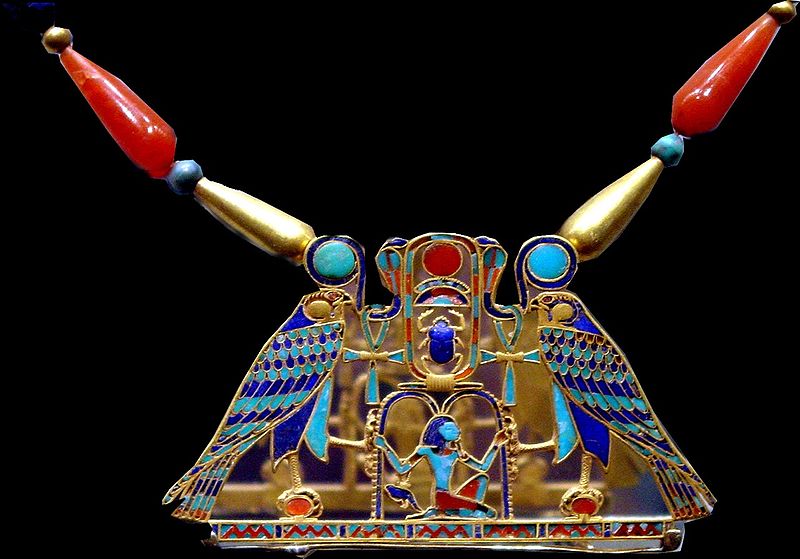
Pectoral of King Senusret II from the tomb of Sit-Hathor Yunet


Source

This piece of jewelry is a pectoral of King Senusret II from the tomb of Sit-Hathor Yunet, daughter of Senusret II.

Crown of Sit-Hathor Yunet


Source

The crown of Sit-Hathor Yunet was used as a wig ornament and adorned with gold and inlaid gold with carnelian, lapis lazuli and green faience. The original piece sits in Cairo, along with the golden tubes that were woven into her hair.

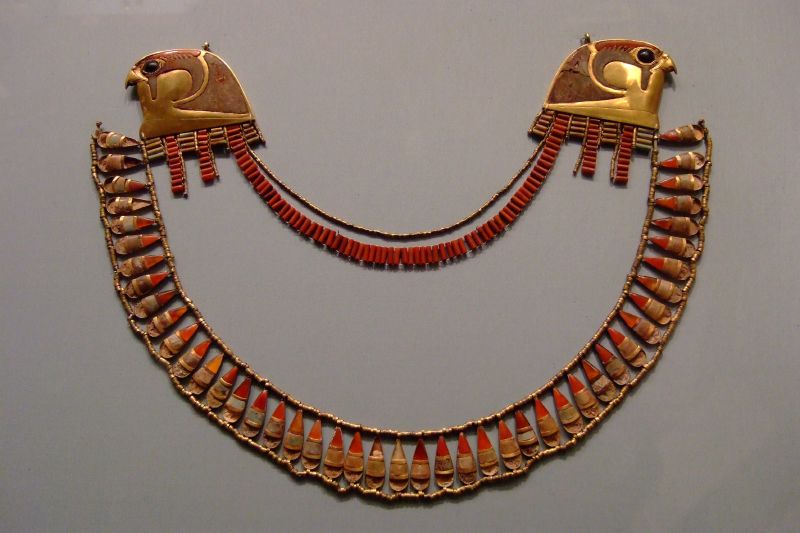
Broad Collar from  Dynasty 18 worn during the reign of Thutmose III


Source
This is a Broad Collar from  Dynasty 18 worn during the reign of Thutmose III 1479-1425 BCE. It is gold inlaid with carnelian glass, from the tomb of the three minor wives of Thutmose III, Thebes. The king's name is inscribed on the backs of the falcon-headed terminals indicating that it was a gift from him to his wife By the New Kingdom, broad collar necklaces were the most frequently worn pieces of jewelry among the royalty and elite in ancient Egypt (Met Museum, 2013)


Author Note: This article was published on a partner site Knoji several years ago by Ancient Digger, but I felt like it should have a place on this site as well. Enjoy!

Monday, February 11, 2013

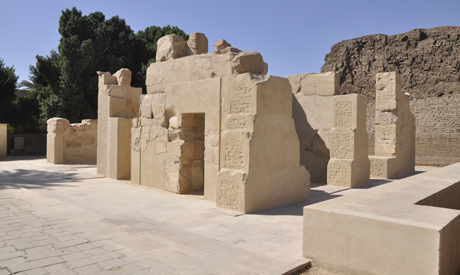
Hatshepsut's limestone chapel at Karnak to open soon for public


At the end of February visitors to Karnak Temples will be able to admire the second chapel of the 18th dynasty Queen Hatshepsut after four years of restoration and reconstruction.

The chapel was constructed in limestone to worship Thebes ancient Egyptian god Amun-Re. It includes an open court and two inner halls embellished with blocks engraved with very distinguished religious scenes depicting Hatshepsut before Amun-Re, with her husband king Thutmose II, as well as their cartouches. Some of the blocks bear the name of Hatshepsut's predecessor king Thutmose III.

Minister of State for Antiquities Mohamed Ibrahim said that the majority of blocks of this chapel were found scattered at the beginning of the 20th century in the Karnak courtyard cachette where a collection of gigantic colossi of different New Kingdom kings, queens, nobles and top officials as well as deities were discovered. Another batch of the blocks, Ibrahim added, was found in mid 1950's during excavation works carried out by Sheata Adam and Farid El-Shaboury at the cachette.

All blocks were stored in Karnak galleries until 2005 when the mission of the Centre Franco-Egyptian D'Etude des Temples de Karnak (CFEETK) restored the blocks, studied them and published their findings.

The blocks stood on mastabas at the open air museum until 2008 when the CFEETK started a comprehensive reconstruction work on all chapels that were dismantled in previous ages.

Some of its blocks were used in the construction of other monuments inside Karnak and elsewhere in Luxor.

Hatshepsut's limestone chapel was reconstructed at the entrance of the open court, along with another one of her chapels known as the Red Chapel, the White Chapel of king Sanusert I, and the calcite shrine of king Amenhotep II.

Mansour Boreik, the supervisor of Luxor Antiquities, told Ahram online in a telephone interview that the newly reconstructed chapel, which is known as the "Sacred Monument," is a very important monument in ancient Egyptian history since it is one of the few still surviving records that attests explicitly to the power of Hatshepsut as ruler before her ascendancy to the throne as king.

Karnak Temples on Luxor's east bank is a vast mix of ancient Egyptian temples, chapels, pylons, and other buildings in ruins. Construction at the complex began in the reign of the Middle Kingdom king Sesostris I and continued into the Ptolemaic period, but most of the buildings date to the New Kingdom.

Karnak complex gives its name to the nearby modern village of El-Karnak, some 2.5 kilometres north of Luxor.

Reconstruction work on this chapel is now completed and it would be open to public end of February.

Source: Ahram

Wednesday, January 30, 2013

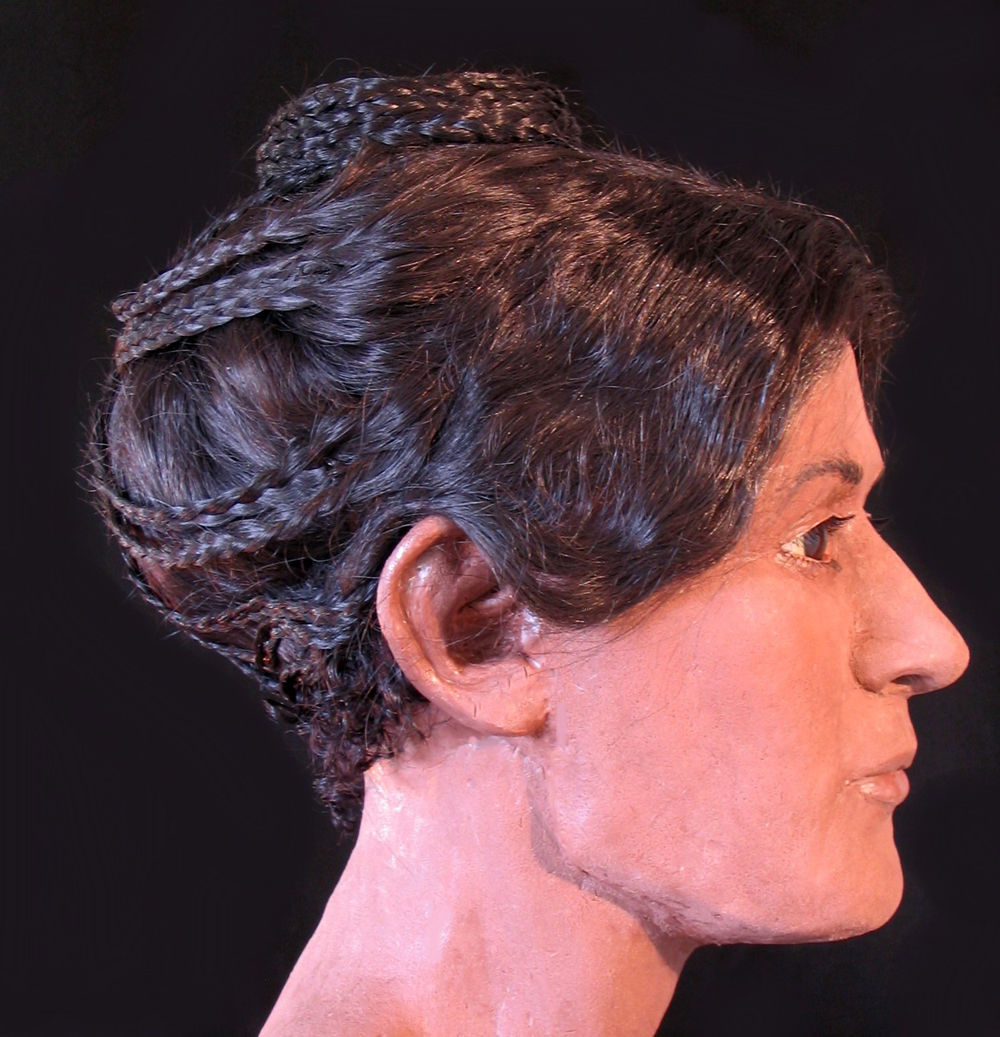
Mummy's Hairstyle from Roman-ruled Egypt is Recreated


© Victoria Lywood
CT scans of the mummy of a young woman in McGill University’s Redpath Museum have allowed researchers to recreate a hairstyle that was popular in Roman-ruled Egypt, nearly 2,000 years ago.

“The mummy's hair is readily appreciable,” wrote the team in a recently published paper, “with longer strands at the middle of the scalp drawn back into twists or plaits that were then wound into a tutulus, or chignon at the vertex (crown) of the head.”

The researchers also studied two other Egyptian mummies from the museum, one of an older woman who lived at the same time as the well-coiffed mummy, and the other of a young man who lived a few centuries earlier. Both had severe dental problems.

Source: Archaeology.org

Friday, January 11, 2013

3000 Year Old Tombs Discovered Beneath Temple of King Amenhotep II


Egypt's Antiquities Minister says Italian archaeologists have unearthed tombs over 3,000 years old in the ancient city of Luxor.

Mohammed Ibrahim says the discovery was made beneath the mortuary temple of King Amenhotep II, seventh Pharaoh of the 18th dynasty who reigned from 1427 to 1401 B.C. The temple is located on the western bank of the Nile.

Ibrahim says remains of wooden sarcophaguses and human bones were found inside the tombs.

Mansour Barek, head of Luxor antiquities, says jars used to preserve the liver, lungs, stomach and intestines of the deceased were found. They were decorated with images of the four sons of the god Horus — figures seen as essential by ancient Egyptians to help the soul of the deceased find its way to heaven.

Source: The Associated Press

Thursday, December 6, 2012

4th Century Sphinx Confiscated From Black Market


An Egyptian granite sculpture of a sphinx that risked ending up on the black market for antiquities is destined instead for a Rome museum.

Italian Tax Police Maj. Massimo Rossi says the sphinx, perhaps as old as the 4th century B.C., was found on the outskirts of Rome last week. It was in a box hidden in a greenhouse near an ancient Etruscan necropolis.

Rossi said Thursday that the sphinx, which is roughly two feet tall and four feet long, likely adorned a 1st century B.C. Roman villa, in keeping with the fashion then for Egyptian sculpture as decoration.

He said an Italian and a Romanian are being investigated in the probe of suspected illicit trafficking in antiquities. Villa Giulia museum, which specializes in Etruscan antiquities, will host the sphinx.

Source: The Associated Press

Monday, November 26, 2012

Royal Statue of New Kingdom King Unearthed at Monthu Temple in Luxor


A French archaeological mission from the French Institute for Archaeological Studies have unearthed an unidentified royal statue of a New Kingdom king during routine excavations at Monthu Temple, northeast of Karnak Temple in Luxor.

The statue is 125 centimetres tall and made of black granite and depicts a standing king wearing short dress with hands aside.

Christopher Tiers, head of the archaeological mission, said that early studies of the statue suggest that the artistic features of the depicted king confirm its royalty.

The statue is to be transferred to the storage facilities of the Ministry of State for Antiquities (MSA) for restoration and documentation. Tiers asserted that excavation at the site is in full swing in order to find any additional statues that may enable archaeologists to identify the New Kingdom king.

Monthu Temple is dedicated to the worship of the falcon-headed got of war Monthu. The temple is located five kilometres northeast of Karnak in an area called Armant on Luxor’s east bank.

Armant was excavated by French archaeologist Fernand Disson de la Roque from 1925 to the post-war period, when he revealed many buildings, including Monthu Temple. The temple replaced an older sanctuary from the Old Kingdom and consists of an open forum with a tower and enclosing two mounds that housed the chapels of worship.

The ruins of the last structure date to the reign of Ptolemy VIII, although decorations and additions continued to be added centuries later by the Romans. Along the span of time, Monthu Temple was a major centre of worshipping Apis bulls, that is why it contains many statues and reliefs of bulls. Most of these statues are now on display in various museums around the world.

Source: Ahram Online

Monday, November 5, 2012

Princess Shert Nebti's 4500 Year Old Tomb Discovered


Princess Shert Nebti's tomb was discovered in
Abu Sir, south of Cairo [Credit: AFP]
n
"We have discovered the antechamber to princess Shert Nebti's tomb, which contains four limestone pillars," he said.

He added that the pillars "have hieroglyphic inscriptions giving the princess's name and her titles, which include 'the daughter of the king Men Salbo and his lover venerated before God the all-powerful'."

Mr Ibrahim said the Czech Institute of Egyptology's mission, funded by the Charles University of Prague and directed by Miroslav Bartas, had made the discovery.

"The discovery of this tomb marks the beginning of a new era in the history of the sepulchres at Abu Sir and Saqqara," he said.

The Czech team also excavated a corridor in the southeast of the antechamber, which leads off to four other tombs, two of which have already been discovered separately.

The two tombs belonged to high-ranking officials including a "grand upholder of the law" and an "inspector of the servants of the palace," according to their inscriptions.

They date from the fifth pharaonic dynasty.

The corridor contains four limestone sarcophagi that contain statuettes of a man, a man accompanied by his son, and two men with a woman.

The discoveries were all made during the excavation season, which began in October.

Source: AFP

Tuesday, October 23, 2012

Mystery of Mummy Conservation at University of Pennsylvania Museum of Archaeology and Anthropology


The Penn Museum is unwrapping the mystery of mummy conservation, giving the public an unusual close-up of researchers' efforts to preserve relics from ancient Egypt.

AP Photo/Jacqueline Larma


Human and animal mummies, as well as an intricately inscribed coffin, are among the items undergoing treatment and repair at the Philadelphia institution's newly installed Artifact Lab.

Housed in a special gallery, the glass-enclosed workspace lets visitors share in "the thrill of discovery," museum director Julian Siggers said.

"It demonstrates to you the work that's actually being done behind the walls of these galleries," Siggers said.

Visitors can watch staff members use microscopes, brushes and other tools of the trade to inspect, study and preserve items including the mummy of a 5-year-old girl, several human heads, a colorful but damaged sarcophagus, and a painting from a tomb wall. Flat-screen monitors display magnified views of the relics as they are being examined.

Conservators will also set aside time twice a day to answer questions from the public. The archaeology and anthropology museum has identified 30 objects from its 42,000-piece Egyptian collection to be conserved during the evolving project. Many of the lab items have not been exhibited before because of their poor condition, said conservator Molly Gleeson. Among Gleeson's first projects are preserving the mummies of a cat, falcon and ibis. She described the falcon's linen wrappings as frayed and powdery, and noted its precariously attached head would need to be stabilized before the mummy could be displayed. Also undergoing study are hieroglyphic-inscribed slabs of wood that comprised the coffin of an Egyptian named Ahanakht, circa 2000 B.C.

"Conservation efforts led researchers to discover hidden inscriptions on the seams", said David Silverman, curator-in-charge of the Egyptian section. Head conservator Lynn Grant said staff members continuously experience a sense of wonder as they work with historical artifacts. "It is a delight, with this new space, to be able to share that with our visitors and give people an idea of what's going on behind the scenes," Grant said.

Source © artdaily.org

Wednesday, August 8, 2012

New Pyramid Complexes Discovered in Egypt


Two unidentified, possible pyramid complexes have been located with satellite imagery from Google Earth.

One of the complex sites contains a distinct, four-sided, truncated, pyramidal shape that is approximately 140 feet in width. This site contains three smaller mounds in a very clear formation, similar to the diagonal alignment of the Giza Plateau pyramids.

The second possible site contains four mounds with a larger, triangular-shaped plateau. The two larger mounds at this site are approximately 250 feet in width, with two smaller mounds approximately 100 feet in width. This site complex is arranged in a very clear formation with the large plateau, or butte, nearby in a triangular shape with a width of approximately 600 feet.

The sites have been documented and discovered by satellite archaeology researcher Angela Micol of Maiden, North Carolina. Angela has been conducting satellite archaeology research for over ten years, searching for ancient sites from space using Google Earth. Angela is a UNC Charlotte alumnus and has studied archaeology since childhood. Google Earth has allowed her to document many possible archaeological sites, including a potential underwater city off the coast of the Yucatan peninsula that has sparked the interest of scientists, researchers and archaeologists. Angela is also a board member of the APEX Institute, founded by archaeologist William Donato, who is pioneering underwater archaeological research in the Bahamas. Angela has been assisted by Don J. Long, fellow APEX researcher and colleague.

The sites have been verified as undiscovered by Egyptologist and pyramid expert Nabil Selim. Nabil’s discoveries include the pyramid called Sinki at Abydos and the Dry Moat surrounding the Step pyramid Complex at Saqqara. Nabil has stated the smaller 100 foot “mounds”, at one of the proposed complex sites, are a similar size as the 13th Dynasty Egyptian pyramids, if a square base can be discovered.
Next Steps

The Egyptian sites have been sent to Egyptologists and researchers for further investigation and “ground truthing”. Angela has stated, “The images speak for themselves. It’s very obvious what the sites may contain but field research is needed to verify they are, in fact, pyramids and evidence should be gathered to determine their origins. It is my hunch there is much more to these sites and with the use of Infrared imagery, we can see the extent of the proposed complexes in greater detail.” This is just one site of many Angela has identified that may contain ancient ruins. "My dream is to work with archaeologists to release sites that I have identified over the past ten years of research. This research is the frontier of discovery and it's just beginning to advance views of our ancient past", states Angela.

Many of the documented areas will remain undisclosed until proper officials are notified and the sites can be protected. Angela and the APEX Institute are raising funds for a documentary that will include many of the undiscovered sites that have been identified using Google Earth. Angela is also forming a non-profit organization to promote satellite archaeology and remote sensing. A select, small portion of the sites can be viewed online with Google Earth by visiting Angela's "anomaly collection" at http://www.googleearthanomalies.com.

Source: Press King


Friday, May 18, 2012

Egyptologist Gustave Jéquier


For many of us Egyptology enthusiasts we are often intrigued by the normalcies of architecture and pharaohs, and by normal I mean the most widely talked about subjects which make us love everything about ancient Egypt. However, there is life outside of Howard Carter and Zahi Hawass, even though we all have so much respect for both of these gentlemen. My knowledge of Egypt was very watered down prior to my Life and Death in Ancient Egypt class this past semester. I certainly have gained a mush greater respect for those men we rarely speak of, Gustave Jéquier being one of them.

Gustave Jéquier was born in 1868 in Neuchâtel, Switzerland. Jéquier began his career as an Egyptologist under the direction of Gaston Maspero and Jacques de Morgan. His primary focus was on the Predynastic Period, which runs from the earliest human occupation of Egypt to the beginning of the Early Dynastic Period of Egypt, starting with King Menes. Egyptian and temple architecture captivated Jéquier, therefore he focused his attention on the Old and Middle Kingdom pyramids. He later published several books on temple architecture.

Gustave Jéquier participated in major excavations sponsored by the Supreme Council of Antiquities including southern cemeteries of Saqqara, Aba, Dahshur, Lisht, and Mazghuna. In 1901, he joined Jacques de Morgan's Susa expedition, which led to the discovery of the famous Code of Hammurabi. Hammurabi was the sixth king of Babylonia and he created 282 laws to regulate people’s actions and relationships including work, marriage, crime, land ownership, and sex. One of his most recognizable scaled punishments was "an eye for an eye, a tooth for a tooth", which of course depended upon social status. In 1928, consequently, he discovered the Mastabat Faraoun of Shepseskaf.

Gustave Jéquier worked on the Pyramid Texts, which are dated to the Old Kingdom and believed to be the oldest evidence of religious works in the world. His work with the Texts provided scholars with a better understanding of religion at that time. Gustave Jéquier was also the first Egyptologist to excavate the pyramid complex of Pepi II between 1926 and 1936. Pepi II was pharaoh of the Sixth dynasty in Egypt's Old Kingdom. Jéquier was also the first excavator who found remains from the tomb reliefs, and the first to publish a thorough excavation report on the complex.

Additionally, Jéquier found several food cases within the enclosure wall of Queen Oudjebten’s pyramid complex at South Saqqara, which he dated to the last third reign of Pepi II. This means the food cases were dated to the last year they were used.

Gustave Jéquier died in 1946, but not without leaving an incurable legacy of discoveries.

Photo

© Une mission en Perse, Paris 1997 p. 128.

Thursday, February 16, 2012

Ancient Egypt 101: Amenhotep III and Hieroglyphics


This semester I'm taking an Ancient Egyptian class and wanted to share some of the incites from a  documentary I just watched entitled Egypt’s Golden Empire Part II: Pharaohs of the Sun.

If you're not familiar with hieroglyphics, this is an educational video, which explains the use of hieroglyphics in politics, especially the use of hieroglyphics by Amenhotep III, and how they compare to diplomatic affairs today.

Here's a general synopsis of Amenhotep III use of hieroglyphics in politics


Amenhotep interchange of political discourse with his rivals was written on small clay tablets, otherwise known as the Amarna letters discovered in 1887. Egypt’s messengers carried these tablets back and forth between rulers. The tablets described Egypt’s status as a superpower. As a sign of loyalty, ambassadors flocked to the Pharaoh's court with gifts and tributes. The eastern kings were envious of Egypt’s riches and the messages expressed their desperation. “They were prepared to beg for it”. The rulers expressed the overabundance of Egypt’s gold in the tablets, and if Amenhotep intended to grow his power, he would essentially have to share it with neighboring countries. He gave them gold, but just enough to keep them wanting more. “The kings of the near east were trading gifts, not blows.”

Amenhotep III uses his hieroglyphic messages to promote his own power and popularity with the people of Egypt


Only Amenhotep’s triumphs were carved into amulets shaped like scarabs. These portable scarabs were inscribed with Amenhotep’s latest achievements and they were distributed to the peoples of Egypt. These items of propaganda were the “first newspapers in history”. Consequently, the amulets were used to send news of Amenhotep’s marriage to a commoner, thus sending word that the almighty king was not only powerful, but also loyal and understanding to the common people. Consequently, the temples erected in Amenhotep’s and Queen Tiye’s honor at Soleb had hieroglyphics at the base of the columns displaying captive Nubians. This was a graphic representation of Amenhotep’s power for the entire world to see.

Amenhotep III’s use of hieroglyphic messages is historically significant

Amenhotep III’s use of hieroglyphic messages provide us a glimpse of Egyptian relations with Babylonia, Assyria, the Mitanni, the Hittites, Syria, Canaan, and Cyprus. They are important for establishing a record and chronology of the period, and consequently, the history of diplomacy. Interestingly enough, at Soleb, references to the Israelite God Yahweh appear in several hieroglyphics, leading many biblical scholars to believe that Amenhotep III, or at least his scribes, must have at least heard about the Hebrew God Yahweh in 1400 BC. Subsequently, this graphic display would lend credence to the Exodus and the Israelite’s journey through the desert led by Moses (Aling et al. March 8, 2010).

Source

  • Aling, Dr. Charles, and Dr. Clyde Billington. Associates for Biblical Research, "The Name Yahweh in Egyptian Hieroglyphic Texts." Last modified March 8, 2010. Accessed February 6, 2012. http://www.biblearchaeology.org/post/2010/03/08/The-Name-Yahweh-in-Egyptian-Hieroglyphic-Texts.aspx.
  • Amenhotep III Photos. Brooklyn Museum


Tuesday, May 3, 2011

University of Pennsylvania SAFE Tour of the Egyptian Collection


May 3, 2011--Keep your schedule wide open as the SAFE Tour begins on May 7th  at 2pm at the University of Pennsylvania Museum with Dr. Jane Hill, Egyptologist, and researcher in the Egyptian Section.

Offering a unique insider’s view of museum collections, SAFE Tours examine the meaning of ancient objects in today’s modern world of collecting and cultural heritage preservation. Unlike any other museum tour, SAFE Tours ask questions. In asking these provocative questions, in the presence of the objects themselves, SAFE Tours tell the story of the foundation of great antiquities collections, the changing trends in museum acquisition policies and heritage law and the unexpected ways certain objects were acquired. SAFE Tours explore these questions in order to raise awareness about the vulnerability of our shared cultural heritage.

The tour of the Penn Museum’s Egyptian collection will highlight finds from excavations the museum has sponsored or conducted, including the sites of Abydos, Memphis and Dendereh. The tour will emphasize how ongoing field research is serving to enhance our understanding of material collected at the turn of the 20th century. Unlike material that is purchased on the antiquities market, often collected merely for its aesthetic qualities, the Penn Museum collection provides a richer and more nuanced understanding of how the ancient Egyptians inhabited their everyday existence as well as their conceptual world. Dr. Hill will also discuss the unfolding situation in Egypt today regarding the administration and care for sites and antiquities.

Jane Hill holds a doctorate in Egyptian Archaeology from the University of Pennsylvania’s Department of Near Eastern Languages and Civilizations. She also holds masters degrees in anthropology and art history/Egyptology from the University of Memphis. She has excavated and performed epigraphy work on archaeological projects at the sites of Giza, Abydos, and Karnak Temple. At her project site of el-Amra she discovered evidence of a Predynastic Egyptian town. In the United States, Ms. Hill has experienced excavating Native American sites of the Mississippian Period in the southeast.

Currently Dr. Hill teaches anthropology, archaeology and environmental studies at Rowan University. Her research interests include co-evolution of major elite cemeteries and urbanism in Egypt's formative period and, the early development of Egyptian administrative and writing systems. She has published a monograph on her research entitled Cylinder Seal Glyptic in Predynastic Egypt and Neighboring Regions.

SAFE Tours are $25, $10 for students with valid ID INCLUDING group admission to the museum. To order tickets online: http://www.savingantiquities.org/whatwedosafetoursHill.php


Wednesday, March 2, 2011

Brother-Sister and Father-Daughter Marriage in Ancient Egypt


I recently read an article by Russell Middleton titled "Brother-Sister and Father-Daughter Marriage in Ancient Egypt". Upon studying the inner workings of Egypt and the Mesopotamian kings, I stumbled upon this piece and thought I would share the main points.

Brother-Sister and Father-Daughter Marriage in Ancient Egypt Overview

Anthropologists recognize that marrying one’s sister, brother, father, or mother was quite common in Ancient Egypt. Marriage of kin functioned "to preserve the purity of the royal blood line," to keep privilege and rank rigidly within the group .

The greatest instance of Pharaoh-sister marriage occurred during the Pharonic period. De Rouge called attention to evidence that Ramses II married two of his sisters and at least two of his daughters. This evidence was refuted by Erman, stating the title of "Royal Wife," bestowed upon daughters, was of mere ceremonial significance. There were no documented cases of brother-sister marriage during this period.

The Ptolemaic kings adopted the royal custom of sister-brother marriage, even though the union wasn’t actually permitted. Middleton mentions, of the thirteen Ptolemaic kings, seven contracted such marriages. Of those unions the most famous being between Ptolemy XIII, married to their sister, and the famous Cleopatra VI. Brother-sister marriage during the Greek period in Egypt seems to have been restricted to the royalty.

Commoners were practicing brother-sister marriage during the Roman period. Documents of a technical character have an "indisputable precision”, to attest to this fact. Most of the marriages were between full sisters.

Ultimately, this act of near kin marriages was a result of cross cultural influence, or rather the “diffusion hypothesis”. Middleton (1962) noted, this hypothesis does not answer the question of why the custom developed in the original host culture or why it was later adopted in a secondary culture.

Your thoughts?

Middleton, Russell. 1962 Brother-Sister and Father-Daughter Marriage in Ancient Egypt. American Sociological Review, Vol. 27, No. 5:603-611.

Also check out:

Friday, February 25, 2011

In the Days of Pharaohs and Deities


If you loved "The Mummy", you're going to love this ancient Egyptian music, composed by my friend Mary Gunderson. As many of you already know, Mary composed the Ancient Digger theme song, but she also composes my music for slideshows and projects.

This piece entitled  In the Days of Pharaohs and Deities is an epic tale of ancient peoples traveling through the desert. Pharaohs fighting on chariots. The gods overlooking the construction of the pyramids.


In the Days of Pharaohs and Deities by maryslyrics

If you loved this piece, make sure to check out Mary's information at the bottom of the page, as well as 1149Productions.

Like Ancient Digger? Why Not Follow Us?


Subscribe Via RSS Feed Follow Ancient Digger on Facebook Follow Ancient Digger on Twitter Subscribe to Ancient Digger Via Email

Get widget

Search


Ancient Digger Archaeology Copyright © 2015 LKart Theme is Designed by Lasantha