• Ancient Digger teaches Archaeology and History to all Ages!

Sunday, December 23, 2012

Interview with the Founder of Dig-It Games and Creator of Mayan Mysteries


I had the immense pleasure of interviewing Suzi Wilczynski, the founder of Dig-It Games. Suzi is a former archaeologist and teacher who has bridged the gap between entertainment and education. Her games were created for people who crave the challenge of a puzzle and who seek knowledge by solving the complexities of a mysterious ancient society through critical thinking.

Her latest creation, Mayan Mysteries, incorporates archaeology techniques with an exhilarating adventure and journey, which leads players into a Maya world of intrigue and mystery. One aspect, and the most important I believe, which makes this game unique, is the fact that it allows the player to use their prior knowledge to break apart information and make sense of it using a combination of science, math,  reading, and geographical knowledge and skills.


Interview with Suzi Wilczynski: Mayan Mysteries


I read that you are a former archaeologist. What was your area of expertise and did you ever discover anything exciting on digs?

I am a Mediterranean archaeologist, with a focus on Bronze Age Greece and cultural interactions. I studied Roman Archaeology in college and spent many seasons at Roman and Byzantine sites in Greece and the Middle East. In my first season, I found the most unusual artifacts: Roman curse tablets. They were thin sheets of lead that people inscribed curses on, then folded up and threw in a well. It was fascinating. We also found a number of complete pottery and glass vessels in that well. It was pretty exciting.

When you started creating archaeology games, did you have the intention of integrating real archaeology terms into the game play like: superposition, carbon dating, trowel, etc?

Absolutely. My games are designed to teach archaeology and terminology plays a huge part. Roman Town included a number of vocabulary-related games. Mayan Mysteries focuses more on concepts such as stratigraphy, recording, context, dating and proper excavation methodology. We incorporate real archaeological tools and techniques as well. My games are authentic archaeological experiences.

How long did it take you to conceptualize this game? Did you employ others’ knowledge while creating it?

For Mayan Mysteries, it took approximately a year from preliminary research to launch. It was a bit more for Roman Town since I had a lot to learn about game design as well. For the content in Mayan Mysteries I worked with Dr. Robert J. Sharer from the University of Pennsylvania, an expert in the field. My process for game design is iterative rather than top down, which means that the design changes during development. So everyone involved in development (programmers, artists, writers, testers) had an impact on the final product.

What was your real motivation behind Mayan Mysteries? Was it for educational purposes or pure pleasure?

Mayan Mysteries was designed as an educational tool. Content was built around National Standards and the Teacher Management System was part of the original design. The mission of Dig-It! Games is to make interactive, educational products that seamlessly blend fun and learning. It is impossible to play one of our games without learning something. Having said that, I won’t release a game unless it’s fun, so we worked hard to make sure that we ended up with an educational tool that is enjoyable outside the classroom. Based on feedback from casual users, we’ve succeeded in making a fun game that happens to be educational.

What age group did you have in mind when you began creating this game?

Mayan Mysteries was created specifically for middle school students. When my own children were ages 11 through14, there were very few products designed specifically for them. Unfortunately, that’s still the case. Middle school students are an underserved group when it comes to games and fun educational products. As an educator, I also believe strongly that middle school education needs to include an emphasis on analytical and critical thinking skills. As a scientist, I feel that middle school is the time when kids need to learn the basic scientific and logical thinking that will enable them to be successful in STEM subjects down the road. I also happen to just like this age group, so it’s enjoyable for me to create products for them, and I love to watch them play my games: you can see the moments when things just start to click for them and the history, science and math suddenly make sense in their lives.

The processes of archaeology can be difficult to understand for a novice. Will Mayan Mysteries be difficult to understand and navigate for younger children?

Mayan Mysteries is an in-depth, immersive historical experience for anyone ages 11 and older. Younger children will struggle with some of the puzzles, but can play with help from a parent or older child. Additionally, Mayan Mysteries is a historically accurate depiction of the Maya culture; some topics such as warfare and sacrifices may not be appropriate for children younger than 11. There is no violence or graphic images in Mayan Mysteries, but some younger children may be disturbed by the concepts discussed. As far as the archaeological content, my goal is to make archaeology accessible to young people. As you say, it can be difficult to understand, and archaeologists often have trouble explaining what they do in simple terms. Dig-It! Games is changing that by creating immersive experiences that turn players into archaeologists. We blend archaeological concepts and methodology with fun, intuitive game play. Players walk away from our games with a true understanding of the fundamentals and importance of archaeology.

Mayan history is very complex with the symbology, culture, architecture, etc. How accurate really is the content in the game, especially if it’s geared towards a younger player who has no prior knowledge of Mayan culture?

The content in Mayan Mysteries was developed with the assistance of Dr. Robert J. Sharer, a world-renowned Maya expert. All the content is 100 percent historically accurate. Additionally, our sites are real places, our artifacts are completely authentic, and we use real Mayan glyphs and terms throughout the game. We incorporate real archaeological tools and techniques as well. Mayan Mysteries is an authentic and historically accurate representation of the Maya, incorporating detailed factual information about the ancient civilization. Our in-game encyclopedia includes more than 300 factual entries, each one paired with photos of actual Maya sites and artifacts as well as artists’ renderings of people, places, artifacts and glyphs. It was important to both Dr. Sharer and me that we create a game that was enjoyable while remaining true to history. I think we did that very well.

I’m a TESOL teacher, how do you think speakers of other languages would be able to navigate with Mayan Mysteries?

Mayan Mysteries was designed for English speakers with at least a 5th grade reading level. Some of the vocabulary may be tricky for non-English speakers, but most difficult terms are connected to links to definitions within the in-game encyclopedia. There are some Spanish terms used in the game, and much of the culture will be familiar to native Spanish speakers from Mexico and Central America. One of my goals with Mayan Mysteries was to create a game that would be successful for all different types of learners. For that reason, every part of the game includes voice-overs reading the text, which should help non-English speakers as well as auditory learners and kids who are not strong readers. The concepts of the game are universal and not reliant on any previous knowledge and game play is intuitive, so the original language of the user is not a factor in understanding and enjoying Mayan Mysteries.

What is it that you hope players will gain from playing Mayan Mysteries?

From playing Mayan Mysteries, players will have a deep understanding of: the fundamentals and importance of archaeology, methods of historical study including the use of primary sources, Maya history and culture, the Maya number system, the Maya calendar, the Mayan language, and Central American Geography.

Players will also gain an understanding of how beliefs are transmitted in societies, what culture is and how it is expressed, the methods by which governments and institutions develop and exercise authority, economic concepts such as trade, markets and production and distribution of goods, and how culture, government and belief systems influence and are influenced by scientific achievements. Finally, players will develop an understanding of why it is important to study the past and how past cultures influence modern life through interaction with Maya artifacts and an examination of Maya culture.

In addition, Mayan Mysteries uses puzzles and problem-solving exercises to develop and enrich kids’ analytical thinking, creative thinking, and independent learning skills. Puzzles about the Maya calendar, number system, and daily life assess reading comprehension, geographical knowledge, spatial reasoning, and science and math skills. Game play also requires players to test fact retention and knowledge in fun challenges.

Do you have intentions of creating archaeology games with the expert archaeologist or grad student, like myself, in mind?

My focus is on introducing elementary and middle school students to ancient civilizations in a way that is meaningful and understandable within their lives. I believe that archaeology is a powerful teaching tool for social studies: it brings history to life while encouraging students to use skills from multiple disciplines such as math, science and language arts. My goal is to create entertaining, interactive games that can be played at school or at home to truly engage children in the science of archaeology and educate them about civilizations and cultures in an immersive way that goes beyond what they can experience from a textbook or film.

Will Mayan Mysteries eventually be offered on more game systems in the future?

Mayan Mysteries can be played on Mac, PC, and tablet devices. We’re also happy to announce Mayan Mysteries is now available as an iPad app so it can be downloaded and played anytime, anywhere!


Are you still immersed in teaching and archaeology or are you spending more time creating new games?

Dig-It! Games is a full-time job, but I also follow the latest developments in education and archaeology.

Monday, November 21, 2011

Archaeology News: November 21, 2011


Elad, the Jerusalem-based group that operates the City of David archaeological park, has begun a new initiative to map, photograph and record all of the Jewish tombstones from the Mount of Olives, some of which may date back several millennia.

New CT scans revealed a deep incision on the right eye of Ötzi the Iceman. Experts disagree about whether an arrow wound killed the Iceman, or if a fall or blow to the head did him in.

Graffiti daubed on the walls of a flat by the Sex Pistols' Johnny Rotten could be as important as the discovery of early Beatles recordings - or even the prehistoric Lascaux cave paintings.

A study of human bones from the ruins of Harappa has revealed signs of lethal interpersonal violence and challenged current thinking that the ancient Indus civilisation was an exceptionally peaceful realm for its inhabitants.

A man has been arrested for bulldozing the Priddy Circles, a set of Neolithic earthworks in southwestern England. “What has happened is outrageous, this sort of vandalism is shocking. It is serious, we will never be able to get this back,” said MP Tessa Munt.

In northeastern Poland, skeletal remains of some 350 people have been found in a forgotten cemetery during the construction of a new road. Some are thought to have been soldiers who died after Napoleon marched on Moscow in the early nineteenth century.

A large kitchen area stocked with over-sized cooking tools has been unearthed at the Maya site of Kabah in southeastern Mexico. “We think large quantities of food were cooked in palaces,” said Lourdes Toscano of Mexico’s National Institute of Anthropology and History.

A seal stone made of red jasper was uncovered at the Minoan sanctuary at Vrysinas on the Greek island of Crete. It is carved on all four sides with Minoan hieroglyphs.

The search for a colonial-era tavern in south-central Pennsylvania yielded more than 30,000 artifacts, including copper and silver coins, a religious medal, pottery, plaster, window glass, and iron nails.

In 1962, Philip Smith of the University of Toronto discovered rock art on the banks of the Nile River while looking for ancient Egyptian settlements ahead of the construction of the Aswan Dam. “They were everywhere on the rock. But we weren’t able to date it directly. At that time there was no way of dating art on the cliffs themselves,” he recalls. American and Belgian scientists recently dated that rock art to between 15,000 and 19,000 years old.

Wednesday, July 6, 2011

Twitter Users Speak Out: Reasons Why You Became An Archaeologist


After my recent epic tale entitled 30 Reasons Why You Should Become An Archaeologist, I took to twitter to find out why archaeologists in the field really chose their profession. Was it glamour? Was it the money? We all know there’s not that much unless you suddenly become the face of a syndicated history show. 

Here are the real reasons why these individuals became archaeologists.
  1. You think the labs at museums are way cooler than the exhibits.~ventur514 (Eric Shertz)
  2. No degree needed - just mad skillz. I've worked w/many fellow refugees from humanities-degree-land!~lisagrimm
  3. The Summer after finishing a B.A. in Economics, I went on a field school & it changed my life. Love finding stuff in the dirt!~circledigs
  4. I enjoy rifling through peoples rubbish- it was this or tabloid journalism~transit_monkey
  5. I love everything that's old: old friends, old times, old manners, old books, old wine." but mainly the wine ...~YorksArch
  6. I became an archaeologist because; as far as I can tell, it's the reason God made me. This is why I exist.~JohnGallinPi
  7. What would it be like to follow in the footsteps of Indiana Jones :-) Serious, I prefer fact to fantasy.~jdarch1
  8. So I could get paid for picking things up off the ground!~archaeocore
  9. It's a field that balances physical & intellectual work with the reward of showing the variety of cultures through time.~processarch
  10. I went to field school in Israel and discovered my heart is still in the balk. I'll to keep excavating and find it. ~mknowles22
  11. I wanted the chance to hold something in my hands that was thousands of years old. An artifact untouched from another century or era is pretty amazing.~AncientDigger
I want to thank each and every Twitter user for contributing to this list. For new readers, I think it’s important to hear the truth from the archaeologists in the field.

Thursday, June 30, 2011

30 Reasons Why You Should Become An Archaeologist


Sometimes it’s not about the school, money, or where you’ll move your family after you graduate. It takes a special individual to do what archaeologists do, and there are some perks and not so nice aspects of the field, but you have to be willing to sacrifice.


If you’re considering a field in archaeology, and up to this point the only research you’ve done is studying the Triple AAA guide to Archaeology schools or posting a question in yahoo answers about how to become an archaeologist, start reading—take it with a grain a sand if you will.
  1. You know Indiana Jones was a just a movie, but you still believe there was an Indiana Jones.
  2. You love history.
  3. You were always a curious kid.
  4. You don’t mind getting dirty.
  5. You like manual labor.
  6. You want to teach people about the past.
  7. You would do it for free.
  8. You believe archaeology is Not about the Money.
  9. You’ve been watching the History Channel since you were a kid and you scream at the TV when they perpetuate pseudohistory. ~Caraobrian
  10. You prefer to watch history and archaeology documentaries while having cocktails with your friends on the weekend.
  11. You tweet about #archaeology everyday, even on #FollowFriday when people are normally taking a break from archaeology. Yeah right! A break? What’s That?
  12. You think archaeology will unite and change the world.
  13. You believe you could “Journey to the Center of the Earth”.
  14. You dream about discovering Alexander the Great’s Tomb and becoming famous.
  15. You dig the attire.
  16. The education involved in becoming an archaeology is well worth it.
  17. You’re still looking for the secrets of the pyramids.
  18. You believe turning up 8 millimeters of top soil in a year is awesome!
  19. The thrill of discovery. This might mean discovering your trowel after you buried it on a dig and forgot.
  20. You don’t have to shower at field school.
  21. The food rocks in the field.
  22. You love working with tools.
  23. Archaeology allows you to use your brain on a daily basis.
  24. Guys get buff and ripped while digging. Women get a great tan and we get to look at the guys getting buff!
  25. The smell of museums and artifacts is intoxicating.
  26. While excavating a pyramid, you secretly hope you will come face to face with Amenhotep and he’ll offer to share his loot.
  27. You love the outdoors and sweating until all layers of your clothing are stuck to you.
  28. In the words of Artofmanliness, “No matter how hard they deny it, every archaeologist is a fan of Indiana Jones. Without him, our field wouldn’t seem nearly as romantic as it does. Whenever I travel to new projects I always bring at least one, if not all four Indy films with me, because it reminds me of the reasons I got into this job.”
  29. You think Archaeology is Sexy!
  30. Everyone thinks archaeologists are cool!

Friday, June 10, 2011

UCF Forensic Anthropologist Dr. John Schultz Takes the Stand in Casey Anthony Trial


University of Central Florida Professor Dr. John Schultz took the stand today in the Casey Anthony trial. As an Anthropology student at UCF with an Archaeological Methods class scheduled for next Fall semester, I was interested to see Dr. Schultz’s testimony.

Forensic Recovery of Human Remains: Archaeological ApproachesDr. Schultz attended University of Florida for his PhD and University of Indianapolis and University of Stonybrook, New York. Dr. Schultz is an associate professor who specializes in biological anthropology. His research interests include forensic anthropology, taphonomy, and ground-penetrating radar methods for forensic and archaeological contexts. Recent publications have focused on the application of ground-penetrating radar for detecting controlled forensic graves, taphonomy of commercial cremations, and taphonomy of skeletal remains from historic contexts. Dr. Schultz also works with local law enforcement agencies on the search, recovery and identification of human skeletal remains. He recently published a book titled Forensic Recovery of Human Remains: Archaeological Approaches (with co-authors T. Dupras, S. Wheeler and L. Williams, CRC Press, 2005). Dr. Schultz was recently featured on the Discovery Channel's series, "Mummy Autopsy".

Dr. Schultz Testimony

Dr. Schultz assisted the Medical Examiner in the case findings. Schultz describes how Caylee's bones were dispersed at the scene.

Some bones of the arm, hand bones and lower legs were found in Area A along with the left foot. Chest and humorous bones were found in Area B. In Area F we see the trunk of the body showing that the lower legs were dragged to this area. Carnivore damage was evident on clavicles, shafts of femurs (proximal), and parts of the pelvis found in this area. The trunk evidently was deposited in that area because of carnivores.

At this point the trunk was carried away from Area A to Area F. In Area D we found the right foot with carnivore damage. One hand bone was found in Area E and in Area G the spinal columns with ribs detached from distal end were discovered. When we started to separate out the bottom of spinal column we discovered it was consistent with animal damage. That part of the spinal column is attached to the pelvis.

Ribs, which were dislocated, were found in Area H. At this point we haven’t seen most of the spine. In Area I, Dr. Schultz found Cervical Vertebrae #12 and Lumbar Vertebrae #5. Overall, Dr. Schultz explains that 20 vertebrae were found.

The bones were dispersed in several areas, leading Dr. Schultz to concur that “As the trunk was being dragged, bones were not being held on by certain ligaments and they dropped to the ground. Some vertebrate are in two parts because the bones have not fused yet in the body.”

The Skeleton Dispersals

When the skeleton was deposited in Area A, it may have been relatively intact. “We did not see any use of tools to dismember the body prior to dumping”, Schultz explains.

The hip bone, known as the “Ilium”, was buried in such a way that would allow for a significant amount of time for it to dry out completely.

Schultz explains, “Many of the bones were located under the leaf fall. It was a swampy area, so it’s quite possible that when the area was filled up with water, actions from the water, silt suspended in the water, would have buried the bone. The bone was found close to palmetto trunk.”

Dr. John Schultz was also surprised to find the mandible still attached by some hair fragments.

Response From Findings

“When we were trying to figure out the time of death, overall the bones were dry with no marrow or tissue. This process would take time.” Schultz replied.

The importance of this testimony means the body had been there since mid summer.

“The body must have been there for at least 6 months for that type of decomposition to take place.” Dr Schultz explains.

The Defense then asked about x-rayed bones and whether or not Dr. Schultz x-rayed the bones. The findings were that there was no evidence of trauma. No childhood fracture or abuse. This doesn’t of course rule out the use of Chloroform, to slowly and lethally kill the child over time.

Defense: “Any evidence to you that the child had traumatic evidence prior to death?”

Dr. Schultz : “No.”

Defense: “How far was Area A from the paved road? Did you participate in the measurement at all.”

Dr. Schultz: “A 3D scanner was brought in and the measurements were provided to me by Ronald Murdock”.

The Defense was trying to explain that the majority of the bones in the bags recovered were from Area A. However, there was no way to determine if there were bones missing since field crews were surveying different areas at different times, and all results had not been compiled.

The discussion of duct tape concluded that the tape was not covering the entire nasal aperture. The nose was decomposed, therefore it was impossible to determine whether that particular area was covered by the tape. Dr. Schultz explains that the mouth would have been covered.

After a review of the dispersal of bones in the various areas Dr. Schultz was dismissed for the day.

Thursday, March 31, 2011

Here Comes the Archaeologists: Stock up on Beer and Wine for the 76th annual meeting of the Society for American Archaeology (SAA)


Ok, so not all archeologists like beer and wine. I myself am partial to a Sapphire Martini, straight up, extra dirty, with some dirty on the side-smile.

Once a year, archaeologists from the United States, Central and South America, and Britain, dress up like Indiana Jones and head to the nearest deli, stocked with every beer and wine you can think of and they trade field stories. Ok, so that's not what really happens.  They do this after their meetings.

The SAA annual meeting brings together great minds, and a few archaeologists, maybe 3000+, to talk about the latest news and findings in the archaeological field, while drinking ancient beverages.

At a 1993 convention in St. Louis, a hotel where the archaeologists stayed ran out beer, he said. "No one could believe the city of Anheuser-Busch ran out of beer," Czaplicki said.

Another archaeologist remarked, "it was illegal to make objects with ivory from endangered elephants, but mammoth ivory was fine". Bruce Bradley, from the University of Exeter in England

Archaeologists are funny with a few light refreshments. Sounds like more of a party than an anuual meeting, but as Stueber remarks, "At the end of the day, you get a beer". 
 
"It's a pursuit of knowledge, he proclaims. 
 
I love this field!!!

Source
 

Thursday, March 3, 2011

Geoglyphology, A New Tool for the Archaeologist


Contributed By Arthur D. Faram

Over the past several years The Faram Foundation has been involved in the research and development of a new and emerging science. That science has been named Geoglyphology. Research has shown that this science has the power to rewrite history as we know it. During our research it was discovered that civilizations have secretly passed down a legacy of geoglyphs on the shores and highlands of land masses around the world. A well known example of this is the Nazca Lines in Peru. The reason the Nazca lines and other Geoglyphs were not discovered until recently is that they are too large to be seen from the ground. And so it is with most geoglyphs.

Until now the majority of the information available to the Archeologist is gleaned from the information recovered at the dig site. We discovered that a great majority of the ancient architectural, monolithic and geoglyphic structures built around the world had something in common. That commonality is that the structures were aligned in such a manner that the study of their linear alignment unveils a much larger story and immensely expands the data available to the archeologist and the related disciplines.

Extensive research on these geoglyphs, which exist on every continent and many islands around the world, have shown that, no matter when or where they were constructed, they all tie into a worldwide network of civilizations that have progressed, prospered and suffered setbacks for millennia. These glyphs range in age from the 10,000 year old Yonaguni Pyramid in Japan, to the 250 year old streets of Washington, DC USA.

Data recovered from these studies includes obtaining the geographical range of the culture being studied, the level of sophistication that existed in relation to their understanding of mathematics and geometry, their knowledge of world geography, the discovery of other archeological sites that were unknown prior to the studies, and the dating of the culture itself by the data collected at the offsite locations and the sophistication of the geoglyphs identified at the other dig sites.

It is our mission to assist the Archaeologist, and the related disciplines, in identifying any collateral data related to the dig site that might assist the Archaeologist in understanding the culture, or in expanding the search area.

More information can be obtained at: http://www.thefaramfoundation.com .

Arthur Faram's Biography


Arthur Faram was born in Fort Worth, Texas and moved with his parents, at the age of 13, to California. He later graduated from high school in Anaheim California. After graduation he joined the Marine Corps, serving 9 years and receiving the Purple Heart in Vietnam. When discharged from the military he was employed as a Computer Analyst and Certified Cartographer by the US Government. Upon retirement Arthur finished College and attended Law School to prepare himself for starting his own business.
Now that Arthur is retired he has the time to research the stories that his grandfather told him about the Faram family when they lived in England. He not only found out that the stories were true but was led into a family history that is more amazing than anything he could have imagined. It was while compiling and verifying his family history that he discovered the Geoglyphs which now form the nucleus of his research.

Sunday, January 23, 2011

Sunday Round Up: Top Archaeology and Anthropology News 1/23/2011


Archaeology

Anthropology

Sue Alcock From Brown University Discusses Petra at University of Texas

As stated by the University of Texas 'Archaeologist Susan Alcock will deliver a talk titled "Putting Petra in Landscape Mode: Alternative Archaeologies at a World Wonder," as part of the fourth annual William J. Battle Lecture Series. Alcock, director of Joukowsky Institute for Archaeology and the Ancient World, is Joukowsky family professor in archaeology and professor of classics at Brown University.

Read more: Sue Alcock From Brown University Discusses Petra at University of Texas

Chinchorro Mummies On Display in Santiago

A group of Chinchorro mummies are on display in 2008 in the cultural centre of the La Moneda presidential palace in Santiago. Switzerland has returned four mummies to Chile, including two of them among the world's oldest, after their private owner agreed to their restitution.

Read more: Chinchorro Mummies On Display in Santiago

Military Archaeology in Russia ww2

Simple Machines for Detachment 14th exploratory season in the "Valley" was going to be easy, but effective. Thanks to colleagues from Demyansk, under the leadership of Anatoly S. Pavlov, as well as in advance to visit the area scout and an experienced search engine Vadim Antonov, found a mysterious unaccounted dumping of Soviet soldiers being in combat strewn ditch full profile. Why mysterious? Will become clear later...

New Colonial Fort Discovered in St. Augustine

Only miles form where I live, there's always archaeological digs going on in St. Augustine, one of my favorite cities on earth. Of course, the greatest attractions for tourists, historians, and archaeologists alike in St. Augustine are the Castillo De San Marco and Fort Matanzas. Imagine my surprise to hear that a new colonial fort may be uncovered in the next few weeks, as archaeologist Carl Halbirt and a team of volunteers is uncovering the remains.

Read more:New Colonial Fort Discovered in St. Augustine

Following Johns Hopkins Egyptologist Betsy Bryan at Mut Temple

Johns Hopkins Egyptologist Betsy Bryan and her team of students, artists, conservators and photographers have returned to their investigation of Mut Temple, focusing their attention on the area south of the temple’s Sacred Lake. Bryan and her crew are resuming their excavation in Luxor, Egypt, and are sharing their work via “Hopkins in Egypt Today,” their popular digital diary offering a virtual window into day-to-day life on an archaeological dig. New posts will appear through the end of January at www.jhu.edu/egypttoday.

Read more: Following Johns Hopkins Egyptologist Betsy Bryan at Mut Temple

Destruction of Arizona's Heritage: Rock Art Vandalism

The defacing of rock art sites in Arizona has become a distressing and persistent reality, which must be addressed swiftly. To promote public awareness and debate about the preservation of rock art sites, a panel of archaeologists will discuss a variety of topics, including recent vandalism at Keyhole Sink; debates over rock art conservation models; Native American concerns about the destruction of cultural heritage; and stewardship of archaeological sites.

Read more: Destruction of Arizona's Heritage: Rock Art Vandalism

Saddleworth's Archaeology Collection on Display

The historical collection of a WWI officer from Saddleworth has gone on display, showing how ordinary people helped progress modern archaeology. 'The Story of Francis Buckley' at Gallery Oldham gathers together many of its titular archaeologist's treasures. Born in 1881, the former barrister became an expert on subjects such as English glass and Stone Age flints. Senior curator Dinah Winch said Francis "amassed the most amazing collection" in his lifetime.

Read more: Saddleworth's Archaeology Collection on Display

Finding Would Reveal Contact between Humans and Gomphotheres in North America

Mexican Archaeologists discovered 3 Clovis projectile heads associated to remains of gomphotheres with an age of at least 12,000 years, in the northern region of the Mexican state of Sonora. The finding is relevant because these are the first evidences in North America of this extinct animal linked to the human species. The finding opens the possibility of the coexistence of humankind with gomphotheres, animals similar to mammoths, but smaller, in this region of America, which contrasts with theories that declare that this species disappeared 30,000 years ago in this region of America and did not coexist with humans.

Read More: Finding Would Reveal Contact between Humans and Gomphotheres in North America

Smart Drug Dealers Know Their Target Audience’

Thomas "Biggie" Zenon and Miguel "G" Guzman were drug dealers. Specifically, they sold weed and high-grade cocaine. "Who in this city uses those kinds of drugs?" they asked themselves. White folks, they decided. College students and graduates with a higher-than-average median income who hate Rudy Giuliani but love Lady Bunny, spicy foreign foods, and movies in the original Swedish. Aha! Village Voice readers!

Read More: Smart Drug Dealers Know Their Target Audience’

Neoliberalism alive and well

Acknowledging that there are different kinds of "capital" -- e.g. cultural -- anthropologist David Harvey denotes that the principal property is that of circulation, the analogy being to life blood. As the ideal, he speaks of 3 percent compound growth and 50-year cycles -- but which is limited for finite resources. We can assume we are here talking mainly about "money" and wealth or the equivalent, even if only as bookkeeping or computer entries.

Read More: Neoliberalism alive and well


A mother struggles to see past herself

Lucy” is a rare event in the theater – a play told from the point of view of an autistic girl who, at 13, is getting to know her mother, a gifted and frustrated anthropologist once solely focused on advancing her career.
It’s an idea that makes Lucy into a modern missing link, and suddenly her name has resonance with another Lucy, the almost 4-foot-tall hominid skeleton from 3 million years ago. Through this comparison with hominid Lucy, Vivian’s daughter becomes a modern miracle – someone worthy of a mother’s love.

Read More: A mother struggles to see past herself

Scientists model ancient bog woman's face

German researchers have shed light on life during the Iron Age after examining the ancient remains of a woman found in a bog in what is now Lower Saxony. The body dates back to the pre-Roman era, more than 2,600 years ago.
A team of experts presented their findings on Thursday in Hannover, including facial simulations of the bog woman dubbed “Moora.” Archaeologists first began studying the find six years ago, according to news magazine Der Spiegel.

Read More: Scientists model ancient bog woman's face

Archeologists discover ancient ruins along Tanzanian coastal area

Tanzanian archaeologists and historical experts have announced the discovery of dozens of ancient ruins along the coastal area, dating back to as far as the 13th century. The new finds will shed new light on life as it was then, the identity of coastal dwellers, and possible trade with other seafaring nations across the oceans, in particular the Gulf area. It is believed from initial assessment that Arabic traders, and also the Portuguese in later centuries, had made landfall in what is now Tanzania and established settlements able to provide water and food to the ships and also trade for commodities in demand back then.

Read More: Archeologists discover ancient ruins along Tanzanian coastal area

Professionals Explain Rock Art Etiquette At Gold Butte Meeting

Around 1,500 years ago, a group of people lived and survived on the land presently called the Virgin Valley. People today know this because they left behind phenomenal petyroglyphs, commonly known as rock art, on sandstone. Although archaeologists gather theories as to exactly who these people were or what these markings mean, the truth is no one knows for sure who they were, where they went or why they documented their lives on stone.

Read More: Professionals Explain Rock Art Etiquette At Gold Butte Meeting

Sunday, January 16, 2011

Sunday Round Up: Top Archaeology and Anthropology News 1/16/2011


Archaeology and Anthropology Latest Headlines

Chemical analysis confirms discovery of oldest wine-making equipment ever found

Analysis by a UCLA-led team of scientists has confirmed the discovery of the oldest complete wine production facility ever found, including grape seeds, withered grape vines, remains of pressed grapes, a rudimentary wine press, a clay vat apparently used for fermentation, wine-soaked potsherds, and even a cup and drinking bowl.
The facility, which dates back to roughly 4100 B.C. — 1,000 years before the earliest comparable find — was unearthed by a team of archaeologists from Armenia, the United States and Ireland in the same mysterious Armenian cave complex where an ancient leather shoe was found, a discovery that was announced last summer. ~UCLA Newroom, From Stone Pages

2011 Excavation List For Excavation In Israel Just Published

Israel's Foreign Ministry posted a preliminary list of archaeological excavations scheduled for 2011. The ministry updates the posting periodically as new digs are notified to them. For ant one who wants to dig in Israel this is a vital piece of information.

This list of archaeological expeditions which accept volunteers is compiled by the Israel Foreign Ministry as a service to the public, and is not an endorsement of any of the projects listed. The excavation details below been published by the archaeologists in charge of the individual expeditions, who bear responsibility for their contents. ~ArchNews

Major Archaeological Project Examines Interactions That Changed China

The Oxford Centre for Asian Archaeology, Art and Culture, based in Oxford University’s School of Archaeology, has received its first major research award since its launch in October last year.

The Leverhulme Trust has awarded a grant of almost half a million pounds for the research project ‘China and Inner Asia (1,000-200 BC): Interactions that changed China’. The project, led by Dame Jessica Rawson, Professor of Chinese Art and Archaeology at the University of Oxford, will look at how the early Chinese societies made use of different foreign materials and technologies. Researchers will track how the Chinese, with their highly organised, relatively dense population, were able to react fast and on a large scale. ~Advert.co.uk

Antiochus VII, Antioch, January 17, 121 BC - Coining an eclipse of Jupiter by the moon

An unusual Greek coin, minted around 120 BC, may have marked a moment in time when people in ancient Syria saw Jupiter being blocked out by the moon.

On one side is a portrait of Antiochos VIII, the king who minted it. On the reverse is a depiction of Zeus, either nude or half-draped, holding a sceptre in his left hand.  Above the god’s head is the crescent of the moon, and his right arm is outreached with a star like figure (that may in fact be Jupiter) hovering just above his palm.

“Nobody ever re-used this iconography again – it was a one off,” said Professor Robert Weir, of the University of Windsor in Canada, who presented his research recently at the annual meeting of the  Archaeological Institute of America.

Culture thrived on future Iowa soil

About 800 years ago, an American Indian culture was concentrated in the Loess Hills near here.

Little is known about the people of what archaeologists call the Glenwood culture. They dwelled in earth lodges, lived on both sides of the Missouri River, and sometime around 1300 A.D. left — possibly being absorbed by the Pawnee or other tribes.

But two new grants from the Iowa Department of Transportation may help scholars and archaeologists learn more about the Glenwood culture people. ~Omaha World Herald

Primitive Peoples of Matto Grosso 1941

This awkwardly narrated black and white film from 1941 shows Anthropologist George Rawls interacting with the Bororo people of Brazil.

This movie is part of the collection: University of Pennsylvania Museum of Archaeology and Anthropology Films at http://www.archive.org

Saturday, December 4, 2010

Survey Archaeology: DePauw University Seeks A Cache


The College of Wooster, Millsaps College, Rhodes College and DePauw University have begun an extensive initiative to study the technique of survey archaeology. Survey archaeology studies the physical landscapes and the change over long periods of time.

Pedar W. Foss, dean of academic life and associate professor of classical studies, is the faculty CGMA representative at DePauw.

Foss says "Survey archaeology is usually non-intrusive and non-destructive – recording what appears on the surface over large areas. "

It’s also mapping the area and trying to find developmental patterns historically for large regions. In recent decades – with the advent of satellite imagery – we can get at what’s underneath without actually digging with a kind of landscape mapping that satellites have made possible.

Check out the entire article appropriately named A Hunt for Cache via DePauw University

Wednesday, December 1, 2010

Dinosaur Exbibits in America


One of my first recollections of a dinosaur exhibit has to be the American Museum of Natural History when I was a child. Of course, you can never forget the large whale floating above your head as you peruse the natural history that surrounds you on every side, but something just draws you in to the dinosaur exhibit. I think this is the case with many natural history museums. It's a childlike fantasy to come face to face with one of these dinosaurs, and as adults, we can still understand the fascination, as we peer into the eyes bones of these massive creatures.

1. Museum of the Rockies T-Rex Dinosaur Exhibit


Source

Located in Bozeman, Montana, the Museum of the Rockies hosts an impressive dinosaur fossil collection, found in the mountains of Montana from the Jurassic and Cretaceous periods. Jack Horner, a paleontologist and curator who served as the science advisor for the Jurassic Park films, leads the area dinosaur digs and restoration process at the museum. The exhibit has on display a T-Rex, Triceratops, and Deinonychus, among others.

2. Natural Museum of Los Angeles County Saber-Toothed Tiger Exhibit


Source

Currently, the Natural Museum of Los Angeles County hosts a well-regarded dinosaur collection, but it will soon expand its exhibit when its Dinosaur Hall opens this coming summer. According to a Business Wire article, the new Hall will make the Los Angeles museum a world leader in dinosaur exhibits, featuring over 300 fossils and 20 full-body specimens. The museum endeavors to make the public more aware of the process of excavation and preparation, as well as to shed light on how dinosaurs lived, by way of interactive media. Especially notable is its T-Rex adult, Thomas, one of the most complete specimens on the planet.

3. Cincinnati Museum Center A View From The Front


source

Although only on display until January, Cincinnati Museum Center debuted an awe-inspiring collection of dinosaur fossils found in the north-central region of China by Chinese paleontologists in 2006. The most exciting part of the exhibit is a rare nest of fossilized dinosaur eggs. For more information, check out this Washington Post article

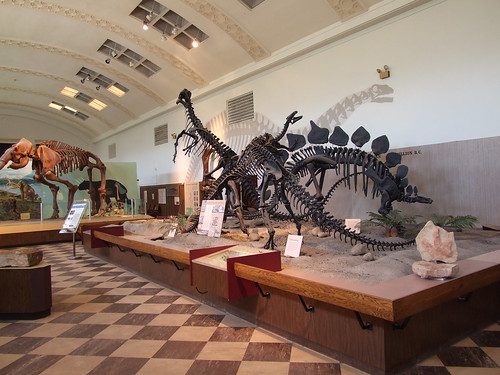
4. Utah Museum of Natural History Dinosaur Exhibit


source

UMNH has a wonderfully diverse range of dinosaur specimens, mostly from the Late Jurassic period. Many of its fossils were found in the Cleveland Lloyd Dinosaur Quarry in Emery County, Utah, which possesses the densest concentration of Jurassic fossils in the world. The latest additions to its stunning collection are two new species of iguanadonts—a Hippodraco and an Iguanacolossus. Iguanadonts are large, beaked, herbivorous dinosaurs from the Cretaceous period. The skull of the Hippodraco will be on display at UMNH early next year.

5. Smithsonian Institution National Museum of Natural History


The Smithsonian is the veritable granddaddy of American dinosaur exhibits. It dinosaur collection was begun way back in the 1850s. Some of the museum's more interesting and complete dinosaur fossils are its Triceratops, which was for a long time one of the most complete fossils of its kind in the world, its tyrannosaur Gorgosaurus, and a saurapod, Diplodocus.

By-line:

This guest post is contributed by Alvina Lopez. She welcomes your comments at her email Id: alvina.lopez @gmail.com.

Monday, November 8, 2010

Monday Ground Up: Isla Del Sol


Isla Del Sol at Lake Titicaca in Bolivia is said to be the location where the sun and moon were born. There are 180 archaeological ruins on the island, all of which have a story and quite a history.

Where Is Isla Del Sol?

Isla Del Sol is located in Lake Titicaca in the Altiplano region of Bolivia and lies close to 12,506 feet above sea level. The island is divided into three parts, with Yumani in the south, Ch’alla in the east, and Challapampa in the north. Isla Del Sol measures 5.5 square miles and takes close to three hours to cross on foot. There’s no cars for transport.

Friday, October 29, 2010

Professor Ehud Netzer: Died Thursday After Fall At Archaeological Site


In, 2007, Professor Ehud Netzer discovered the famed site of King Herod. On Monday, Netzer fell six meters after a wooden bean collapsed. He was admitted immediately to Hadassah University Hospital, suffering a fractured skull and neck vertebrae

Professor Netzer, considered one of the most senior researchers on
Herod, has been excavating at the Herodium site south of Jerusalem
since 1972 in efforts to identify the burial site of the King of the
Jews. Netzer continued his active participation in the excavations
following the discovery, despite reaching the age of 76.

Netzer died Thursday after succumbing to wounds at the Tomb of King Herod. Ancient Digger would like to extend our sincere condolences to his family. It's a great lose to the community and to the field of archaeology.

In a statement, Prime Minister Benjamin Netanyahu said "Netzer's tragic death is a loss for his family, for research into the heritage of Israel and for archaeology."

Source and Quotes: Haaretz
Picture: Wikipedia

Thursday, October 28, 2010

Archaeology News: Thursday October 28, 2010


Paleontologists have revealed the earliest known African anthropoids found to date - three previously unknown kinds of the primates from Dur At-Talah in central Libya that apparently date back 38 million to 39 million years ago. The diversity and timing of the new anthropoids raises two scenarios. Anthropoids might simply have emerged in Africa much earlier than thought, and gone undiscovered by modern paleontologists. Or they could have crossed over from Asia, where evidence suggests that anthropoids lived 55 million years ago, flourishing and diversifying in the wide-open ecological niches of an anthropoid-free Africa.

Niah Caves Should Be A World Heritage Site. The Niah Caves, located some 120 kilometres from Miri city, should be another world heritage site in Sarawak for its uniqueness, Chief Minister, Tan Sri Abdul Taib Mahmud said here.

Italy: DNA tests may reveal true fate of Sicilian 'Robin Hood'. - The tomb of one of Italy's most legendary bandits was due to be opened on Thursday in Sicily to gather forensic evidence that will either fuel or put to rest suspicion that the body inside doesn't match the name on the sarcophagus: Salvatore Giuliano.

Archaeologists solve mystery of Silbury Hill (maybe) It is one of England's most mysterious monuments. Just a short walk from the massive stone circle complex of Avebury, Silbury Hill is a giant, flat-topped mound rising 120 feet above the surrounding countryside. Researchers have proposed dozens of theories over the years to explain its purpose, suggesting everything from a giant burial mound to a platform for religious music. 

Archaeologists find pre-historic migrants "This is of great regional significance, and it will generate national interest", said Edward Biddulph, senior project manager with Oxford Archaeology which conducted the dig.

Cornell Archaeologist Makes Neolithic Era Discovery. A project led by a Cornell professor is helping to re-write the early prehistory of Cyprus, the island nation in the eastern Mediterranean Sea. By taking a new approach to examining human civilization, Prof. Sturt Manning, classics, and his team of undergraduate and graduate students from Cornell, the University of Toronto and the University of Cyprus, have uncovered new evidence that agricultural settlements had been formed up to half a millennium earlier than previously believed. 

Ayodhya verdict based on ASI report: Archaeologist. The Lucknow bench of the Allahabad High Court relied heavily on  the ASI report  in its verdict on the Ram Janmabhoomi-Babri Masjid dispute, says Dr AK Mishra, one of the three observer-archaeologists appointed by the high court for their vigil during the excavation by ASI at the disputed site in Ayodhya.

Tuesday, October 26, 2010

Top Archaeology News: Tuesday October 26, 2010


An Armenian archaeologist says that scientists have discovered a skirt that could be 5,900-year-old. Pavel Avetisian, the head of the Institute of Archeology and Ethnography in Yerevan, said a fragment of skirt made of reed was found during recent digging in the Areni-1 cave in southeastern Armenia.

Learn what archaeologists found under and around the 263-year-old house of the Rev. John Hancock in a program to be held Sunday afternoon at Buckman Tavern in Lexington.

Silbury Hill mysteries are unravelled in new book.

Egyptian pyramids are one of the seven wonders of the world. However, a study conducted by UK’s Truprint Photo Company, a digital photo printing service, has also revealed that Egypt’s Giza Pyramids are photographed the most by British tourists.

The mausoleum was created about 2,200 year ago and served as a tomb for Qin Shi Huang – the first emperor of China. While the emperor’s tomb is largely unexcavated, archaeologists have found thousands of life-size terracotta figures nearby. It’s believed that this army was created to serve the emperor in the afterlife.

The Shakers were known for their simple, economical ways. But as archaeologists discovered Monday, even their dirt was clean. 

Click on the links for more information and the full story. Have a wonderful week from Ancient Digger!

Saturday, October 23, 2010

Top Archaeology News: Saturday October 23, 2010


A team of Chinese archaeologists dedicated to the excavation and study of the world famous terracotta warriors in northwest China's Xi'an City on Friday received the Prince of Asturias Award for Social Sciences in Spain.

Archaeologists have found remains of five females who may have been ritually sacrificed in a 1,400-year-old flat-topped pyramid in the Lamayaeque region's southern Jequetepeque Valley.

Her life has been celebrated in song, story and a Disney cartoon, but no one knew where Pocahontas tied the knot with a tobacco farmer—until now.

Archaeologists unearth 10,000 year old camp site along US/Canada border. A team of archaeologists has spent the last several weeks gathering and collecting artifacts along the banks of the Saint Croix River on property owned by the federal government behind the U.S. Customs Port of Entry in Forest City.

Hundreds gathered for the annual meeting of the North American Sea Glass Association, to celebrate a hobby that seems an odd mix of amateur archaeology, environmental monitoring and antique collecting, with a little chemistry thrown in. 

The discovery of starch remnants on stone tools indicates that our ancestors were making flour out of starchy roots 30,0000 years ago. Karen Hopkin reports.

Russian Submarine SC-213 discovered by divers from Black Sea Wreck Divers near the coast of Constanta, Romania (Black Sea)

A group of archaeologists from Queensland University have discovered the oldest known high altitude human settlement.

Click on the links for more information and the full story. Have a wonderful weekend from Ancient Digger!

Friday, October 22, 2010

Top Archaeology News: Friday October 21, 2010


Groton's rolling hills are vestiges from ice-age glaciers of long ago. Life was non-existent until the age of glaciations ended and five-thousand feet of ice in our region slowly melted, approximately 15,000 years ago.

Magdeburg, Germany - Hundreds of Germans paid their last respects Friday to an English queen born 1,100 years ago, during a reburial ceremony in the cathedral of the eastern city of Magdeburg.

Peruvian archaeologists have unearthed four perfectly preserved mummies at an ancient burial site in the capital city, Lima.

More skeletal remains been uncovered at the Gisborne District Court extension site.

A 400-year-old village of 10 longhouses has been uncovered in Ontario, on the banks of Strasburg Creek. Some artifacts from the site are even older, dating back 4,500 and 9,000 years. “The descendants of the people from that site are now among the Six Nations today,” said contract archaeologist Paul Racher. ~Archaeology News


After yesterday's site visit, archaeology team says passageway is around three centuries old; blueprint of GPO building may be available at British Library in the UK

Many ancient artifacts have been curated at the Sunshine Coast Museum, but very little information exists around the meaning and function of these items.

Thursday, October 21, 2010

Top Archaeology News: Thursday October 21, 2010


Most victims of Mt. Vesuvius' massive eruption in 79 AD probably died from thermal shock, rather than the previous generally accept theory of suffocation, according to a new study.

Nearly 3,000 of those once-buried treasures are kept at the Siegfried H. Horn Archeological Museum & The Institute of Archeology at Andrews University just outside Berrien Springs.

The University of Winchester’s archaeological excavations at St Mary Magdalen, on the outskirts of Winchester, have revealed evidence for what may be Britain’s earliest known hospital.  

It has been 100 years since excavations started on the Madinat Al Zahra, the magnificent 10th century palace city near Cordoba in southern Spain.

Archaeologists think they've found the site of a cabin that belonged to southern Oregon pioneer photographer Peter Britt

The mummies of a woman and three children from the Huari culture have been discovered in Lima, Peru, in an intact tomb at the top of a pyramid. The tomb is estimated to be 1,150 years old.  ~Archaeology News

East Contra Costa road work unearths more Indian graves. Shea Homes construction crews have found 30 sets of human remains over the past couple of months while widening a stretch of Marsh Creek Road just west of where it intersects the Highway 4 bypass.

Cornell archaeologists are helping to rewrite the early prehistory of human civilization on Cyprus, with evidence that hunter-gatherers began to form agricultural settlements on the island half a millennium earlier than previously believed.


Make sure you click on the links for the entire story. Have a great day and thanks for visiting Ancient Digger.

Wednesday, October 20, 2010

Top Archaeology News: Wednesday October 20th, 2010


Archaeologists and Middle Tennessee State University students believe the remains of a mastodon are behind a Franklin home, about 20 miles south of Nashville. Mastodons are prehistoric, elephant-like creatures, believed to have weighed up to 12,000 pounds.

Swiss archaeologists find 5,000-year-old door that may be one of the oldest ever found in Europe.

Egypt's top archaeologist has shown off a newly discovered tomb of a pharaonic priest, a find he says could point the way to a new necropolis to be excavated near the famed Giza pyramids.

When freelance artist Ben Wood and archaeologist Eric Blind heard about a hidden 18th-century mural at Mission Dolores in 2004, they wanted to see it. With permission from the church, they lowered a camera into a 3-by-3-foot trap door in the attic.

One of the stars of the Oriental Institute’s new show, “Visible Language: Inventions of Writing in the Ancient Middle East and Beyond,” is a clay tablet that dates from around 3200 B.C. On it, written in cuneiform, the script language of ancient Sumer in Mesopotamia, is a list of professions, described in small, repetitive impressed characters that look more like wedge-shape footprints than what we recognize as writing.


This Thursday evening, Oct. 21, Verde Valley residents will have their first opportunity to hear about the recently proposed Verde Valley Archaeological Center, during the monthly meeting of the Verde Valley Chapter of the Arizona Archaeological Society.

A World War II-era bomb crater was spotted in Darwin, Australia. The city was subjected to 63 bombing raids during the war.

Make sure you click on the links for the entire story. Have a great day and thanks for visiting Ancient Digger.

Friday, October 15, 2010

University of Chicago Oriental Institute: The Sea Of Galilee Boat


From peg mortise-and-tenon-joinery, weather-cocking, and a full and fascinating explanation of ship construction, Shelley Wachsmann from Texas A&M University lectures on an ancient boat discovered in 1986.

In 1986, a 2,000-year-old boat was discovered in Israel on the banks of the Sea of Galilee. The vessel is representative of the large fishing boats common on the ancient lake, and the type of boat used in the Gospels by the disciples of Jesus. It is also the type of boat used by the Jews in the brutal nautical Battle of Migdal in AD 67 against a makeshift Roman fleet. The lecture describes the adventure of the boat's discovery and excavation, and delves into the revealing research about the vessel and its milieu.

Like Ancient Digger? Why Not Follow Us?


Subscribe Via RSS Feed Follow Ancient Digger on Facebook Follow Ancient Digger on Twitter Subscribe to Ancient Digger Via Email

Get widget

Search


Ancient Digger Archaeology Copyright © 2015 LKart Theme is Designed by Lasantha