• Ancient Digger teaches Archaeology and History to all Ages!

Wednesday, December 12, 2012

Basilica Dated to Constantine Reign Discovered


© Sascha Hoffmann/sxc.hu
Archaeologists in Bulgaria’s capital city Sofia have found a basilica said to date from the time of emperor Constantine the Great in the area of the West Gate of Serdica, as the city was known in Roman times.

The basilica is 27 metres wide and about 100m long, according to Yana Borissova-Katsarova, head of research at the site. It featured multi-coloured mosaics. Further exploration of the find will be difficult because of its location under the modern city.

Sofia deputy mayor in charge of culture, Todor Chobanov, said that the discovery of the basilica may be proof that Constantine intended to establish the city as a centre of Christianity.

Constantine, who ruled from 306 to 337 CE, was the first Roman emperor to convert to Christianity. Sofia, as Serdica, was under Roman rule from 29 BCE and remained under Roman and later Byzantine rule, with some interruptions because of Hun invasions and destruction, for a number of centuries.

Serdica is said to have been described by Constantine as “my Rome”. Chobanov said that the discovery of the basilica suggested that this saying attributed to Constantine was “not just words”.

The area around the West Gate of Sofia is being studied by archaeologists as part of a programme being funded mainly by Sofia municipality.

Sofia mayor Yordanka Fandukova said that there were plans for a garden and park in the area which would enable visitors to view the discoveries at the archaeological site. This project should start in 2013 and be completed within two years, local media quoted the mayor as saying.

Borissova-Katsarova, a professor at Sofia University, said that the archaeological project at the site was a continuation of excavations done between 1975 and 1980. The current project is a partnership between the municipality, the university and the Bulgarian Academy of Science.

Work at the site has resulted in the uncovering of the wall, a gate and tower. The gate was said to date from the fifth to sixth century CE, and the tower from the sixth. The wall was initially built in the second century by emperor Marcus Aurelius and was later expanded and strengthened. The foundations, two metres deep, suggest that the wall about eight to nine metres high.

She said that excavations had found that Serdica had been a very well developed town in terms of irrigation and sanitation. Archaeologists had found pipelines for fresh water.

Archaeologists had found the Via Militaris, the street used mainly for military purposes and leading to the city wall. Most of the artifacts found at the site were related to everyday life, such as coins.

Source: Sofia Globe

Monday, November 29, 2010

Monday Ground Up: Putna Monastery In Bukovina, Romania


Putna Monastery took three years to build on land bordering the Putna River in Bukovina River. Construction of the Romanian Orthodox monastery was overseen by Prince Stephen the Great, ruler of Moldavia from 1457 to 1504.

Prince Stephen the Great was the son of Bogdan the Second and was considered by many to be one of the best  army commanders of all times. Prince Stephen was a genius in politics and was a great promoter of Romanian culture.

Saturday, September 18, 2010

Photography of Dunkeld Cathedral in Scotland


Dunkeld emerged as a centre of Christianity during the 7th Century, when Columba came over from Iona, and much work was carried out by his successors. In the 9th Century, Kenneth MacAlpin, the first King of Scots, made Dunkeld head of the Celtic Church and capital of the newly-formed nation created by the union of the Scots and the Picts.


Dunkeld Cathedral sits on the north bank of the River Tay in Dunkeld, Perth and Kinross, Scotland. Built in square-stone style of predominantly gray sandstond, Dunkeldt stands on the site of the former Culdee Monastery of Dunkeld.


The Church grew in power and wealth and the Cathedral, started in 1325, was extremely important in ecclesiastical terns until the Reformation in the 16th Century, when it was destroyed.


The Choir of the Cathedral was re- roofed in 1600 to serve as the parish church, and there was relative peace until 1689, when there was a short, but extremely violent Battle between the Jacobites and the Cameronians (a newly-raised regiment supporting William of Orange) and most of Dunkeld was burned to the ground. ~History of Dunkeld By DunkeldCathedral.Org


Want To See More of Landon Walker's Work?


Resources:

All images © Landon Walker

Ancient Digger secured copyright privileges from the photographer prior to publishing.

Copyright : Images are subject to copyright and may not be used without consent of the photographer. Images copied off Ancient Digger are monitored and can be traced, so please keep this in mind.


Wednesday, October 28, 2009

The Life of Monks and Nuns


The life of a monk or a nun can be quite sheltered and lonely, although the people that choose to partake in this type of existence have made a choice to forgo all material or social aspects of a humane society. Monks during the time of early medieval society chose this position for spiritual purposes, not aware that their new practices would establish new ideals, the act of moderation and communal life was also being practiced, and women were choosing to dedicate themselves to God thus becoming nuns.

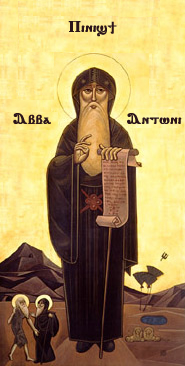
Christian monks practiced the life of a solitary man who sections himself off from society to pursue spiritual aspects of the Christian world. Saint Anthony was one such man who had forsaken all of his possessions to join the monastery, giving all of his land to the poor. Additionally, Saint Simeon lived atop a 60 foot pillar for three years, whereby establishing or setting an example for a new Christian ideal. The new Christian ideals modeled by the monks were clearly different that what earlier Christians had practiced, allowing themselves to be dead to the world and achieving a spiritual life through the denial of common social factors.

Eastern monasticism had a large influence of strict moderation, however due to the beliefs of Saint Benedict, moderation did not preclude a hard and disciplined existence, rather a life of obedience to God. Benedict rules stated that all monks were to complete some type of physical labor every day, as well as pray up to 7 times a day. The Benedictine life stressed community, whereby the monks ate, worked, slept, and worshiped together. Under the rules of Saint Benedict, the vow of poverty was also taken to stress that fact that all must be equal, and overindulgence is unnecessary.

Women during the early medieval middle ages were also trying to find ways to withdraw from the world and dedicate themselves fully to God. During the third centuries women had communed in the deserts of Egypt and Syria, however the first rules for western women weren’t produced until the fifth century. The organization was both rigid and tightly sanctioned to protect the women from outside danger. It wasn’t until the 8th and 9th centuries that both monks and nuns were established in double monasteries allowing then to reside in close proximity and follow the same set of rules.

Monks not only became the heroes of Christian civilization because of their dedication to God, but they also played a significant role in spreading Christianity all over Europe in the way of missionaries and the construction of churches. This in itself allowed for a common worship area for local Christians, spreading the words of God to all who would listen.

Wednesday, July 8, 2009

Polyphonic Musical Composition at Notre Dame


In the central portion of Paris, France there lies an island in the middle of the river Seine. There you will find the huge Cathedral at Notre Dame which was built around 1200 AD. NotreDame is one of the most magnificently architectural locations in all of Europe. It's also a focal point for the first polyphonic music, created in honor of Notre Dame's completion.

In the 12th and 13th centuries, Notre Dame was the focal point of polyphonic music. Polyphony is a texture consisting of two or more independent melodic voices, as opposed to music with just one voice (monophony) or music with one dominant melodic voice accompanied by chords (homophony).

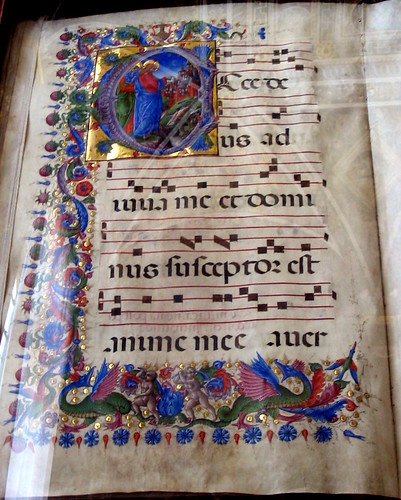
The earliest written sources of music were medieval manuscripts of the late 9th century that contain liturgical texts. Small symbols were used called “neumes that indicated the contour of the melodic lines.

The Cathedral of Notre Dame

 © source

In honor of the construction of this massive structure, two composers created the first polyphonic music in the history of Western music. Leoninus was the eldest son and originally started the collection of polyphonic music that was composed for Notre Dame, adding to the collection by extending the range and scope of the music.

Magnus Liber Organi


The polyphonic musical pieces were made into a compilation of medieval music called the Magnus Liber Organi (Latin for "Great Book of Organum"), known as organum.

Viderunt Omnes


The most famous of the musical compositions was the fourth part of Viderunt Omnes by Perotinus, based on the plainchant of the same name. This chant was meant to be played in the middle of Mass services on Christmas Day.

The most incredible aspect about this musical piece by Perotinus is that, it is built entirely on an ancient structure of musical composition. In addition, the voice parts of the composition were sang entirely by monks or priests.

The evolution of harmony began in the 10th century and it made its way all over the country and the entire world. Not only would your favorite harmonical songs be nonexistent if not for this invention, but our lives would be filled with monophonic music lacking instrumentation and including the voices of monks in unison.

Like Ancient Digger? Why Not Follow Us?


Subscribe Via RSS Feed Follow Ancient Digger on Facebook Follow Ancient Digger on Twitter Subscribe to Ancient Digger Via Email

Get widget

Search


Ancient Digger Archaeology Copyright © 2015 LKart Theme is Designed by Lasantha