• Ancient Digger teaches Archaeology and History to all Ages!

Saturday, December 31, 2011

A Film Unfinished: The Making of a Nazi propaganda film


Last semester I watched several documentaries and films including the "The Kings Speech", "The Linguists", "The Ax Fight", "The Birdcage", amongst many others. Documentaries allow use to gain a perspective through the eyes of the filmmaker. It's true. Sometimes there is an agenda, yet sometimes, the footage is entirely raw and leaves you feeling a bit uncomfortable and perplexed. This is certainly my reaction to the documentary, "A Film Unfinished".

A Film Unfinished, by Yael Hersonski, explores the making of a 1942 Nazi propaganda film of the Warsaw Ghetto two months before its liquidation, in a Nazi operation known as the Grossaktion Warsaw. It premiered at the 2010 Sundance Film Festival, where it won the "World Cinema Documentary Editing Award".


The footage is highly disturbing.  Hitler had an extensive collection of these propaganda films stashed in what appears to be a vault. It's ironic really that so much was documented, and yet, so many individuals still question the validity of the events that occurred under Hitler's turbulent reign. In this lost footage, the Nazi's have presented their subjects in such an odd way. It looks staged to be honest. They've made these people look like they were carrying on everyday tasks, not bothered by their condition of living. Pulled in rickshaws to local shops for goods and dancing on the streets.

A Jewish Council was set up in the Ghetto by the Nazis, just like it had always been done before. Adam Czerniaków, the head of the Jewish Council, was set up in the inside, to manage what was essentially "a holding pen" for the final destination. He wrote extensively about his role in the film, documenting the details in his journals.

The documentary also features many of the survivors, watching the footage in a theatre, and sighing at the staged antics of the Nazis.

One survivor remarked, "I keep thinking that among all these people I might see my mother walking".

Germans would often show up in the Ghetto, "usually for unpleasant reasons and usually shooting.  So when they were filming it was much more positive". 


For years, the identity of the filmmakers went undiscovered, until a lead in the 1960's lead to the name Willy Wist. Willy was one of the cameramen for Das Ghetto, but he took great pains to cover his tracks.

If I had to chose one scene or one moment in the film that stopped my heart, it was the filming of the cookies on a neatly placed tray, in the middle of a feces pile. Starving residents were handed cookies in their bed, and you could plainly see, they were near death. Starving. The sight of a cookie was all together surprising. Another facade of this staged propaganda film.


It's difficult to watch A Film Unfinished and not have an immediate reaction to the footage. You may remember where you were the day the events took place. You may have even had relatives there at the time. This is a film that certainly demonstrates a false sense of security.


If you'd like to watch A Film Unfinished, it's available on Netflix for streaming. It's also available for sale on Amazon.

Credits

Film by Yael Hersonski
Edited by Joelle Alexis

Monday, September 5, 2011

Islands at the Edge of the World – the Canaries Before the Conquest AD


Monday Ground Up Special Edition By Wozniacki


September 4, 2011--Say 'Canary Islands', and most Europeans will have 'all-year-round holiday destination' leap into their minds. For many Americans, the scary phrase 'mega-tsunami' may be conjured up – courtesy of worries that the island's unstable volcanic slopes will one day collapse. But for all their modern-day familiarity as holiday-destinations – or harbingers of doom – when looked at historically, the Canary Islands were always an exotic outpost right on the edge of the map.

Up until 500 years ago, cartographers would draw a line just west of these tiny volcanic fragments, and place on it the label 'here be monsters' – capturing the unknown essence of the oceans stretching westwards off of the map. But although right at the geographic limits of the Old World, for thousands of years, the Canary Islands have been anything but short of history. Before the Spanish planted Castile's flag – as part of their Conquest of the islands in the 15th century – Berbers, Romans, Arabs and even Greeks, may have come to explore these fascinating outposts.

The inhabitants the Spanish found living on the islands when they arrived in 1402, were described as from a different, more primal era. Labeled 'Guanches', the debate has raged ever since their origins. Some had them down as Phoenicians sailors and traders, others as prisoners abandoned by King Juba II of Numidia, back in 100 years BC. But DNA evidence has now conclusively pointed to the original Guanches as being of Berber-descent – an ancient people who lived in the North African mountains.


© R. Liebau (Reconstruction of a Guanche village Tenerife).


The first archaeological evidence left by the Guanches suggests that they arrived sometime before 1000 BC. They bought with them domesticated animals, such as sheep, goats and dogs, as well as grain crops from North Africa – suggesting that theirs was a settlement with a purpose. What is strange is that, for all their sea-faring skills in having to reach the islands – strong currents ensure it is very difficult to make landfall on the Canaries from North Africa. They had lost all ability to sail, even between islands, by the time the Spanish arrived on the scene.

But the ancient world certainly could, and did, reach them. Many think that the home of the nymphs who dwelt in the Garden of the Hesperides, from Greek legend, could have been on these very islands. The first reference in history, though, comes from the Romans. The famous Roman writer, Pliny the Younger, described them as being 'discovered' by the Juba II, King of Numidia, in the first century BC. He had sent an expedition from the dye-making port of Mogador in western Morocco, to explore the islands – perhaps drawn by the peak of Mount Teidu, which is clearly visible from the African coast.
His visit also gave rise to the name of the islands – Islas Canarias. By Pliny's account, Juba II found that the island peoples made use of particularly fierce dogs. So he called them the Islands of the Dogs, canis being the Latin for dog. Archaeologists have since found evidence that the Romans themselves visited on several occasions. Off of the coast of Lanzarote, Roman amphorae, for carrying wine and oils, were found at the site of a shipwreck. And excavations on the same island have found Roman pottery fragments, pieces of glass and metals – all dating to between the 1st and 4th Centuries AD. The Arabs too came to trade with the Guanches.

It appears that these earlier visitors left the peoples of the Canary Islands to themselves – unlike the Spaniards who arrived later. But what was life like for these original peoples? Archaeologists reckon that they lived quite simple lives, from a material point of view at least. Goat, sheep and pigs were all kept, they grew crops on small plots, and lived mostly in caves, or small round stone-huts. But spiritually they had a quite a sophisticated religious world, with a pantheon of deities, spirits and demons. Many gods were acknowledged, relating to the Sun and the Moon, the rain and the mountains. And no observer of the strangely compelling stone-carved hieroglyphics can fail to be touched by the Guanches deep connection to the lands they inhabited.

Politically, there was a definite diversity of approaches taken across the islands. In Gran Canaria, an hereditary autocracy appears to have held sway – but power was passed down through the mother's side of the family. Tenerife was split into 9 small kingdoms ruled by a 'Mencey', as the kings were known, whilst other islands are though to have elected their leaders. It was this cultural and political fragmentation that may ultimately have led to their downfall, however.

The Castillan adventurers who arrived from Spain were superior in both arms, and guile. One by one, each island and kingdom was subjugated in a campaign of violence, that exploited the differences between the different groups. But to their credit, these island peoples did fend off the Spanish Conquest for a century, with little more than Neolithic weapons of stone and wood. That is something that many other indigenous groups in the Americas would find hard to emulate.

And the Guanches are still here. Forgetting all the death, disease and slavery at the hands of their Conquistadors, DNA evidence shows that 10-35% of the genes of islanders comes from the Guanches. It would seems that today's Canary Islander is deeply connected to the original habitants of these fabled isles.


Saturday, June 18, 2011

Dr. Beach Explains The Crazy World Of Leonardo Da Vinci


Most of us appreciate, yet question, Leonardo da Vinci's mind frame and where his bizarre inventions came from. Leonardo da Vinci may have solved the riddle of earthshine, but he was a devious and cunning individual and a known prankster, who also ventured into the unknown with his fascinating war machines and mechanical puzzles.

Dr. Beach over at Beachcombing's Bizarre History Blog always gives readers a new perspective on the past.

Beachcombing thought that today he would share Leonardo’s attempt to build a tank four hundred years before the Cambrai front was swarming with them. How would these fascinating inventions actually work? Well, like mice churning butter or gerbils running on wheels, men would have turned cranks to provide mobility: while their colleagues loaded the canons that were mounted there.

Read More: Jousting with Medieval Tanks

Sunday, May 22, 2011

The Skull of the Mysterious Mona Lisa Discovered?


The Mysterious Mona Lisa, the mystifying women painted by Leonardo da Vinci, is a painting of legends and myths. Some say the picture is actually Leonardo himself, with a slight varition in sexual orientation that is.

Today, the skull of a women rumored to be the model for Leonardo da Vinci’s Mona Lisa may have been unearthed. A “female-sized” skull was discovered in the burial grounds under the St. Ursula convent in Florence on May 19. Researchers are searching for the bones of Lisa Gherardini Del Giocondo, the wife of a rich Italian silk merchant who has long been rumoured as the famous painting’s muse.

“We don’t know yet if the bones belong to one single skeleton or more than one,” controversial art sleuth Silvano Vinceti, who is in charge of the dig, told the Austrian Times.

“But this confirms our hypothesis that in St. Ursula convent there are still human bones, and we cannot exclude that among them there are bones belonging to Lisa Gherardini.”


Edited From Toronto Star

Thursday, March 17, 2011

An Irish Blessing and Otherworld Story For St. Patrick's Day


One of my most precious pieces from my grandmother is an Irish Blessing encased in an old golden cloth-like frame, with the glass so old, the dust hast clung to it without repeal. I happened to peer at the words today and remembered a time when things were simple.  days were spent watching the horse races with my grandfather and the smells of pierogies and or clams and spaghetti filled the air.

On this special day, I'm wishing you all, with even a smidgen of Irish in you, a Happy St. Patrick's Day!

“May the road rise up to meet you, may the wind be ever at your back. May the sun shine warm upon your face and the rain fall softly on your fields. And until we meet again, May God hold you in the hollow of his hand.”

Here's a bit of Irish history, or rather a favorite tidbit of mine, which I published back in 2009, but I found it was quite appropriate for this special holiday.

The Irish Celtic Otherworld

Caesar believed that the Celtic Druid's of the Otherworld preached immortality of the soul, and it would allow them to be fierce warriors. However, many believe that their souls migrate to different vessels, allowing them to live for centuries.

This belief of reincarnation is quite different than Hinduistic rituals where reincarnation affected all those that were worthy. The druids believed that their souls, even when they were long gone, would be able to control their body in the otherworld.

The otherworld was believed to be a place where men and women lived in complete happiness in a land that was lush and plentiful. Not to be confused with the underworld which was filled with pale wanderers and gloomy landscapes.

During the 17th century, poets painted the otherworld as a "Land of the Living", where beautiful woman are plentiful and bright birds fly with ease through the river valleys. Once there, you will overcome all. However, when you leave, your hair will turn gray and your skin will shrivel.  

Interestingly enough, when you take note of the lyrics of Irish verse or musical expressions, it’s reaped in color and descriptions of green pastures and marvels of beauty.


Source

It was said to be a world within a world below the ground or under the sea, as was the land of Atlantis. A paradise where one never aged and all that resided were completely equal of value and importance, as was the fountain of youth.

Cave of Cruachan


Source

Rathcroghan


Source

There were passages to enter, or rather secret portholes only allowed by the insight of your mind. The Cave of Cruachan was a possible entrance referenced in the story of Nera’s Adventure.


Source

The otherworld is not free of aggression or war, for many Irish and welsh tales tell of the conquering of Kings or the kidnapping of precious treasures.

In the tale of the Adventure of Laegnaire, a man appears out of mist before the King of Connacht asking for assistance to claim his wife who he has lost in a battle. The son of the King sets out with 50 men to overcome his enemies and reclaim the mans wife. He returns the wife to the King, although he leaves immediately because his men have taken wives from Magh Da Cheo(The Plain of the Two Mists-name given to the otherworld by the Irish) and they wish to stay there to avoid the mortal world.

Newgrange


Source (Dwelling of the Divine Oenghus)

The otherworld has also been clearly referenced as an abode in the Irish countryside where it welcomes limitless guests to feast on whatever they desire. Food is often refurbished by reincarnation. This picture of obscurity is often compared to the “Land of the Dead”.

In the story of the “Destruction of the Hostel of Da Derga”, King Conaire is drawn to a house “bruidhen”, however on his way there he meets the three “Reds”. Their steeds are of the Donn Detscorach from the otherworld. This confirmed that Derga and Donn were one being, the “God of the Dead”, and he who enters his abode is either foredoomed or dead already.

The Feast of Samhain, which happened on the 1st of November was initially where this sombre image of death predominated.


Source

The duration of the Samhain celebration according to the Celts was filled with a peculiar supernatural energy and within that they have concentrated many of their mythical events. During this time, the universe is suspended and all things supernatural and natural have no barriers. There is a “Sidn” that remains open for spirits to move freely amongst the living, sometimes with hostility. Mortals are strongly urged not to venture within its precinct.

In the “Spoils of Annan”, it tells of a rather disastrous expedition by Arthur and his knights. The world becomes a fortress of glass where none of the occupants have a response, and in Celtic traditions this is surely the mark of the dead.

The otherworld has not been widely accepted by scholars with the inconsistencies in the history and the folklore. The belief that only kings and nobles were able to access a world of music and fables and ordinary men were far from it’s reaches being less fortunate in the afterlife, was always questionable.


Tuesday, November 9, 2010

German archaeologists recover Nazi-era ‘degenerate art’


Subway workers and archaeologists in Berlin have discovered a trove of early 20th-century art that was thought to be destroyed by the Nazi regime.

Workers building a new subway line in the German capital stumbled onto the remains of sculptures that were part of a list of ‘degenerate art’ the Nazi regime deemed too Jewish or un-German.

No one is entirely sure how the sculptures survived Nazi propagandists and the Second World War, although there is speculation that an anti-Nazi Berliner saved the works  from destruction. Der Spiegel also has a photo gallery of the works which are now housed in Berlin’s Neues Museum.

Read the entire story about  German archaeologists recover Nazi-era ‘degenerate art’


Monday, September 20, 2010

Monday Ground Up: Archaeological Discovery of Viking Artifacts Reveals Facts about Ancient Society


Guest Article By Maria Rainier


Scientists working in Norway’s Jotunheimen mountain range have been reaping the benefits of climate change, taking advantage of warmer conditions to make an exciting archaeological discovery whose implications may help to reconstruct the region’s ancient society.

With glaciers melting quickly enough to reveal layers of ice that have never been exposed before, it’s an archaeological opportunity almost too much to handle. Artifact collection in frozen areas is a delicate process which often requires finding an artifact within a few days of its emergence. The artifact must then be carefully removed, transported to a laboratory, and frozen to keep it from disintegrating. This is especially true of any type of fiber (clothing, rope, and thread), animal skins, feathers, or hair, while wood takes a few years to rot and is easier to manage for archaeologists.

The Viking artifacts being discovered in Norway are predominantly wooden hunting weapons, but archaeologists are still struggling to collect all specimens before they start to fall apart.

Artifacts from Viking Hunters

Archaeologists are quickly learning more about Viking reindeer hunters based on the tools they’re finding in the mountains. The most commonly discovered artifacts are part of an innovative scare tactic meant to drive reindeer toward hidden batteries of Viking archers. This scare tactic involved creating a barrier of wooden stakes spaced about 6 ½ feet apart. Each stake had a foot-long piece of wood tied to its tip so any gust of wind would cause the entire row of stakes to start “flapping,” scaring reindeer toward the waiting Viking hunters.

Most of these archaeological discoveries are incomplete, missing the thread which tied the moving pieces to the stakes, but scientists are hoping to find some intact as they increase their efforts. Bows and arrows and a leather shoe have also been found at the Jotunheimen sites.

Reconstructing Norway’s Ancient Society

According to Norse mythology, the Jotunheimen mountains were inhabited by the “Ice Giants,” also called Frost Giants or Jötunn (Jotunheimen means “home of the giants”). While they may have been tall in stature, these “giants” weren’t the superhuman entities of lore.

What archaeologists do know about them is that they had an organized society, a conclusion drawn from the way Vikings would have cooperated to create the stake barriers for reindeer hunting. Scientists hypothesize that they hunted in groups of 15 or 20, lying in wait together with their bows and arrows until the frightened reindeer ran within about 65 feet of them. This implies that Norway’s ancient society was characterized by hierarchy, as leadership would have been a necessary part of organizing and executing a collective hunting strategy. The prolific Jotunheimen sites are likely to offer more insights into this ancient society and scientists are working to make more meaningful archeological discoveries.


Bio: Maria Rainier is a freelance writer and blog junkie. She is currently a resident blogger at Online Degrees, researching areas of online colleges. In her spare time, she enjoys square-foot gardening, swimming, and avoiding her laptop.

Sources:

Photo: Marcin Szala, used with permission

Saturday, September 18, 2010

Photography of Dunkeld Cathedral in Scotland


Dunkeld emerged as a centre of Christianity during the 7th Century, when Columba came over from Iona, and much work was carried out by his successors. In the 9th Century, Kenneth MacAlpin, the first King of Scots, made Dunkeld head of the Celtic Church and capital of the newly-formed nation created by the union of the Scots and the Picts.


Dunkeld Cathedral sits on the north bank of the River Tay in Dunkeld, Perth and Kinross, Scotland. Built in square-stone style of predominantly gray sandstond, Dunkeldt stands on the site of the former Culdee Monastery of Dunkeld.


The Church grew in power and wealth and the Cathedral, started in 1325, was extremely important in ecclesiastical terns until the Reformation in the 16th Century, when it was destroyed.


The Choir of the Cathedral was re- roofed in 1600 to serve as the parish church, and there was relative peace until 1689, when there was a short, but extremely violent Battle between the Jacobites and the Cameronians (a newly-raised regiment supporting William of Orange) and most of Dunkeld was burned to the ground. ~History of Dunkeld By DunkeldCathedral.Org


Want To See More of Landon Walker's Work?


Resources:

All images © Landon Walker

Ancient Digger secured copyright privileges from the photographer prior to publishing.

Copyright : Images are subject to copyright and may not be used without consent of the photographer. Images copied off Ancient Digger are monitored and can be traced, so please keep this in mind.


Tuesday, August 24, 2010

Neville Hall: Centre of the Northern Coal Trade


Guest Post By Michael Johnson

The North of England Institute of Mining and Mechanical Engineers was founded in Newcastle in 1866. The renowned engineer Robert Stephenson bequeathed £2000 towards the building of a permanent home for the Institute. A site was purchased in 1867 and building commenced in 1869. Designed by Archibald Matthias Dunn (1832-1917), Neville Hall is an example of High Victorian Gothic architecture. The building presents two faces, each of three main bays, pivoted around a polygonal turret, with a Venetian balcony projecting from the north front and a wide gable thrusting out at the west. The three storeys are treated as separate compositional elements and the attic storey is arrayed with miniature Gothic dormers.

The building of Neville Hall defined Newcastle as the epicentre of the coal trade, the dominant industry of North East England. Inside the building is the Wood Memorial Hall, a library named after the colliery engineer Nicholas Wood (1795-1865). Wood gained experience of mine engineering at Killingworth Colliery under George Stephenson, and assisted Stephenson in the development of his safety lamp and the construction of the Stockton to Darlington railway. 

In 1844 Wood became manager of Hetton Colliery in County Durham. Over the next two decades he became the pre-eminent colliery engineer on the northern coalfield and in 1862 he was elected first President of the Institute. Wood was a supporter of education for the working classes and built several schools in mining villages across County Durham. He was among a number of eminent men who encouraged Durham University to establish a College of Science in Newcastle, which eventually became Newcastle University. The Wood Memorial Hall is dominated by a shrine-like monument to Wood, with a pristine statue sculpted by Edward William Wyon (1811-85). 


The design of Neville Hall is highly revealing. The choice of architect can largely be explained by nepotism. Dunn’s father, Matthias Dunn (c.1789-1869) was a prominent figure in the history of mining and one of the first government Inspectors of Mines. As a founding member of the Institute he was instrumental in securing the prestigious commission for his son.

The Venetian Gothic style used at Neville Hall had the loquacious support of the famous art critic John Ruskin, to whom the separate compositional layers were evocative of geological strata. Arguably, this made the style symbolically appropriate for a Mining Institute, a body concerned with delving into the earth. Dunn was among the legion of young architects whom Ruskin inspired to tour the continent, and he spent his time sketching examples of French and Italian architecture.


A page from A.M. Dunn’s Notes and Sketches of an Architect, showing his sketch of a church in Bologna dated 26 January 1876.


With its medieval associations, the Gothic style could give individuals or institutions a spurious pedigree by evoking historical lineage. By using this style, the proud, self-made men who dominated the region’s coal trade were deliberately cultivating a group persona as gentlemen and intellectuals. Neville Hall thus promotes an image of historical continuity that was intended to challenge the common perception of the industrial nouveaux riches.


Read More of Michael Johnson's Articles On Architecture


In practice, Queen Anne was an eclectic style incorporating Classical, Flemish and French Renaissance influences. Queen Anne gained support as the Gothic Revival declined in popularity during the 1870s and 80s. The younger generation of ... From: The Queen Anne Style of Architecture

The defining characteristic of Newcastle architecture is the persistence of the Neo-Classical tradition established by the speculative builder Richard Grainger and his forebears. This encompassed the central core of Newcastle, including key emblems of the town’s identity such as the Central Station (1849-50), Town Hall (1858-63, demolished) and Literary and Philosophical Society (1822-5). Neo-Classicism, the revival of ancient Greek and Roman models, was recognised as a fundamental trait of the city’s identity at both local and national level. In his inaugural address as President ... From: Classical Oasis: The Architecture of Newcastle

Much of Le Corbusier’s manifesto Vers une architecture (1923) is dedicated to promoting the architectural virtues of the machine. Often misunderstood, his famous declaration, ‘The house is a machine for living in,’ meant that the guiding principle for architects should be to make the house as well suited to its purpose as was a machine. This reiterated the argument that functionalism was more important than appearance. In order to progress, he believed, it was necessary for architects to abandon the notion of traditional styles and decorative effects: ‘Architecture has ... From: Towards a New Architecture: Le Corbusier's Modernist Manifesto


About the Author


Michael Johnson is a lecturer and academic tutor based in the North East of England. He has a PhD in architectural history, and teaches the history of architecture and design at two North East universities. Read more of Michael Johnson's articles on architecture

Monday, August 23, 2010

Monday Ground Up: Mysterious Crypts..... What They Are, Why They Were Used, and Where Can They Be Found


You may be wondering, what exactly is a crypt? Why were crypts used instead of cemeteries? They have such a foreboding reputation, and in most cases, they may have, however there was reasoning behind this. You and I perceive them as creepy. A room breathing and speaking death. A dungeon in the pits of the abyss we’d rather avoid at night. For those that reside in the crypts, they mean something entirely different.

What is a Crypt?

According to Wikipedia, “In architecture, a crypt (from the Latin crypta and the Greek κρύπτη, kryptē; meaning concealed, private) is a stone chamber or vault beneath the floor of a church usually used as a chapel or burial vault possibly containing sarcophagi, coffins or relics.”

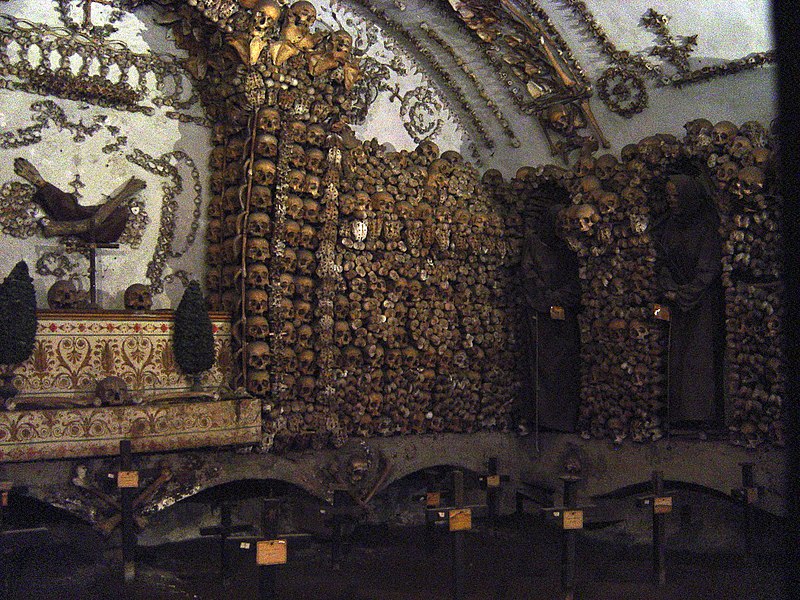
The keyword in this definition is possibly containing, meaning many of the crypts around the world have mummified bodies completely uncovered and in pieces. Hanging on walls. Framing an altar. In some cases, the bones were used for a bannister or staircase. Is this a new form of design? Not exactly.

I believe the bones, and you can tell me if you agree with this, represent the afterlife. They have been left behind, as they served their purpose.

Why Crypts Were Used as Opposed to Cemeteries?

In a practical sense, crypts were used much like cemeteries. To bury the dead. Associations with vampires over the years, however, have cause mixed opinions. This is, of course, because of mainstream media and the Hollywood horror genre in movies and television.

Crypts have been used for centuries for the following reasons:
  • To combat the issue of cemetery crowding, crypts were used.
  • To stop looters or vandals from stealing precious artifacts.
  • To protect the dead from the harsh environment.
  • To preserve a person of significant importance.
  • To furnish an altar only accessible to certain people.
  • To honor the dead.
  • To evoke fear and the possibility of evil, crypts were used.

Personally, I’m a bit fearful of small spaces. Crypts represent the discomfort people feel in the presence of the dead and in small spaces. This proves to you and me, whether we believe spirits are present in these crypts, our human connection with this idea makes us uncomfortable. It’s this idea keeping people away from the crypts. The spirits. The dead. An atmosphere built on a person’s greatest fear.

Where Can Crypts Be Found?

Crypts can be found all over the world in places like:

  • Poland
  • Italy
  • Germany
  • France
  • Switzerland
  • Portugal
  • The Netherlands
  • England
  • Turkey
  • North Africa
  • Romania

Are There Different Types of Crypts?

The answer to the question is yes. There are several types of crypts, those being:

  • Catacombs- are ancient, human-made subterranean passageways for burial or protection. The word “catacomb” is most commonly associated with the Roman Empire.
  • Tombs- a storehouse for the remains of the dead. It’s generally any structurally enclosed interment space or burial chamber, of varying sizes. The word is used in a broad sense to encompass a number of such types of places including: sarcophagi, vaults, rock cut tombs, crypts, monuments, sepulchres.
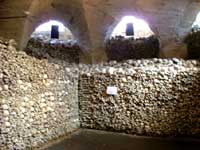
  • Ossuary-a chest, building, well, or site made to serve as the final resting place of human skeletal remains. They are frequently used where burial space is scarce. A body is first buried in a temporary grave, then after some years the skeletal remains are removed and placed in an ossuary. The greatly reduced space taken up by an ossuary means it’s possible to store the remains of many more people in a single tomb than if the original coffins were left as is.
  • Mausoleum-are above ground, free standing buildings, often concrete structures holding family members or one person. A tomb can be found inside a mausoleum.

Four Examples of Crypts Found In Portugal, France, Poland, and Italy


Catacombs of Paris


Catacombs of ParisImage via Wikipedia

You may be familiar with the Catacombs in Paris, which is a series of tunnels, the remnants of France's stone mines, lined with over six million bodies from around the 12th century from the overcrowding of cemeteries during the rise of Christianity. The Catacombs is a form of ossuary, meaning it holds the skeletal remains of humans.

Capela Dos Ossos in Evora, Portugal


The Capela Dos Ossos crypt in Evora, Portugal was constructed around the 16th century. The Capela Dos Ossos is a macabre chapel built by Franciscan monks whom believed life could change in a moment, and they urged others to share in this contemplation during prayer. Read this post about the Capela Dos Ossos

Capuchin Church


The Capuchin Church is a Baroque inspired church built in Bryno in 1604. Capuchin is famed for its crypt, which contained more than 150 friars buried here between 1658 and 1787 during the reign of Emperor Joseph II. Today, there are 24 friars lying on the floor. The friars are fully clothed and their heads rest on bricks. Oddly, their facial expressions remain, as do the religious objects, which have been placed on their chests.

An inscription in the crypt reads:

“What we are, they once were; what they are, we will be.”

What do you suppose it means?

Wola Gułowska

Coffin in a brick-lined crypt under the church...Image via Wikipedia
The Wola Gułowska , built in 1782, is most famous for its miraculous image of the Virgin Mary, recognised in 1982 by the Archbishop Józef Glemp, and a copy of the image of Madonna. Under the church, a small brick lined crypt was built, which contains a coffin and two skulls. In October 1939, Polish soldiers fought the Nazi invaders in the Wola district of Gułowskiej, culminating in the Battle of Kock near the village. A shrine and Museum was erected in the village after the war to remember the fighting.

A Humorous Side To Crypts


Is there a funny side to crypts you may be asking? Well, Dr. Kara Cooney certainly gives her own amusing take on the matter. Dr. Kara Cooney just recently gave a lecture at Tulsa's Philbrook Museum of Art. Cooney is  an expert when it comes to all of those ancient Egyptian crypts that fascinate us. Dr. Cooney has appeared on The Craig Ferguson Show and is on The Discovery Channel presently as well. Video By: Jerrys_Menu

Conclusion

Crypts represent many facets of life, as well as death. Over the centuries, they’ve been used to combat overcrowding of cemeteries, as well as repository units for royal families, monks, priests, and other significant persons.

For you and me, they appear to be small spaces encompassing a part of life we’d like to avoid. For those that reside in the crypts, they may represent completion of a life lived well. With honor. Without malice. A place we should respect.

In your opinion, what is the significance of a crypt as opposed to being buried in a cemetery? I believe they invoke a sense of spirit. You?

Also Check Out:


The Skull Tower archaeological site dates back to around 1809 during the first revolt in Serbia, and was an Ottoman monument intended to mark the empire's success in defeating the Serbian rebels close to Nis in May 1809.Read This Piece About Skull Tower In Serbia
Enhanced by Zemanta

Wednesday, August 11, 2010

The Lake Dwellers of the Lake of Zurich and Fiave, Italy


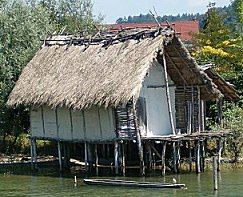
In the winter of 1853-1854, Swiss archaeologist Ferdinand Keller examined a ghostly cluster of wood posts protruding through the top of the Lake of Zurich. A drought had lowered the water level, exposing the bizarre beams.

Were these posts the supports for lake houses centuries ago? Keller’s assessment fascinated the public, stating the homes belonged to a long lost society, or lake dwellers, of early Europeans.

The idea of prehistoric people living above the water on stilts was just as captivating to scholars as tree people. Once investigations began on western lakes in the region, eyebrows began to raise.

Scholars didn’t believe these so called “huts” were situated where Ferdinand Keller had believed. In fact, the opinion was that no houses were built on the lake on stilts, even though piles of wood were found under the water. There was a clear explanation for this, as water levels had risen since prehistoric times and submerged the homes.

Fiave, Italy Bronze Age Dwellings


An archaeological dig took place from 1974-1975 on a small island in Lake Carera in Faive, Italy. Archaeology digs unearthed several Bronze Age dwellings dating to 2000 BC. They were constructed all over the water and  on the sloping shores of Lake Carera. On dry land, the dwellings sat upon piles, the same as they do today to protect against rising waters.

Modern scientific analysis and dating have shown that the settlements were slightly different from what had been supposed earlier. Specialists now prefer to talk about ‘lake people’, who actually built on land (in marshy areas). 

At that time, between 4,300 BCE and 800 BCE, the water level in the lakes was much lower and varied from year to year. There were no platforms, only individual houses standing apart from one another. And the hundreds of poles that had led to the platform theory were, in fact, from other periods. The question as to why the lake peoples chose to live in muddy environments remains to be answered. ~EVELINA RIOUKHINA, UNECE

Also Check Out:


The Bantu speaking Baganda people created the state of Uganda from a small territory during the late 19th century, under their kabakas, or Buganda kings. The territory had little or no contact with the outside world until the middle of the 19th century, when Arab slavers penetrated the interior.

History of The Kasubi Hill Tombs of the Buganda Kings 

The Spear Masters of the Dinka Tribe of the upper Nile are a hereditary priesthood, and according to mythology, their presence is reinforced by political and religious ideals. There are several legends of the origins of these spear using masters, one in which includes a lion and a man dancing.

The Spear Masters of the Dinka Tribe 

The Cro Magnon people left no written records about themselves, however they replaced the Neanderthals over 30,000 years ago. So what do we know about this prehistoric forerunner to the Homo sapiens? Similar to the Neanderthals, they buried tools, weapons, and ornaments with their dead.


The Cro Magnon Religion


Picture Sources

Source Fiave, Italy)
Prehistoric reproduction Lake Dwelling

Tuesday, August 10, 2010

Holocaust Cartoon On Iranian Site


I'm not accustomed to putting politically incorrect text on the Ancient Digger, but this made me very angry, especially considering my personal heritage.

Over the course of one year, I have attended several Jewish Heritage Festivals and I've also done in depth studies on the History of the Holocaust, several times throughout my schooling. I appreciate my family history and I certainly know enough about it to to view this story as a complete fallacy.

One Iranian website has taken it too far, once again calling the Holocaust a complete fabrication. I thought we were past this and I though there was enough evidence to prove that the Holocaust actually happened. Am I naive in thinking this?

The version of the slaughter of six million Jews by their Nazi persecutors during World War II is called "the great lie" by the site, which recounts its version of events in cartoon form.
Displaying images of bearded large-nosed figures, the site aims to denounce the Holocaust as a "lie with which the Palestine occupier Zionists have justified their occupying of Palestine and lots of other crimes for years." In one image, A Jew is tied to a chair on a movie set as a canister of Zyklone-B is dropped through the roof of the gas chamber.

The site is sponsored by the Khakriz Cultural Institute, and is "dedicated to those killed under the pretext of the Holocaust." The imagery is like taking a trip back to Nazi occupied Germany and seeing the hundreds upon thousands of propaganda. It's unsettling and unnecessary!

I refuse to link to the site, as I can not and will not agree with their approach on the matter.

I want to hear from you? What are your opinions about this?

Sited Info (adnkronosinternational) This is not the Iranian Site


Iran's Ahmadinejad Interview With Peter Jennings on Holocaust


This is an interview between Peter Jennings and Ahmadinejad about whether the Palestines believe the Holocaust actually happened. It's about anger, jealousy, self determination, safety, and women's rights. It's about recognizing an event that meant so much to so many Jews and so little to Palestinians.

Monday, August 9, 2010

Monday Ground Up: The Famous Teatro Olimpico By Palladio in Vicenza Italy


The Teatro Olimpico, located in Vicenza, northern Italy, was constructed in 1580-1585 AD. The theater is one of three of the world’s oldest surviving Renaissance theaters and is the world’s oldest indoor theater.The Teatro Olimpico is the last work of renowned architect Andrea Palladio.
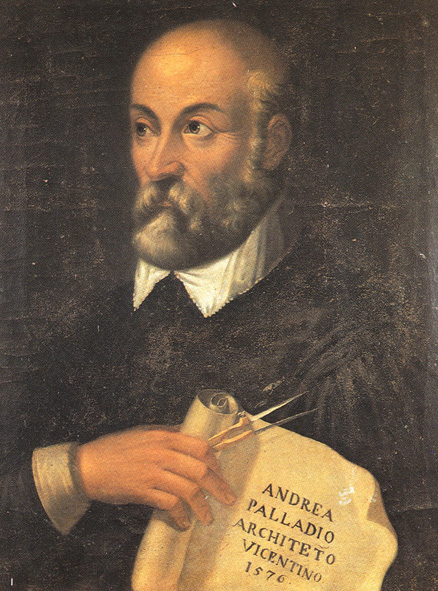
In 1570, Palladio published I Quattro Libri dell' Architettura [The Four Books of Architecture]. This literary work cemented Palladio's place in architectural history. 

"The book set out Palladio's architectural principles as well as practical advice for builders. The most critical element, perhaps, was the set of meticulous woodcut illustrations drawn from Palladio's own works to illustrate the text. The work was subsequently translated into every European language and remains in print today both in paperback and hardcover".~Boglewood

Palladio is widely considered to be one of the most influential figures in European architecture.

Construction of Teatro Olimpico

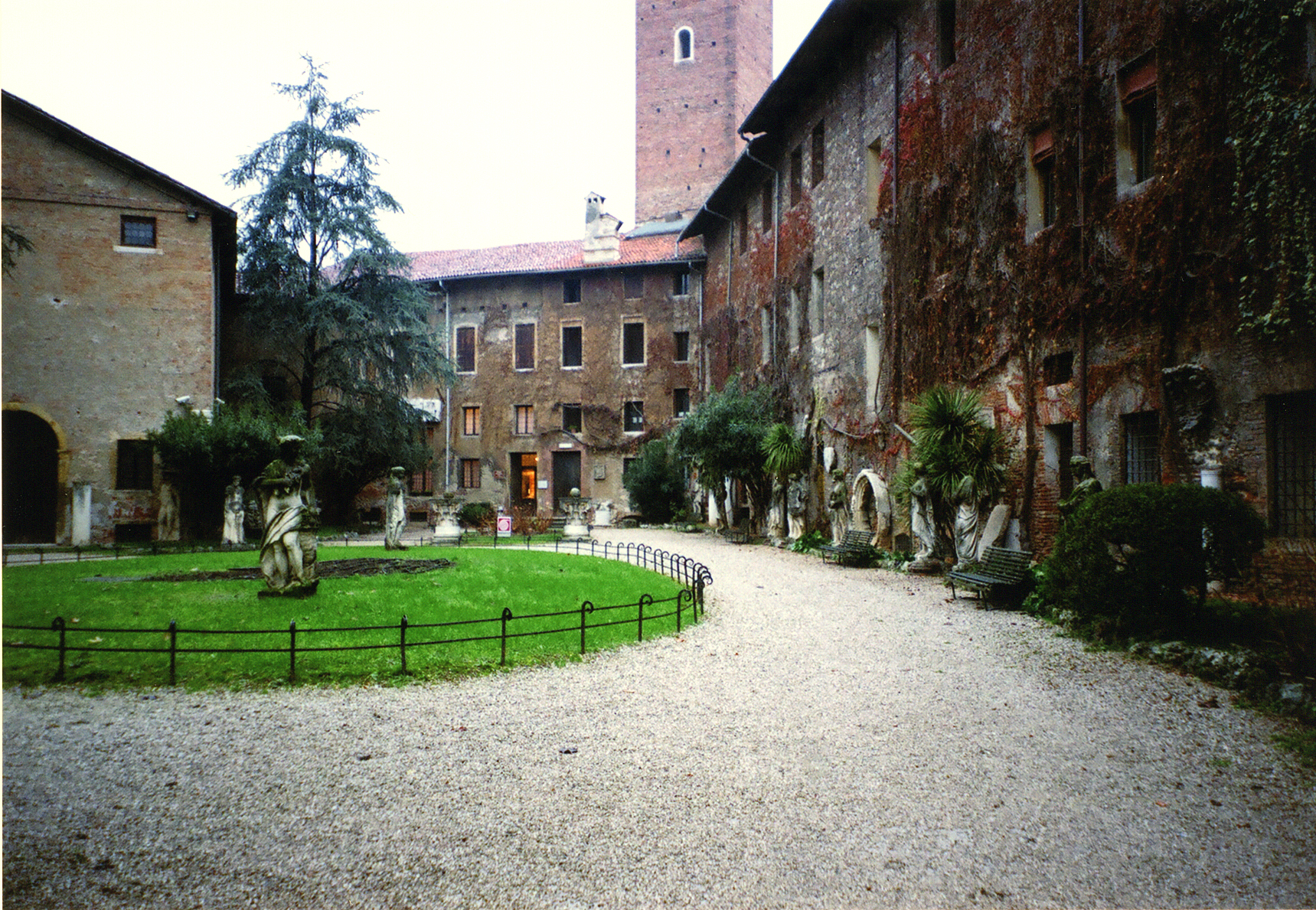
Commissioned by the Olympic Academy in 1580, Teatro Olimpico was constructed upon the site of a medieval fortress, used as a prison and powder store.

Palladio planned the design for Teatro Olimpico in 1579, planning a classically inspired structure using sketches and drawings. Unfortunately, Palladio passed in August 1580, only six months after the construction of Teatro Olimpico started. The sketches and drawings Palladio scribed were used by Vincenzo Scamozzi, a Venetian architect that inherited Palladio’s project.
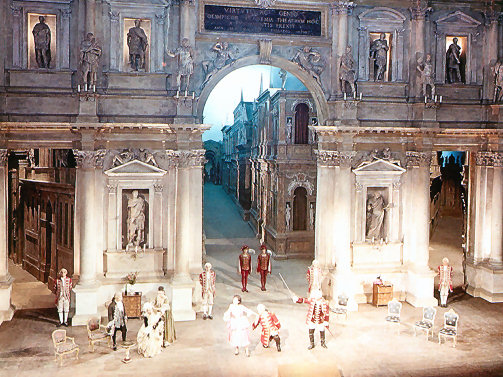
Vincenzo had an excellent starting point with the sketches provided by Palladio, however Palladio never produced designs for the stage floor of Teatro Olimpico. Scamozzi completed this project himself, fashioning a stage made out of wood and stucco. The stage was meant to be temporary, however it survived and remains in the Teatro Olimpico today.

Image via Wikipedia

There are also two rooms designed by Vincenzo Scamozzi at the Teatro Olimpico, those being the Odèo and Antiodèo, as well as the original entrance “archway which leads from the street, through an old medieval wall into the courtyard of the old fortress”.

Image via Wikipedia

Scamozzi's stage set at the Teatro Olimpico was the first practical introduction of perspective views into Renaissance theatre. The scenery consists of seven hallways decorated to create the illusion of looking down the streets of a city from classical antiquity. The way in which seats in all parts of the theatre were provided with at least one perspective view can be seen by observing the theatre floor plan and following the sight lines of audience members in different parts of the theatre.


Operation of the Teatro Olimpico


On March 3rd, 1585, Teatro Olimpico was inaugurated with a performance of Sophocles’ Oedipus Rex. Sadly, only a few more performances took place after that, and then the theater was abandoned. A performance of Oedipus the King took place in 1997 at the Teatro Olimpic using the original lighting by Scamozzi.
 Source (Bob And Jenny's Bed and breakfast in Italy )

Today, the Teatro Olimpico still hosts musical performances and plays, but on a smaller scale for conservative reasons of course. Classical plays take place in the autumn and the festival II Suono dell’Olimpico in the spring. Every June, Palladio's Teatro Olimpico is used for the graduation ceremony for students from the American Department of Defense high school in Vicenza.

Influence of the Teatro Olimpico

Teatro Olimpico stands to represent one of the most influential architects in the history of European theater, Palladio. Unlike many of its counterparts, the Globe Theater in London, the Teatro Olimpico still stands in its original state. It remains as a significant historic link to the Renaissance stage.

“The Palladian project reconstructed the Roman Theater with an archaeological precision.”

Centro de Studi Architettura Andrea Palladio

More Related Content

The Greeks were gifted, being situated in an area with the highest quality stone. Of course the buildings that were derived from these stones were free of bronzed sculptures, polished monuments, and shrines painted with vivid colors. Monday Ground Up: Greek Architecture

The Sumerian cities were surrounded by walls, much like the Forbidden City, as a way to keep their culture secret and sacred. Sumerian city dwellings were constructed out of sun-dried bricks, including peasant quarters and the larger dwellings of priestly and civic officials.Monday Ground Up: Sumerian Cities

Although the Romans had depended greatly on the ideals of the Greeks when adopting their art and literature, they themselves developed some of the most innovative of inventions that succeeded Western Civilization. The evolution of Roman law which brought about the idea of a systematic principle for justification, the invention of roads allowed for easier transit for soldiers and citizens, as well as the construction of Roman bridges that still stand today.Monday Ground Up: Roman Achievements in Law and Engineering

Roman architecture is classical and hardly practical. It could be described as masculine in a sense, with a hint of solitude. No matter how we interpret the structure, we can all agree that it exhibited a solid foundation and architectural form.Monday Ground Up: Two Architectural Gems in Rome, Italy


Photo sources

Palladio

Like Ancient Digger? Why Not Follow Us?


Subscribe Via RSS Feed Follow Ancient Digger on Facebook Follow Ancient Digger on Twitter Subscribe to Ancient Digger Via Email

Get widget

Search


Ancient Digger Archaeology Copyright © 2015 LKart Theme is Designed by Lasantha