• Ancient Digger teaches Archaeology and History to all Ages!

Friday, July 27, 2012

Augustan Programs Which Rejuvenated the Roman State


Augustus was the Roman Empires’ first emperor and was the grandnephew of Julius Caesar and adopted son. Augustus went by the name “Octavian” and he brought an end to civil war and appeared to be restoring the republic, but in actuality, he ruled as an autocrat. He was credited as heralding the start of the Roman Empire, which would last for over four centuries. Augustus transformed Rome stating, “He found a city of bricks and left it a city of marble”. During his rule, we saw the creation of a new order, a powerful new army, a new social order and reforms, and many literary accomplishments.

In 27 BC, the senate gave him the imperial title “Augustus” and he used this position to not only create a new order, but to reform the army. Augustus created a new constitutional order, which consisted of the preceps (Augustus) and the senate. The senate now had the ability to affect the law, but not without prior consent of the preceps. In actuality the preceps had little power, but up until 23 BC, Augustus had also held the position of consul, which gave him imperium. After Augustus gave up the consulship in 23 BC, he was given maius imperium, so his position of consulship was unnecessary. Augustus’ authority insured that the senate would always be filled with officials who supported him. Augustus was well liked and highly respected. Tacitus commented, “Indeed, he attracted everybody’s goodwill by the enjoyable gift of peace…Opposition did not exist”1 . The civil unrest was waning and Augustus was growing even more powerful, yet the crucial source of his power was the new army he created.

The Roman Army


The command of the Roman army during Caesar’s rule was an executive political office therefore its undertaking could be risky business for unscrupulous generals. Only six months after the tyrannical Caesar was murdered, Augustus sought friendly relations with his generals and friends. The Roman army was a source of upward mobility for the provinces, since the army’s purpose was also to maintain domestic order within them.

Colonies of veterans were created under Augustus, which would prove especially valuable in Romanizing the provinces. Augustus’ army maintained a standing army of twenty-eight legions. Those legionaries served twenty years and were primarily recruited from the citizenry in Italy. There was also a large contingent of auxiliary forces, serving as light infantry and cavalry. The auxiliaries during Augustus numbered close to 130,000 and they were primarily non-citizens. They served twenty-four years and they received citizenship after their term of service.

Augustus also established the Praetorian Guard. The Praetorian Guard consisted of nine thousand men and they had the main responsibility of protecting the preceps. They were recruited from Roman citizens in Italy and served for sixteen years. The Praetorian Guard would eventually play a pivotal role in making and disposing of emperors. The preceps’ relationship with the Praetorian Guard gave rise to a new distinction. When the preceps was victorious in battle, his troops bestowed on him the title imperator.

Although the army had a hand in domestic negotiations in the provinces, it was now the job of the provincial governors. The deputies were assigned by the preceps and known as legates. The legates were from the senatorial class and held office until the emperor chose to allow them. Although a dual system of provincial administration seems to have been created, in reality the greater proconsular imperium that had been granted to Augustus essentially gave him the power to overrule the senatorial governors and thus to establish a unified imperial policy 2 .

Adding Territories


All provincial governors received salaries, cutting down on extortion, which had characterized the Late Republic. Augustus’ new policy allowed for a certain amount of autonomy in the cities. City councils allowed leading citizens to maintain a stable government and they were often rewarded for their successes. Military campaigns were also utilized to consolidate natural boundaries of the Roman Empire and increase revenues, thus leading to the increased size of the Roman Empire overall.

Augustus added more Roman territory to the empire than any other Roman. Augustus encouraged client kingdoms in the east, thus allowing him to use his army elsewhere. In 19 BC, after the pacification of Spain, Augustus conquered the maritime and central Alps and then expanded control over the Balkans up the Danube River. Augustus was essentially opening the doors to Germany. Around AD 6, the Romans advanced between the Elbe and Danube, but they ran into some difficulties. In AD 9, three legions under Varus were massacred by a coalition of German tribes led by Arminius. The defeat made Augustus realize that Rome’s power was limited and she should maintain her present borders, instead of expanding.

The Social Order


The social order was also altered under Augustus. One needed to possess property worth one million sesterces to belong to the senatorial order. When Augustus took charge, the senate had over a thousand members. Augustus reduced its size to six hundred but also added new men from wealthy families throughout Italy. Overall, Augustus was successful in winning the support of the senatorial class for his new order.

Equestrians were also given a share of power in the new imperial state. All Roman citizens of good standing who possessed property valued at 400,000 sesterces could now hold military and governmental offices. Citizens not of the senatorial or equestrian orders were provided with free grain and public spectacles to keep them from creating disturbances. By gaining wealth and serving as lower officers in the Roman legions, it was sometimes possible for them to advance to the equestrian order.

Public Reforms


Augustus instigated many reforms while in power. He believed that public religion had been in civil disarray since the 1st century, so he decided to restore traditional priesthoods that had fallen into disuse in the Late Republic, rebuilt many ruined temples and shrines, and constructed new ones to honor the Roman gods. Augustus also instituted a new religious cult that would serve to strengthen the Roman Empire.

Augustus promised that he would interfere with the workings in the senate, but he was driven for justice and he wanted to resurrect Rome to the glory it once was. He never considered himself to be a god, but he did permit the construction of temples to his deified adoptive father, Julius Caesar. Augustus also permitted the buildings of temples to Augustus and Roma.

Augustus also believed that the center of Rome was corrupt and that increased wealth had undermined Roman simplicity. These lack of morals led to an increase in divorce, a falling birthrate among the upper classes, and lax behavior manifested in hedonistic parties and the love affairs of prominent Romans with fashionable women and elegant boys 3. Augustus looked to restore piouty in the Roman people, so he also made adultery a criminal offense. He revised tax laws and penalized unmarried men, widowers, and married couples who had fewer than three children.

Literature


The high point of Latin literature was also reached in the time of Augustus. The most distinguished poet of the Augustan Age was Virgil, who welcomed Augustus’ rule, and wrote his greatest work The Aeneid, in the emperor's honor. Horace, another prominent literary figure during the Augustan age, wrote the Satires, a combination of poems on a variety of subjects. Additionally, paying homage to Greek culture and literature, which flowed quite deeply throughout the city, Horace used the imaginary letter in verse-to provide a portrait of his friends and society and the things he held most dear: a simple life, good friends, and his beloved countryside.

Ovid was a youth who often ridiculed Roman values. His most notable work was the Metamorphoses, but it was The Art of Love, which pushed the boundaries of upper class Roman sexual morals. Augustus was not pleased, and Ovid ignored the wishes of Augustus to resist the urge to write such trifles. He paid a price for it in AD 8 when he was exiled for supposedly having sexual relations with the emperor’s daughter.

The most famous Latin prose work, written during Augustus, was by the historian Livy. Livy's masterpiece was a history of Rome from the foundation of the city to 9 BC written in 142 books. Livy's History of Rome celebrated Rome's greatness. He built scene upon scene that not only revealed the character of the chief figures but also demonstrated the virtues that had made Rome great. He also composed dome scathing work called the Rape of Lucretia.

The Age of Augustus saw the beginnings of the Roman Empire along with grand feats of architecture and a systematic principle for justification applicable to all people and their rights as citizens. The army continued to evolve in the Roman Empire as new emperors with effective leadership and organizational skills adopted new reforms, key to the success of the army and the empire. When Augustus finally died in AD 14, he left an order, which was so highly regarded and respected that few Romans looked for an alternative. Indeed, as the Roman historian Tacitus pointed out, "Actium had been won before the younger men were born. Even most of the older generation had come into a world of civil wars. Practically no one had ever seen truly Republican government.... Political equality was a thing of the past; all eyes watched for imperial commands”4.

Sources
  1.  Spielvogel, Jackson J, Western Civilization. 7th Edition, (Belmonst: Thomson Higher Education, 2009).   
  2. Ibid, p 109.
  3. Ibid, p 152.
  4. Colin M Wells, The Roman Empire, (Cambridge: Harvard University Press, 1995), 30

Monday, June 18, 2012

The Destructive Nature of Eros


So the topic of sex and gender and erotic sicknesses continues as I work through a semester's worth of explicit material. I hope you are enjoying this textual romp through the world of ancient sex and erotica. As always, Ancient Digger intends to share all facets of history, even though the topics may border on the obscene, according to many.

Eros is the son of Aphrodite who essentially meddles in the affairs of gods and mortals, causing bonds of love to form, often illicitly. In early Greek art, Eros is depicted as a adult male with sexual prowess, but becomes cupid, the blindfolded and childlike boy who flies around, shooting his arrows at unsuspecting individuals destined for love. Eros draws one thing to another by attraction or even gravity. Hesiod explained that Eros existed long before the goddess of love, Aphrodite. According to many philosophers, Eros was an awe-inspiring universal force.

Eros is the fairest among the deathless gods, who unnerves later the limbs and overcomes the mind, and counsels of all gods and all men within them. Pre-Socratic philosophers believed Eros was a natural force responsible for creation. It wasn’t just good or bad, but destructive. Eros was vital because it operated as a social concept, yet it had moral implications. It was hard to control because in many cases, individuals would become slaves to it.


This destructive force was the root of the evil. However, while the destructive impulses are thus being satisfied, such satisfaction cannot stabilize their energy in the service of Eros. Their destructive force must drive them beyond this servitude and sublimation, for their aim is, not matter, not nature, not any object, but life itself1 . Greek literature depicts the forces of eros as frightening, socially destructive and physically, emotionally and mentally debilitating. In this sense, the separation of the wife and children from the sexual activities of the slave-quarters, the brothels and the male drinking parties or symposia, ensured that the oikos and its most important members were protected from the potentially damaging forces of uninhibited sexual expression2 .

The numerous examples of the destructive force of eros are not always mythological or legendary in orientation. Eros reaches into the minds of some of the most famous and notorious of emperors and also notable philosophers and writers, who sought to tell tales of legend, though the stories almost always embraced some truth. Eros could be accessed through the eyes, or “the gaze”, as 19th century scholars called it. The ancients could be seen as passive victims who allowed objects to intrude upon them. This could be artistic objects, theatrical events, or even natural elements.

The fact was that looking at things that were attractive and desirable was dangerous; therefore the act of looking could invoke emotion, arousal, lust, and desire. Eros was driven by men. Men would compel an object of desire to submit to them. In this aspect, eros is cured by reciprocity. If the object would not submit, spells would sometimes be utilized. These spells would be inflicted at night in isolation using agents that were not commonly acquirable. You had to put in the effort in order for the spells to take hold.


One spell was used to induce dreams of a desired object. The person, most likely a woman, would go through a suffering and longing process for the person they wanted. There was a certain degree of violence in this because control and victimization are inverted throughout the dream, and one cannot control their actions and impulses in their dreams. Using magic the man would get control. The same spell was not invoked on men because men tend to dream while they are awake-they daydream. Therefore a spell of desire would have to be altered somewhat if the woman was in control.

It is clear that eros drove women to madness, but men were just as vulnerable to the power of eros. A prime example would be Nero. Nero was free with his mind, money, and body. He had issues with boundaries and he was addicted to eros. This addiction ran much deeper than just for carnal pleasure, however. Nero was also addicted to the theater, where themes of the real world were often inverted to create an imaginary one. Nero lived his life in excess, violating customary expressions of pleasure to the point he forgoes imperial responsibilities. He embraces popularity and the love of the populace. The love of the people is where eros goes wrong. The people loved him so much that they created a monster and his general obsessions were driven by his libido and desire. Libido without restraint becomes worse. He is the very opposite of an epicurean, who typically partakes in simple pleasures, yet they also abstain from bodily desires such as sex and appetites verging on denial.

The Rape of Lucretia is another excellent example of eros gone wrong, as it pertains to the hyper sexuality of man. Lucretia, an object of desire put forth by her own husband, is the ultimate undertaking of any man looking to overcome the innocence of a pious woman. When the men arrived, they were all impressed by Lucretia's chaste honor, but it was Tarquinius who was “seized by the desire (hyper sexuality) to violate Lucretia's chastity, seduced both by her beauty and by her exemplary virtue”3 . He threatened her with death, raped her, and he left, having taken away her honor. Her beauty and virtue not only drove Tarquinius to desire her, but it created an innate violence in a powerful man, put into a position where he could control submission. It was no different than war, as men seek honor on the field, they seek the same type of acknowledgement in the bedroom.

The History of Appius and Virginia by Livy is another key example of a virtuous woman who tempts, unintentionally, man’s desire to the point of violence. Appius Claudius lusts after the daughter of a centurion, Virginia. Virginia was already promised to Lucius Icilius, a former tribune of the plebs, and when she rejected Claudius, he gave instructions to Marcus Claudius, one of his clients, that he should claim the young woman as his slave, and not submit to any demand which should be made, of her being left at liberty until the decision of the suit, thinking that the absence of the damsel's father afforded the fittest opportunity for the injury which be meditated4.

After Marcus Claudius had successfully abducted her, the decemviri, led by Appius Claudius himself, demanded he bring the case to court. Virginia’s father Verginius was recalled from the field to defend his daughter, and Icilius, after threats of violence, succeeded in having Virginia returned to her house while the court waited for her father to appear. When Verginius finally arrived, his supporters left the forum so not to cause further violence. Questioning whether her virtue would be preserved if he acted in haste, Verginius grabbed a knife and stabbed Virginia. Verginius and Icilius were arrested, and their followers returned to attack the lictors and destroy their fasces. This led to the overthrow of the decemviri and the re-establishment of the Roman Republic4 .

The very last place we would expect the humiliation of women to occur would be in the Symposium, but the presence of the hetaerai may have only fueled the natural hunger of man’s desire to dominate the opposite sex. Hetaerai were the only women who actively took part in the symposium where their opinion was welcomed and respected by men. They drank and partied, but the drinking usually took a completely different turn near the end of the evening. The Symposium is a social function for young men to integrate into their status group, and as part of this, the men engage in ritualized violence with the hetaerai as a rite of passage. Men would force them to have anal sex and beat them with a staff, rod or shoe. Hetaerai were essentially integrated into a ritual for the sake of man’s inability to restrain his primal urges.

Eros is instilled with a deep-seated tension that manifests itself in various guises, which, however, have a common structure based on the fact that eros is a striving for the reversal of eros, and that therefore the existence of eros is incompatible with its telos. The highest goal of eros is the destruction of eros, the transformation of the lovers into an existence that no longer needs eros. According to Diotomo’s speech at the Symposium, Eros is “a great spirit (daimon)” that is situated between mortals and gods, and oscillates between the two; it is by virtue of its origin an intermediate being, that nevertheless strives towards the better5.


You may also like


The Sickness of Eros
Ancient Sex and Love Magic
Ovid's Art of Love 
Erotic Art and Roman Sexuality
Eroticism, Eros, and Sex in Pompeii


References

  1. Herbert Marcuse, Eros and Civilization: a philosophical inquiry into fraud, (Abingdon: Routledge and Kegan Paul Ltd, 1956), 86.
  2. Terry Ryan, and Marguerite Johnson, Sexuality in Greek and Roman Society and Literature, (New York: Routledge, 2005), 3-4.
  3. "Tite-Live: Histoire Romaine," 1, Vol. 1, ed. Jean Bayet and Gaston Baillet (Paris: Societé d'Édition "les belles-lettres, 1995).
  4. Livy. The History of Appius and Virginia, History of Rome. English Translation by Rev. Canon Roberts. New York. E. P. Dutton and Co, New York, 1912.
  5. Benjamin Jowett, trans., Plato’s Symposium, (Penguin Books Limited, London, 1956).

Tuesday, June 12, 2012

Ancient Sex and Love Magic


The Kama Sutra and the Joy of Sex were not strictly ancient sex manuals, but actual instructions on pleasing one’s wife. Ancient sex is the only stand-alone genre in ancient literature. The writing of pornographic material evolves in the 4th or 5th century BC. Ancient sex manual writing comes at the same time as aristocratic writing. It is a cultural viewpoint that seeks to classify a certain type of knowledge. It makes a science of the human body by focusing on the human body to arouse you. It also helps to intellectualize the writing of smut and sexualized material and sets it in on equal footing to the sciences and mathematics. The authors talking about sex were doing so from the female’s point of view. In antiquity, women supposedly authored the books, but in actuality men using a woman’s name wrote them.


The mythical founder of the genre was Astyanassa, but it is said that the female Philaenis was even more popular than Astyanassa. The poet Aeschrion of Samos denied that Philaenis was really the author of this notorious work. Brief fragments of the manual, including the introductory words, have been rediscovered among the Oxyrhynchus Papyri. It begins: “Philaenis of Samos, daughter of Ocymenes, wrote the following things for those wanting ... life”1. When the books were produced they came with graphic illustrations. The texts don’t survive but the impact on society does. We see these sexual images at Pompeii where every type of sexual position with every type of gender is depicted.

Sex was a mythical religion and should not be discussed, but authors were beginning to classify and catalogue types of women and the types of sex you should engage with them. Lucritious was a 1st century poet and philosopher who would catalogue types of women (physiognomy). Avid defined women by certain attributes, and after that, with a specific sexual position. If old, you would have sex with her from the back, and if young, lay her on her back. Women were becoming symbols and they were stripped of their humanity. They were anatomical parts.

Another example of ancient sex was sacred prostitution. Sacred prostitutes were connected to temples and the temples of Aphrodite. Slaves were purchased on the open market and forced to work in the sex trade industry where profits went to the temple. Some women even engaged in ritualized prostitution for a short period of time before marriage. Prostitution was sanctioned by the elites, and in places like Athens; state officials enforced price controls on prostitution. This was often because the wealthy owned the brothels, but a madam ran them. You would spend time training for prostitution usually at a young age. Your career consumed your adult years and at age twenty-five you were considered old. At one time in your life you could buy your freedom. Contraception was used but it rarely worked. It led to higher pregnancy rates, and those children born to free men, were rarely acknowledged. The women often lived in the brothels with a madam, who was usually an ex-slave, who would often take care of the children. There were high rates of miscarriage and exposure to disease and pollution. Not surprising considering the work environment was often dark and unsanitary. Disease was rampant, and not just STDS.

Love Magic

Literary accounts of erotic love magic go back to Homer, however evidence for actual performance of spells, in the form of lead curse tablets aimed at rivals, does not appear until the fourth century BC. The increased popularity of magic under the Roman Empire is demonstrated in the papyri from Egypt, which contains handbooks of prescriptions and recipes into which the names of agent and victims were to be inserted. Literature, meanwhile associated them, as it had in the past, with the figure of the witch who employs her craft to exert sexual power over men. There were also servants of divine intervention in Egypt who worked with families to cast spells and charms. They were a source of sexual information, and to some, they were regarded as witches.

Traditional association between witchcraft and sexuality had become even more sinister and was now colored by the lure of the forbidden. At the same time, though much of what we loosely call "erotic love magic" can be seen to conform to Mediterranean common sense, the confrontation between actual erotic spells and the masculine literary fantasies about erotic witchcraft will illuminate some dark comers of personal anguish and interpersonal spite2. There were dozens of different spells and curses including binding spells (agogai) to inflame someone with eros for the perpetrator, curses designed to separate couples, and philia spells to strengthen an existing relationship. Because astrology allowed individuals to profit from awareness of the future and sorcery enabled the weak to control the strong, those technologies were perceived as seditious; imperial decrees forbade consultations, expelled practitioners, and punished the guilty with exile or death3.

Winkler talks about the competition between families and how magic can give you a leg up. This was true in marriage, the acquisition of a lover, and social relations. Sex lives become a means of rivalry. Social standing and power in the community is at stake. Moreover social approval is equally significant. Magic tilts the scales in your favor and agogai were designed to lead a desired person to one's house and bed. It assured success of self and failure for others, therefore belief in magic allowed for blame to be shifted. Interestingly, papyri and archaeological evidence suggests it was men who evoked a third party, whether that were the dead, spirits, or the gods. This is a projection of male fantasy and the literature inverts the fantasy.

Spells revolve around eros. Some of the most common spells are those that improve one’s place in society. They ask for improvement in physical appearance. The person asks that both women and men find them charming. The spells are invoked because the person is essentially seeking arête. The secondary part asks for protection from death or embarrassment. Third, the competition must suffer. Spells are structured and ritualized. Spell XVII states, if you are the bearer of an inscribed wormwood root that you will be charming and befriended and admired by all who see you4. One spell was even used to induce dreams of a desired object. The person, most likely a woman, would go through a suffering (sickness of eros) and longing process for the person they wanted. There was a certain degree of violence in this because control and victimization are inverted throughout the dream, and one cannot control their actions and impulses in their dreams. Using love magic the man would get control. The same spell was not invoked on men because men tend to dream while they are awake-they daydream.

You may also like

Ovid's Art of Love 
Erotic Art and Roman Sexuality
Eroticism, Eros, and Sex in Pompeii
The Complete Illustrated Kama Sutra By Vatsyayana/ Dane, Lance (EDT)/ Dane, Lance
Art of Love: The Second Book of Kama Sutra


Sources

  1. Philip W Comfort and David P Barrett, The Text of the Earliest New Testament Greek Manuscripts, (Wheaton: Illinois: Tyndale House Publishers Incorporated, 2001). 
  2. Marilyn B. Skinner, Sexuality in Greek and Roman Culture, (Malden: Blackwell Publishing, 2005). 
  3.  Ibid, p 278. 
  4. John J Winkler, “The Constraints of Desire: Erotic Magic Spells,” The Constraints of Desire, (New York: Routledge, 1990) 71-98.


Sunday, June 10, 2012

Ovid's Art of Love


Ovid’s narrative often highlights the thrill of fear; as if it is an attractive quality to have, to inflict fear on the innocent. 


Ovid was the last of the great poets of the golden age. He belonged to a privilege group of Roman youths who liked to ridicule old Roman values. In keeping with the spirit of this group Ovid wrote a frivolous series of love poems known as the Amores, intended to entertain and shock. They ultimately achieved their goal. Another of Ovid's works was The Art of Love. This was essentially a takeoff on didactic poems. Whereas authors of earlier didactic poems had written guides to farming, hunting, or some such subject, Ovid's work was a handbook on the seduction of women.


Read the entire article: Ovid: Art of Love and Rape By Ancient Digger Via Knoji

Friday, June 8, 2012

Sophrosyne: The Simple Meaning of Moderation


Sophrosyne was the goddess of moderation, self-control, temperance, restraint, and discretion. She was one of the good spirits who escaped Pandora's box when the woman first lifted the lid and fled back to Olympus, abandoning mankind. Her Roman equivalents were Continentia and Sobrietas. Sophrosyne was one of the cardinal virtues, consisting in a harmonious state of rational control of one's desires. In Aristotle the temperate person is one who can abstain or indulge appetites to the right degree without a severe effort of will; the person who needs the effort of will is not temperate, and needs to be content.


We see several examples of sophrosyne in literature including the story of Cupid and Psyche. Aphrodite was furious about her son Cupid-Eros’ affair with (Psyche exclaims:] “But what am I to do, now that I'm becoming a laughing-stock? Where shall I go, how shall I curb in this scoundrel? Should I beg the assistance of my enemy Sobrietas (Sobriety, Temperance)? So often alienated from me through this fellow's loose living.”

Plato’s Symposium is another perfect example of sophrosyne, as Socrates talks about moderation of one’s actions and the honor in doing so. Socrates also asserts that the highest purpose of love is to become a philosopher or, literally, a lover of wisdom. A lover of wisdom often accompanied better judgment and temperance for other’s ideas. Consequently, the symposium was a drinking party, but according to Aristophanes, “ we should, by all means, avoid hard drinking, for I was myself one of those who were yesterday drowned in drink” .

The epicureans also practiced sophrosyne, as they also abstain from bodily desires such as sex and appetites verging on denial. Epicurus argued that when eating one should not eat too heavily, for it could lead to disappointment later, such as the grim realization that one could not afford such delicacies in the future. Likewise, sex could lead to increased lust and dissatisfaction with the sexual partner.


"Cupid and Psyche Sculptural Wall Frieze in Antique Stone"
"Cupid and Psyche Bonded Marble Bust"
Cupid and Psyche and Other Tales from the Golden Ass

Wednesday, June 6, 2012

The Sickness of Eros


The sickness of eros is often described in the context of the seasons. The idea of polar opposites, hot and cold, moist and dry, allow for a blend in temperance and harmony, they bring to men, animals, and plants health and plenty, and do them no harm; whereas the wanton love, getting the upper hand and affecting the seasons of the year, is very destructive and injurious, being the source of pestilence, and bringing many other kinds of diseases on animals and plants; for hoar-frost and hail and blight spring from the excesses and disorders of these elements of love, which to know in relation to the revolutions of the heavenly bodies and the seasons of the year is termed astronomy. However, the sickness of eros can also be observed in many forms and in many sources of literature. We see this illness of love in Euripides’ Medea, Chloe and Daphnis, and also in the tyrannical rule of governors as well as their ill rebutted affairs and love of youths, described by Socrates as “a disease of the soul” in the Symposium by Plato.

Lingus' tale of Chloe and Daphnis is an attempt to portray a woman in her most un-desirous form. As a creature of lust and prone to the pathetic notions of admiring someone from a far she might not deserve. However, the ultimate theme or resolution to this romantic obstacle course is marriage, and the consummation of that union. The entire plot is wreaked with longing and love sickness, as Chloe admires and lusts for Daphnis. Yet, she is in the beginning of womanhood and she is not well versed in the sexual exploits of men. As the story unfolds, Daphnis sleeps with older women and gains worldly experience as opposed to Chloe who has the opportunity to experiment, but doesn’t. She must remain virginal until her wedding night, which is the stereotypical idea of women and the same for men. The intrigue and unbearable nature of the story explains the notion of eros. You will succumb to diseases of love if you don’t satisfy it, and in Chloe and Daphnis’s case, love is death unless consummated.

We also see the concept of eros as a sickness in Medea. If eros had not inspired Medea to fall in love with Jason, and be cast aside, her lust would have never drove her to act in such a violent way. She murdered her brother and essentially hacked him up into little pieces like a serial murderer; killed her children with Jason; murdered Jason’s new wife with a crown and robe laced with poison, which burned the skin off her body. After which, her father King Creon died holding her lifeless body. She later tried to trick her husband into poisoning his son Theseus. The idea here is that not only is eros destructive, but for some like Medea, it is a love illness. She never acts with moderation and never just accepts the fact the love can be fleeting. Her approach to her husband was not much different than a young girl with an innocent crush on an older man. They are often delirious with hope or resentment, and see no woman as a match to herself.

Plato’s Symposium is a drinking party held essentially to explain love using a sequence of speeches. The party is for Agathon to celebrate his prize for his first tragedy at the Lenaia in 416 B.C.. Each man must deliver an encomium (praise of a person or thing), a speech in praise of Eros. Love is the supreme god and only the young can enjoy it. Socrates in his speech asserts that the highest purpose of love is to become a philosopher, or literally, a lover of wisdom. However he also speaks of the sickness of eros, which is hidden behind the lines of the speeches and conversation. Socrates experiences difficulty in explaining what the sickness of tyrannical eros is. He evidently does associate it with desire, but is that not the same as eros? Socrates declares that it is a human madness, a disease of the soul.

There are several manifestations and types of the sickness of tyrannical eros, but typically it is directed simultaneously at individual persons and would be a tyrant's polity. The diseased eros variously desires to use its beloveds not only as agents of sexual pleasure but also as slavish sources of wealth, position, and honor. The sick eros hopes to convert its polity into an instrument of world conquest that improves its domestic status; a guarantee of its illicit sexual and social interests; a tool that facilitates a tyrannical technician's conquest of nature; an engine that co-opts all mankind into its metaphysical revolt; a vast association organized to worship its metaphysical revolt; a vast association organized to worship the man who incarnates it; and the slavish power base that deifies the tyrant by making him ruler of the world . In all these forms, the diseased eros employs "moving logoi" that transfer the emotional effects of beauty from beautiful realities to itself in order to seduce the intended slaves, charming them into embracing the tyrant and the tyranny as beautiful.

Eryximachus explains that there two kinds of love in the human body. One love is healthy and the other is diseased. Their desires are unlike one another, and as Pausanias stated prior to this speech, to indulge good men is honorable, and bad men dishonorable, so too in the body the good and healthy elements are to be indulged, and the bad elements and the elements of disease are not to be indulged, but discouraged . On the other hand, Phaedrus articulated that eros could be a public expression if the cities rules for love permitted lovers to openly walk about like average citizens. Aristophanes thought Phaedrus was wrong to believe that one could let eros go public and still retain a private good: there is no non-lover; eros is definitive of the human and, as essentially political, rules our any transpolitical life defined by a transpolitical good available to man as man. The city is a world of falsehood from which there is no ascent and man is not merely suffering from a sickness, he is a sickness and this sickness has no cure .

Socrates battles with himself throughout the Symposium about the cures that could possibly heal or cure the aristocratic forms of the sickness, and the Phaedrus depicts them working to defeat his attempt to heal the democratic prototype of the disease. However, we might be able to apply Socrates' therapies to our own would-be tyrants with better results, if we catch their illnesses in time. According to Aristophanes, the only cure to the illness of love, plutonic love, or however these men may define it, is through eros. This is because Eros is not the chief attribute of human beings or the most prominent symptom of our illness, but a god or a divine physician who is able to overcome our suffering and heal our affliction .

Therefore love, or the sickness of love, was not only about inhibited love or desire, but the way in which one acted upon their desires. Medea believed in violence and revenge, not only because her honor had been put at stake, but also because the love that she professed for Jason was so great, thus turning to obsession. Chloe and Daphnis was merely a case of unrequited love, and love unconsummated until marriage. In Plato’s Symposium, the speeches touch on plutonic love and the acceptance of eros between two men, as long as it was behind closed doors. Yet, an underlying theme existed in the Symposium, which allowed the speech givers to understand the sickness of love expressed between two men, which only eros could be the cure.


Work's Cited
  • Berg, Steven. Eros and the intoxications of enlightenment: on Plato's Symposium. Albany: State University of New York Press, 2010.
  • Rhodes, James M. Eros, Wisdom, and Silence: Plato's erotic dialogues. Columbia: University of Missouri Press, 2003.
  • Jowett, Benjamin trans.Plato’s Symposium. Penguin Books Limited, London, 1956.

Monday, October 10, 2011

Aristocratic Life and Values in Homeric Greece


Homer’s idea of Greek aristocratic lifestyle has influenced the Western worldview of what we characterize as success and power. Diffusing ideas of grandeur, institutions, government and philosophy steered the aristocracy into a life of mentorship and glory and spoils in warfare. Kurke explains, “In a period when various factors cause a broader distribution of wealth and political influence, threatening the power monopoly of the elite, conscious forms of aristocratic display become more and more prominent in reaction” . In Homeric Greece and the lliad, the main themes that Homer highlights are personal honor and arête, transience of human life, pederasty, and society and politics.

Werner Jaeger explains arête as the “quintessence of early aristocratic education”, yet it was also characterized by the individual personification of one’s self. Am I the best (aristos)? The most handsome? The best warrior or public speaker? A noble's arête, in Homer, is specifically indicated by his skill and prowess as a soldier in war, and as an athlete in peace” . Yet, his over inclination to human perfection and self-fulfillment was most often the result of his prowess in leadership, which can’t be separated from arête. According to Homer, arête is expressed by a struggle or contest in war. Through a man’s willingness to fight, he will protect his family, preserving his own honor and that of his family, and thus preserves his reputation.

James McGlew explains that offspring of divine mortal relationships are always exceptional in arête. This statement is best embodied by the relationship of Achilles and Agamemnon in the lliad. Both men are proud and seek personal honor and excellence. Arête is expressed by those respecting their distinct reputation and importance, thus foregoing the wellbeing of their own forces . Only one, however, is of divine and mortal origin and it is he who seeks Kleos and Agamemnon who seeks timé. Arête was the driving force in Greek aristocratic society, which is why the theme of arête comes up several times in the lliad.

The lliad provides a universal lesson of all aristocratic warrior men. Spielvogel mentions one account of a commentator stating, “men will still come and go like the generations of leaves in the forest; that [man] will still be weak, and gods strong and calculable; that the quality of man matters more than his achievement” .

Does the quality of man really distinguish his achievements? In the lliad, we were introduced to Agamemnon, chief of the Achaean forces, who believes that he’s entitled to Briseis. This of course denies the Achaean Achilles his warrior prize, and thus, forces him to defend his claim over Briseis, rather than defuse the situation entirely. Spoils of war and the entitlement to these so-called prizes, are the very essence of timé. Yet, one wonders, with Achilles’ claim to an early heroic death, why he would even bother the humiliation, rather than acting of honor or duty. We see demonstrated the aristocratic warrior way, where a man puts his own interests ahead of that of his people, jeopardizing the war effort.

Although the transience of warrior life, especially for warrior aristocrats, was fleeting, they recognized that, or believed that they were, essentially immortal like their great gods. It was the responsibility of the elder men to educate the young, feeble-minded warrior men about life. The obstacle was that in Homeric Greece, texts such as the Odyssey and lliad were meant to represent the glories of war and the honor one might obtain by embarking on such a mission. Life wasn’t always about war, yet men lived as though it was. Thus, relationships formed to instruct the young men on matters of state, life, family, and war.

Homer said, “To have a great man for an intimate friend seems pleasant to those who have never tried it; those who have, fear it” . Greek male aristocracy had rites of passage much like men do today in fraternities, albeit in a stricter sense, pedastery was based upon close intimate relationships. These intimate, sometimes erotic, relationships didn’t define a Greek male’s personal lifestyle, yet they influenced their standing in the political arena with the older, more established and revered, Greek aristocratic males. There were no such things as ‘gay’ or ‘straight’ in ancient Greece. Your sexual orientation depended on how you had sex, with whom, and your social status. Therefore, gender roles during sex were fluid and were only characterized by the terms “penetrator” and “penetrated”.

The Marquis De Sade defended pedastery in his book Philosophy in the Bedroom, explaining that the act was misconstrued and falsely criticized. The Marquis states that, “The lawgivers of Greece would they have introduced it to their country if it was [dangerous]? Quite the contrary, they thought it necessary for a warrior people . It’s evident that erotic relationships between Greek Athenian men and adolescent boys were seen as completely natural and admirable. Sexual relations were a large part of the overall master/apprentice relationship. Like a practicum for young men of refinement to learn how to become respectable members of aristocratic society.

Society in Homeric Greece was largely based on agriculture, which the warrior aristocracy controlled. A large gulf separated the wealthy land owning aristocrats from the peasants who hardly embraced their existence. Hesiod, a poet and farmer, wrote a poem titled Works and Days scrutinizing the aristocrats for their obsession with pride and war and their treatment of the farmers and peasants. In the other hand, he explains that the gods punished injustice, and the way to success was work. “Famine and blight do not beset the just, who till their well-worked fields and feast. The earth supports them lavishly” . Consequently, many aristocrats worked the land along side their hired men and slaves, which makes Hesiod’s statement over justified. If both aristocrats and slaves worked the land, thus appeasing and pleasing the gods, then why would the earth not provide for them both?

“In the human realm, the guarantors of order and justice are the basileis. Thus they are the earthly counterparts of Zeus” . The king's responsibilities varied from state to state and, however they did have religious duties as well. The widespread designation of the title basileus for religious officials signals how great a reverence was still attached to the name; the Greek aristocrats felt a need to keep the very important religious sphere of polis existence linked to the ancestral champions of the demos. The Homeric tribal society during the Archaic was dwindling, yet some states, mostly of Dorian origin, kept the tradition alive. Consequently, in Argos, a dynasty of hereditary basileis retained authority into the seventh century, resisting the attempts of the aristocrats to establish oligarchic rule. One of them, Pheidon, using his position of traditional basileus as a springboard, managed to make himself into a tyrant with absolute powers . The Spartans maintained a tribal system for the longest time, which allowed for not one but two hereditary, life-long basileis.

Aristocratic Greeks controlled the city-states for generations utilizing an advisory board. “Membership was confined to the high offices of the state, or magistracies, to their own landholding class.” Offices, especially in the early polis, were restricted to the aristocrats considering their high rank and birthright. They claimed their powers to govern
were derived from the gods, therefore, they believed they were the most excellent and the best aristoi-and thus the government they headed in each state is known as an aristocracy, the rule of the best.

Aristocratic women in Homeric Greece were expected to pursue excellence. Displaying courage during times of war and intelligence in governing her household while her husband was away was seen as admirable. Aristocratic young females, most associated with Spartan society, often appeared nude in ritual ceremonies, thus exemplifying the desire for physical perfection. Women’s bodies could also be assessed for childbearing purposes. After all, aristocratic society thrived on New Greek citizens.

Young men from wealthy aristocratic families and of citizen rank also underwent training and education and were accompanied to private school by a paidagogas, an elderly and trusted slave who supervised and protected the boy. Whereas boys of lesser means pursued education for no more than three or four years, the rest continued for as many as ten years. Young Athenian boys played sport and exercised in the nude as physical training was also seen as education for the mind, and athletics assumed an increasingly important role as the boy approached manhood.

The Pantheon of gods the aristocrats claimed lineage from was a huge aspect of the way in which the landed aristocracy ruled and lived their lives. Homer presents deities in a way that deviated from the older gods who didn’t claim immortality and superpowers. For this reason, aristocrats in Homeric Greece never regarded gods, which could succumb to death or injury, as their greatest. “In Homer, the deities lead an existence paralleling in many ways that of the earthly nobles. Although the warrior nobles are supported or opposed at every turn by the heaven, they regard their relations with the gods as those between a lesser and greater order of beings” .

In essence Homeric Greece evolved out of one blind man’s interpretation of perfection. A land of Utopia, which Thomas Moore in the 16th century believed was attainable by adhering to godly standards of piousness and purity. While young women enjoyed the arts, dancing, and singing, warrior nobles were learning the art of war and leadership. Mentorship and personal honor. Homer is regarded as saying, “men grow tired of sleep, love, singing, and dancing sooner than war”. As we’ve seen throughout history, men like Henry the 5th, Henry the 8th and Alexander the Great, have all left a legacy of their successes in personal honor and war. Homeric Greece was very much the same. So we see that Homeric Greece, which slowly started to dwindle, or rather, was virtually non-existent in Classical Greece, was a foundation in which many warriors through the ages based their efforts. The foundation, I believe, was never really lost.

Related Articles

Sources
  1. Dandrow, Edward. Ancient Greece Class Notes, 2011.
  2. Dunstan, William E. Ancient Greece. Orlando: Harcourt College Publishers, 2000.
  3. Heinl, Robert Debs. Dictionary of Military and Naval Questions. Annapolis: United States Naval Institute, 1966.
  4. Kurke, Leslie. "The Politics of in Archaic Greece." Classical Antiquity 11 (1992): 91-120.
  5. McGlew,James F. Tyranny and Political Culture in Ancient Greece. Ithica: Cornell University Press, 1993.
  6. Moskowitz, Michael. Reading Minds: guide to the cognitive neuroscience revolution. Great Britain: Karnac Books, 2010.
  7. Percy III, William Armstrong. Pedastery and Pedagogy in Archaic Greece. Illinois: Board of Trustees University of illinois, 1996.
  8. Pomeroy, Sarah B. Ancient Greece: a Political, Social, and Cultural History. New York: Oxford University Press, 1999.
  9. Sansone, David. Ancient Greek Civilization. United Kingdom: Blackwell Publishing Ltd, 2004.
  10. Spielvogel, Jackson J. Western Civilization. 7th Edition. Belmonst: Thomson Higher Education, 2009, 2006.

Tuesday, July 26, 2011

Best Graduate Schools for Classical Archaeology


Classical archaeology is a deeply interesting subject that has enchanted researchers and students for ages. Quite simply, it is the study of archaeological excavations from Ancient Greece and Rome. However, some only consider it to be the study of the Roman and Athenian civilizations, but it can include other subjects such as Minoan and Crete civilizations. This field involves not only excavations in the Mediterranean, but the analysis and research into the artifacts, deciphering the ancient texts, and learning about the history of the region. Completion of graduate programs for classical archaeology can mean careers in teaching and writing at major research universities, working at a museum as a curator, or even doing research and excavations.

Special Skills


Applying to graduate programs in classical archaeology can be the beginning of a very rewarding career, but it is important to have the required skills in order to be accepted to graduate programs in the classics. A strong background in Greek and Latin language, culture, and history are required for all classics programs. It is necessary to understand how to read Greek and Latin to decipher the ancient texts. Applicants must have taken previous course work in the field as undergraduates. Many people that apply to classical archaeology programs usually have undergraduate degrees in Latin, philosophy, anthropology, theology or religious studies, or art history. Even if someone has an undergraduate degree in an unrelated field, they still have an opportunity to apply to a program if they are willing to go back and take some undergraduate courses.

In order to be taken seriously by any of the programs, it is strongly recommended that an applicant have at least some experience working in the field or participating in research and study at excavation sites. Due to the fact that the excavations themselves will take place in Europe near the Mediterranean, it is very helpful to have a some language ability in Italian, German, and French. Fluency in those languages are not required, but it is recommended that applicants have a background in the languages to be prepared for professional work in the field.

Best Graduate Schools for Classical Archaeology in the United States

University of Chicago


The University of Chicago is one of America's most selective institutions and it happens to have one of the best graduate programs for classical archaeology in America. They have both PhD and masters programs available ranging from classical languages, ancient Greek or roman philosophy, or the study of the ancient Mediterranean world. There is also a joint PhD program that teaches social thought and classics. Students work closely in conjunction with faculty from the anthropology and art history departments. Current faculty research interests include the ancient Greek economy, political monuments, Roman art and architecture, and the social history of ancient cities. Recently, a faculty member received the National Endowment for the Humanities Fellowship and another teacher was awarded the Umhoefer Prize for Achievement in Humanities.

Website

University of Michigan


University of Michigan is "internationally renowned for its scholarly excellence and its graduate programs". The Kelsey Museum at University of Michigan is a world leader in anthropological archeology research, with particular emphasis on material collections from eastern North America and Asia. The Kelsey Museum also contains antiquities and the Papyrus Collection in the Harlan Hatcher Graduate Library. The department offers a program in Museum Studies, a joint program in Anthropology and Social Work, and a Doctoral Program in Anthropology and History. The University also offers an Interdepartmental Program in Classical Art and Archeology, a doctoral-track course of study.

Website

University of North Carolina at Chapel Hill


The University of North Carolina at Chapel Hill is one of America's oldest public universities with one of the most prestigious programs in classics. Their internationally known program offers both PhDs and masters for the study of the classics (with or without a historical emphasis), archaeology, and classical and medieval Latin. The program works very closely with Duke University, so there are cross registration opportunities available. Current faculty research interests include the Iron Age, Greek archaeology, Roman and Greek architecture and art.

Website

Harvard University


Harvard University is the oldest university in the country and it is one of the world's most prominent institutions, especially for graduate programs for classical archaeology. Harvard offers PhD programs in classical philology, ancient history, archaeology, Byzantine Greek, and Medieval Latin. The program works alongside the other departments like European art and architecture, history, and literature to provide multidisciplinary experience. Current faculty research interests include Greek numismatics, Homeric poetry, Greek and Latin linguistics, and science in ancient Rome and Greece. A faculty member has received a Paideia Award from the Greek Arch Diocese of America.

Website

University of California at Berkeley


The University of California at Berkeley is a major public research institution with a strong classics program. They offer both masters and PhD programs in the field with concentrations in philosophy and archaeology. Current faculty research interests include ancient metrics, Greek and Roman legal and political theory, as well as Greek mythology and religion. Faculty members have received the Charles J. Goodwin Award of Merit of the American Philological Association, the MacArthur Award, and Guggenheim Fellowships.

Website

Bryn Mawr College


Bryn Mawr College is a small women's college in the suburbs of Philadelphia that happens to have graduate programs for classical archaeology. It has a classical studies program with a focus in archaeology and art history for both masters and PhD levels. Students are able to cross register and study alongside faculty members at surrounding institutions such as the University of Pennsylvania and Temple University. Faculty interests include Greek art, imperialism, and Aegean prehistory.

Website

Cornell University


Cornell University is a large ivy league college in upstate New York with an excellent classical studies program offering a PhD program in areas such as Greek and Latin languages and linguistics, classical literature and philology, ancient history, and ancient philosophy. Faculty members are currently researching ancient philosophy, classical art, Greek historiography and epigraphy.

Website

University of Texas at Austin


The University of Texas at Austin is a major public research institution and the largest university in Texas. Their classics department offers both masters and PhD programs in the classics, archeology, philosophy, and language. Students have access to the other campuses of the University of Texas and work closely with faculty from other departments such Literature, Geography, Art, and Anthropology. Faculty research interests include Greek and Roman literature, Greek lyric poetry, and Aegean scripts and prehistory.

Website

Stanford University


Stanford University is an ivy league college in Palo Alto, California. It is home to a large classical studies program which offers PhD and masters programs in philosophy, ancient science, archaeology, Greek and Latin language, and ancient history. Faculty members are currently researching ancient Greece, Magna Graecia, and the visual and material culture of the Roman Empire. Faculty members have received the Neumann Prize and National Book Awards.

Website

Best Graduate Schools for Classical Archaeology in the United Kingdom

University of Kent


The University of Kent is known as the UK's European university in Kent, England. The classical studies program takes place at the Canterbury campus, which has a substantial offering of museums, libraries, and resources related to classical art, literature, and culture. They offer a masters and PhD program in the concentrations of classical literature, archaeology, and ancient history. Currently, faculty members are researching Minoan constellations and transmanche archaeology. A faculty member recently became a Fellow of The Society of Antiquaries.

Website

University of Cambridge


The University of Cambridge is one of the best universities in the world located in Cambridge, England. Their masters and PhD programs specialize in archaeological theory and science. The faculty is currently researching Roman architecture, food globalization in prehistory, and Medieval origins of commercial sea fishing.

Website

University of Oxford


The University of Oxford is known as the best university in UK as it is home to the Rhodes Scholars program. Their classical studies program is world renowned and they also have tremendous resources and materials for students at the Sackler Library, which contains one of the largest collections of classics literature in the world. The program offers both masters and PhDs in the areas of ancient history, archaeology, languages, and Literature. Faculty members are currently researching funerary archaeology, historical linguistics, and Greek literature. A faculty member recently received the Wiseman Book Award.

Website

University of London


The University of London is a federal university and actually the largest university in the UK. It has a large department of classics, history, and archaeology that offers masters and PhD programs concentrating in ancient languages, history, and archaeology. The faculty is researching Roman law and political thought, classical Athens, and Roman Provincial Archaeology.

Website

References


  1. http://www.fas.harvard.edu/~classics/programs/graduate.html
  2. http://www.brynmawr.edu/gradgroup/archaeology/
  3. http://www.kent.ac.uk/secl/classics/about.html
  4. http://www.gradschools.com/search-programs/archaeology
  5. http://classics.cornell.edu/graduate/concentrations/archaeology.cfm
  6. http://www.stanford.edu/dept/classics/cgi-bin/web/programs/classical-archaeology
  7. http://classics.uchicago.edu/prospective/classical-archaeology
  8. http://classics.berkeley.edu/programs/graduate/archPhD.php
  9. http://www.utexas.edu/cola/depts/classics/Graduate/Archaeology-Program.php
  10. http://www.ox.ac.uk/admissions/undergraduate_courses/courses/classical_archaeology_and_ancient_history/classical_3.html
  11. http://www.greatarchaeology.com/classical_archaeology.htm
  12. http://en.wikipedia.org/wiki/Classical_archaeology
  13. http://icls.sas.ac.uk/
  14. http://www.classics.ox.ac.uk/
  15. http://www.utexas.edu/cola/depts/classics/
Author Bio
Harold Smith is a professional writer and blogger.

Saturday, July 9, 2011

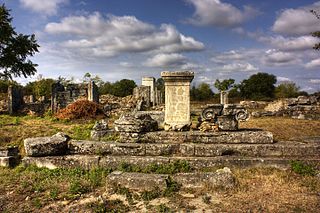
Archaeology News: Secrets of the Bulgarian Pompeii


Bulgarian Pompeii

Archaeologists have begun to explore the Bulgarian Pompeii, an ancient city of Nikopolis-ad-Istrum near Veliko Tarnovo deriving its name from one of the world’s most famous archaeological sites, Pompeii. If you interested in finding out more about exhibits featuring Pompeii, check out my Worlds Most Popular Archaeology Museums.


Image via Wikipedia

Archaeologists are exploring a building dating back to the ruling of Roman emperor Septimus Severus. According to experts, the building was used as temple by the worshippers of Cybele, who was widely known as the goddess of caverns, of the Earth in its primitive state; worshipped on mountain tops.
“So far the archaeologists have found fragments of wall paneling, details of door cases, windows and niches. They are expecting expert results that would enable them to restore the architectural layout of the settlement at the beginning of its history - early 2nd cent. during the reign of Emperor Trajan.”

The classical town of Nikopolis-ad-Istrum was planned according to the orthogonal system. A perfectly orthogonal grid would have entailed significant differences in the distance from the houses to particular structures, or a basilica to outlying public buildings.

“The rich architecture and sculptures show a similarity with those of the ancient towns in Asia Minor.”

Like Ancient Digger? Why Not Follow Us?


Subscribe Via RSS Feed Follow Ancient Digger on Facebook Follow Ancient Digger on Twitter Subscribe to Ancient Digger Via Email

Get widget

Search


Ancient Digger Archaeology Copyright © 2015 LKart Theme is Designed by Lasantha