Monday, August 31, 2009
The Monday Ground Up: Knights Templar the Soldiers of Christ
And so the popes conceived the idea of feudal knights into a militia of Saint Peter that was to be controlled by the clergy. However, the Templar Knights were more of a revival of medieval principles.
With the pressures of the church for a perfect Christian Knighthood, blood was only meant to be shed in the name of a glorious reward for slaying the foe. The Soldiers of Christ would kill swiftly, would serve his interests in dying, and Christs interests in killing.
A contradiction at best where those that protected the word of God would be restricted from holy things, yet when that word was challenged it was met by Christs Soldiers who had no protection themselves.
The leader of the Templars, Hugues de Payns assured the Templars that they were not killing with greed in mind. They were punishing the unjust and unbelievers, seizing the booty that was streaked in sin. During this time and under Payns rule, most of the Templars time was spent plundering.
It's possible that the intentions of Payn and his knights were to retreat into a monastery, or perhaps found a lay confraternity comparable to the hospice of Saint John that had been founded by the merchants of Amalfi to care for pilgrims before the first crusade. ~Piers Paul ReadBrief History of the Templar Order Courtesy of Nights Templar Vault
The Knights Templar Fortifications
The Templars erected many buildings in the west including preceptories, churches, and granges for administration purposes. They were simplistic and utilitarian in form with of course a few exceptions. There was no dictated form of Templar church architecture.
Over the years, misconceptions about the circular construction of temples in Paris have led people to believe that every circular building was constructed by the Templars. However, that was not the case.
Furthermore, the Templars did not the believe that money should be spent on elaborate church construction and ornate accessories. Furthermore, allowing the construction of overblown and over indulgent European castles would only be an economic liability.
Ancient Digger says in 1099, Jerusalem was captured by the crusaders and instead of the complete destruction of Solomons temple, it was turned into a royal palace for the crusaders. In 1119, the temple was turned into the main headquarters for the Knights Templar. Read More about the Mysterious and Mystical Templar Castles, Churches, and Fortresses

Francois Hagnere says "On the road of Santiago de Compostella, the Knights Templar founded a commandery with a frescoed chapel between 1150 and 1160. The place was chosen by the monks-soldiers because a well was located here with the particularity of never getting dry. " Read more about The Knights Templar Fabulous Chapel in Cressac
This photograph is of a Masonic Knights Templar symbol showing a cross within a crown inside a Maltese cross, which has the Latin phrase, “in hoc signo vinces.” The phrase means “in this sign you shall conquer” and was used by Constantine as a military motto in the early 4th Century.Joe Beine’s photographs on Flickr.
Related Articles:
Symbols
The Master of the Knights Templar's great seal was double-sided and showed the picture of The Dome of the Rock on one side and the Order's symbol of two knights on one horse on the other side.There was also a smaller, single-sided seal, which showed the Dome of the Rock (or the circular dome of the Holy Sepulchre).
A different symbol was adopted by each and every Grand Master. In addition, these seals were kept under close watch, often locked in a compartment that could only be opened by a small number of people. The Grand Master and his highest two officials were the only holders of the keys.
Used on the Seal of Etienne de Til-Chatel, lord of Pichanges, Preceptor of La Fontenotte. Representation of a dove, facing backwards and grasping an olive branch within its beak.
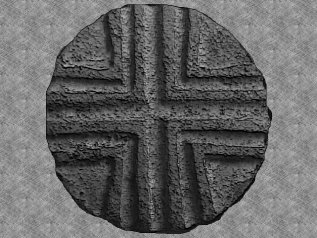
From Hugues de Payens period. Hand carved Grand Seal. Alike wax imprints were found on official documents addressed to Hugues de Payens.Royston Cave
The carvings in the cave include four saints known to have been revered by the Templars. Below the original entrance is St. Christopher, patron saint of travellers, with the child Jesus on his shoulder and staff in hand. Moving to the left high up on the west part of the wall is St. Katherine for whom the Templars had a special regard as it was on St. Katherine's day in 1177 that they had a notable victory over the Saracen Saladin. Farther to the left is St. Lawrence who was martyred on the gridiron.Rosslyn Chapel
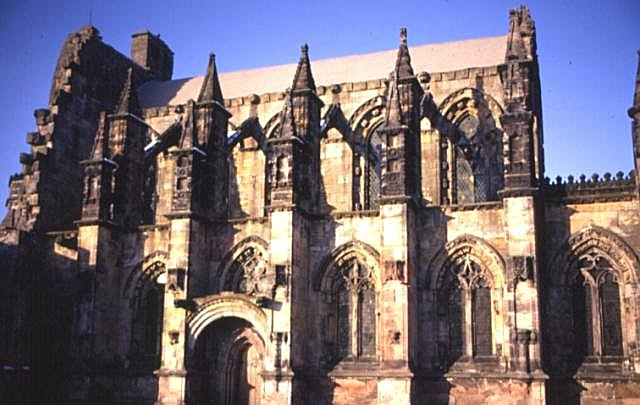
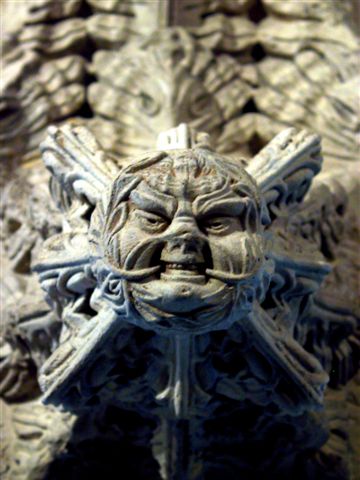
However, as documented by St. Clairs, the symbols did not appear until the late 1800's when restoration work took place instructed by Edinburgh architect David Bryce, a known Freemason.
The connection of the symbols for the Templars and the Masons has always been under scrutiny, however scholars depend on history, and history makes it clear that their was so connection between the two orders. Although, the carvings in the chapel display the Masons as direct descendants of the Templars, which may tell another story.
Legends and Myths
Many of the Templar legends are associated with the Order's early occupation of the Temple Mount in Jerusalem and speculation about what relics the Templars may have found there, such as the Holy Grail or the Ark of the Covenant. These relics have often been portrayed in Hollywood Blockbusters like "National Treasure" and the 'Da Vinci Code".During the Templar trials, a relic came under fire being described as cat, a bearded head, or in some cases as Baphomet.
This accusation of idol worship levied against the Templars has also led to the modern belief by some that the Templars practiced witchcraft. However, modern scholars generally explain the name Baphomet from the trial documents as simply a French misspelling of the name Mahomet (Muhammad).
Patrick Bernauw says "the Story of the Grail was the earliest account of the Quest for the Holy Grail, telling us about Perceval who was raised by his mother in a Welsh forest. When the boy encounters some knights, he realizes he wants to be one. He travels to the court of King Arthur and in his knight’s armour, he sets out for adventure." Read More about Perceval and the Grail of Bruges: By Chrétien De Troyes
Follow Ancient Digger
If you're new to Ancient Digger and you're not sure what subscribing actually means, I'll make it easy for you. Subscribing is a way to follow your favorite blogs though email or another feed reader service you use, like Google. You'll receive an email letting you know I've updated the website with a new story. Or add Ancient Digger to your reader. Subscribing is a great way to keep all of your favorite blogs in one place. If you love this article and want to learn more, subscribe to Ancient Digger. Subscribe to The Ancient Digger by Email![]() |
NeatoHub
Sunday, August 30, 2009
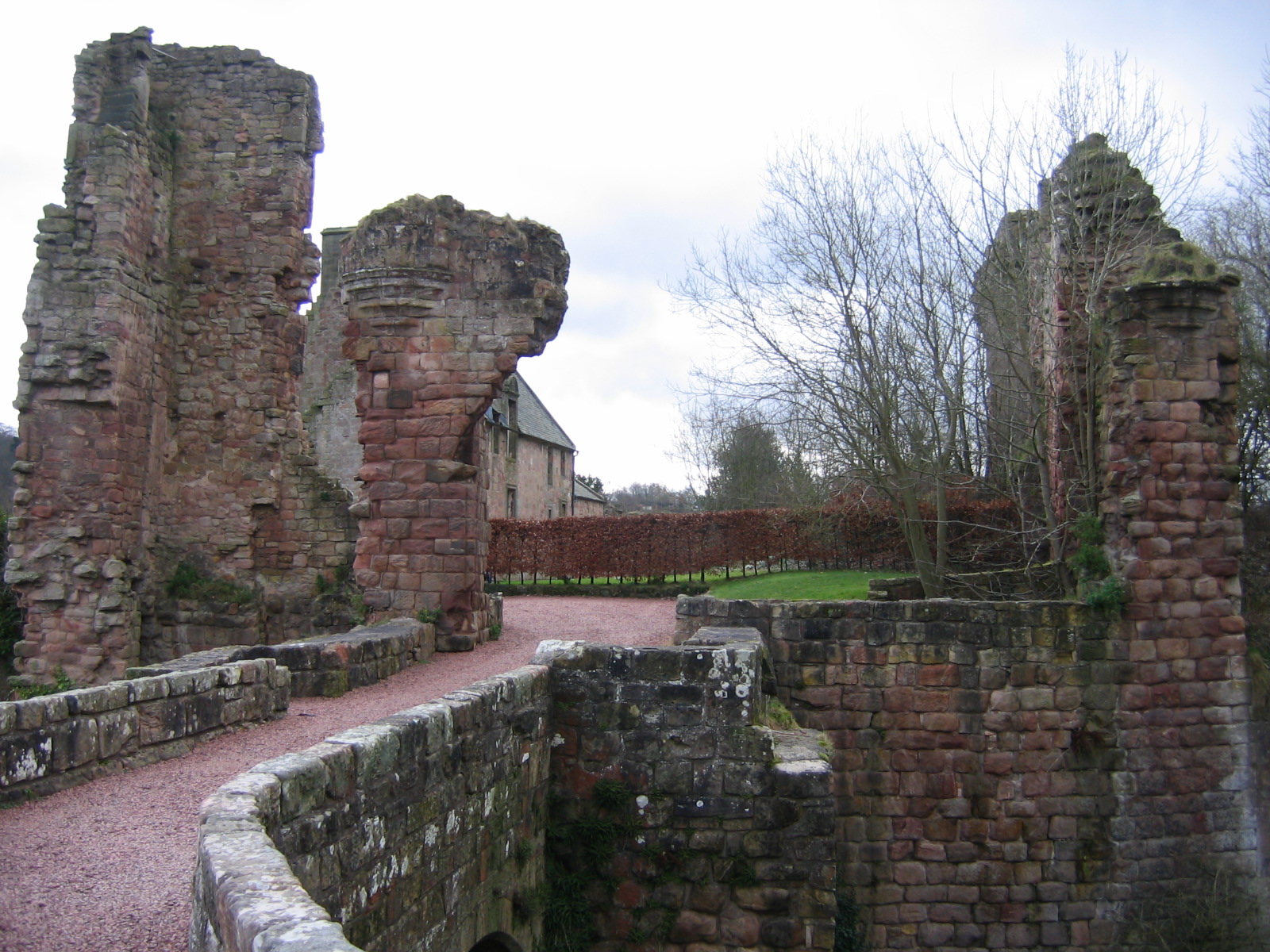
Roslin Castle in Scotland
Keeping with my latest obsession with stone freemasonries, forts, and castles, I happen to stumble upon Rosslyn Castle by accident when I was preparing my weekly Monday Ground Up.
The castle is partly in ruin, but of course that adds to the mystery. Roslin castle is located is a village called Roslin in Midlothian, Scotland. The castle is dated back to the 14th century by the St. Clairs, Earls of Caithness and Barons of Roslin. You may remember that the Sinclair family actually testified against the Templars during their trial in 1309.
The castle was damaged by a domestic fire in 1452, and legend has it that during the domestic fire the Earl was in quite dismay because of his valuable manuscripts, including the Roslin-Hay manuscript, believed to be the earliest extant work in Scots was in danger of being destroyed. However, the they were lowered to safety from a window by his chaplain.
Roslin was more severely damaged by the Earl of Hertford, who burned the castle during the War of the Rough Wooing in 1544. The keep was almost totally destroyed, although its one remaining ruined wall can still be seen.
When the castle was initially in use, there was drawbridge for access to the site. However, after the site was renovated in the 16th century, an elongated, high stone bridge was constructed to take it's place. The upper part of the east range was renovated in 1622, with renaissance details and carvings on the windows and doors.
The current owner, the Earl of Rosslyn, a descendant of the Sinclairs, leases the castle as holiday accommodation via the Landmark Trust.
Resources
- Rosslyn Castle Feature Page on Undiscovered Scotland
- Rampant Scotland: Roslin Castle
- Gazetteer for Scotland: Roslin Castle
Photo 1
Source
Follow Ancient Digger
If you're new to Ancient Digger and you're not sure what subscribing actually means, I'll make it easy for you. Subscribing is a way to follow your favorite blogs though email or another feed reader service you use, like Google. You'll receive an email letting you know I've updated the website with a new story. Or add Ancient Digger to your reader. Subscribing is a great way to keep all of your favorite blogs in one place. If you love this article and want to learn more, subscribe to Ancient Digger. Subscribe to The Ancient Digger by Email![]() |
NeatoHub
Friday, August 28, 2009
Fascinating Castles and Palaces From Around the World

The Classic Fairytale’s Castle: Neuschwanstien Castle is located in the Bavarian Alps of Germany and is the most famous of three Royal Palaces built for Louie II of Barvaria who was sometimes referred to as Mad King Ludwig. It was started in 1869 and wasn’t finished when Louie died in 1886. This castle is certainly one of romance in the 19th century and could set your imagination stirring at a glance especially where it is set with towers and spires. It is set on a high point of the Pullat River gorge, just the place for a knight in shining armor to come riding on a white horse to rescue the damsel in distress. Believe it or not this castle had running water on all floors back then, toilets that flushed and a warm air heating system for every floor. by Betty Carew
Follow Ancient Digger
If you're new to Ancient Digger and you're not sure what subscribing actually means, I'll make it easy for you. Subscribing is a way to follow your favorite blogs though email or another feed reader service you use, like Google. You'll receive an email letting you know I've updated the website with a new story. Or add Ancient Digger to your reader. Subscribing is a great way to keep all of your favorite blogs in one place. If you love this article and want to learn more, subscribe to Ancient Digger. Subscribe to The Ancient Digger by Email![]() |
NeatoHub
Thursday, August 27, 2009
Romanesque Art and Symbolism: The Church of La Gripperie Saint-symphorien

Once again Francoise Hagnere stirs my curiosity with an amazing tale of La Gripperie in France. Whats interesting about this Church is the placement of the carvings. There are some over the arched doorways and in places you don't suspect.
Driving through the marshes, we suddenly reached the skirt of a wood. Here in the meadow was erected a gem of the Romanesque Art in Saintonge. A miraculous fountain where pilgrims used to come on August, 22, gave the church of La Gripperie Saint-Symphorien its reputation. The XIIth century parts and décor really are noteworthy.
Follow Ancient Digger
If you're new to Ancient Digger and you're not sure what subscribing actually means, I'll make it easy for you. Subscribing is a way to follow your favorite blogs though email or another feed reader service you use, like Google. You'll receive an email letting you know I've updated the website with a new story. Or add Ancient Digger to your reader. Subscribing is a great way to keep all of your favorite blogs in one place. If you love this article and want to learn more, subscribe to Ancient Digger. Subscribe to The Ancient Digger by Email![]() |
NeatoHub
Wednesday, August 26, 2009
Forts, or rather Fortifications in Florida
Do you really want to know what started all of this?

When I was about 10 years old, my mother brought me to the Castillo de San Marco's in Saint Augustine where I found myself crawling on my knees into the dungeon that was sealed up for 100 years, only to be opened up by American soldiers in 1819. Really Creepy! It was this fortification that made me love Archaeology.
So today, I thought it would be a great idea to embark on a new location, but like I said, I couldn't find one nearby. Even the ones that I did find were virtually impossible to navigate or the remnants of the structures were completely gone, so I would have needed a land surveyor or historian with me to know what is was I was looking at.
I even rummaged through Wikipedia pages and couldn't find one that had any information. And when I say no information, the page was empty. What happened and why are these places not being excavated?
Your thoughts on this?
Read more about the Castillo de San Marco's
Florida Forts
Follow Ancient Digger
If you're new to Ancient Digger and you're not sure what subscribing actually means, I'll make it easy for you. Subscribing is a way to follow your favorite blogs though email or another feed reader service you use, like Google. You'll receive an email letting you know I've updated the website with a new story. Or add Ancient Digger to your reader. Subscribing is a great way to keep all of your favorite blogs in one place. If you love this article and want to learn more, subscribe to Ancient Digger. Subscribe to The Ancient Digger by Email![]() |
NeatoHub
Tuesday, August 25, 2009
What's on Discovery Channel Tonight?
Out of Egypt: Dr. Kara Cooney
I was exceedingly impressed with the information Kara provided. My knowledge of the pyramids is quite limited, but with the help of Dr. Cooney, I was able to explore so many more aspects of the structures, as well as the reasoning behind them.Dr. Kara Cooney is an Assistant Professor of Egyptian Art and Architecture at UCLA. She earned her PhD in Near Eastern Studies from Johns Hopkins University in 2002. She has been part of archaeological excavations in Egypt at the craftsmen’s village of Deir el Medina, the royal temple site of Dahshur and various elite Theban tombs. She is published under the name Kathlyn M. Cooney, but called Kara by everyone.
Cleopatra: A Portrait of a Killer
This one hour special discussed the Ptolemaic dynasty of Egypt. Cleopatra was painted as an evil and conniving seductress who initially led Caesar to entrap her sister Arsinoë IV at Ephesus, a sanctuary where she was murdered by Roman soldiers.Of course, this is where it gets interesting. The tomb of Arsinoë was identified by Hilke Thür with an octagonal monument situated in the centre of Ephesus. This was the first member of the Ptolemaic dynasty to have ever been found.
In April, Archaeologists found possible locations, or rather tombs in Egypt that may also hold the bodies of Cleopatra and Antony.
Archaeologists last year unearthed the alabaster head of a Cleopatra statue, 22 coins bearing Cleopatra's image, and a mask believed to belong to Mark Antony at the temple. Read more about the Cleopatra discovery
Follow Ancient Digger
If you're new to Ancient Digger and you're not sure what subscribing actually means, I'll make it easy for you. Subscribing is a way to follow your favorite blogs though email or another feed reader service you use, like Google. You'll receive an email letting you know I've updated the website with a new story. Or add Ancient Digger to your reader. Subscribing is a great way to keep all of your favorite blogs in one place. If you love this article and want to learn more, subscribe to Ancient Digger. Subscribe to The Ancient Digger by Email![]() |
NeatoHub
Monday, August 24, 2009
The Monday Ground Up: Celtic Druid Folklore and the Otherworld
This belief of reincarnation is quite different than Hinduistic rituals where reincarnation affected all those that were worthy. The druids believed that their souls, even when they were long gone, would be able to control their body in the otherworld.
The otherworld was believed to be a place where men and women lived in complete happiness in a land that was lush and plentiful. Not to be confused with the underworld which was filled with pale wanderers and gloomy landscapes.
During the 17th century, poets versed the otherworld as a "Land of the Living", where beautiful woman are plentiful and bright birds fly with ease through the river valleys. Once there, you will overcome all. However, when you leave your hair will turn gray and your skin will shrivel. Read the entire story 0f the otherworld (You will be redirected to Socyberty)
Iron age Britain was populated by an ancient, indigenous people called the Celts. Spreading from Ireland, across mainland Britain and right into Europe, the Celts were a superstitious people with a rich mythology and ritualistic religious practice. Human Sacrifice in Celtic Britain By CaSundara
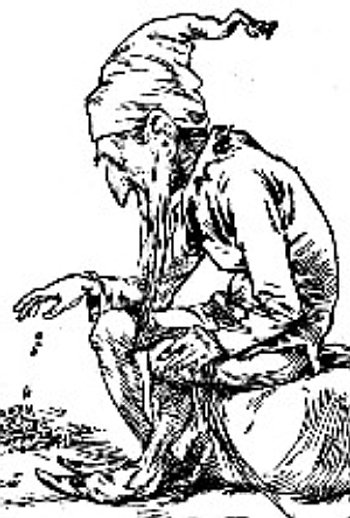
Celtic folklore is full of interesting creatures, unusual stories, and superstitions that still fascinate us. Some of those legends still thrive in books, novels, and modern celebrations, keeping a handful of unique Celtic myths familiar to audiences.Celtic Myths: Selkies, Banshees, and Leprechauns By writecornerHigh stone pillar adjacent to the Druid's Temple near Ilton


A reconstructed Celtic burial mound located near Hochdorf in Germany. Such burials were reserved for the influential and wealthy in Celtic society.
- Celtic Art & Cultures: a detailed description of the Gundestrup cauldron
- Celtic Religion - What Information do we really have
- Pretanic World - Celtic Pantheons
- What We Don't Know About the Ancient Celts
- Timeless Myths: Celtic Mythology Myths and legends from Celtic Ireland, Scotland, Wales and Brittany.
- Newgrange.com
- Irish passage tombs and other Neolithic monuments
- 101 Facts About Newgrange
- Boyne Valley Portal Website - Information on Newgrange
- Research on Newgrange's possible alignment
- MegalithicIreland.com
Follow Ancient Digger
If you're new to Ancient Digger and you're not sure what subscribing actually means, I'll make it easy for you. Subscribing is a way to follow your favorite blogs though email or another feed reader service you use, like Google. You'll receive an email letting you know I've updated the website with a new story. Or add Ancient Digger to your reader. Subscribing is a great way to keep all of your favorite blogs in one place. If you love this article and want to learn more, subscribe to Ancient Digger. Subscribe to The Ancient Digger by Email![]() |
NeatoHub
Saturday, August 22, 2009
Seaside Strongholds in Charente Maritime
The fort was built at the end of the XVIIIth century in order to ensure the protection of the mouth of the Charente, as well as the Royal Fountain. This fountain was erected in 1671 to supply the King’s ships in potable water from a source underneath the river. With those of Brest and Belle-Ile, the Fontaine Lupin remains one of the last three ships watering places of France. The ships built in the Rochefort arsenal all stopped here. The frigate L’Hermione, on which LaFayette set sail to America to help the Insurgents, was also fed here. The fort was built from 1683 to 1686 by the great engineer Vauban (1633-1707)and was listed in 1950. By Francoise Hagnere
Follow Ancient Digger
If you're new to Ancient Digger and you're not sure what subscribing actually means, I'll make it easy for you. Subscribing is a way to follow your favorite blogs though email or another feed reader service you use, like Google. You'll receive an email letting you know I've updated the website with a new story. Or add Ancient Digger to your reader. Subscribing is a great way to keep all of your favorite blogs in one place. If you love this article and want to learn more, subscribe to Ancient Digger. Subscribe to The Ancient Digger by Email![]() |
NeatoHub
Pierre Montet's Discovery of the Tombs at Tanis

Just about everyone is familiar with the discovery of King Tutankhamun's tomb in the Valley of the Kings. But did you know that there was an equally, if not more, amazing discovery made in Egypt in 1939 by a French archaeologist by the name of Pierre Montet? This discovery would have enthralled the world, much like Tut's tomb did, had it not been overshadowed by the outbreak of World War II. Pierre Montet had uncovered not one, but three royal tombs at the lost city of Tanis and hardly anyone noticed. Read More about the Discovery of the Tombs at Tanis
by Shelly Barclay
Follow Ancient Digger
If you're new to Ancient Digger and you're not sure what subscribing actually means, I'll make it easy for you. Subscribing is a way to follow your favorite blogs though email or another feed reader service you use, like Google. You'll receive an email letting you know I've updated the website with a new story. Or add Ancient Digger to your reader. Subscribing is a great way to keep all of your favorite blogs in one place. If you love this article and want to learn more, subscribe to Ancient Digger. Subscribe to The Ancient Digger by Email![]() |
NeatoHub
Friday, August 21, 2009
What's Underneath? Why Archaeologists study what's already been discovered
Archaeologists go to school for years, pick a topic like the pyramids or Greek architecture, and then focus their studies on those structures that have been studied and researched so many times before.
I'm not saying that all archaeologists follow this path, but what I am saying is that many don't take chances, therefore they hide behind a desk reading about another persons discovery and say to themselves, 'I want to do that too".
So when do you start to think about what actually exists beneath the structures that have already been discovered? When do you start asking questions about what was there before and how can you find that information out?
Of course, as everyone already knows, I am in the beginning stages of my life in Archaeology. However, I think what made me a bit concerned about my direction was when I told my fiance that there was nothing interesting to study here in Florida. I though my attitude was a bit short-sided and I had to check myself for a moment.
Then I started to think about the surrounding areas and the parks that I often visit with my dogs when I go hiking. I started to dig deeper and what I found was truly astounding. I found no records or information about a certain natural springs park I visit quite often and I wondered what was there before.
Isn't it a fact that early civilizations made their homes near fresh water, mainly for trade purposes, transportation routes, and of course food? So if this spring had been running for hundreds of years, why was there so little information about it?
Once I get to the bottom of my discovery, I will surely share it with all of you.
The moral of this rant, so to speak, is that you have to take the structures you see everyday and start asking questions. What was there before?
The most interesting aspect about Archaeology is new discoveries, so if you're not getting dirty, your not working hard enough to uncover the secrets left all over the world.
Here are some areas that need some more attention.
Bosnian Pyramids

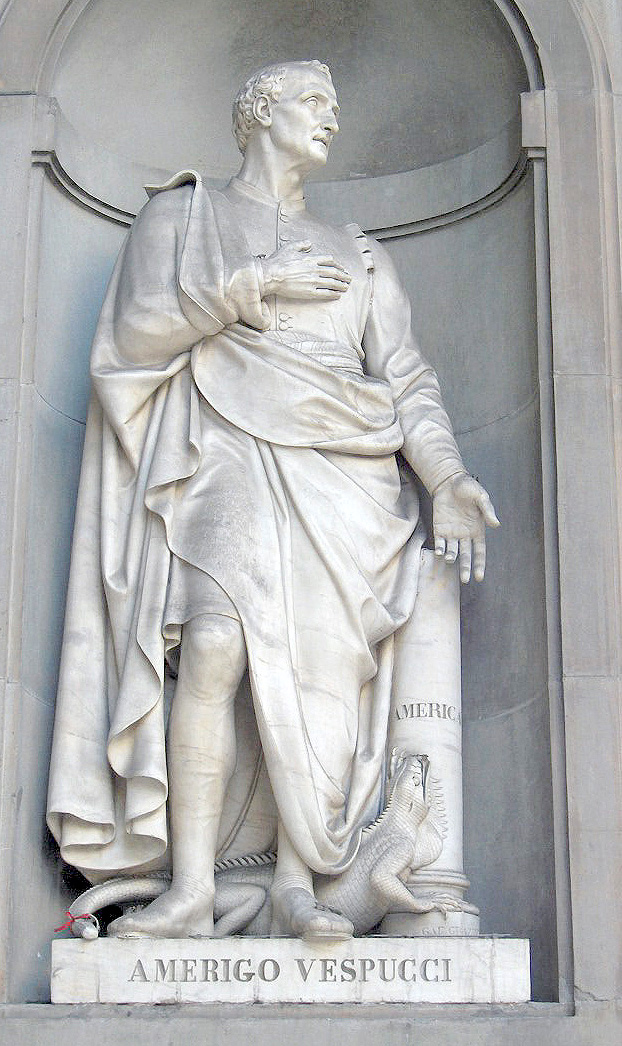
Amerigo Vespucci
Follow Ancient Digger
If you're new to Ancient Digger and you're not sure what subscribing actually means, I'll make it easy for you. Subscribing is a way to follow your favorite blogs though email or another feed reader service you use, like Google. You'll receive an email letting you know I've updated the website with a new story. Or add Ancient Digger to your reader. Subscribing is a great way to keep all of your favorite blogs in one place. If you love this article and want to learn more, subscribe to Ancient Digger. Subscribe to The Ancient Digger by Email![]() |
NeatoHub
Tuesday, August 18, 2009
Illustrious and Historical Legends, Tales, and Myths of The World
Atlantis is a fabled city on the floor of the sea worn ocean, covered by a massive tidal wave centuries ago. In an attempt to rid the notion that Greeks had accomplished a superior race of man, the Egyptians told Solon the story of Atlantis, where thousands of years before the noblest of men ruled the world. Read More about Myths and Tales of the world
Also check out:
Follow Ancient Digger
If you're new to Ancient Digger and you're not sure what subscribing actually means, I'll make it easy for you. Subscribing is a way to follow your favorite blogs though email or another feed reader service you use, like Google. You'll receive an email letting you know I've updated the website with a new story. Or add Ancient Digger to your reader. Subscribing is a great way to keep all of your favorite blogs in one place. If you love this article and want to learn more, subscribe to Ancient Digger. Subscribe to The Ancient Digger by Email![]() |
NeatoHub
Neanderthals Likely Didn't Like Brussels Sprouts: Discovery News
Spanish researchers say they're a step closer to resolving a "mystery of evolution" -- why some people like Brussels sprouts but others hate them.They have found that a gene in modern humans that makes some people dislike a bitter chemical called phenylthiocarbamide, or PTC, was also present in Neanderthals hundreds of thousands of years ago. Read more about Neanderthals Likely Didn't Like Brussels Sprouts: Discovery News
Follow Ancient Digger
If you're new to Ancient Digger and you're not sure what subscribing actually means, I'll make it easy for you. Subscribing is a way to follow your favorite blogs though email or another feed reader service you use, like Google. You'll receive an email letting you know I've updated the website with a new story. Or add Ancient Digger to your reader. Subscribing is a great way to keep all of your favorite blogs in one place. If you love this article and want to learn more, subscribe to Ancient Digger. Subscribe to The Ancient Digger by Email![]() |
NeatoHub
Monday, August 17, 2009
The Monday Ground Up: Ancient Symbols of the Theosophical Society
Several years after the society was formed, Blavatsky and Olcott moved to India to establish the International Headquarters at Adyar, Madras (Chennai). While in India, they became exceedingly interested in eastern religions so they were also included in the societies agenda.
After several iterations the Society's objectives have evolved to be:
- to form a nucleus of the universal brotherhood of humanity without distinction of race, creed, sex, caste, or colour.
- to encourage the study of comparative religion, philosophy, and science.
- to investigate the unexplained laws of nature and the powers latent in man.
Unfortunately, these ideologies were completely mixed up by Guido von Lizst who included nationalistic and fascist ideas with Blavatsky's ideals; this system of thought became known as Ariosophy.
Unlike Theosophists (whose first objective was "to form the nucleus of a Universal Brotherhood of Humanity without distinction of race, colour, or creed"[10]), "The Thule Society preached Aryan supremacy and acted to achieve it. It provides the final link between occult racial theories and the racial ideology of Hitler, who skewed the fundamental principles of and understandings for sociological and economic control by the emerging Nazi party."[11]

Thanks to the historians, professors, and scholars over at Historum, I was able to to decipher the meaning and relationship of the star of David included on this emblem. However, the truth is, this star doesn't represent what everyone thinks it does.
Star of David
Here are some of the insights provided:
"Well put it this way, the six-pointed star is NOT a Jewish symbol since it's totally absent from the Torah-- not found in there. This symbol re-appears within the religion in the Medieval era.
It's generally known to be an occultic symbol of pagan origins, much like the rest of most mainstream symbols." Oracle_of_Truth
"Well the hexagram, or, star of david as it is called when in a Jewish context, was actually a common symbol used by Christians as well (as well as many other religious, such as Islam and Hinduism), so in that emblem it does not necessarily have to denote any sort of connection to Judaism. Actually the symbol frequently has no connection at all to Judaism and is one of the most ancient recorded symbols we have.
It has also frequently been associated with occultism in general, and was a very common symbol in many emblems of the Freemasons and is on nearly every Masonic temple or structure that exists." Alex III
"The Shield of David (magen David - not star, but shield) as it is called by the Jews, is actually not a star at all or a hexagram - but two triangles intertwined. It was USED by David as his emblem, no one ever claimed he INVENTED it, and was indeed a symbol already in his time. Has philosophy behind it, like every other symbol.
There is NO connection between it and the bible, but it was adopted by Judaism as one of its symbols because of its meaning to kind David (one of the most revered figures in Judaism).
Just as the cross was not a Christian invention, the crescent was not an Arab invention, the swastika was not a Nazi invention..." Vera
"And the sign above the swastika is "OM" written in devanagari ......
OM stands for Brahman ........
You probably know it from the mantra : om mani padme hum ........" Merlin
Brahman(OM)
SourceMaharishi Mahesh Yogi's view on Brahman
In his writings on the Bhagavad Gita, Maharishi Mahesh Yogi defines Brahman as follows:[14]
Brahman, which is an all-pervading mass of bliss, does not exhibit any quality of bliss. It may be likened to a mass of energy- matter - which does not exhibit any quality of energy... Brahman is that which cannot be expressed into words, even thought the Upanishads use words to educate about Its nature. In the field of speech, Brahman lies between two contrary statements. It is absolute and relative at the same time. It is the eternal imperishable even while It is ever changing. It is said to be both This and That. It is spoken of as Sat-Chita-Ananda but includes what is not Sat, what is not Chit, and what is not Ananda. It is beyond speech and thought, yet the whole range of thought and speech lies within It. ‘Within It’ and ‘without It’ are just expressions, and like any other expressions about Brahman they do justice neither to Brahman nor to the speaker nor to the listener. Brahman is lived by man with ease but cannot be spoken of, in the sense that words are inadequate to encompass That which is the unlimited fullness of transcendental Being and the fullness of active life at the same time. Verse 29 of Chapter II (of the Bhagavad-Gita) speak of It as a “wonder”, for it is not anything that can be conceived of intellectually; it is not anything that can be appreciated by emotion…Brahman is the value of our life and the truth of it is that it is lived ‘with ease'.
Ankh

Source
Swastika

Source
For centuries, the swastika has appeared on several shards in Iran and on pottery found in parts of Russia. "Indian swastika symbols were found at Lothal and Harappa, on Indus Valley seals."
The most interesting aspect of the symbol is that it has appeared in so many cultures, suggesting that it did represent a unity of ideals. However, in some cases that hypothesis can not be supported and the symbol is shrouded with hate and blood.
Ouroboros
The Ouroboros is a symbol that is associated with many different religions and customs, and is also claimed to be related to Alchemy. The Ouroboros is a snake eating its own tail in the shape of a circle, representing demonstration of one's own life and resurrection, leading to immortality.
Artifacts Displaying the Symbols in Different Cultures:
Source
Temple carving at Hoysaleswara temple representing the Trimurti: Brahma, Shiva and Vishnu.
Source
Seals from the Indus Valley Civilization preserved at the British Museum.

Source
This Iranian necklace was excavated from Kaluraz, Gilan, first millennium BC, National Museum of Iran.

Source

Source
An Osiris Pillar of Senusret I from the 12th Dynasty

Source
The Star of David in the oldest surviving complete copy of the Masoretic text, the Leningrad Codex, dated 1008.

A page from a 14th century manuscript of the Guide for the Perplexed by Maimonides. The figure seated on the chair with Stars of David is thought to be Aristotle.
That concludes this edition. Submit your blog article to the next edition of
the ancient digger monday ground up using our carnival submission form.
Technorati tags:
the ancient digger monday ground up, blog carnival.
Follow Ancient Digger
If you're new to Ancient Digger and you're not sure what subscribing actually means, I'll make it easy for you. Subscribing is a way to follow your favorite blogs though email or another feed reader service you use, like Google. You'll receive an email letting you know I've updated the website with a new story. Or add Ancient Digger to your reader. Subscribing is a great way to keep all of your favorite blogs in one place. If you love this article and want to learn more, subscribe to Ancient Digger. Subscribe to The Ancient Digger by Email![]() |
NeatoHub
Saturday, August 15, 2009
HMS Ocelot, Chatham Dockyard, UK
This was the case of the HMS Ocelot, located in Chathem Dockyard, United Kingdom. This massive structure has had a world-wind of historical experience.
She was launched on May 5, 1962 and commissioned for service on January 31, 1964. The HMS Ocelot was the very last diesel-electric sub built for the Royal Navy at Chatham Dockyard. Read more about the HMS Ocelot

Follow Ancient Digger
If you're new to Ancient Digger and you're not sure what subscribing actually means, I'll make it easy for you. Subscribing is a way to follow your favorite blogs though email or another feed reader service you use, like Google. You'll receive an email letting you know I've updated the website with a new story. Or add Ancient Digger to your reader. Subscribing is a great way to keep all of your favorite blogs in one place. If you love this article and want to learn more, subscribe to Ancient Digger. Subscribe to The Ancient Digger by Email![]() |
NeatoHub
Friday, August 14, 2009
Trip to Mahabalipuram or Mamallapuram: Chapter 1: The Shore Temple, Mahabalipuram
So the total distance of Mahabalipuram from Bangalore is about 342 km. We had nice breakfast of Pongal near Hosur. Then, we continued our journey and after about 6 hours we reached Mahabalipuram. Mahabalipuram also known as Mamallapuram is a town in Kanchipuram district in the Indian state of Tami Nadu. Mahabalipuram was a 7th century port city of the South Indian dynasty of the Pallavas around 60 km south from the city of Chennai in Tamil Nadu. It is believed to have been named after the Pallava king Mamalla.
Follow Ancient Digger
If you're new to Ancient Digger and you're not sure what subscribing actually means, I'll make it easy for you. Subscribing is a way to follow your favorite blogs though email or another feed reader service you use, like Google. You'll receive an email letting you know I've updated the website with a new story. Or add Ancient Digger to your reader. Subscribing is a great way to keep all of your favorite blogs in one place. If you love this article and want to learn more, subscribe to Ancient Digger. Subscribe to The Ancient Digger by Email![]() |
NeatoHub
Ancient Digger's Big Award
Follow Ancient Digger
If you're new to Ancient Digger and you're not sure what subscribing actually means, I'll make it easy for you. Subscribing is a way to follow your favorite blogs though email or another feed reader service you use, like Google. You'll receive an email letting you know I've updated the website with a new story. Or add Ancient Digger to your reader. Subscribing is a great way to keep all of your favorite blogs in one place. If you love this article and want to learn more, subscribe to Ancient Digger. Subscribe to The Ancient Digger by Email![]() |
NeatoHub
Wednesday, August 12, 2009
Wandjina Petroglyphs Representing Aliens 5000 years ago
The Wandjina Petroglyphs are a perfect example of this. It's odd really. Today we tend to describe these extra terrestials in the way of small heads, a flat mouth, and no nose. However, according to Aboriginal mythology, if these creatures were seen with no mouths, the rain would never end.
Wandjinas are believed to have made the sea, the earth and all its inhabitants.The existing rock art found, has depicted them as having huge upper bodies and large heads. Their faces show eyes and nose, but typically lack mouths. Around the heads of Wandjinas there appears to be lightning and feathers. The Wandjina is thought to have special powers and if offended, can cause flooding and
intense lightning. The paintings are still believed to have special powers and
therefore are to be approached cautiously.
Wanjina Rock Art


Source
Also check out:
Mysterious Crop Circles
Follow Ancient Digger
If you're new to Ancient Digger and you're not sure what subscribing actually means, I'll make it easy for you. Subscribing is a way to follow your favorite blogs though email or another feed reader service you use, like Google. You'll receive an email letting you know I've updated the website with a new story. Or add Ancient Digger to your reader. Subscribing is a great way to keep all of your favorite blogs in one place. If you love this article and want to learn more, subscribe to Ancient Digger. Subscribe to The Ancient Digger by Email![]() |