• Ancient Digger teaches Archaeology and History to all Ages!

Monday, July 16, 2012

Ancient Digger Composer Mary Gunderson Introduces Mystic Score


A few years ago, Mary Gunderson composed a theme song for a little blog, which eventually became Ancient Digger. Her music transcends the boundaries of ancient lands and mysterious characters, entrenched in passion and love, fate and understanding.

Her inspiring compositions have once again turned into a musical triumph called Mystic Score.

This new CD is compilation of cultural songs which touch on the subjects of Bollywood, Arabian Nights, the mysteries of the Egyptians temples, Indigo Nights, Native American rituals, as well as some tribal melodies which transport you to the farthest reaches of the earth.

It would be hard for me to pick a favorite song, as most of Mary’s music always helps me draw inspiration when I’m lacking in that particular department.

This CD, I believe, represents what Ancient Digger is really about, and the many subjects and cultures we try to investigate and represent.

The song "In the Courts of Pharaoh" is a fascinating trip through the hieroglyphic carved walls of Pharaoh’s tomb, and Dances with Fire is a stirring and provocative song which tempts the very nature of what we believe is sacred. Siddha Bhakti, most certainly a favorite of mine, is simply a soothing and comforting invocation of the gods, the earth, and nature.

If you draw inspiration from music like I do, and you appreciate music that embodies global cultures, then you will love Mystic Score.


Mystic Score is available at Wise Awakenings for $12.00

You may also here a sampling of Mary’s music at Soundcloud.

Friday, August 19, 2011

Archaeologists Do NOT Do Dinosaurs


The problem with archaeology is that most people have no idea what it is or what it entails. There are no fedoras or leather whips and no dinosaurs chasing us around dinosaur alley. So what is the difference? Well, before I let you lose on this hilarious video, I’ll clue you in on the differences between paleontologists and archaeologists.

First I’ll ask you one question. How many of you have seen or heard the Payless commercial about being a paleontologist? You may have noticed those large skeletal beasts in the background. Those are dinosaurs and archaeologists don’t study them, paleontologists Do.

Paleontology is the study of the history of life on Earth, as reflected in the fossil record. They don’t just study dinosaurs, however.

Like Indiana Jones, archaeologists study artifacts. Artifacts are things like tools and pots and other implements made and used by people. Ecofacts are the remains of plants or animals that were used by or eaten by people. Archaeologists also study landscapes, and there is a particular field called Landscape Archaeology, which allows the study of the modified landscapes and the behavior put forth to alter it.

Without further ado, here’s “We Don't Do Dinosaurs!” (The Archaeology Song). Raise your Trowels or a pint a beer, because this is a great ending to a hectic week.

Happy Friday!

Saturday, July 23, 2011

Hilarious Archaeology Song Improv


This Archaeology song was created at an improv club. The game is called the Pointing Song and the audience has chosen the word “archaeology”.

You’ll either find this incredibly funny or terribly stupid. I mean, when a comedian sings about digging up old poop and loving it, you can’t go wrong..*smile*.

Wednesday, July 20, 2011

“The Sounds of Prehistory”


“The Sounds of Prehistory” is a performance that took place at the XXIV Valcamonica Symposium, using Paleolithic musical instruments.

 paleolithic instruments

The Valcamonica Symposia brings out the most skilled specialists in prehistoric and tribal art, but it’s also a platform to share skills and knowledge in an interdisciplinary context, which often includes prehistory, archeology, anthropology, ethnology, story of the art, story of the religions, psychology, philosophy and linguistics. 

The video is in Italian, but the samples of prehistoric music are relatable to all art and music lovers. Enjoy!

Friday, February 25, 2011

In the Days of Pharaohs and Deities


If you loved "The Mummy", you're going to love this ancient Egyptian music, composed by my friend Mary Gunderson. As many of you already know, Mary composed the Ancient Digger theme song, but she also composes my music for slideshows and projects.

This piece entitled  In the Days of Pharaohs and Deities is an epic tale of ancient peoples traveling through the desert. Pharaohs fighting on chariots. The gods overlooking the construction of the pyramids.


In the Days of Pharaohs and Deities by maryslyrics

If you loved this piece, make sure to check out Mary's information at the bottom of the page, as well as 1149Productions.

Monday, August 9, 2010

Monday Ground Up: The Famous Teatro Olimpico By Palladio in Vicenza Italy


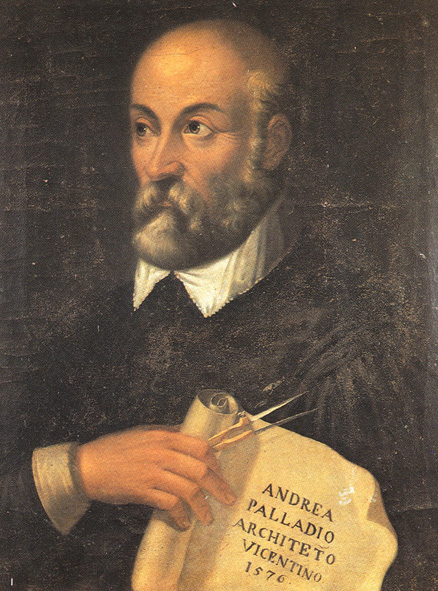
The Teatro Olimpico, located in Vicenza, northern Italy, was constructed in 1580-1585 AD. The theater is one of three of the world’s oldest surviving Renaissance theaters and is the world’s oldest indoor theater.The Teatro Olimpico is the last work of renowned architect Andrea Palladio.

In 1570, Palladio published I Quattro Libri dell' Architettura [The Four Books of Architecture]. This literary work cemented Palladio's place in architectural history. 

"The book set out Palladio's architectural principles as well as practical advice for builders. The most critical element, perhaps, was the set of meticulous woodcut illustrations drawn from Palladio's own works to illustrate the text. The work was subsequently translated into every European language and remains in print today both in paperback and hardcover".~Boglewood

Palladio is widely considered to be one of the most influential figures in European architecture.

Construction of Teatro Olimpico

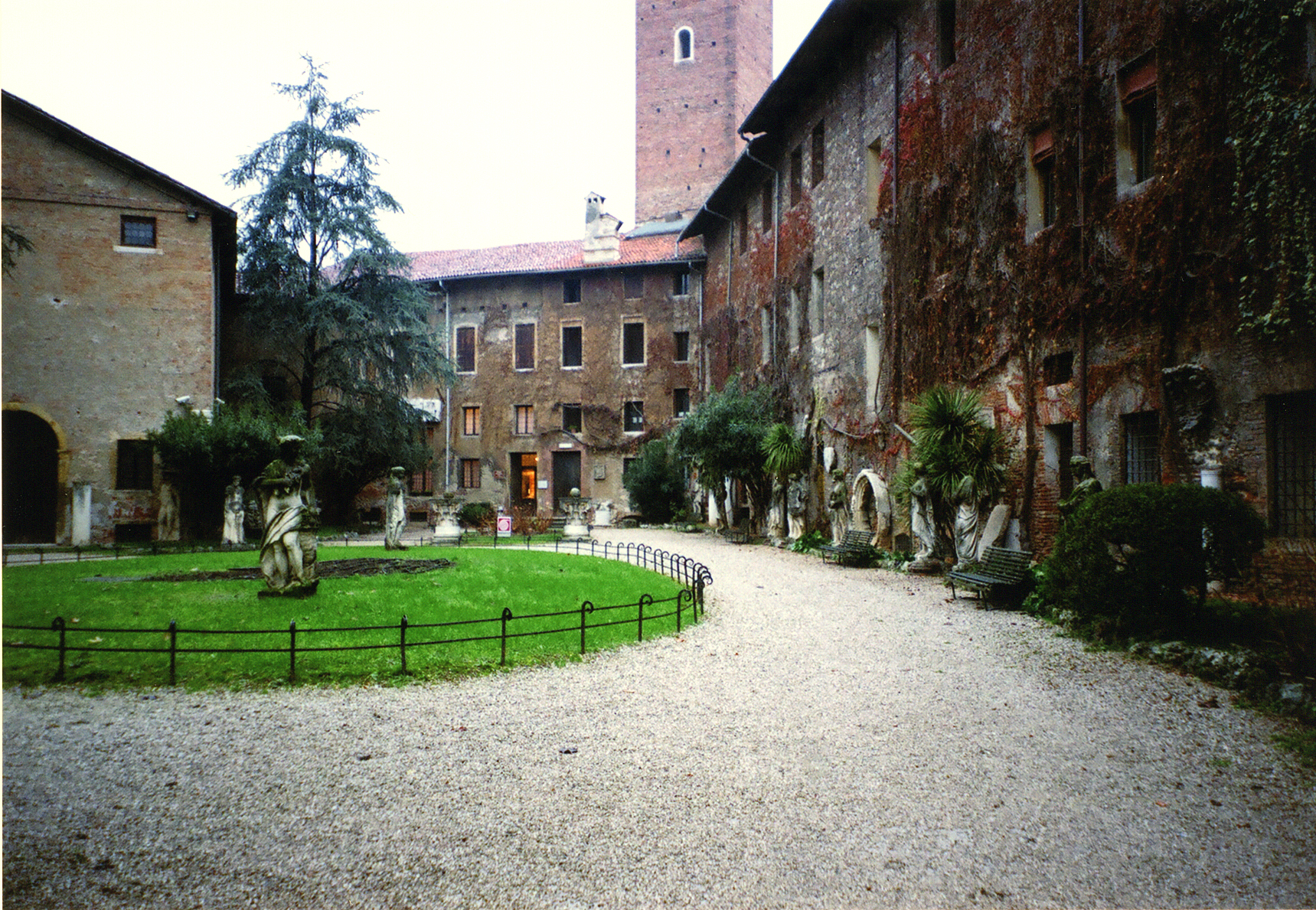
Commissioned by the Olympic Academy in 1580, Teatro Olimpico was constructed upon the site of a medieval fortress, used as a prison and powder store.

Palladio planned the design for Teatro Olimpico in 1579, planning a classically inspired structure using sketches and drawings. Unfortunately, Palladio passed in August 1580, only six months after the construction of Teatro Olimpico started. The sketches and drawings Palladio scribed were used by Vincenzo Scamozzi, a Venetian architect that inherited Palladio’s project.

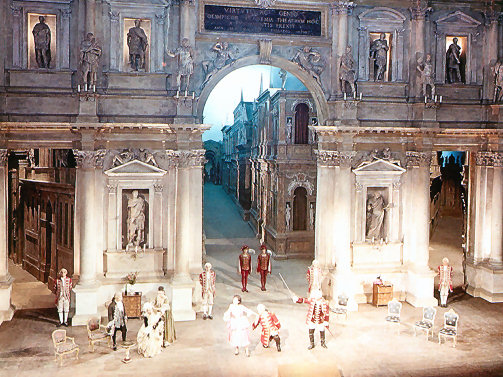
Vincenzo had an excellent starting point with the sketches provided by Palladio, however Palladio never produced designs for the stage floor of Teatro Olimpico. Scamozzi completed this project himself, fashioning a stage made out of wood and stucco. The stage was meant to be temporary, however it survived and remains in the Teatro Olimpico today.

Image via Wikipedia

There are also two rooms designed by Vincenzo Scamozzi at the Teatro Olimpico, those being the Odèo and Antiodèo, as well as the original entrance “archway which leads from the street, through an old medieval wall into the courtyard of the old fortress”.

Image via Wikipedia

Scamozzi's stage set at the Teatro Olimpico was the first practical introduction of perspective views into Renaissance theatre. The scenery consists of seven hallways decorated to create the illusion of looking down the streets of a city from classical antiquity. The way in which seats in all parts of the theatre were provided with at least one perspective view can be seen by observing the theatre floor plan and following the sight lines of audience members in different parts of the theatre.


Operation of the Teatro Olimpico


On March 3rd, 1585, Teatro Olimpico was inaugurated with a performance of Sophocles’ Oedipus Rex. Sadly, only a few more performances took place after that, and then the theater was abandoned. A performance of Oedipus the King took place in 1997 at the Teatro Olimpic using the original lighting by Scamozzi.

 Source (Bob And Jenny's Bed and breakfast in Italy )

Today, the Teatro Olimpico still hosts musical performances and plays, but on a smaller scale for conservative reasons of course. Classical plays take place in the autumn and the festival II Suono dell’Olimpico in the spring. Every June, Palladio's Teatro Olimpico is used for the graduation ceremony for students from the American Department of Defense high school in Vicenza.

Influence of the Teatro Olimpico

Teatro Olimpico stands to represent one of the most influential architects in the history of European theater, Palladio. Unlike many of its counterparts, the Globe Theater in London, the Teatro Olimpico still stands in its original state. It remains as a significant historic link to the Renaissance stage.

“The Palladian project reconstructed the Roman Theater with an archaeological precision.”

Centro de Studi Architettura Andrea Palladio

More Related Content

The Greeks were gifted, being situated in an area with the highest quality stone. Of course the buildings that were derived from these stones were free of bronzed sculptures, polished monuments, and shrines painted with vivid colors. Monday Ground Up: Greek Architecture

The Sumerian cities were surrounded by walls, much like the Forbidden City, as a way to keep their culture secret and sacred. Sumerian city dwellings were constructed out of sun-dried bricks, including peasant quarters and the larger dwellings of priestly and civic officials.Monday Ground Up: Sumerian Cities

Although the Romans had depended greatly on the ideals of the Greeks when adopting their art and literature, they themselves developed some of the most innovative of inventions that succeeded Western Civilization. The evolution of Roman law which brought about the idea of a systematic principle for justification, the invention of roads allowed for easier transit for soldiers and citizens, as well as the construction of Roman bridges that still stand today.Monday Ground Up: Roman Achievements in Law and Engineering

Roman architecture is classical and hardly practical. It could be described as masculine in a sense, with a hint of solitude. No matter how we interpret the structure, we can all agree that it exhibited a solid foundation and architectural form.Monday Ground Up: Two Architectural Gems in Rome, Italy


Photo sources

Palladio

Thursday, July 8, 2010

John Dowland: Selected Works for Guitar


English composer and lutenist, John Dowland traveled to Paris in 1580 as 'servant' to the ambassador to the King of France, and returned in 1584 a converted Catholic. In 1588 he departed to Oxford for a "Bacheler of Musick" (sic), and in 1592 came his opportunity to perform before Queen Elizabeth herself, when the masque of Daphne and Apollo was presented for her entertainment at Sudeley Castle.
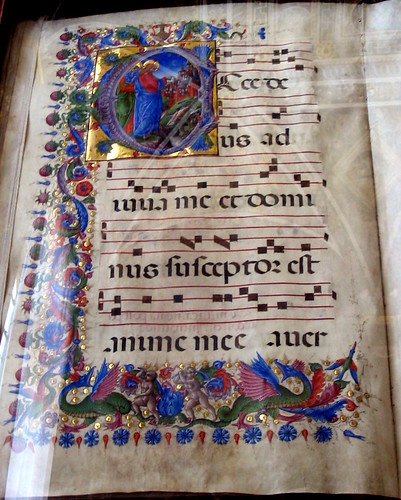
This opportunity was not realized, for when one of the queen's lutenists died in 1594, Dowland applied for the post and was rejected. Dowland speculated bitterly that it was his Catholicism ...

Read More John Dowland: Selected Works for Guitar via Ileen Zovluck

Tuesday, April 6, 2010

Musical Stones of Skiddaw in North Cumbria, England


Do all of you remember playing around in music class on an instrument called the xylophone? Well this historical instrument, using the Musical Stones of Skiddaw, makes me look at the modern day piano or xylophone from a completely different perspective.

Around 1785, Peter Crosthwaite, an eccentric inventor, was walking around the area of Skiddaw in North Cumbria, England when he made a startling discovery. He found "hornfels" rock that produced sound. He spent months and months looking for more rocks that made the desired sound he was looking for.

The result was a type of xylophone, in which he set up to attract visitors to his museum. With the help of his daughter and an old woman, they formed an impromptu welcoming party to the Keswick Museum.


According to the Musical Stones of Skiddaw Blog, the updated instrument is a 14 foot-long 1.5 ton stone xylophone made in 1827 by Keswick stonemason Joseph Richardson out of rare 'hornfels' rock found between the mountains Skiddaw and Blencathra in North Cumbria, UK.

Also check out:

Ancient Digger: Leoninus and Perotinus: The First Polyphonic Music

Sources

Thursday, March 25, 2010

Eric Whitacre: Uniting the Internet Through Music


Although it's not archaeology, it's still cultures coming together for one common reason, music. Eric Whitacre's Virtual Choir - 'Lux Aurumque'-is burning up youtube and inspiring people from around the globe. The harmonies, the soft eloquent voices, and the soothing mood, creates an astounding and miraculous experience.


I wanted to thank Glenn over at Man-Overboard for finding and posting this amazing piece of artistry.

PRODUCED AND MANAGED BY:
Scott Haines

COMPOSED AND CONDUCTED BY:
Eric Whitacre

Wednesday, July 8, 2009

Polyphonic Musical Composition at Notre Dame


In the central portion of Paris, France there lies an island in the middle of the river Seine. There you will find the huge Cathedral at Notre Dame which was built around 1200 AD. NotreDame is one of the most magnificently architectural locations in all of Europe. It's also a focal point for the first polyphonic music, created in honor of Notre Dame's completion.

In the 12th and 13th centuries, Notre Dame was the focal point of polyphonic music. Polyphony is a texture consisting of two or more independent melodic voices, as opposed to music with just one voice (monophony) or music with one dominant melodic voice accompanied by chords (homophony).

The earliest written sources of music were medieval manuscripts of the late 9th century that contain liturgical texts. Small symbols were used called “neumes that indicated the contour of the melodic lines.

The Cathedral of Notre Dame

 © source

In honor of the construction of this massive structure, two composers created the first polyphonic music in the history of Western music. Leoninus was the eldest son and originally started the collection of polyphonic music that was composed for Notre Dame, adding to the collection by extending the range and scope of the music.

Magnus Liber Organi


The polyphonic musical pieces were made into a compilation of medieval music called the Magnus Liber Organi (Latin for "Great Book of Organum"), known as organum.

Viderunt Omnes


The most famous of the musical compositions was the fourth part of Viderunt Omnes by Perotinus, based on the plainchant of the same name. This chant was meant to be played in the middle of Mass services on Christmas Day.

The most incredible aspect about this musical piece by Perotinus is that, it is built entirely on an ancient structure of musical composition. In addition, the voice parts of the composition were sang entirely by monks or priests.

The evolution of harmony began in the 10th century and it made its way all over the country and the entire world. Not only would your favorite harmonical songs be nonexistent if not for this invention, but our lives would be filled with monophonic music lacking instrumentation and including the voices of monks in unison.

Like Ancient Digger? Why Not Follow Us?


Subscribe Via RSS Feed Follow Ancient Digger on Facebook Follow Ancient Digger on Twitter Subscribe to Ancient Digger Via Email

Get widget

Search


Ancient Digger Archaeology Copyright © 2015 LKart Theme is Designed by Lasantha