• Ancient Digger teaches Archaeology and History to all Ages!

Friday, April 19, 2013

Sex and the Sun Temple in Konarak, India


Imagining the erotic images and sculptures that drape the ancient temples of India causes us to question the actual meaning and message behind them. Like the ancients in Pompeii, sex was never just sex. Sex  in Pompeii was a completely normal and fulfilling experiencing, much like India, and most of what we know about the eroticism that took place in both of these places was left on the walls.

What is the Sun Temple at Konarak?

© dracozlat
The Sun Temple is a 13th century Hindu temple, created to honor the deity Surya, the Sun God. The temple is a pristine example of Orisssan architecture, but unfortunately the temple continues to crumple. The Sun Temple was said to be created by King Narasimha of the Eastern Ganga dynasty. Although legend says that the temple was constructed by Samba, the son of Lord Krishna, there is more plausible evidence to support construction during Narasimha's reign. The reliefs on Konarak depict secular events, and one in particular, is a clear celebration of the military victory of Narasimha over the Muslims.

In 1931, the Earl of Ronaldshay remarked on the Sun Temple,

"One of the most stupendous building....a pile of overwhelming grandeur even in it's decay".

The Architecture of Konarak

Like many of the holy temples in India, Konarak is raised off the ground on a plinth. The superstructure and roof of the sanctuary collapsed sometime during the 19th century, however the main entrance still retains its pyramidal roof. Residents and tourists alike cannot enter the building regardless, as the entire structure was filled with sand and stone to keep it from collapsing.

In total, there are three sections that make up the Sun Temple. The main shrine connects to a prayer hall and the entrance to the temple. The pillared dance hall is separated from the main shrine, and is located in front of the main shrine. On of the most fascinating sections of the Sun Temple, in my opinion at least, are the twelve large wheels. It is said that the wheels are meant to represent the chariot of Surya.

Sculptures

Originally, there were seven horses that stood in front of the chariot, however only one remains intact. According to Hamshitha Acharya (2012) , "the spokes of these wheels serve as sundials, and the shadows formed by these can give the exact time of the day. Some says that the wheels represent the 24 hours of the day and others says the 12 months in its concept, where as the seven horses dragging the temple makes up the seven days of the week".

© India Mike
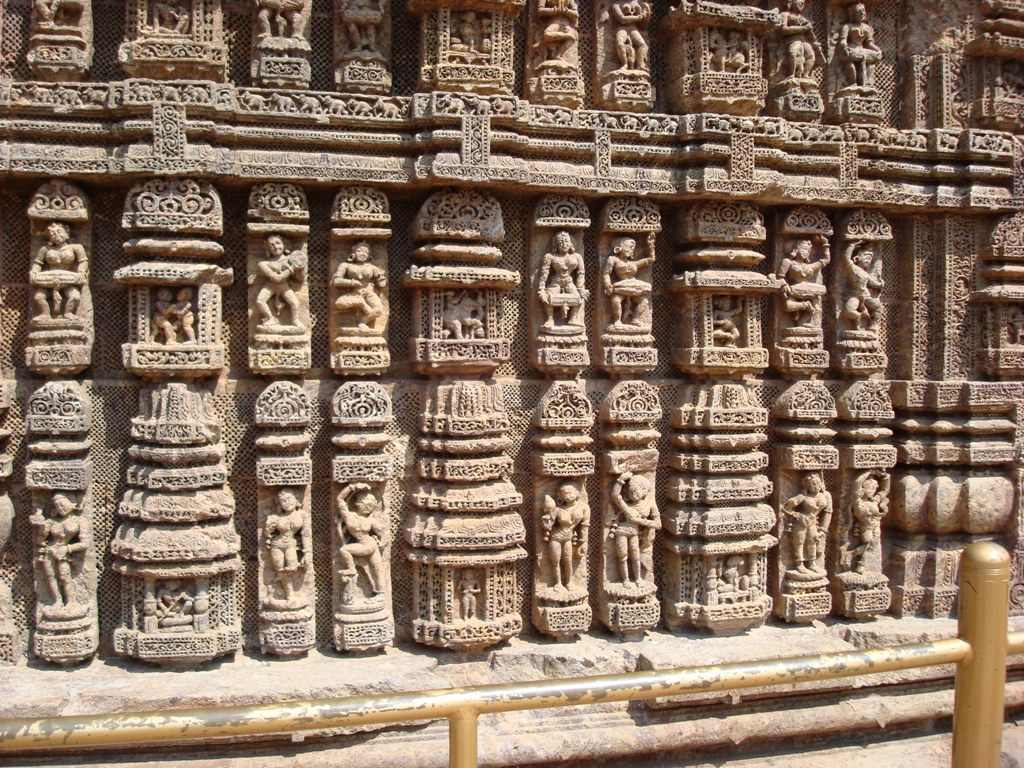
There are several friezes of couples between the wheels, and nymphs, deities, musicians, and also dancers that can be found on the lower section of the Sun Temple. Lively carvings of birds and animals, mythological creatures, and geometrical carvings can be found interspersed throughout the temple.

Erotic Sculptures

The temple is famous for its erotic sculptures, which can be found primarily on the second level of the porch structure. Although it's unclear as to what these erotic art forms represent, we can postulate that they could have been used as amulets to avert evil. Of course, I like to think that that they meant a great deal more than what most people assume. The sculptures on the Sun Temple are lyrical and romantic, majestic and serene, and they all represent a realism that reflects a revolving circle of life.

Source

Acharya, H. (2012 ). Sun temple – konark, a source of sculptural beauty . Retrieved from http://indianmonumentsattractions.wordpress.com/2012/08/31/sun-temple-konark-a-source-of-sculptural-beauty/

Saturday, January 5, 2013

Torandwar Existed in Sirpur Earlier Than Believed


In a claim that could stroke a debate in archaeology, archaeologists excavating at Sirpur in Chhattisgarh are pointing out that the concept of "Torandwar" in temples existed in primitive forms here in sixth century AD questioning the known history known so far that the concept was first developed in South Indian temples and it later travelled to other places.

"Recent findings in Sirpur is enough to indicate that the idea of 'Torandwar" existed here in the 6th century and it later travelled to South India in the 7th century", octogenarian archaeologist A K Sharma, who is also excavator for the ancient site, told TOI.

He said the known history so far was that 'Torandwar' in temples was developed in South Indian temples, apparently in the 8th century. "Now, there are sufficient evidences, including stone pillars with specific inscriptions, to prove it otherwise," he claimed.

Elaborating his point, Sharma said the 7th century ruler of erstwhile Dakshinkaushal, Mahashivgupta Balarjun, had two wives—Amba Devi from local Chhattisgarh region and Ambaddi Devi, who was a princess from Karnataka region. "People from Ambaddi Devi's region took the concept of 'Torandwar and fortification" to the Southern state of Karnataka," he claimed.

The veteran archaeologist, who has excavated, exposed and conserved 48 mounds ”out of the total 184 mounds spread over in an area of 29.25 square kilometre, said the archaeological findings proved that Sirpur—a little known town in Mahasamund district ”was once the nucleus of culture. It was home for Hindus, Buddhists, Shaivas as well as Jains. Known as the city of wealth from 6th century, Sirpur had a very rich multi-faith culture.

"Even today, there are people who think that Chhattisgarh is a tribal dominated remote area. The archaeological findings and revelations from Sirpur are sufficient to prove that the region was much developed than many other known civilizations from 6th to 10th century," Sharma said adding that the region, however, was destroyed in 12th century AD due to a powerful earthquake with an epicentre somewhere near Amravati in Vidarbha, now in Maharashtra.

Throwing light on other Sirpur findings, Sharma said recovery of 85 bronze statues, raw materials such as ancient ingots and crucibles indicated that the region had one of the biggest stone and metal art centre. Besides, lakhs of pieces of glass and coloured glass bangles were found during excavations indicating that the region was also a fine glass producing centre. "In the sand of river Mahanadi, gold traces are found. The glass produced with gold mixed sand was considered fine," he added.

Source: Times of India

Thursday, November 29, 2012

Officials Finally Wake Up After Sump Dug Up at Mecca Masjid


Weeks after a 15-20 feet pit was dug up inside the Mecca Masjid complex for building a water tank and local complaints of how it has become an eyesore, the Department of Archaeology and Museums (DAM) which protects the structure, said it has not given any permission.

Any excavation at the Mecca Masjid needs permission of DAM while the Archeological Survey of India which protects Charminar does not usually allow any construction near 300 meters of the historic structure. It has recently issued notices to several groups after finding constructions taking place without permission.

"We will depute an officer tomorrow to check the status of this excavation and will take appropriate action," GV Ramakrishna, director of DAM told TOI, when asked about the dug-up pit at the masjid.

Authorities are building a sump with a capacity of five lakh litres at an estimated cost of Rs 35 lakh to cater to the routine maintenance of the mosque and needs of worshippers. The need for water at the mosque remains critical which was not addressed due to technical problems and the recent spate of communal incidents.

Surprised observers including heritage activists pointed out that despite the plans for the sump being drawn a year ago and execution work starting in September this year, the DAM still remains either indifferent to development activity in the mosque or has been caught napping while cranes and bulldozers are clearing soil and boulders near the proposed tank area.

Officials of the HMWS&SB had no answers when they were asked if they sought permission from DAM but pushed the blame on the roads and buildings department. "We are not certain if permission has been sought from the archaeology department. This is because the work was allotted to us when the R&B department had failed to take it up," an official from the HMWS&SB said, on the request of anonymity.

The official added that he would have to sift through documents to check if DAM's permission was sought in the first place.

After excavation, a concrete bed would be laid which would be followed by laying a steel base for reinforcement.

Meanwhile, chemical conservation of the Mecca Masjid has resumed with fungus, moss and lichen being removed from the maqbara. The marble lattices will also be cleaned using preservatives. According to deputy director Trimurthy Raju, the maintenance work is supposed to be completed by December 20.

"Around 3,600 square metres of the monument will be chemically cleaned. The delay is on account of the more than 100 feet height of the facade and walls. Further, it is required that we carry out work carefully and not at breakneck speed," he said.

Times View

It is surprising that officials of the Department of Archaeology and Museums (DAM) and Archaeological Survey of India ( ASI) were completely in the dark about the dug-up pit inside Mecca Masjid even after weeks of work. The monuments in the Old City, especially the Charminar are not just structures of brick and mortar but entities which narrate true tales of events which have shaped the city and the country and should be protected in a much more serious manner. Authorities should carry out regular trainings of staff on protection of such monuments.

Source: Times of India

Wednesday, November 28, 2012

Experts inspect Baladevjew temple


Experts of State Archaeology and director of culture Sushil Kumar Das on Tuesday inspected the 400-year-old Baladevjew temple in the town to ascertain the cause of falling of stones from the ancient structure.

Archaeologist Aswini Kumar Satapathy said the temple would be examined thoroughly and necessary repairs taken up as per the advice of the statutory technical committee.

A stone slab weighing 50 kg had fallen from the temple on Saturday, leading to cracks on the main temple. This is not a lone incident.

Such cases have been reported earlier raising questions about the safety of the temple. Nrusingha Patri, a priest of the temple, attributed it to faulty conservation of the temple.

Dhiren Sahoo, chairman of Kendrapara Municipality, conveyed the apprehensions of the devotees about the damage to the aging stone blocks which formed the roof of the main temple and some small structures, including the kitchen room, to the director of culture.

A State Archaeology team had inspected the temple four months ago and found that seepage due to heavy rain had eroded the ground underneath the structure leading to loosening of stones at the temple top, Satapathy said. The team has already started the renovation works after the recent incidents, he added.

Source: Times of India

Tuesday, August 21, 2012

India Uses History and Artefacts To Build Bridges with Sri Lanka


Four bone fragments of the Buddha housed in the National Museum, Delhi are on a two-week tour of Sri Lanka to enable Buddhists there to pay homage to them. While all relics of the Buddha are revered, these are special. They are part of the trove of 22 bone fragments that were discovered by the Archaeological Survey of India (ASI) in the 1970s in Kapilavastu, Uttar Pradesh, where he grew up as a prince before renouncing the world.

The journey of the relics, from New Delhi to Colombo, and to six other places in Sri Lanka this year, being observed as the 2,600th anniversary of the Buddha’s enlightenment, brings up some old questions.
For the two governments, the historical antecedent of the relics is a settled fact, and the exchange of cultural artefacts between the two countries is a continuation of the long history that dates back to the days of Emperor Ashoka.

But Nepal has for years raised doubts about the relics, claiming that the true Kapilavastu lies in its territory, and not in U.P. as Indian archaeologists claim.

After Gautama Buddha died or attained Mahaparinirvana in the 5th century BCE, eight ruling families shared the relics from his body. Among them were the Sakyas, the clan to which the Buddha belonged. They built a stupa over their share in Kapilavastu, the capital city. After the decline of Buddhism, many stupas and monasteries were abandoned and the one built by the Sakyas too went to seed. When the Chinese pilgrims Fa-hien and Hiuen Tsang visited India centuries later in the 5th and 7th C.E respectively, most of these sites lay in ruins.

PEPPÉ’S DISCOVERY

It was in the 19th century that Buddhist archaeology began to be properly noticed as British antiquarians set out to pursue the Buddha’s trail. In 1898, William Peppé, a planter, while clearing his estate near Piprahwa, a village in eastern Uttar Pradesh near the India-Nepal border, found a brick dome that contained a sand stone box with five caskets, relics said to be that of the Buddha, and other artefacts. An inscription found on one of the caskets, though dated to after the Buddha’s death, established the authenticity of the relics.

Based on this discovery and the location with respect to Lumbini, the Buddha’s birthplace in Nepal, Piprahwa was identified as Kapilavastu. But there were counter claims. In 1896, and again in 1899, a few archaeologists identified Tilaurakot, a village in Nepal’s terai region as Kapilavastu. Though they could not find any relics, the presence of a large ensemble of structures and their correlation with the Chinese pilgrims’ description supported their claim. Tilaurkot’s case was bolstered by the disagreement among archaeologists over the decipherment of the Piprahwa inscription.

The dispute continued in the post-independence period. Nepal commenced a series of excavations in 1962 and found more structures around Tilaurakot, but failed to locate any relics. Matters turned in India’s favour in 1971. K.M. Srivastava, an archaeologist with the ASI, following a complaint forwarded to him from the Prime Minister’s Office regarding the poor upkeep of Piprahwa, decided to look afresh at the place. He began new excavations and dug deeper to discover two remarkable soap stone urns. One of them contained 10 bone fragments and the other 12, all dateable to 5th century BCE. Besides this, many terracotta seals with inscriptions found at the site supported India’s claim. This was “an epoch making discovery” that settled the location of Kapilavastu, Mr. Srivastava said in his report. For reasons that are still unknown, the ASI published the report only 20 years after the excavations were completed.
Nepal refused to acknowledge these developments and persists with its claim. It even nominated Tilaurakot along with Lumbini for World Heritage status. Unesco, which accepted the nominations, declared Lumbini as a World Heritage Site in 1997. Tilaurakot is still on the tentative list. The controversies over Kapilavastu were in the spotlight again last year when Charles Allen published his absorbing book, The Buddha and Dr. Füher: an Archaeological Scandal.

Evidently none of the contesting claims has worried Sri Lanka. It was the first county to invite the relics and exhibit them in 1978. The exhibition, The Hindu reported then, drew more than 10 million visitors.

TIRUKETHEESWARAM PROJECT

The exchange of ideas and objects around Buddhism between India and Sri Lanka go back more than two millennia. In the 3rd century BCE, a mission led by Mahinda, Ashoka’s son, reached Sri Lanka and converted the Sri Lankan king Tissa to Buddhism. One of Tissa’s first requests, as the Sri Lankan text Mahavamsa compiled in 6th century CE describes, was for a branch of the Bodhi tree. The request was accepted, and Sanghamitra, Ashoka’s daughter, carried the branch to Anuradhapura.

Unlike in 1978, when the Indian government first exhibited the relics at Chennai’s Egmore Museum, en route to Sri Lanka, this time, in the current atmosphere of political antipathy in Tamil Nadu towards the Sri Lankan government, it evidently did not want to take chances. The relics were flown directly to Colombo.

This brings us to a second question around the lending of the relics to Sri Lanka. In the light of the unresolved Tamil issue, at least one political party, the MDMK, has objected to it. In a letter to Prime Minister Manmohan Singh, its leader Vaiko wrote that this was an “unpardonable betrayal” of Sri Lankan Tamils by the Indian government.

Perhaps it was in anticipation of such criticism that at the same time as the inauguration of the relics exposition in Colombo, India will launch a project for the conservation of the Tiruketheeswaram temple in Mannar.

Indeed, in the joint declaration issued on June 9, 2010, during the visit of Sri Lankan President Mahinda Rajapaksa to India, alongside the plans for “joint activities” by the two countries to mark this year’s anniversary of Buddha’s enlightenment, there is also the following line: “Both leaders also welcomed the proposal for the restoration of Tiruketheeswaram temple at Mannar to be undertaken with the assistance of the Archaeological Survey of India and the College of Architecture and Sculpture, Mamallapuram, with the involvement of the Department of Archaeology of Sri Lanka.”

Union Minister of Culture Kumari Selja, who has accompanied the relics to Colombo, will travel to Mannar on Monday to launch the project, to which New Delhi has committed Rs.135 million.

Source: The Hindu


Friday, July 6, 2012

Possible Remains of Akbarabadi Masjid Unearthed


A stone masonry deck and old artifacts unearthed during excavation for the Subhash Park Metro station have led to speculation among locals that these could be the remains of Akbarabadi Masjid that was razed by the British after the 1857 uprising.

While the Archaeological Survey of India is still to inspect these findings, the area's Muslim residents seem excited about the discovery and have already started revering the site. On Thursday, Matia Mahal MLA Shoaib Iqbal said, "When I was a child, elders used to ask us not to wear shoes and play at this place. They believed the Akbarabadi mosque lay somewhere here. But we never saw any remains. After three weeks of digging, we finally have evidence." Chandni Mahal resident Md Yasin said, "I think we have found the Akbarabadi mosque because all the marble engravings seem to be very old".

The mosque, built in 1650 AD by one of Shahjahan's wives, Akbarabadi Begum, was razed almost 160 years ago. People's sudden interest in it, therefore, may be inspired by childhood tales. A skeptical Inamuddin, who sells shoes outside the Metro site, said: "How can we say this is the same mosque, though we have heard there used to be a very old mosque here?"

Iqbal and some other locals said parts of a stone wall and the mosque structure, some stone utensils, pieces of pillars, finials and engravings had been found at the site. When the first artifacts were unearthed, Delhi Metro had denied the possibility of their being remnants of Akbarabadi Masjid. The chief minister, after a meeting with senior Metro officers, chief secretary PK Tripathi and Iqbal, had later said ASI's opinion would be sought before resuming the Metro work.

ASI officials told TOI they had not received any request to inspect the site but would do so all the same. "There are references in several books about the mosque standing at the site in question. But we cannot comment till the area is explored and excavated properly. A detailed study is needed,'' said a senior ASI official.

Superintending archaeologist Dr DN Dimri said he would visit the site soon. "I will see the findings. Other departments in ASI can be involved to authenticate them, and we will handle things accordingly,'' he said. ASI's excavation branch and institute of archaeology are likely to be involved.

Other conservationists said discovery of the remains was not surprising as the mosque had stood in the area. "It is well known that in the aftermath of 1857 the British cleared hundreds of structures between Jama Masjid and Red Fort, including the Shahjahan-era Akbarabadi Masjid. The mosque would have rivaled Fatehpuri Masjid and Zeenat ul Masjid in scale, and its foundations would be of significant interest,'' said conservationist Ratish Nanda.

Source: Times of India

Tuesday, July 3, 2012

Hampi: Historic Temple in India Saved from Slow Destruction


Hampi is a village in the northern Karnataka state of southern India. Located within the ruins of Vijayanagara, the former capital of the Vijayanagara Empire (from 1336 to 1565), its history hails back to the 1st century C.E. It has been identified with the mythical kingdom of Kishkindha, the Vanara (monkey) kingdom mentioned in the hindu epic, Ramayana. Ruled by King Sugriva, the Vānara were ape-like humanoids described in the epic as possessing supernatural powers, able to change their shapes.

Today, Hampi lies within an area that boasts over 500 monuments dispersed across approximately 26 square kilometers of forested natural scenery. Years of research have uncovered a much larger area of settlement surrounding this Hampi urban core, a broader area that supported a large population over a region of about 650 square kilometers, including forts, walled settlements, temples and religious sites, mortuary sites, canals, fields, trade routes, the remains of industrial production sites, all within a scenic watershed featuring massive boulder outcrops.

Read the Full Report on Popular Archaeology
Picture © Popular Archaeology

Sunday, April 10, 2011

Dolmens at Shankarpur discovered by Archaeologists


PUNE April 10, 2011: Archaeologists of the Deccan college post-graduate and research institute have found four dolmens of the Megalithic Age (Third century B C) or the Iron Age at the Shankarpur village near Chandrapur, about 150 km from Nagpur. The discovery holds importance as such burial methods are rare in the state and also because one of the dolmens is being claimed to be the largest in the state and India.

Dolmen is an ancient stone structure consisting of a large flat stone on top of two or more upright ones, built above the place where humans were buried. These were usually erected in the memory of the dead.

In India, such structures are mainly found in the southern states of Karnataka and Kerala.

Kanti Pawar led the excavation for Deccan College. He was assisted by students Kim Yong Jun, Akash Srinivas and Pankaj Kahalekar.

Edited from the Times of India: Dolmens at Shankarpur discovered by Archaeologists

Wednesday, March 30, 2011

Excavations at Attirampakkam in India Reveal An Amazing Prehistoric Past


Leave it up to timing as the topics of my recent studies seem to all fall into the subject of Indian history.

In my Archaeology of Sex class, I'm reading about women in India. I just recently published my ethnography with Artira Dutta, and now, the discovery of stone tools dating to 1.5 million years ago have been discovered in India.

The excavations took place at a prehistoric site near Chennai and may change how we look at the evolutionary patterns of humans from Africa to India.

Stone hand-axes and cleavers from Attirampakkam have been dated to at least 1.07 million years old using two dating methods including Cosmogenic nuclide burial dating.

12 years of painstaking work The extensive excavations at Attirampakkam have brought to light a deep stratified sequences of occupation by prehistoric populations.

The excavations at Attirampakkam show a deeply stratified sequence of occupation.The Tamil Nadu site was first discovered in 1863 by British geologist Robert Bruce Foote, and has been excavated at various times since then.

Archaeologists Shanti Pappu and Kumar Akhilesh from the Sharma Centre for Heritage Education have spent the last 12 years continuing to excavate the site and have now found 3,528 artefacts that bear a distinct similarity to prehistoric tools discovered in western Asia and Africa.

The tools fall into a class of artefacts called Acheulian that scientists believe were first created by Homo erectus – ancestors of modern humans – in Africa about 1.6 million years ago.

Read the Full story about The 1.5 Stone Tools Discovered in India @ Past Horizons

Picture ©  Sharma Centre for Heritage Education, India

Monday, March 21, 2011

Monday Ground Up: Nonverbal Ethnography With Aritra Dutta From Kolkata, India


I met Aritra through my fiancé, as he’s in the graduate program at UCF for mathematics. He gained a Master’s Degree in India, but has been placed in the same classes he had already completed back home, giving him both an edge over his classmates and sense of our own education system. Although culturally, Aritra and I came from the same middle class background, our customs, languages, and view of the world, in retrospect, are slightly different. We spoke about family, work, education, UCF, holidays, American and Indian culture, and their differences, traditions, and religion. I informed him I would be reading his body language as opposed to the details of his answers. I also asked if I could use his name in my research, and he humbly replied with “of course” and a delightful grin, as if he nothing to hide and he was proud of his heritage.

We sat down at a table facing each other, about an arm’s length away. He sat up straight and looked positive, as the sides of his mouth shaped into a crescent, delighted to oblige.

I asked Aritra why he came to America. He immediately shifted in his seat side to side and his posture was a bit slumped. “I felt isolated”, as he lowered his head to his feet, shuffling his body in uncertainty. Was you’re upbringing an influence of your decision to move to America? A concrete “yes” and a serious expression translated that he had very little choice, but he was steered this way because his parents ultimately always wanted what was best for him.

I asked “what is the biggest difference you’ve noticed about American culture as opposed to Indian culture?” Aritra immediately put his hand to his brow and with a squint his eyes, looked to the right in deep contemplation. His eyes were down and as he looked up to make eye contact, his posture was more upright. “It’s hard to decide” he replied. He rested forward, as closer social distances are customary in India, and described the use of space and how Americans are uncomfortable about their personal distance with strangers.

I then asked if there was any aspect of American culture that he preferred over Indian culture. He immediately leaned back and with delicate smile and ease stated “independence”. He gestured and illustrated his point with his right hand, making a wave like motion. Why? Perhaps because the independence he perceives watching American culture is not set in stone. It’s always fluctuating and moving. He added, “There’s space in thinking in America.” He then placed his elbows on the table and looked into my eyes with certainty, explaining that “work is different in India”. The boss’s opinion is the only opinion and there’s no room for a personal voice. He then took his elbows off the table and his proximity to me once again shifted as he reclined back.

The last question I posed in our culture discussion was, do you feel you’ve lost any of your cultural identity (a sense of your own culture unique to India) since you’ve been in America? He shook his head immediately and replied “no”. He crossed his hands and reached for his metaphorical batons ready to lead his orchestra. He had music in him, and like a classical piece of Mozart playing in the background, waved his hands like a conductor. Music was a large part of his heritage and it flowed through his veins, even now while I sat in awe of his musical dance.

As I informed Aritra that we were shifting topics to school, he peered over at a friend and gave him a great smile of appreciation. I then asked Aritra about his favorite things about UCF. As his shoulders raised and the corners of his mouth turned upwards, he said his friends. He became quite animated, smiling and shaking his head, and started using both hands to communicate the social aspect of working with a group of such diverse individuals. “What do you like least about UCF?” I asked. “Nothing”, Aritra replied, with a fixed grin. I knew, judging from his proxemics as he stood up straight and beamed about his friends, that they should feel the same way about him. I asked Aritra how his classmates typically perceived him. “Happy”, he replied. “Always laughing”, as the corners of his mouth stretched as high as his eyebrows. Twisting in his chair as if dancing to a James Brown song.

Aritra’s persona was infectious as I felt myself laughing and smiling so hard my eyes closed tightly. His demeanor changed as he described what he had no tolerance for. Although people usually perceive Aritra as a happy go lucky person most of the time, there is one type of behavior that is not tolerable to him, that being humiliation. He leaned towards me, changing our proximity once again, and started to point his finger and shake his head. He explained that professors who shame students when they answer a question incorrectly or a person openly degrading others is just not an acceptable behavior. To some people this may be a trait common to Aritra’s culture, respect I mean, but in all honesty, this is and should be universal in all cultures.

As I wrapped up my school discussion with Aritra I asked if he noticed differences in universities in America as opposed to India. He confidently sat up straight and with a sense of self described his dormitory days in India. Dorms were often referred to as hostels in India, and it was in these places that bonds would grow strong. As he smiled he described the jokes they would tell in the hostel and the long talks they conducted. It was a brotherhood of men, much like the fraternities we have here in America. There is, however, a big difference. As he crinkled his brow and looked slightly away from me, as if to understand why others are so bothered when people impede on personal distance, or even touch in a platonic way. “There is no concept of gay” in this scenario. If you’re in a hostel and a brother puts a hand on your shoulder, no one thinks anything of it. Looking me straight in the eye and leaning forward, Aritra exclaimed that “when you’re distressed you need this type of brotherhood”. He shook his head in disbelief and explained that a situation such as this would be very different in America. I had to agree.

Aritra and I moved on to our next topics which were traditions, religion, and family. I asked him about his family and what they did in India. His composure and posture immediately changed, as he started to describe his parents. As I mentioned before, Aritra’s father was a chief person in politics and the union while his mother worked at home.

He placed his finger to his temple, squeezing his brow as he spoke about motivation and how his parents, especially his mother, always pushed him to be the best at anything he ever did. “She did a good job raising me”, Aritra replied with a delicate smile. His family suffered a lot, but they were always able to confide in each other about everything. No subject was off limits. As he spoke about his mother and how she would scold him, he leaned forward in his seat and pointed his finger at me. A display or representation of the act in progress I suppose.

I followed with a series of questions pertaining to traditions, asking how he typically celebrated his birthday. He calmly said “with family”. It was hard for him to answer, as he looked down at his hands resting on his legs. “Sometimes there was a cake and a big meal”, and waving his right hand, using it as an illustrator, spoke about his twenty-fourth birthday. When Aritra was a teenager his near and dear ones presented him money on his birthday. When I asked how Aritra used his money, he shook his head in disbelief. He would never think to keep the monies and always told his parents to keep it at the end of the day, as they needed it more than he did. To Aritra, this was the true bondage between him and his parents and which does not hover around the daily mundane material needs.

As we spoke about the traditions of Christmas, he slouched in his chair, with arms on his legs and smiling, described how his mom would bake a cake and make coffee in the morning. The westernized view of Christmas was not observed in India, as Aritra described the lack of Christmas trees, tinsel, and presents. I figured this would be the right time to discuss his religious views and philosophy and Aritra certainly had a brilliant outlook on the matter.

He sat up straight and spoke about every religion. There was light in his eyes and passion in his gestures and voice. He appreciated and treasured all religions. He had a great respect for all facets of the inner workings. However, when we started discussing Christianity, Aritra’s posture and manner was much more serious. He shook his head and looked down as he spoke of the crusades. He pointed his finger and spoke of how religion kills because people were “misguided”. He became a bit more animated, using his hands to draw a circle of life in both directions. It was at this time that my posture and overall perspective changed as he described gods.

Aritra explained that if someone worships water; a certain tree; a beach; a mountain, then they may consider these objects their god. He kept drawing a circle on the table, pressing harder into the wood, as his eyes traced the outline he was making. He then looked up and with an overwhelming sense of clarity, spoke of the spirit of self, meaning we really invent what we want our god to be. Sometimes, we are the gods. Aritra became engulfed in this present conversation and focused on an outward showing of prayers as he leaned backwards and forwards with his eyes closed. I allowed him to finish, as he was in his element, and I was almost in a trance like state, trying to decipher the words.

I asked Aritra about his name and what it meant. The Bengali translation means “one who saves someone from the enemy”, he replied proudly with a smile. He fervently spoke of Krishna, which his name is derived from. He created a bow and arrow with his arms, shooting the arrow, and I asked what it represented. He told the story of Arjuna’s, whose arrow struck Karna’s Chariot, and in turn, Karna strikes Arjuna’s chariot. Krishna praises Karna for his abilities and asks Arjuna to compare Karna’s chariot with Arjuna’s own which consisted of the Universe in the form of Lord Krishna. The moral of the story is that neither held an upper hand in the battle.

I then asked Aritra, if there anything else he’d like to add about Indian culture? Its uniqueness? Aritra pondered for a moment and with complete calmness, opened his eyes widely and with a glimpse of absolute conviction replied that India was the oldest civilized country in the world. India had never invaded another country and his voice, as it calmly fluttered, was in awe of this notion. “Everyone has an oath or an existence to that debt. People need to contribute to the goodness of the world and keep pace with everyone else”, Aritra replied. I was perplexed with this answer, as I lowered my eyelids in slight misperception for a moment. Aritra eyes read like he was aware of the state of my uncertainty, and for clarity sake, he spoke of the history.

He described Alexander the Great in detail, making charging arm motions of a leader. Alexander entered India and noticed a monk, rather a “Gymnophist”. Alexander asked him “what are you doing?” The Gymnophist answered, “I am experiencing nothing” then the Gymnophist asked Alexander “What are you doing?” and he came to know that Alexander is a great conqueror. Each one thought that the other was the fool. The Gymnophist thought why is he conquering the world? It’s pointless and Alexander thought why is he experiencing nothing? Why waste time? Aritra then described that to understand the difference in their viewpoint we have to understand the subjective truth of Alexander. He lived his life by simple works, as simple to him was controlling the army, life, women, etc. With light in his eyes and clarity in his words, Aritra continued to explain that Alexander had been told to be a spectacular winner since his childhood and a man of destiny. Like Greek heroes, he always desired to live an extraordinary life and wanted to enter in the heaven of heroes. Aritra drew a river with his finger, and as he crossed the river, he made a fist. “Grab everything”, he replied and “Life is one”, he added, with optimistic and passionate eyes. That was the belief of Alexander because that was the way he developed the idea of his mythology. On the other hand the Gymnophist had this belief from his childhood, developing from his mythology, that life is an infinite journey.

Aritra included much of his philosophy in his interview with me, which was illuminating and rousing, as shown by his gentle body sway.

You have to cross the river of life to and fro again and again and again because nothing lasts for ever in India not even the death so what goes around always comes around and this rule is applied not just to man but also to the God. Not you will get infinite life but the same life lived an infinite number of times to get the point of it all. Two different mythologies and two different ways of looking at the life, one linear and other cyclical. So the denominator of Alexander’s life was one and the value of his life was the sum total of his achievement. The accomplishment and the denominator the Gymnosophist’s life was infinity so no matter what he did the outcome is nothingness or an absolute zero. Their belief was influenced by their behavior and you cannot say which one is the absolute truth. So all we can do is develop the realization of every religion and experience the light in the different forms which enlightens the heart of everyone.

As we started to finish our conversation, Aritra contracted his face and spoke of Rama and the pain in his life, but his prayers that he spoke in his native tongue, were like musical notes dancing off the page. He started to chant about Krishna and Atman Brahman, which is a representation of our true self and our soul that resides in the spirit within our bodies. Aritra closed his eyes and once again moved his body delicately to the words, describing whole love of the gods, reaching out with his right arm, and grabbing at life with his hand. “AUM pUrNamadaH pUrNamida.n, pUrNAt.h pUrNamudachyate, pUrNasya pUrNamAdAya, pUrNamevAvashiShyate”, he chanted. In English, this translates to “That is whole; this is whole; From that whole this whole came; From that whole, this whole removed, What remains is whole.

My conversation with Aritra opened my eyes to a philosophy I’ve always deeply appreciated and aspired to attain. We share the same middle class background, a positive and happy outlook on our lives, and the love of family and friends. Aritra is full of life and animated by nature and culture. Although I believe I am as well, he projects this with every word and gesture that comes from his spirit within. The minor differences I did observe were trivial at best.

There was lack of a Christmas tree during the holidays, which I don’t attest to be a Christian tradition, but for me, a love of the season. Aritra’s holiday affairs were certainly lacking in pretension, where westerners flaunt their material wealth instead of partaking in a humble existence. The Bengali language was an obstacle, even I understand that. However, I reverted back to Chomsky’s beliefs in this instance. The human brain contains a limited set of rules for organizing language, what he calls “universal grammar”. The structural basis of all languages is the same; so to say a divide exists in communication between Aritra and myself, would be an untruthful statement. Why? Even though he spoke his prayers in Sanskrit, his body language translated into the words of my native language. To me that’s inspiring!

Picture Sources
  1. Kolkata - Kalighat Red Light Area
  2. Victoria Memorial
  3. Man in street doing laundry in Kolkata
  4. Hindu temple in Kolkata

Sunday, March 20, 2011

Ethnography With Aritra Dutta Part One


It was a long and challenging road to actually speak with my willing participant as his sister, two days prior, fell off in the elevator shaft at a construction site in India and died. My interview was with Aritra Dutta, born in Kolkata, India. Aritra comes from a middle class family. His father is a chief serviceman, working in a government organization and a dedicated union leader and involved in active politics and his mother is the “house maker”. He speaks the Bengali language, his prayers in Sanskrit, which is the Official State Language. The language is centuries old, dating to about 1000AD and wasn’t documented until about three hundred years ago. Bengali, which is a form of ancient Sanskrit, is derived from Magadhi Prakrit and Pali, the earliest recorded spoken languages in the region and the language of the Buddha.

Each soul is potentially divine. The goal is to manifest the divinity within by controlling nature, external and internal. We can do this either by work or by philosophical practice – by one or all of these and to me this is the whole of religion. Doctrines or dogmas or rituals or forms or sects are but secondary details. They count for little compared with the essence of existence in each man, which is spirituality. We can show by your life that religion does not mean words or names or sects, but that it means spiritual realization.

The embodiment of freedom, the master of nature is what I call God. Everything beautiful, everything truthful, everything free and everything being and becoming is what I call God. The religion can only be attained by the Union of all existence and we have to hold on to that. The debt, which the world owes to our motherland, is immense. Taking country with country there is not one race on this earth to which the world owes so much as to the patient Hindu, the mild Hindu. To many Indian thought, Indian manners, Indian Customs, Indian philosophy, Indian literature are repulsive at the first sight; but let them persevere, let them read, let them become familiar with the great principles underlying those ideas and their charm will come over them and fascination will be the result.

I am truly moved by that charm and fascination that’s why I never fear to lose my cultural identity. But the older I grow, the better I seem to think of these time-honored institutions of India, as each tradition is the embodiment of centuries. We have yet something to teach to give to the world; this is the very reason, which this nation has lived on, in spite of hundreds of years of persecutions and nearly a thousand years of foreign oppression. The nation still lives; the reason is that, it still holds to god.

Stay tuned for the Monday Ground Up: Nonverbal Ethnography With Aritra Dutta From Kolkata, India

Monday, March 7, 2011

Archaeological Discovery: Rare Human Skulls Found At Annigeri


Scores of human skulls found have been termed a ‘rare find' by archaeologists and historians.They reckon that it is a mass grave, but what makes it unique is the manner in which the skulls are arranged. 

Addressing a press conference here, Deputy Commissioner of Dharwad Darpan Jain, Director of the Department of Archaeology and Museums R. Gopal and historian M.S. Krisnamurthy said there was no report on the existence of such a mass grave so far.

Initially, only 50 skulls were found next to a drain after the ground was dug up for clearing the silt. As the finding caused a sensation, the administration cordoned off the area and requested the Directorate of Archaeology and Museums to conduct a study. A team of experts, led by Mr. Gopal and Professor Krishnamurthy, visited the site, but put off excavation because the area was damp. The excavation began on January 12 after the drain was diverted so as to allow the ground to dry. 


Tuesday, February 1, 2011

5,000-year-old Harappan Ruins of Dholavira May Be World's Oldest Stage


The 5,000-year-old Harappan ruins of Dholavira in Kutch (district of Gujarat state in western India) have the capacity to rewrite an important portion of the history of theatre of the world. Until now, it was believed that Greek and Roman theatre, with their amphitheatres and poignant plays, were the oldest in the world - dating back 2,500 to 3,500 years. But, archaeologists who excavated Dholavira say they found remains of what can be the world's oldest stage.

Well-known archaeologist R S Bisht, who is credited with excavating Dholavira, says, "We found a multipurpose open field which must have been used for everything, from sports like wrestling and bullock cart races, to plays." The field is 283 metres by about 45 metres and is placed between a citadel or what is known as the upper town, and the middle town in the ruins.

Read more: Will Dholavira ruins rewrite history of ancient theatre? - The Times of India

Graphic © Archaeologival Survey of India

Saturday, March 6, 2010

Dwarka - Legendary city of Shri Krishna


In the early eighties an important archaeological site was found in Bharat, at Dwaraka, the site of the legendary city of Lord Krishna. Dwaraka was submerged by the sea right after the death of Lord Krishna.

This inscription refers to Dwaraka as the capital of the western coast of Saurashtra and still more important, states that Sri Krishna lived here. The discovery of the legendary city of Dwaraka which is said to have been founded by Sri Krishna, is an important landmark in the history of Bharat.

It has set to rest the doubts expressed by historians about the historicity of Mahabharata and the very existence of Dwaraka city. It has greatly narrowed the gap in Indian history by establishing the continuity of the Indian civilization from the Vedic Age to the present day.

Friday, October 2, 2009

Dinosaur Eggs Found in India


Researchers, archaeologists and geologists of Periyar University in India have found a nesting site of dinosaurs with 20 fossilized eggs. This is probably the first nesting site in southern India. Watch the video for information.

Friday, August 14, 2009

Trip to Mahabalipuram or Mamallapuram: Chapter 1: The Shore Temple, Mahabalipuram


Rock cut architecture is among the most interesting and innovative aspects of Archaeology. Over time, building styles changed and the integration of structural building took form all over the world. Admirable India gives us a tour of Mahabalipuram, which is a town in the Kancheepuram district in the Indian state of Tamil Nadu. Read more about their trip to Mahabalipuram

So the total distance of Mahabalipuram from Bangalore is about 342 km. We had nice breakfast of Pongal near Hosur. Then, we continued our journey and after about 6 hours we reached Mahabalipuram. Mahabalipuram also known as Mamallapuram is a town in Kanchipuram district in the Indian state of Tami Nadu. Mahabalipuram was a 7th century port city of the South Indian dynasty of the Pallavas around 60 km south from the city of Chennai in Tamil Nadu. It is believed to have been named after the Pallava king Mamalla.

Like Ancient Digger? Why Not Follow Us?


Subscribe Via RSS Feed Follow Ancient Digger on Facebook Follow Ancient Digger on Twitter Subscribe to Ancient Digger Via Email

Get widget

Search


Ancient Digger Archaeology Copyright © 2015 LKart Theme is Designed by Lasantha