• Ancient Digger teaches Archaeology and History to all Ages!

Friday, April 19, 2013

Sex and the Sun Temple in Konarak, India


Imagining the erotic images and sculptures that drape the ancient temples of India causes us to question the actual meaning and message behind them. Like the ancients in Pompeii, sex was never just sex. Sex  in Pompeii was a completely normal and fulfilling experiencing, much like India, and most of what we know about the eroticism that took place in both of these places was left on the walls.

What is the Sun Temple at Konarak?

© dracozlat
The Sun Temple is a 13th century Hindu temple, created to honor the deity Surya, the Sun God. The temple is a pristine example of Orisssan architecture, but unfortunately the temple continues to crumple. The Sun Temple was said to be created by King Narasimha of the Eastern Ganga dynasty. Although legend says that the temple was constructed by Samba, the son of Lord Krishna, there is more plausible evidence to support construction during Narasimha's reign. The reliefs on Konarak depict secular events, and one in particular, is a clear celebration of the military victory of Narasimha over the Muslims.

In 1931, the Earl of Ronaldshay remarked on the Sun Temple,

"One of the most stupendous building....a pile of overwhelming grandeur even in it's decay".

The Architecture of Konarak

Like many of the holy temples in India, Konarak is raised off the ground on a plinth. The superstructure and roof of the sanctuary collapsed sometime during the 19th century, however the main entrance still retains its pyramidal roof. Residents and tourists alike cannot enter the building regardless, as the entire structure was filled with sand and stone to keep it from collapsing.

In total, there are three sections that make up the Sun Temple. The main shrine connects to a prayer hall and the entrance to the temple. The pillared dance hall is separated from the main shrine, and is located in front of the main shrine. On of the most fascinating sections of the Sun Temple, in my opinion at least, are the twelve large wheels. It is said that the wheels are meant to represent the chariot of Surya.

Sculptures

Originally, there were seven horses that stood in front of the chariot, however only one remains intact. According to Hamshitha Acharya (2012) , "the spokes of these wheels serve as sundials, and the shadows formed by these can give the exact time of the day. Some says that the wheels represent the 24 hours of the day and others says the 12 months in its concept, where as the seven horses dragging the temple makes up the seven days of the week".

© India Mike
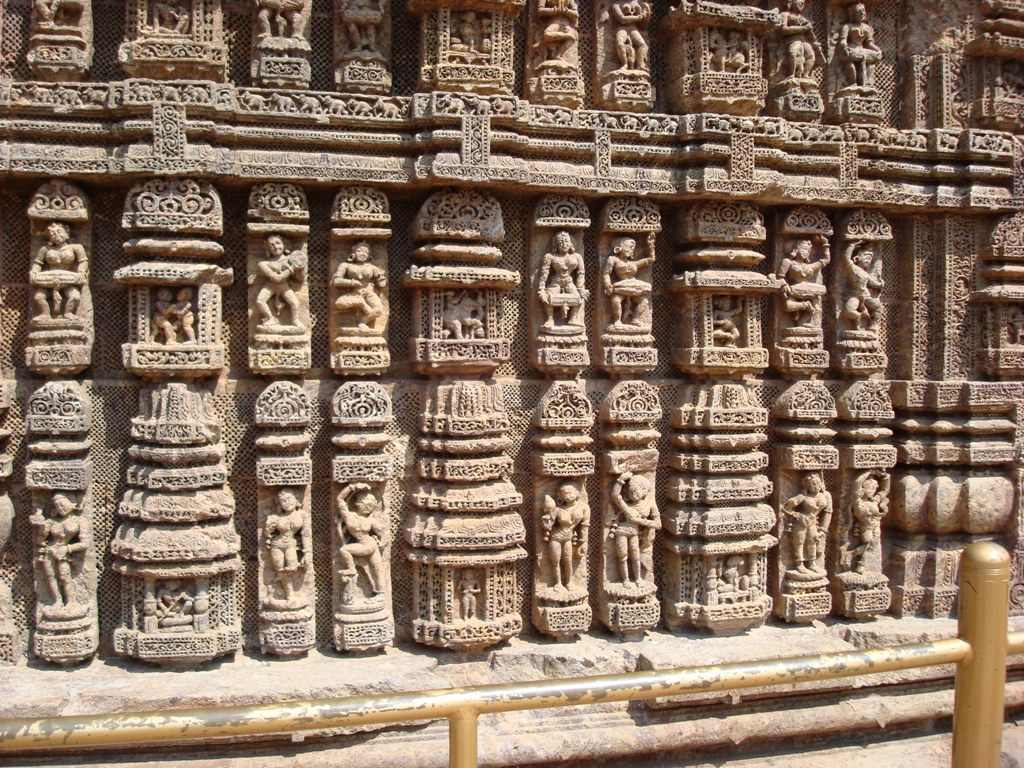
There are several friezes of couples between the wheels, and nymphs, deities, musicians, and also dancers that can be found on the lower section of the Sun Temple. Lively carvings of birds and animals, mythological creatures, and geometrical carvings can be found interspersed throughout the temple.

Erotic Sculptures

The temple is famous for its erotic sculptures, which can be found primarily on the second level of the porch structure. Although it's unclear as to what these erotic art forms represent, we can postulate that they could have been used as amulets to avert evil. Of course, I like to think that that they meant a great deal more than what most people assume. The sculptures on the Sun Temple are lyrical and romantic, majestic and serene, and they all represent a realism that reflects a revolving circle of life.

Source

Acharya, H. (2012 ). Sun temple – konark, a source of sculptural beauty . Retrieved from http://indianmonumentsattractions.wordpress.com/2012/08/31/sun-temple-konark-a-source-of-sculptural-beauty/

Monday, June 18, 2012

The Destructive Nature of Eros


So the topic of sex and gender and erotic sicknesses continues as I work through a semester's worth of explicit material. I hope you are enjoying this textual romp through the world of ancient sex and erotica. As always, Ancient Digger intends to share all facets of history, even though the topics may border on the obscene, according to many.

Eros is the son of Aphrodite who essentially meddles in the affairs of gods and mortals, causing bonds of love to form, often illicitly. In early Greek art, Eros is depicted as a adult male with sexual prowess, but becomes cupid, the blindfolded and childlike boy who flies around, shooting his arrows at unsuspecting individuals destined for love. Eros draws one thing to another by attraction or even gravity. Hesiod explained that Eros existed long before the goddess of love, Aphrodite. According to many philosophers, Eros was an awe-inspiring universal force.

Eros is the fairest among the deathless gods, who unnerves later the limbs and overcomes the mind, and counsels of all gods and all men within them. Pre-Socratic philosophers believed Eros was a natural force responsible for creation. It wasn’t just good or bad, but destructive. Eros was vital because it operated as a social concept, yet it had moral implications. It was hard to control because in many cases, individuals would become slaves to it.


This destructive force was the root of the evil. However, while the destructive impulses are thus being satisfied, such satisfaction cannot stabilize their energy in the service of Eros. Their destructive force must drive them beyond this servitude and sublimation, for their aim is, not matter, not nature, not any object, but life itself1 . Greek literature depicts the forces of eros as frightening, socially destructive and physically, emotionally and mentally debilitating. In this sense, the separation of the wife and children from the sexual activities of the slave-quarters, the brothels and the male drinking parties or symposia, ensured that the oikos and its most important members were protected from the potentially damaging forces of uninhibited sexual expression2 .

The numerous examples of the destructive force of eros are not always mythological or legendary in orientation. Eros reaches into the minds of some of the most famous and notorious of emperors and also notable philosophers and writers, who sought to tell tales of legend, though the stories almost always embraced some truth. Eros could be accessed through the eyes, or “the gaze”, as 19th century scholars called it. The ancients could be seen as passive victims who allowed objects to intrude upon them. This could be artistic objects, theatrical events, or even natural elements.

The fact was that looking at things that were attractive and desirable was dangerous; therefore the act of looking could invoke emotion, arousal, lust, and desire. Eros was driven by men. Men would compel an object of desire to submit to them. In this aspect, eros is cured by reciprocity. If the object would not submit, spells would sometimes be utilized. These spells would be inflicted at night in isolation using agents that were not commonly acquirable. You had to put in the effort in order for the spells to take hold.


One spell was used to induce dreams of a desired object. The person, most likely a woman, would go through a suffering and longing process for the person they wanted. There was a certain degree of violence in this because control and victimization are inverted throughout the dream, and one cannot control their actions and impulses in their dreams. Using magic the man would get control. The same spell was not invoked on men because men tend to dream while they are awake-they daydream. Therefore a spell of desire would have to be altered somewhat if the woman was in control.

It is clear that eros drove women to madness, but men were just as vulnerable to the power of eros. A prime example would be Nero. Nero was free with his mind, money, and body. He had issues with boundaries and he was addicted to eros. This addiction ran much deeper than just for carnal pleasure, however. Nero was also addicted to the theater, where themes of the real world were often inverted to create an imaginary one. Nero lived his life in excess, violating customary expressions of pleasure to the point he forgoes imperial responsibilities. He embraces popularity and the love of the populace. The love of the people is where eros goes wrong. The people loved him so much that they created a monster and his general obsessions were driven by his libido and desire. Libido without restraint becomes worse. He is the very opposite of an epicurean, who typically partakes in simple pleasures, yet they also abstain from bodily desires such as sex and appetites verging on denial.

The Rape of Lucretia is another excellent example of eros gone wrong, as it pertains to the hyper sexuality of man. Lucretia, an object of desire put forth by her own husband, is the ultimate undertaking of any man looking to overcome the innocence of a pious woman. When the men arrived, they were all impressed by Lucretia's chaste honor, but it was Tarquinius who was “seized by the desire (hyper sexuality) to violate Lucretia's chastity, seduced both by her beauty and by her exemplary virtue”3 . He threatened her with death, raped her, and he left, having taken away her honor. Her beauty and virtue not only drove Tarquinius to desire her, but it created an innate violence in a powerful man, put into a position where he could control submission. It was no different than war, as men seek honor on the field, they seek the same type of acknowledgement in the bedroom.

The History of Appius and Virginia by Livy is another key example of a virtuous woman who tempts, unintentionally, man’s desire to the point of violence. Appius Claudius lusts after the daughter of a centurion, Virginia. Virginia was already promised to Lucius Icilius, a former tribune of the plebs, and when she rejected Claudius, he gave instructions to Marcus Claudius, one of his clients, that he should claim the young woman as his slave, and not submit to any demand which should be made, of her being left at liberty until the decision of the suit, thinking that the absence of the damsel's father afforded the fittest opportunity for the injury which be meditated4.

After Marcus Claudius had successfully abducted her, the decemviri, led by Appius Claudius himself, demanded he bring the case to court. Virginia’s father Verginius was recalled from the field to defend his daughter, and Icilius, after threats of violence, succeeded in having Virginia returned to her house while the court waited for her father to appear. When Verginius finally arrived, his supporters left the forum so not to cause further violence. Questioning whether her virtue would be preserved if he acted in haste, Verginius grabbed a knife and stabbed Virginia. Verginius and Icilius were arrested, and their followers returned to attack the lictors and destroy their fasces. This led to the overthrow of the decemviri and the re-establishment of the Roman Republic4 .

The very last place we would expect the humiliation of women to occur would be in the Symposium, but the presence of the hetaerai may have only fueled the natural hunger of man’s desire to dominate the opposite sex. Hetaerai were the only women who actively took part in the symposium where their opinion was welcomed and respected by men. They drank and partied, but the drinking usually took a completely different turn near the end of the evening. The Symposium is a social function for young men to integrate into their status group, and as part of this, the men engage in ritualized violence with the hetaerai as a rite of passage. Men would force them to have anal sex and beat them with a staff, rod or shoe. Hetaerai were essentially integrated into a ritual for the sake of man’s inability to restrain his primal urges.

Eros is instilled with a deep-seated tension that manifests itself in various guises, which, however, have a common structure based on the fact that eros is a striving for the reversal of eros, and that therefore the existence of eros is incompatible with its telos. The highest goal of eros is the destruction of eros, the transformation of the lovers into an existence that no longer needs eros. According to Diotomo’s speech at the Symposium, Eros is “a great spirit (daimon)” that is situated between mortals and gods, and oscillates between the two; it is by virtue of its origin an intermediate being, that nevertheless strives towards the better5.


You may also like


The Sickness of Eros
Ancient Sex and Love Magic
Ovid's Art of Love 
Erotic Art and Roman Sexuality
Eroticism, Eros, and Sex in Pompeii


References

  1. Herbert Marcuse, Eros and Civilization: a philosophical inquiry into fraud, (Abingdon: Routledge and Kegan Paul Ltd, 1956), 86.
  2. Terry Ryan, and Marguerite Johnson, Sexuality in Greek and Roman Society and Literature, (New York: Routledge, 2005), 3-4.
  3. "Tite-Live: Histoire Romaine," 1, Vol. 1, ed. Jean Bayet and Gaston Baillet (Paris: Societé d'Édition "les belles-lettres, 1995).
  4. Livy. The History of Appius and Virginia, History of Rome. English Translation by Rev. Canon Roberts. New York. E. P. Dutton and Co, New York, 1912.
  5. Benjamin Jowett, trans., Plato’s Symposium, (Penguin Books Limited, London, 1956).

Tuesday, June 12, 2012

Ancient Sex and Love Magic


The Kama Sutra and the Joy of Sex were not strictly ancient sex manuals, but actual instructions on pleasing one’s wife. Ancient sex is the only stand-alone genre in ancient literature. The writing of pornographic material evolves in the 4th or 5th century BC. Ancient sex manual writing comes at the same time as aristocratic writing. It is a cultural viewpoint that seeks to classify a certain type of knowledge. It makes a science of the human body by focusing on the human body to arouse you. It also helps to intellectualize the writing of smut and sexualized material and sets it in on equal footing to the sciences and mathematics. The authors talking about sex were doing so from the female’s point of view. In antiquity, women supposedly authored the books, but in actuality men using a woman’s name wrote them.


The mythical founder of the genre was Astyanassa, but it is said that the female Philaenis was even more popular than Astyanassa. The poet Aeschrion of Samos denied that Philaenis was really the author of this notorious work. Brief fragments of the manual, including the introductory words, have been rediscovered among the Oxyrhynchus Papyri. It begins: “Philaenis of Samos, daughter of Ocymenes, wrote the following things for those wanting ... life”1. When the books were produced they came with graphic illustrations. The texts don’t survive but the impact on society does. We see these sexual images at Pompeii where every type of sexual position with every type of gender is depicted.

Sex was a mythical religion and should not be discussed, but authors were beginning to classify and catalogue types of women and the types of sex you should engage with them. Lucritious was a 1st century poet and philosopher who would catalogue types of women (physiognomy). Avid defined women by certain attributes, and after that, with a specific sexual position. If old, you would have sex with her from the back, and if young, lay her on her back. Women were becoming symbols and they were stripped of their humanity. They were anatomical parts.

Another example of ancient sex was sacred prostitution. Sacred prostitutes were connected to temples and the temples of Aphrodite. Slaves were purchased on the open market and forced to work in the sex trade industry where profits went to the temple. Some women even engaged in ritualized prostitution for a short period of time before marriage. Prostitution was sanctioned by the elites, and in places like Athens; state officials enforced price controls on prostitution. This was often because the wealthy owned the brothels, but a madam ran them. You would spend time training for prostitution usually at a young age. Your career consumed your adult years and at age twenty-five you were considered old. At one time in your life you could buy your freedom. Contraception was used but it rarely worked. It led to higher pregnancy rates, and those children born to free men, were rarely acknowledged. The women often lived in the brothels with a madam, who was usually an ex-slave, who would often take care of the children. There were high rates of miscarriage and exposure to disease and pollution. Not surprising considering the work environment was often dark and unsanitary. Disease was rampant, and not just STDS.

Love Magic

Literary accounts of erotic love magic go back to Homer, however evidence for actual performance of spells, in the form of lead curse tablets aimed at rivals, does not appear until the fourth century BC. The increased popularity of magic under the Roman Empire is demonstrated in the papyri from Egypt, which contains handbooks of prescriptions and recipes into which the names of agent and victims were to be inserted. Literature, meanwhile associated them, as it had in the past, with the figure of the witch who employs her craft to exert sexual power over men. There were also servants of divine intervention in Egypt who worked with families to cast spells and charms. They were a source of sexual information, and to some, they were regarded as witches.

Traditional association between witchcraft and sexuality had become even more sinister and was now colored by the lure of the forbidden. At the same time, though much of what we loosely call "erotic love magic" can be seen to conform to Mediterranean common sense, the confrontation between actual erotic spells and the masculine literary fantasies about erotic witchcraft will illuminate some dark comers of personal anguish and interpersonal spite2. There were dozens of different spells and curses including binding spells (agogai) to inflame someone with eros for the perpetrator, curses designed to separate couples, and philia spells to strengthen an existing relationship. Because astrology allowed individuals to profit from awareness of the future and sorcery enabled the weak to control the strong, those technologies were perceived as seditious; imperial decrees forbade consultations, expelled practitioners, and punished the guilty with exile or death3.

Winkler talks about the competition between families and how magic can give you a leg up. This was true in marriage, the acquisition of a lover, and social relations. Sex lives become a means of rivalry. Social standing and power in the community is at stake. Moreover social approval is equally significant. Magic tilts the scales in your favor and agogai were designed to lead a desired person to one's house and bed. It assured success of self and failure for others, therefore belief in magic allowed for blame to be shifted. Interestingly, papyri and archaeological evidence suggests it was men who evoked a third party, whether that were the dead, spirits, or the gods. This is a projection of male fantasy and the literature inverts the fantasy.

Spells revolve around eros. Some of the most common spells are those that improve one’s place in society. They ask for improvement in physical appearance. The person asks that both women and men find them charming. The spells are invoked because the person is essentially seeking arête. The secondary part asks for protection from death or embarrassment. Third, the competition must suffer. Spells are structured and ritualized. Spell XVII states, if you are the bearer of an inscribed wormwood root that you will be charming and befriended and admired by all who see you4. One spell was even used to induce dreams of a desired object. The person, most likely a woman, would go through a suffering (sickness of eros) and longing process for the person they wanted. There was a certain degree of violence in this because control and victimization are inverted throughout the dream, and one cannot control their actions and impulses in their dreams. Using love magic the man would get control. The same spell was not invoked on men because men tend to dream while they are awake-they daydream.

You may also like

Ovid's Art of Love 
Erotic Art and Roman Sexuality
Eroticism, Eros, and Sex in Pompeii
The Complete Illustrated Kama Sutra By Vatsyayana/ Dane, Lance (EDT)/ Dane, Lance
Art of Love: The Second Book of Kama Sutra


Sources

  1. Philip W Comfort and David P Barrett, The Text of the Earliest New Testament Greek Manuscripts, (Wheaton: Illinois: Tyndale House Publishers Incorporated, 2001). 
  2. Marilyn B. Skinner, Sexuality in Greek and Roman Culture, (Malden: Blackwell Publishing, 2005). 
  3.  Ibid, p 278. 
  4. John J Winkler, “The Constraints of Desire: Erotic Magic Spells,” The Constraints of Desire, (New York: Routledge, 1990) 71-98.


Like Ancient Digger? Why Not Follow Us?


Subscribe Via RSS Feed Follow Ancient Digger on Facebook Follow Ancient Digger on Twitter Subscribe to Ancient Digger Via Email

Get widget

Search


Ancient Digger Archaeology Copyright © 2015 LKart Theme is Designed by Lasantha