• Ancient Digger teaches Archaeology and History to all Ages!

Thursday, April 25, 2013

Archeologists unearth new information on origins of Maya civilization


The Maya civilization is well-known for its elaborate temples, sophisticated writing system, and mathematical and astronomical developments, yet the civilization's origins remain something of a mystery.

A new University of Arizona study to be published in the journal Science challenges the two prevailing theories on how the ancient civilization began, suggesting its origins are more complex than previously thought.

Anthropologists typically fall into one of two competing camps with regard to the origins of Maya civilization. The first camp believes that it developed almost entirely on its own in the jungles of what is now Guatemala and southern Mexico. The second believes that the Maya civilization developed as the result of direct influences from the older Olmec civilization and its center of La Venta.

It's likely that neither of those theories tells the full story, according to findings by a team of archaeologists led by UA husband-and-wife anthropologists Takeshi Inomata and Daniela Triadan.

"We really focused on the beginning of this civilization and how this remarkable civilization developed," said Inomata, UA professor of anthropology and the study's lead author.

In their excavations at Ceibal, an ancient Maya site in Guatemala, researchers found that Ceibal actually predates the growth of La Venta as a major center by as much as 200 years, suggesting that La Venta could not have been the prevailing influence over early Mayan development.

That does not make the Maya civilization older than the Olmec civilization – since Olmec had another center prior to La Venta – nor does it prove that the Maya civilization developed entirely independently, researchers say.

What it does indicate, they say, is that both Ceibal and La Venta probably participated in a broader cultural shift taking place in the period between 1,150-800 B.C.

"We're saying that the scenario of early Maya culture is really more complex than we thought," said UA anthropology graduate student Victor Castillo, who co-authored the paper with Inomata and Triadan.

"We have this idea of the origin of Maya civilization as an indigenous development, and we have this other idea that it was an external influence that triggered the social complexity of Maya civilization. We're now thinking it's not actually black and white," Castillo said.

There is no denying the striking similarities between Ceibal and La Venta, such as evidence of similar ritual practices and the presence of similar architecture – namely the pyramids that would come to be the hallmark of Mesoamerican civilization but did not exist at the earlier Olmec center of San Lorenzo.

However, researchers don't think this is the case of simply one site mimicking the other. Rather, they suspect that both the Maya site of Ceibal and the Olmec site of La Venta were parts of a more geographically far-reaching cultural shift that occurred around 1,000 B.C., about the time when the Olmec center was transitioning from San Lorenzo to La Venta.

"Basically, there was a major social change happening from the southern Maya lowlands to possibly the coast of Chiapas and the southern Gulf Coast, and this site of Ceibal was a part of that broader social change," Inomata said. "The emergence of a new form of society – with new architecture, with new rituals – became really the important basis for all later Mesoamerican civilizations."

The Science paper, titled "Early Ceremonial Constructions at Ceibal, Guatemala, and the Origins of Lowland Maya Civilization," is based on seven years of excavations at Ceibal.

Additional authors of the paper include Japanese researchers Kazuo Aoyama of the University of Ibaraki, Mito and Hitoshi Yonenobu of the Naruto University of Education, Tokushima.

"We were looking at the emergence of specific cultural traits that were shared by many of those Mesoamerican centers, particularly the form of rituals and the construction of the pyramids," Inomata said. "This gives us a new idea about the beginning of Maya civilization, and it also tells us about how common traits shared by many different Mesoamerican civilizations emerged during that time."

Source: UA News

Thursday, February 7, 2013

4 Mesoamerican Digs for 2013


With the hype of 2012 and bad interpretations of Mayan dating techniques finally behind us, it's time to get down to the real work that is archaeology in Mesoamerica, allowing us to better understand the real history of the Mayans, Incas, and Aztecs in that part of the world.

From exciting sites that offer a glimpse of the relatively simple lives lead by America's ancient peoples, to the honor of finding yourself in the midst of of large and magnificent ruins, volunteer opportunities abound where South and Central American archaeological digs are concerned. Here is a look at four of the prime volunteer and student-friendly Mesoamerican digs that will be taking place in 2013:

1. Belize Valley Archaeological Projects

Over two sessions that will take place in June and August of 2013, the Belize Valley Archaeological Reconnaissance Project will be conducting work at the site known as Baking Pot, an area rich in camping remains, and playing host to two groups of monumental architecture.

This summer's research will focus narrowly on one area in particular: the monumental center at a palace complex known to those working at the site as Group B. Those on site will be working towards clearing sections of the structures and courtyards in an effort to uncover new artifacts and develop a more thorough understanding of the chronology and heritage of the site.

And those who strive for more fun than ancient civilizations offer, can use car rental services of companies like Cheapcarrental.net and dig for a little more action at Mexico's world renown resorts such as Cancun, which is less than 300 miles away from Belize!

2. Blue Creek Project

If the past few years of silliness surrounding the Mayan people and their dating methods have lead you to a natural curiosity about the facts behind their works and lives, the Maya Research Program and its Blue Creek Project is the place for you.

For the 21st year in a row, this American group will sponsor extensive fieldwork at the Mayan site called Blue Creek, located in northwestern Belize, offering everyone involved the opportunity to discover the fascinating reality of Mayan existence.

The project will be open to students and non-students alike, and experience - or lack thereof - is not a concern in the application process. With academic credit and even scholarships available, this project is well-worth checking out for anyone with a working interest in archaeology.

3. Oaxaca, Mexico

For the third straight year, Indiana University will be playing host to anthropology faculty members, students, and outside volunteers for their field program based in Oaxaca, Mexico. With a focus on archaeology that often finds itself embracing modern anthropology, this course will introduce students to the wide range of diversity in this region, ranging from the ancient Maya to the current inhabitants.

While some of the course's planned activity will involve active time at dig sites, you'll also have the opportunity to attend local festivals and learn about the modern issues, both economic and ecological, facing Oaxaca's people.

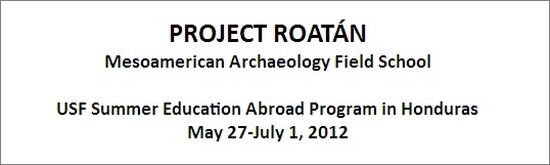
4. Project Roatan, Honduras

The University of South Florida is set to host a fantastic learning opportunity for burgeoning archaeologists with a passion for Mesoamerica with its Mesoamerican Archaeology Field School. Taking students on a five-week journey through the history of the pirates and puritans who dominated the Caribbean in the 16th and 17th centuries, the course will focus its attention on the excavation of the English and Pech settlements located at New Port Royal and Camp Bay Village.

Students attending this once-in-a-lifetime course will learn to use archaeological methods to answer the questions that face us in exploring the history of those who came before us, offering a strong base for any historian and archaeologist.

Guest Post Contributor: Jessie Troy

Tuesday, January 29, 2013

Skulls of human sacrifice victims discovered in Mexico


An excavation in Mexico has led to the discovery of troves of human skulls. Archaeologists believe that the skulls come from the largest mass human sacrifice unearthed yet in ancient Meso-America.

The study, published in the journal Latin American Antiquity, describes the surprising finding. The skulls were found miles from the nearest study in what used to be a body of water called Lake Xaltocan but now simply contains an empty field. The location was so unassuming that researchers had not even immediately thought to look there; they discovered the site when they stumbled upon evidence of looting when viewing satellite images of ancient canals, irrigation channels and lakes that would have surrounded the ancient Teotihuacan kingdom, according to LiveScience.

Upon investigation, the archaeologists discovered over 150 human skulls that were attached to one or two vertebra. The location also held a shrine, which contained incense burners, deity figurines and pottery that indicated a ritual linked with local agriculture. Through carbon dating, researchers have found that the skulls were a minimum of 1,100 years old and, of the dozens of skulls that have been tested so far, the majority belonged to men.

Because most of the skulls belonged to men, researchers believe that they were carefully chosen, rather than the result of indiscriminate slaughter of a village. However, that determination shakes up previously held assumptions about human sacrifice in the region. While several cultures in Meso-America, including the Teotihuacan kingdom, participated in human sacrifice, they mostly occurred at large urban pyramids and were connected to state power - a far cry from this mass human sacrifice that would have taken place in a rural area.

Researchers believe that a drought caused the end of the Teotihuacan kingdom, which led to a period of bloody war and political infighting among several regional groups.

Source: Medical Daily

Wednesday, January 2, 2013

Archaeologists find 800 year old skeletons in Mexico


Archaeologists from the National Institute of Anthropology and History of Mexico found in the center of the country, skeletons of 13 persons, children and adults, estimated to have lived approximately 800 years ago. The discovery occurred when archaeologists supervised the installation of a new drainage system in Cholula, a town about 120 kilometers from Mexico City, the capital.

Archaeologists are now working to identify the sex and ethnicity of the skeletons. The skeletons were found in 12 boxes made of basalt, a funeral tradition. According to experts, the skeletons were grouped into two burials, probably a family mortuary space.

In the same region, a few months ago, mammoth bones were found more than 10,000 years old. According to scholars, the animals lived in the Ice Age.

In April, 17 skeletons about 700 years old were also discovered in the same region.

According to experts, the Chiapas region is full of shelters under the rocks of Guanajuato, which contributes to the discovery of artifacts and skeletal remains.

Experts say the studies show that there are paleontological discoveries dating back to the Ice Age (10,000 years ago), with cave paintings and tools of hunter-gatherers of the first inhabitants of the Americas.

Some skeletons wore ornaments made from shells and snails found in the region of the Gulf of California. They were bangles, a nose ring, earrings, pendants and necklaces of shell beads. Also, an individual was buried with a turtle shell placed at the height of the abdomen.

"The North, the desert, the Northeast and the coast are the most researched, from these findings it is known that the southeast is different from what was known, this side is completely new."

Translated from the Portuguese version by: Lisa Karpova

Source: Pravda.Ru

Tuesday, December 18, 2012

Adventurers Meet on Ancient Ruins to await End of World


A few words by an American scholar, a crumbling Mexican monument and the love of a good yarn were all it took to spawn the belief that the world could end this week.

December 21 marks the end of an age in a 5125 year-old Maya calendar, an event that is variously interpreted as the end of days, the start of a new era or just a good excuse for a party.

Thousands of New Age mystics, spiritual adventurers and canny businessmen are converging on ancient ruins in southern Mexico and Guatemala to find out what will happen.

"No one knows what it will look like on the other side," said Michael Di Martino, 46, a long-haired American who is organizing one of the biggest December 21 celebrations at the Maya temple site of Chichen Itza on the Yucatan peninsula.

It is not the world but "the way we perceive it" that will end, said DiMartino, who pledged his event at ground zero for 2012 acolytes will be a "distilling down of various perspectives into a unified intention for positive transformation, evolution and co-creation of a new way of being."

A mash-up of academic speculation and existential angst seasoned with elements from several world religions, the 2012 phenomenon has been fueled by Hollywood movies and computer games, and relentlessly disseminated by Internet doom-mongers.

Mass hysteria in a Russian prison, a Chinese man building survival pods for doomsday and UFO lovers seeking refuge with aliens in a French mountain village are just some of the reports that have sprung up in the final countdown to December 21.

Robert Bast, a New Zealander living in Melbourne who wrote a book called "Survive 2012" on how to cope with the possible catastrophe, believes the Maya may have sent out a warning.

"The most likely thing for me is a solar storm, but that's not going to kill you straight away. It's more of a long term disaster," said Bast, 47, noting a flu pandemic could also strike the planet. "I feel the world isn't as safe as we think it is. The last couple of generations have had it very cosy."

When dawn breaks on Friday, according to the Maya Long Count calendar, it marks the end of the 13th bak'tun - an epoch lasting some 400 years - and the beginning of the 14th.

This fact would probably have languished in academic obscurity had not a young Maya expert named Michael Coe written in the 1960s that to the ancient Mesoamerican culture the date could herald an "Armageddon" to cleanse humanity.

Since then, the cult of 2012 has snowballed.

Among the sun-bleached pyramids, shaded mangroves and deep cenotes of the Maya heartland, there are hopes December 21 will bring a spiritual re-birth.

Nobody seems quite sure what to expect on Friday, but it has not stopped people getting their hopes up.
"This is the Arab Spring of the spiritual movement," said Geoffrey Ocean Dreyer, a 52-year-old US musician wearing a sombrero and mardi gras beads. "We're going to create world peace. We're going to Jerusalem and we're going to rebuild Solomon's temple."

ANXIETY ATTACKS

The words of Coe, a highly respected Maya scholar, were published in 1966 at the height of the Cold War, stirring fears in a world haunted by the prospect of nuclear holocaust.

Coe could not be reached for comment for this article, but friends and academics who know him insist he never meant to inspire a vision of apocalypse when he committed them to paper.

Stephen Houston, a Maya expert at Brown University in Rhode Island and student of Coe's, said too much has been read into the end of the 13th bak'tun, which was little more than a "dull mathematical declaration" used to bracket dates.

"I see it all as an expression of present day anxiety and not much more than that," Houston said.
Few remaining inscriptions refer to the event, and the best known one is part of a monument recovered from a Maya site in Tabasco state called Tortuguero - much of which was torn down in the 1960s to make way for the construction of a cement factory.

Still, the mix of religion, ancient inscriptions and media-driven speculation about impending doom remains potent.

"I got an email the other day from a mother who was contemplating taking her own life, because she didn't know what was really going to happen, she didn't want her children to live through this ordeal," said David Stuart, a Maya expert at the University of Texas. "We can dismiss it as a kooky idea, which it is, but they're still ideas and they still have power."

US space agency NASA has sought to allay fears of impending catastrophe, noting that "our planet has been getting along just fine for more than 4 billion years, and credible scientists worldwide know of no threat associated with 2012."

Nothing has given the 2012 theories more oxygen in the run-up to the big day than the Internet, noted John Hoopes, a Maya anthropologist at the University of Kansas.

"Computers come straight out of the same people who were smoking pot and protesting at Berkeley and Stanford," he said, referring to US student movements in the 1960s.

"This Maya calendar stuff has been part of hacktivism lore for 40 years, since the beginning, and with every significant change in computer technology, it's gotten another boost."

Many of those gathering in Chichen Itza praised the Internet as a discussion forum and organizing tool for New Age events.

"We don't need leaders now we have the Internet," said Muggy Burton, 66, who had traveled to Mexico from Canada with her 15-year-old, blue-haired granddaughter, Talis Hardy.
The two, who communicate with each other by whistling, plan to live in Mexico for six months, according to Burton, who is going to homeschool Hardy. "It's the end of the world for her, and the beginning of a new one," she added.

MAYA SKEPTICS

Mexico's federal government is not officially marking the phenomenon, but the country's tourism agency has launched a "Mundo Maya 2012" website with a countdown to December 21.
Up to 200,000 people are expected to descend on Chichen Itza alone for the night of December 20.
Among modern descendants of the Maya, the idea it could all come to an end on Friday generally raises a wry smile - but they are happy to play along if it makes money.

"It's a psychic epidemic," said Miguel Coral, 56, a cigar salesman in Merida, a colonial town and capital of Yucatan state. "It's all about business, but that's fine. It helps our country. I think it's excellent we've exported this idea."

Nearby, workers built a pyramid of spray-painted polystyrene blocks for the opening of the town's Maya festival.

"If people who believe in this joke want to come, let them," said Jose May, a Merida tourism official of Maya descent. "Nobody here believes that. Those people were sold an idea."

Hazy rumors have helped feed the sense of anticipation.

A few hours' drive south of Merida in the remote Maya town of Xul, which means "the end," media reports began circulating as early as 2008 that a group of Italians were readying themselves for impending doom by building apocalypse-proof bunkers.

Today, the settlement dubbed the "end of the world resort" is open for business as "Eco Spa Las Aguilas."

"There's no truth in it," said deputy manager Andrea Podesta, 45, referring to speculation it was a cult.
"Some people came here, took some hidden photos, and published some very unpleasant articles about us," he added, noting the glistening new spa was booked up well into 2013.

Inside, a group of elderly Italians, mostly dressed in white, were watching the path of an asteroid on a giant screen. A black-and-white image of Christ's face hung from the wall and a large stone statue of a robed woman greeted visitors.

Whatever lies in store for the planet, even Maya academics who have fought to play down the hype surrounding the passing of another 24 hours feel there could still be some surprises.

"I think there may be some mischief on December 21 because the whole world is watching," said Hoopes in Kansas, citing rumors hacktivist group Anonymous was planning a stunt. "It's a very fertile opportunity for a tremendous prank."


Source: The Age

Saturday, April 16, 2011

Copan Ruins In Honduras


The settlement at Copan is located not far from the borders of Honduras and Guatemala and is believed to exhibit the some of the most amazing ruins of the Mayan occupied territories. Copan achieved its greatest standing during the 5th century under the ruler the Great Lord Quetzal Macaw. The Great Lord was named after two of the most prominent birds in the area and he left a legacy of a settlement that thrived until the 12th century.

What distinguishes Copan from the other pre-Columbian ruins is that the people were not forced to leave by the Spanish. In fact, they appear to have moved before their arrival, at least two years prior to the conquistadors.


There are several theories as to why they left the civilization at Copan, however the most widely accepted belief is that they left because the land was no longer suitable for agriculture.
As for the name, no one really knows if the original settlement had one. However, during the 16th century, the Spanish decided to name it Copan.

Replica of Rosalila Temple 

Rosalila temple replica
© xinning

If you happen to travel to the site, it takes several days to walk around the ruins. There are numerous royal homes, servants quarters, religious areas, and middle class dwellings around the site. There is, however, something that lies beneath, buried by the Maya and incredibly well preserved. Under the ground lies the 6th century Rosalila Temple, with the original layers of intricate paint and design.


Source

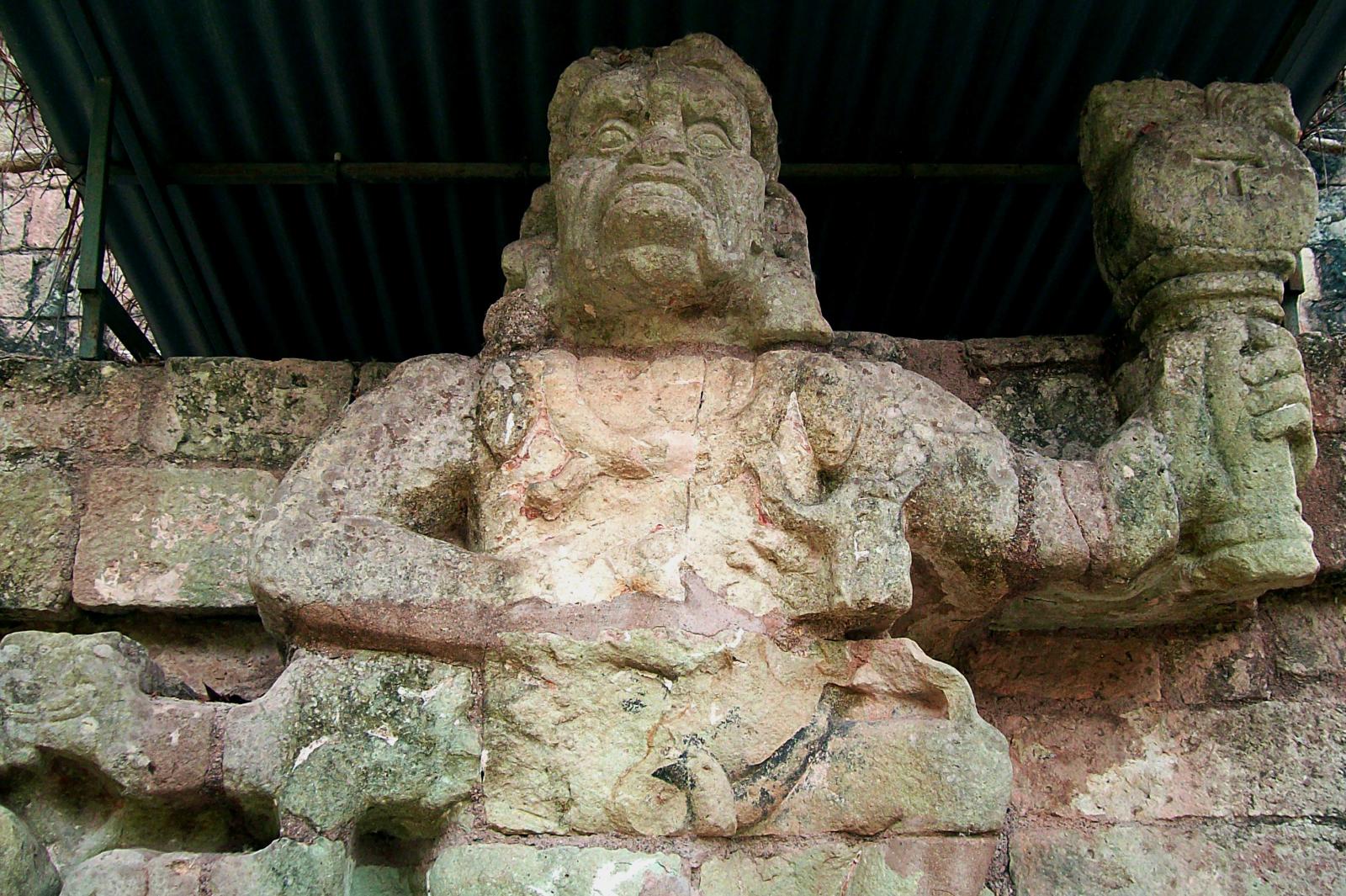
Like many other pre-Columbian civilizations, there are temples above the ground decorated with carved human faces. The faces are both frightening and humorous, some also taking the form of animals and birds.

Today, the macaws of Copan still inhabitat the ruins, flying around the ancient temples and ruined buildings. Sadly, however, the quetzal is rarely seen due to its endangered status.

Picture source Temple © pirate0007


Wednesday, May 5, 2010

Happy Cinco De Mayo


The holiday of Cinco De Mayo, The 5th Of May, commemorates the victory of the Mexican militia over the French army at The Battle Of Puebla in 1862. This is not the day that Mexico gained independence, which is what is commonly thought about this specific day.

Cinco De mayo, es el cinco de mayo, conmemora la victoria de la milicia mexicana sobre el ejército francés en La Batalla De Puebla en 1862. Esto no es el día que México ganó independencia, que es lo que es pensada comúnmente acerca de este día específico.

Tuesday, December 29, 2009

Xcaret Theme Park in The Riviera Maya


Xcaret Theme Park is a unique and interesting underground geological formation that includes pools, lagoons, fresh water sink holes, and let’s not forget, a beach to bask in the sun and rest your tired body after a long snorkel through the crystal clean waters of the Riviera Maya.

The soft currents make for an easy swim through the caves so you don’t have to worry about being an avid snorkeler or diver. Along the way, you’ll observe prehistoric marine fossils on the cavern walls as well as stalagmites and stalactites. At the tops of the limestone cavern there are small sky light openings that allow for an ample amount of light to guide you along your journey. The entire underground river adventure takes approximately 20 minutes, however in some cases; it can feel a bit longer. If you feel yourself getting tired there are many exit areas to rest so you can catch your bearings before continuing down the river.

Read more about Xcaret Theme Park in The Riviera Maya

Like Ancient Digger? Why Not Follow Us?


Subscribe Via RSS Feed Follow Ancient Digger on Facebook Follow Ancient Digger on Twitter Subscribe to Ancient Digger Via Email

Get widget

Search


Ancient Digger Archaeology Copyright © 2015 LKart Theme is Designed by Lasantha