• Ancient Digger teaches Archaeology and History to all Ages!

Thursday, April 25, 2013

Archeologists unearth new information on origins of Maya civilization


The Maya civilization is well-known for its elaborate temples, sophisticated writing system, and mathematical and astronomical developments, yet the civilization's origins remain something of a mystery.

A new University of Arizona study to be published in the journal Science challenges the two prevailing theories on how the ancient civilization began, suggesting its origins are more complex than previously thought.

Anthropologists typically fall into one of two competing camps with regard to the origins of Maya civilization. The first camp believes that it developed almost entirely on its own in the jungles of what is now Guatemala and southern Mexico. The second believes that the Maya civilization developed as the result of direct influences from the older Olmec civilization and its center of La Venta.

It's likely that neither of those theories tells the full story, according to findings by a team of archaeologists led by UA husband-and-wife anthropologists Takeshi Inomata and Daniela Triadan.

"We really focused on the beginning of this civilization and how this remarkable civilization developed," said Inomata, UA professor of anthropology and the study's lead author.

In their excavations at Ceibal, an ancient Maya site in Guatemala, researchers found that Ceibal actually predates the growth of La Venta as a major center by as much as 200 years, suggesting that La Venta could not have been the prevailing influence over early Mayan development.

That does not make the Maya civilization older than the Olmec civilization – since Olmec had another center prior to La Venta – nor does it prove that the Maya civilization developed entirely independently, researchers say.

What it does indicate, they say, is that both Ceibal and La Venta probably participated in a broader cultural shift taking place in the period between 1,150-800 B.C.

"We're saying that the scenario of early Maya culture is really more complex than we thought," said UA anthropology graduate student Victor Castillo, who co-authored the paper with Inomata and Triadan.

"We have this idea of the origin of Maya civilization as an indigenous development, and we have this other idea that it was an external influence that triggered the social complexity of Maya civilization. We're now thinking it's not actually black and white," Castillo said.

There is no denying the striking similarities between Ceibal and La Venta, such as evidence of similar ritual practices and the presence of similar architecture – namely the pyramids that would come to be the hallmark of Mesoamerican civilization but did not exist at the earlier Olmec center of San Lorenzo.

However, researchers don't think this is the case of simply one site mimicking the other. Rather, they suspect that both the Maya site of Ceibal and the Olmec site of La Venta were parts of a more geographically far-reaching cultural shift that occurred around 1,000 B.C., about the time when the Olmec center was transitioning from San Lorenzo to La Venta.

"Basically, there was a major social change happening from the southern Maya lowlands to possibly the coast of Chiapas and the southern Gulf Coast, and this site of Ceibal was a part of that broader social change," Inomata said. "The emergence of a new form of society – with new architecture, with new rituals – became really the important basis for all later Mesoamerican civilizations."

The Science paper, titled "Early Ceremonial Constructions at Ceibal, Guatemala, and the Origins of Lowland Maya Civilization," is based on seven years of excavations at Ceibal.

Additional authors of the paper include Japanese researchers Kazuo Aoyama of the University of Ibaraki, Mito and Hitoshi Yonenobu of the Naruto University of Education, Tokushima.

"We were looking at the emergence of specific cultural traits that were shared by many of those Mesoamerican centers, particularly the form of rituals and the construction of the pyramids," Inomata said. "This gives us a new idea about the beginning of Maya civilization, and it also tells us about how common traits shared by many different Mesoamerican civilizations emerged during that time."

Source: UA News

Thursday, February 7, 2013

4 Mesoamerican Digs for 2013


With the hype of 2012 and bad interpretations of Mayan dating techniques finally behind us, it's time to get down to the real work that is archaeology in Mesoamerica, allowing us to better understand the real history of the Mayans, Incas, and Aztecs in that part of the world.

From exciting sites that offer a glimpse of the relatively simple lives lead by America's ancient peoples, to the honor of finding yourself in the midst of of large and magnificent ruins, volunteer opportunities abound where South and Central American archaeological digs are concerned. Here is a look at four of the prime volunteer and student-friendly Mesoamerican digs that will be taking place in 2013:

1. Belize Valley Archaeological Projects

Over two sessions that will take place in June and August of 2013, the Belize Valley Archaeological Reconnaissance Project will be conducting work at the site known as Baking Pot, an area rich in camping remains, and playing host to two groups of monumental architecture.

This summer's research will focus narrowly on one area in particular: the monumental center at a palace complex known to those working at the site as Group B. Those on site will be working towards clearing sections of the structures and courtyards in an effort to uncover new artifacts and develop a more thorough understanding of the chronology and heritage of the site.

And those who strive for more fun than ancient civilizations offer, can use car rental services of companies like Cheapcarrental.net and dig for a little more action at Mexico's world renown resorts such as Cancun, which is less than 300 miles away from Belize!

2. Blue Creek Project

If the past few years of silliness surrounding the Mayan people and their dating methods have lead you to a natural curiosity about the facts behind their works and lives, the Maya Research Program and its Blue Creek Project is the place for you.

For the 21st year in a row, this American group will sponsor extensive fieldwork at the Mayan site called Blue Creek, located in northwestern Belize, offering everyone involved the opportunity to discover the fascinating reality of Mayan existence.

The project will be open to students and non-students alike, and experience - or lack thereof - is not a concern in the application process. With academic credit and even scholarships available, this project is well-worth checking out for anyone with a working interest in archaeology.

3. Oaxaca, Mexico

For the third straight year, Indiana University will be playing host to anthropology faculty members, students, and outside volunteers for their field program based in Oaxaca, Mexico. With a focus on archaeology that often finds itself embracing modern anthropology, this course will introduce students to the wide range of diversity in this region, ranging from the ancient Maya to the current inhabitants.

While some of the course's planned activity will involve active time at dig sites, you'll also have the opportunity to attend local festivals and learn about the modern issues, both economic and ecological, facing Oaxaca's people.

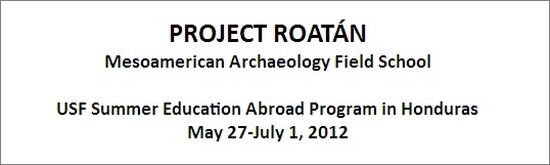
4. Project Roatan, Honduras

The University of South Florida is set to host a fantastic learning opportunity for burgeoning archaeologists with a passion for Mesoamerica with its Mesoamerican Archaeology Field School. Taking students on a five-week journey through the history of the pirates and puritans who dominated the Caribbean in the 16th and 17th centuries, the course will focus its attention on the excavation of the English and Pech settlements located at New Port Royal and Camp Bay Village.

Students attending this once-in-a-lifetime course will learn to use archaeological methods to answer the questions that face us in exploring the history of those who came before us, offering a strong base for any historian and archaeologist.

Guest Post Contributor: Jessie Troy

Monday, January 7, 2013

Maya 'fat god' platter discovered in ruins


An international archaeology team, for example, reports that a well-known Maya ruin site had its origins further back in time than anyone first supposed. Nestled in the hilly interior of Mexico's Yucatan Peninsula, the ruin of Kiuic turns out to boast a pyramid of surprising antiquity, dating back to 700 B.C., as shown by carbon dating. Long seen as a transitional corridor between the ancient Maya cities of Central America and the later ones of the Yucatan coast, the hilly "Puuc" region that is home to Kiuic and other sites, instead, looks like a longtime home of the vanished culture.

"They were living here going way back," says archaeologist George Bey of Millsaps College in Jackson, Miss. The pyramid was discovered long ago, with writer John Lloyd Stephens visiting Kiuic's ruins in the 1840s, and dates to after 800 A.D., when the site was thriving. But now excavation to the foot of a four-story pyramid in the center of the ruin has helped pin down its birth date, showing it started out as a ceremonial platform, as was typical of ancient Maya towns and cities.

In 2010, Bey and Mexican archaeologist Tomás Gallareta Negrón of INAH reported that artifacts left at Kiuic indicated the site had undergone rapid abandonment around 880 A.D., part of the famed collapse of ancient Maya cities at the time. More than 6 million Maya still live in Central America today, but the rulers and the pyramid cities of the era were abandoned in a diaspora that modern-day scholars have tied to long-term drought, over-farming and other factors.

At one of the houses showing signs of rapid abandonment on a hilltop overlooking Kiuic, the team reports they have found inscriptions on a keystone block as well as the remains of a large feasting bowl left behind, more evidence of rapid flight. Earlier discoveries at the site included grinding stones left tilted against doorways, kitchen implements left stacked in rooms and remains of ancestors left behind that Maya traditions would have typically seen as needing removal if a place faced permanent abandonment. Instead, it looks like the residents just left, expecting to shortly return. But they never did. "These were the Maya middle class, and they were doing well," Bey says.

The three feet of the platter depicted the Maya "fat god," a patron of feasting, appropriately enough, next to tools for applying stucco to homes. Apparently, the heavy feasting platter was too big to take when the homeowner left (sort of like leaving the family silver behind when going on a vacation now), Bey says, but such a valuable object would have been taken if a permanent move were planned.

The team hopes that analysis of the site, slowly being unearthed by archaeologists, provides a time capsule of the time when abandonment took place at Kiuic, and might offer insight into its occurrence elsewhere. Scholars generally divide ancient Maya eras into a Classic one that started after 200 A.D. and a "Pre-Classic" one that dates back to perhaps 900 B.C., but the latest finds point to more continuity between the two eras instead, Bey suggests.

Source: 9 News

Sunday, December 23, 2012

Interview with the Founder of Dig-It Games and Creator of Mayan Mysteries


I had the immense pleasure of interviewing Suzi Wilczynski, the founder of Dig-It Games. Suzi is a former archaeologist and teacher who has bridged the gap between entertainment and education. Her games were created for people who crave the challenge of a puzzle and who seek knowledge by solving the complexities of a mysterious ancient society through critical thinking.

Her latest creation, Mayan Mysteries, incorporates archaeology techniques with an exhilarating adventure and journey, which leads players into a Maya world of intrigue and mystery. One aspect, and the most important I believe, which makes this game unique, is the fact that it allows the player to use their prior knowledge to break apart information and make sense of it using a combination of science, math,  reading, and geographical knowledge and skills.


Interview with Suzi Wilczynski: Mayan Mysteries


I read that you are a former archaeologist. What was your area of expertise and did you ever discover anything exciting on digs?

I am a Mediterranean archaeologist, with a focus on Bronze Age Greece and cultural interactions. I studied Roman Archaeology in college and spent many seasons at Roman and Byzantine sites in Greece and the Middle East. In my first season, I found the most unusual artifacts: Roman curse tablets. They were thin sheets of lead that people inscribed curses on, then folded up and threw in a well. It was fascinating. We also found a number of complete pottery and glass vessels in that well. It was pretty exciting.

When you started creating archaeology games, did you have the intention of integrating real archaeology terms into the game play like: superposition, carbon dating, trowel, etc?

Absolutely. My games are designed to teach archaeology and terminology plays a huge part. Roman Town included a number of vocabulary-related games. Mayan Mysteries focuses more on concepts such as stratigraphy, recording, context, dating and proper excavation methodology. We incorporate real archaeological tools and techniques as well. My games are authentic archaeological experiences.

How long did it take you to conceptualize this game? Did you employ others’ knowledge while creating it?

For Mayan Mysteries, it took approximately a year from preliminary research to launch. It was a bit more for Roman Town since I had a lot to learn about game design as well. For the content in Mayan Mysteries I worked with Dr. Robert J. Sharer from the University of Pennsylvania, an expert in the field. My process for game design is iterative rather than top down, which means that the design changes during development. So everyone involved in development (programmers, artists, writers, testers) had an impact on the final product.

What was your real motivation behind Mayan Mysteries? Was it for educational purposes or pure pleasure?

Mayan Mysteries was designed as an educational tool. Content was built around National Standards and the Teacher Management System was part of the original design. The mission of Dig-It! Games is to make interactive, educational products that seamlessly blend fun and learning. It is impossible to play one of our games without learning something. Having said that, I won’t release a game unless it’s fun, so we worked hard to make sure that we ended up with an educational tool that is enjoyable outside the classroom. Based on feedback from casual users, we’ve succeeded in making a fun game that happens to be educational.

What age group did you have in mind when you began creating this game?

Mayan Mysteries was created specifically for middle school students. When my own children were ages 11 through14, there were very few products designed specifically for them. Unfortunately, that’s still the case. Middle school students are an underserved group when it comes to games and fun educational products. As an educator, I also believe strongly that middle school education needs to include an emphasis on analytical and critical thinking skills. As a scientist, I feel that middle school is the time when kids need to learn the basic scientific and logical thinking that will enable them to be successful in STEM subjects down the road. I also happen to just like this age group, so it’s enjoyable for me to create products for them, and I love to watch them play my games: you can see the moments when things just start to click for them and the history, science and math suddenly make sense in their lives.

The processes of archaeology can be difficult to understand for a novice. Will Mayan Mysteries be difficult to understand and navigate for younger children?

Mayan Mysteries is an in-depth, immersive historical experience for anyone ages 11 and older. Younger children will struggle with some of the puzzles, but can play with help from a parent or older child. Additionally, Mayan Mysteries is a historically accurate depiction of the Maya culture; some topics such as warfare and sacrifices may not be appropriate for children younger than 11. There is no violence or graphic images in Mayan Mysteries, but some younger children may be disturbed by the concepts discussed. As far as the archaeological content, my goal is to make archaeology accessible to young people. As you say, it can be difficult to understand, and archaeologists often have trouble explaining what they do in simple terms. Dig-It! Games is changing that by creating immersive experiences that turn players into archaeologists. We blend archaeological concepts and methodology with fun, intuitive game play. Players walk away from our games with a true understanding of the fundamentals and importance of archaeology.

Mayan history is very complex with the symbology, culture, architecture, etc. How accurate really is the content in the game, especially if it’s geared towards a younger player who has no prior knowledge of Mayan culture?

The content in Mayan Mysteries was developed with the assistance of Dr. Robert J. Sharer, a world-renowned Maya expert. All the content is 100 percent historically accurate. Additionally, our sites are real places, our artifacts are completely authentic, and we use real Mayan glyphs and terms throughout the game. We incorporate real archaeological tools and techniques as well. Mayan Mysteries is an authentic and historically accurate representation of the Maya, incorporating detailed factual information about the ancient civilization. Our in-game encyclopedia includes more than 300 factual entries, each one paired with photos of actual Maya sites and artifacts as well as artists’ renderings of people, places, artifacts and glyphs. It was important to both Dr. Sharer and me that we create a game that was enjoyable while remaining true to history. I think we did that very well.

I’m a TESOL teacher, how do you think speakers of other languages would be able to navigate with Mayan Mysteries?

Mayan Mysteries was designed for English speakers with at least a 5th grade reading level. Some of the vocabulary may be tricky for non-English speakers, but most difficult terms are connected to links to definitions within the in-game encyclopedia. There are some Spanish terms used in the game, and much of the culture will be familiar to native Spanish speakers from Mexico and Central America. One of my goals with Mayan Mysteries was to create a game that would be successful for all different types of learners. For that reason, every part of the game includes voice-overs reading the text, which should help non-English speakers as well as auditory learners and kids who are not strong readers. The concepts of the game are universal and not reliant on any previous knowledge and game play is intuitive, so the original language of the user is not a factor in understanding and enjoying Mayan Mysteries.

What is it that you hope players will gain from playing Mayan Mysteries?

From playing Mayan Mysteries, players will have a deep understanding of: the fundamentals and importance of archaeology, methods of historical study including the use of primary sources, Maya history and culture, the Maya number system, the Maya calendar, the Mayan language, and Central American Geography.

Players will also gain an understanding of how beliefs are transmitted in societies, what culture is and how it is expressed, the methods by which governments and institutions develop and exercise authority, economic concepts such as trade, markets and production and distribution of goods, and how culture, government and belief systems influence and are influenced by scientific achievements. Finally, players will develop an understanding of why it is important to study the past and how past cultures influence modern life through interaction with Maya artifacts and an examination of Maya culture.

In addition, Mayan Mysteries uses puzzles and problem-solving exercises to develop and enrich kids’ analytical thinking, creative thinking, and independent learning skills. Puzzles about the Maya calendar, number system, and daily life assess reading comprehension, geographical knowledge, spatial reasoning, and science and math skills. Game play also requires players to test fact retention and knowledge in fun challenges.

Do you have intentions of creating archaeology games with the expert archaeologist or grad student, like myself, in mind?

My focus is on introducing elementary and middle school students to ancient civilizations in a way that is meaningful and understandable within their lives. I believe that archaeology is a powerful teaching tool for social studies: it brings history to life while encouraging students to use skills from multiple disciplines such as math, science and language arts. My goal is to create entertaining, interactive games that can be played at school or at home to truly engage children in the science of archaeology and educate them about civilizations and cultures in an immersive way that goes beyond what they can experience from a textbook or film.

Will Mayan Mysteries eventually be offered on more game systems in the future?

Mayan Mysteries can be played on Mac, PC, and tablet devices. We’re also happy to announce Mayan Mysteries is now available as an iPad app so it can be downloaded and played anytime, anywhere!


Are you still immersed in teaching and archaeology or are you spending more time creating new games?

Dig-It! Games is a full-time job, but I also follow the latest developments in education and archaeology.

Tuesday, December 18, 2012

Adventurers Meet on Ancient Ruins to await End of World


A few words by an American scholar, a crumbling Mexican monument and the love of a good yarn were all it took to spawn the belief that the world could end this week.

December 21 marks the end of an age in a 5125 year-old Maya calendar, an event that is variously interpreted as the end of days, the start of a new era or just a good excuse for a party.

Thousands of New Age mystics, spiritual adventurers and canny businessmen are converging on ancient ruins in southern Mexico and Guatemala to find out what will happen.

"No one knows what it will look like on the other side," said Michael Di Martino, 46, a long-haired American who is organizing one of the biggest December 21 celebrations at the Maya temple site of Chichen Itza on the Yucatan peninsula.

It is not the world but "the way we perceive it" that will end, said DiMartino, who pledged his event at ground zero for 2012 acolytes will be a "distilling down of various perspectives into a unified intention for positive transformation, evolution and co-creation of a new way of being."

A mash-up of academic speculation and existential angst seasoned with elements from several world religions, the 2012 phenomenon has been fueled by Hollywood movies and computer games, and relentlessly disseminated by Internet doom-mongers.

Mass hysteria in a Russian prison, a Chinese man building survival pods for doomsday and UFO lovers seeking refuge with aliens in a French mountain village are just some of the reports that have sprung up in the final countdown to December 21.

Robert Bast, a New Zealander living in Melbourne who wrote a book called "Survive 2012" on how to cope with the possible catastrophe, believes the Maya may have sent out a warning.

"The most likely thing for me is a solar storm, but that's not going to kill you straight away. It's more of a long term disaster," said Bast, 47, noting a flu pandemic could also strike the planet. "I feel the world isn't as safe as we think it is. The last couple of generations have had it very cosy."

When dawn breaks on Friday, according to the Maya Long Count calendar, it marks the end of the 13th bak'tun - an epoch lasting some 400 years - and the beginning of the 14th.

This fact would probably have languished in academic obscurity had not a young Maya expert named Michael Coe written in the 1960s that to the ancient Mesoamerican culture the date could herald an "Armageddon" to cleanse humanity.

Since then, the cult of 2012 has snowballed.

Among the sun-bleached pyramids, shaded mangroves and deep cenotes of the Maya heartland, there are hopes December 21 will bring a spiritual re-birth.

Nobody seems quite sure what to expect on Friday, but it has not stopped people getting their hopes up.
"This is the Arab Spring of the spiritual movement," said Geoffrey Ocean Dreyer, a 52-year-old US musician wearing a sombrero and mardi gras beads. "We're going to create world peace. We're going to Jerusalem and we're going to rebuild Solomon's temple."

ANXIETY ATTACKS

The words of Coe, a highly respected Maya scholar, were published in 1966 at the height of the Cold War, stirring fears in a world haunted by the prospect of nuclear holocaust.

Coe could not be reached for comment for this article, but friends and academics who know him insist he never meant to inspire a vision of apocalypse when he committed them to paper.

Stephen Houston, a Maya expert at Brown University in Rhode Island and student of Coe's, said too much has been read into the end of the 13th bak'tun, which was little more than a "dull mathematical declaration" used to bracket dates.

"I see it all as an expression of present day anxiety and not much more than that," Houston said.
Few remaining inscriptions refer to the event, and the best known one is part of a monument recovered from a Maya site in Tabasco state called Tortuguero - much of which was torn down in the 1960s to make way for the construction of a cement factory.

Still, the mix of religion, ancient inscriptions and media-driven speculation about impending doom remains potent.

"I got an email the other day from a mother who was contemplating taking her own life, because she didn't know what was really going to happen, she didn't want her children to live through this ordeal," said David Stuart, a Maya expert at the University of Texas. "We can dismiss it as a kooky idea, which it is, but they're still ideas and they still have power."

US space agency NASA has sought to allay fears of impending catastrophe, noting that "our planet has been getting along just fine for more than 4 billion years, and credible scientists worldwide know of no threat associated with 2012."

Nothing has given the 2012 theories more oxygen in the run-up to the big day than the Internet, noted John Hoopes, a Maya anthropologist at the University of Kansas.

"Computers come straight out of the same people who were smoking pot and protesting at Berkeley and Stanford," he said, referring to US student movements in the 1960s.

"This Maya calendar stuff has been part of hacktivism lore for 40 years, since the beginning, and with every significant change in computer technology, it's gotten another boost."

Many of those gathering in Chichen Itza praised the Internet as a discussion forum and organizing tool for New Age events.

"We don't need leaders now we have the Internet," said Muggy Burton, 66, who had traveled to Mexico from Canada with her 15-year-old, blue-haired granddaughter, Talis Hardy.
The two, who communicate with each other by whistling, plan to live in Mexico for six months, according to Burton, who is going to homeschool Hardy. "It's the end of the world for her, and the beginning of a new one," she added.

MAYA SKEPTICS

Mexico's federal government is not officially marking the phenomenon, but the country's tourism agency has launched a "Mundo Maya 2012" website with a countdown to December 21.
Up to 200,000 people are expected to descend on Chichen Itza alone for the night of December 20.
Among modern descendants of the Maya, the idea it could all come to an end on Friday generally raises a wry smile - but they are happy to play along if it makes money.

"It's a psychic epidemic," said Miguel Coral, 56, a cigar salesman in Merida, a colonial town and capital of Yucatan state. "It's all about business, but that's fine. It helps our country. I think it's excellent we've exported this idea."

Nearby, workers built a pyramid of spray-painted polystyrene blocks for the opening of the town's Maya festival.

"If people who believe in this joke want to come, let them," said Jose May, a Merida tourism official of Maya descent. "Nobody here believes that. Those people were sold an idea."

Hazy rumors have helped feed the sense of anticipation.

A few hours' drive south of Merida in the remote Maya town of Xul, which means "the end," media reports began circulating as early as 2008 that a group of Italians were readying themselves for impending doom by building apocalypse-proof bunkers.

Today, the settlement dubbed the "end of the world resort" is open for business as "Eco Spa Las Aguilas."

"There's no truth in it," said deputy manager Andrea Podesta, 45, referring to speculation it was a cult.
"Some people came here, took some hidden photos, and published some very unpleasant articles about us," he added, noting the glistening new spa was booked up well into 2013.

Inside, a group of elderly Italians, mostly dressed in white, were watching the path of an asteroid on a giant screen. A black-and-white image of Christ's face hung from the wall and a large stone statue of a robed woman greeted visitors.

Whatever lies in store for the planet, even Maya academics who have fought to play down the hype surrounding the passing of another 24 hours feel there could still be some surprises.

"I think there may be some mischief on December 21 because the whole world is watching," said Hoopes in Kansas, citing rumors hacktivist group Anonymous was planning a stunt. "It's a very fertile opportunity for a tremendous prank."


Source: The Age

Wednesday, November 28, 2012

The apocalypse or the crock-alypse?


Edwin Barnhart, an archaeologist and expert on Mayan civilization, will speak on the prediction that end of the world is coming Dec. 21 on Dec. 10 at 6 p.m. in the Robert B. Moore Theatre.
The lecture is free and open to the public. The program is presented by OCC Staff Development and the OCC Foundation.

The Mayan calendar ends on Dec. 21and it has been predicted by some that the world will end on that day. Barnhart, an archaeologist, is one of the world’s leading authorities on Mayan civilization. He is director of the Maya Exploration Center, a Fellow of the Explorer Club, and regular contributor to broadcasts airing on The Discovery Channel, The History Channel, and public television worldwide.

A widely recognized authority on ancient Maya astronomy, mathematics and calendar systems, Barnhart spent more than 20 years exploring Maya archaeology.


Source: Coast Report

Like Ancient Digger? Why Not Follow Us?


Subscribe Via RSS Feed Follow Ancient Digger on Facebook Follow Ancient Digger on Twitter Subscribe to Ancient Digger Via Email

Get widget

Search


Ancient Digger Archaeology Copyright © 2015 LKart Theme is Designed by Lasantha