Four bone fragments of the Buddha housed in the National Museum, Delhi are on a two-week tour of Sri Lanka to enable Buddhists there to pay homage to them. While all relics of the Buddha are revered, these are special. They are part of the trove of 22 bone fragments that were discovered by the Archaeological Survey of India (ASI) in the 1970s in Kapilavastu, Uttar Pradesh, where he grew up as a prince before renouncing the world.
The journey of the relics, from New Delhi to Colombo, and to six other places in Sri Lanka this year, being observed as the 2,600th anniversary of the Buddha’s enlightenment, brings up some old questions.
For the two governments, the historical antecedent of the relics is a settled fact, and the exchange of cultural artefacts between the two countries is a continuation of the long history that dates back to the days of Emperor Ashoka.
But Nepal has for years raised doubts about the relics, claiming that the true Kapilavastu lies in its territory, and not in U.P. as Indian archaeologists claim.
After Gautama Buddha died or attained Mahaparinirvana in the 5th century BCE, eight ruling families shared the relics from his body. Among them were the Sakyas, the clan to which the Buddha belonged. They built a stupa over their share in Kapilavastu, the capital city. After the decline of Buddhism, many stupas and monasteries were abandoned and the one built by the Sakyas too went to seed. When the Chinese pilgrims Fa-hien and Hiuen Tsang visited India centuries later in the 5th and 7th C.E respectively, most of these sites lay in ruins.
PEPPÉ’S DISCOVERY
It was in the 19th century that Buddhist archaeology began to be properly noticed as British antiquarians set out to pursue the Buddha’s trail. In 1898, William Peppé, a planter, while clearing his estate near Piprahwa, a village in eastern Uttar Pradesh near the India-Nepal border, found a brick dome that contained a sand stone box with five caskets, relics said to be that of the Buddha, and other artefacts. An inscription found on one of the caskets, though dated to after the Buddha’s death, established the authenticity of the relics.
Based on this discovery and the location with respect to Lumbini, the Buddha’s birthplace in Nepal, Piprahwa was identified as Kapilavastu. But there were counter claims. In 1896, and again in 1899, a few archaeologists identified Tilaurakot, a village in Nepal’s terai region as Kapilavastu. Though they could not find any relics, the presence of a large ensemble of structures and their correlation with the Chinese pilgrims’ description supported their claim. Tilaurkot’s case was bolstered by the disagreement among archaeologists over the decipherment of the Piprahwa inscription.
The dispute continued in the post-independence period. Nepal commenced a series of excavations in 1962 and found more structures around Tilaurakot, but failed to locate any relics. Matters turned in India’s favour in 1971. K.M. Srivastava, an archaeologist with the ASI, following a complaint forwarded to him from the Prime Minister’s Office regarding the poor upkeep of Piprahwa, decided to look afresh at the place. He began new excavations and dug deeper to discover two remarkable soap stone urns. One of them contained 10 bone fragments and the other 12, all dateable to 5th century BCE. Besides this, many terracotta seals with inscriptions found at the site supported India’s claim. This was “an epoch making discovery” that settled the location of Kapilavastu, Mr. Srivastava said in his report. For reasons that are still unknown, the ASI published the report only 20 years after the excavations were completed.
Nepal refused to acknowledge these developments and persists with its claim. It even nominated Tilaurakot along with Lumbini for World Heritage status. Unesco, which accepted the nominations, declared Lumbini as a World Heritage Site in 1997. Tilaurakot is still on the tentative list. The controversies over Kapilavastu were in the spotlight again last year when Charles Allen published his absorbing book, The Buddha and Dr. Füher: an Archaeological Scandal.
Evidently none of the contesting claims has worried Sri Lanka. It was the first county to invite the relics and exhibit them in 1978. The exhibition, The Hindu reported then, drew more than 10 million visitors.
TIRUKETHEESWARAM PROJECT
The exchange of ideas and objects around Buddhism between India and Sri Lanka go back more than two millennia. In the 3rd century BCE, a mission led by Mahinda, Ashoka’s son, reached Sri Lanka and converted the Sri Lankan king Tissa to Buddhism. One of Tissa’s first requests, as the Sri Lankan text Mahavamsa compiled in 6th century CE describes, was for a branch of the Bodhi tree. The request was accepted, and Sanghamitra, Ashoka’s daughter, carried the branch to Anuradhapura.
Unlike in 1978, when the Indian government first exhibited the relics at Chennai’s Egmore Museum, en route to Sri Lanka, this time, in the current atmosphere of political antipathy in Tamil Nadu towards the Sri Lankan government, it evidently did not want to take chances. The relics were flown directly to Colombo.
This brings us to a second question around the lending of the relics to Sri Lanka. In the light of the unresolved Tamil issue, at least one political party, the MDMK, has objected to it. In a letter to Prime Minister Manmohan Singh, its leader Vaiko wrote that this was an “unpardonable betrayal” of Sri Lankan Tamils by the Indian government.
Perhaps it was in anticipation of such criticism that at the same time as the inauguration of the relics exposition in Colombo, India will launch a project for the conservation of the Tiruketheeswaram temple in Mannar.
Indeed, in the joint declaration issued on June 9, 2010, during the visit of Sri Lankan President Mahinda Rajapaksa to India, alongside the plans for “joint activities” by the two countries to mark this year’s anniversary of Buddha’s enlightenment, there is also the following line: “Both leaders also welcomed the proposal for the restoration of Tiruketheeswaram temple at Mannar to be undertaken with the assistance of the Archaeological Survey of India and the College of Architecture and Sculpture, Mamallapuram, with the involvement of the Department of Archaeology of Sri Lanka.”
Union Minister of Culture Kumari Selja, who has accompanied the relics to Colombo, will travel to Mannar on Monday to launch the project, to which New Delhi has committed Rs.135 million.
Source: The Hindu


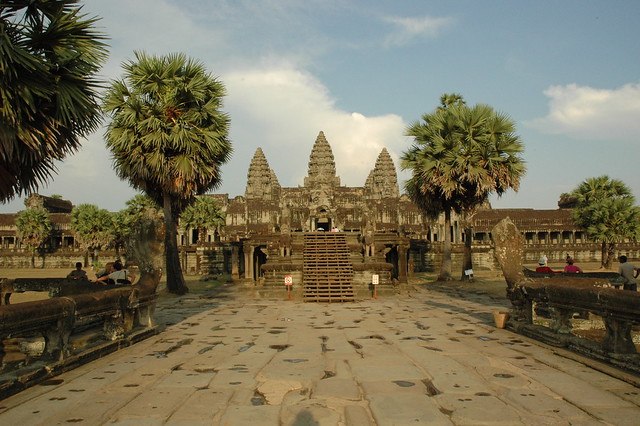
 have stood as a symbol of the nation of Cambodia. So much so that Angkor Wat appears on the Cambodian flag, its beauty and magnificence a source of national pride.