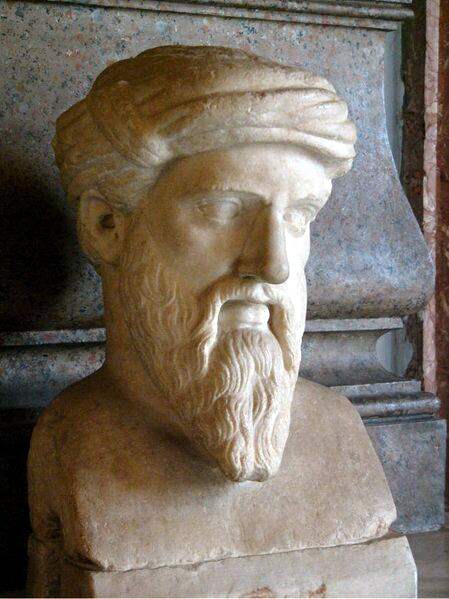
The Ionian Cultural Revolution was a trend towards a different view, and explanation of, the natural world, astronomy, science and medicine, architecture, logic and reasoning, and literature. It’s important to remember, however, that when we speak of 'the Ionian revolution ' this should not be interpreted literally as a total break with the past or a completely new beginning. We know that the' revolution' required several generations and that it involved a critical reworking of existing literary and intellectual traditions . Consequently, scientific and philosophical thought was not unlike earlier periods. The knowledge gained was simply used for more practical purposes.
During the Ionian Cultural Revolution,
Thales of Miletus, regarded as the “father of science” and Greek thinker, was pondering the nature of matter and believed that solids, liquids, and gases, were all made up of water. It makes complete sense, as water is one of the many substances that we can observe changing into all of these different states. While
Anaximenes was convinced that air was the fundamental substance,
Heraclitus believed the complete opposite. Fire was the fundamental substance according to him. One of the greatest discoveries, or observations, was by Leucippus, and his student
Democritus. They posited that matter was made up of tiny particles and separated by space. This is similar to the atomic theory we have today. The issue was, the idea of atomic theory had arrived in India long before Greece during the 6th century . Yet, western civilization traces the ideas directly back to ancient Greece.
During the 5th century,
Meton of Athens introduced a calendar that brought the lunar calendar into approximate correlation with the solar year by adding intercalary months at specified intervals in a nineteen-year cycle . This calendar was essentially used for astronomical observations. This calendar was never utilized during the Scientific Revolution, as cosmological views came from
Aristotle and
Ptolemy, especially Ptolemy’s geocentric conception-the universe was seen as a series of concentric spheres with a fixed earth at its center. Pythagoras, however, had a profound affect on the Ionian Cultural Revolution, as well as the Scientific Revolution. Evidently,
Pythagoras had a prejudice for the beauty of perfect circles, therefore the sun and the earth had to be circular. Pythagoras had a philosophy based on mathematical ‘perfection’ and the scientific method, and that complex idea and problems can break down into simple ones . His legacy and work was a fundamental driving force for many scientists, including Isaac Newton during the Scientific Revolution.
During the Ionian Cultural Revolution, Hippocrates was promoting a rational, scientific approach to medicine, giving it a firm footing as a professional endeavor. He observed symptoms of patients, and rejected traditional medical theories about illnesses and their cures . Today, the phrase “Hippocratic Oath” is still used between doctors and patients to explain the ethical relationship between the two parties. One of Hippocrates’ pupils advocated that the body was made up of four humors, taking the idea from Empedocles’ theory that the cosmos was made up of four elements. Similarly, advances in medical theory during the Scientific Revolution proved that there were serious misconceptions about the human body. Galen’s theory was that the human body contained four major fluids–blood, yellow bile, black bile, and phlegm - and if one of the four fluids were present in too little or too great an amount, predictable illness would result. Unfortunately for Galen, his hypothesis that the body had two blood systems and looking deeper into the four humors in the body could cure diseases proved to be inaccurate.
During the
Scientific Revolution, Europeans had turned to the church for guidance. The discoveries of the Scientific Revolution overturned the tenets of the traditional belief system, and the general population of European society gradually accepted them. Consequently, those that thought traditional beliefs were easier to understand often rejected them. The Scientific Revolution would prove that their goals or traditions were no longer valid, and this was something they didn't take lightly . Consequently, the Ionian sophists during the revolution attempted to redirect religion, which was based upon myth, and also subject to criticism, away from its godly pursuits. Although pre-Socratic philosophers such as Thales and Anaxagoras didn’t voice their opposition to the old religion, they did present a new perspective on the Olympian gods.
At the time of the Sophists, the Greek way of looking at the supernatural was waning, especially in light of the Persian wars, in which the gods were expected to intervene in favor of the Greeks. The Sophists taught young men the art of rhetoric and even professed to teach arête, however, one of the most controversial statements by the famous sophist, Protagoras, was still to come. Protagoras’ doctrine proclaimed, “man is the measure of all things”, meaning there are no absolute truths, whether scientific or religious. The implication of such moral relativism is that humans created religion to satisfy their needs . This was a far cry from the ideas on religion during the scientific revolution, when Europeans were still baffled by religion, but many didn’t deny the existence of a creator. Protagoras, however, was essentially an agnostic, explaining that he didn’t know if the gods existed at all.
Architecture flourished during the Ionian Cultural Revolution. The Athenian Acropolis was restored under Pericles to its former glory, after its destruction during the Persian wars.
Mnesicles added the left proplylaea entrance to the acropolis from 437 to 432 BCE. The Parthenon was constructed from 447 to 432 BE and was headed by architect Ictinus. The Parthenon is the most important surviving building of Classical Greece, generally considered to be the culmination of the development of the Doric order . The Temple of Nike was constructed to the right of the Propylaea in the late 5th century. It was identified with Athena, the goddess of victory, but the “temple was erected in the hope rather than the possession of victory, for the tragic death struggle with Sparta was in progress” . The Erechtheum was created in the 5th century on the location where Poseidon had killed him. The temple was sacred to Poseidon,
Erechtheus, and Athena. Lastly, the open-air theater of
Dionysus was constructed to host comedies and Athenian tragedies.
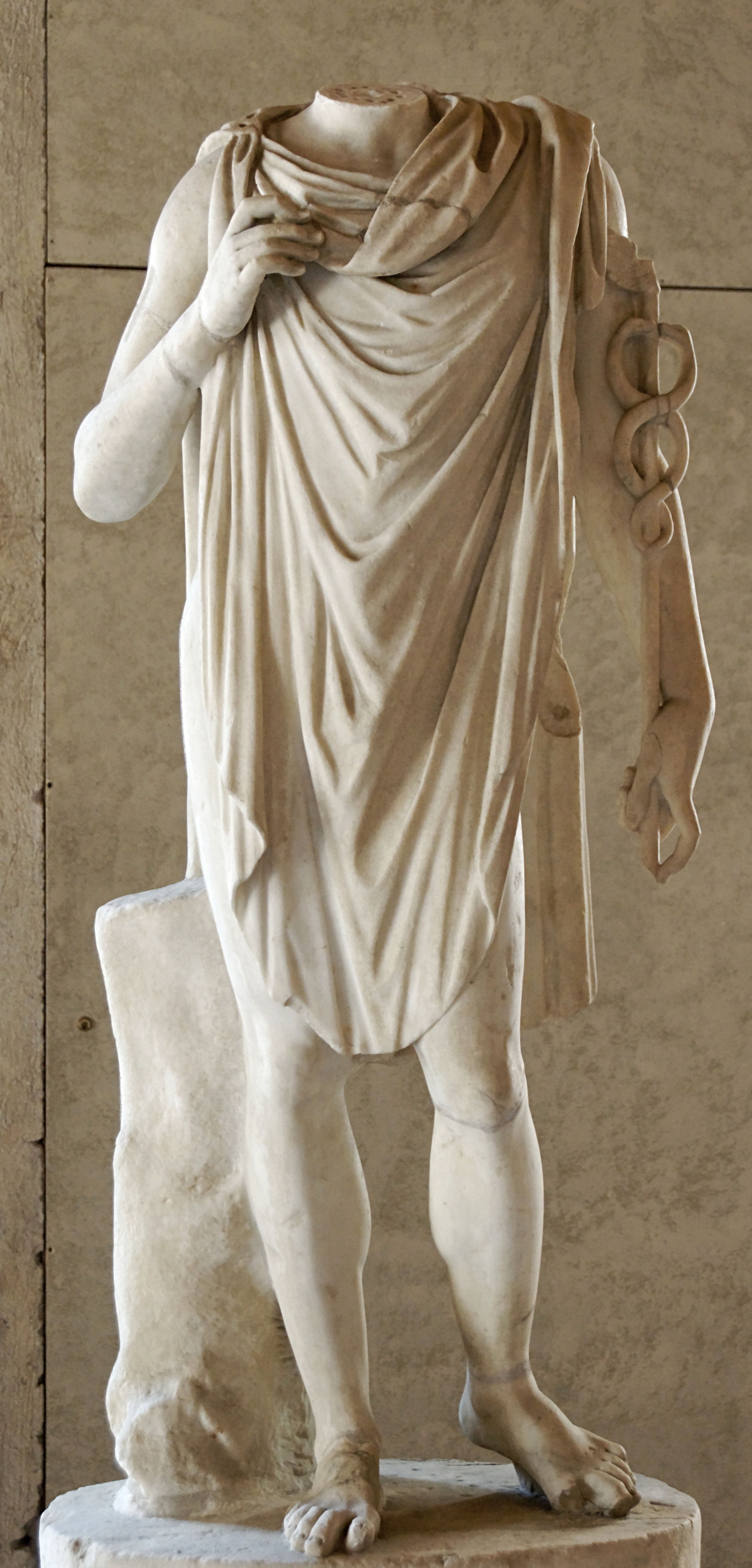
Sculpture during the Ionian Cultural Revolution was reflective of the human form. Sculptor Polyclitus was famous for creating
Kouroi of idealized athletes. The sculptures were typically of nude men, engaged in sport like discus or spear throwing. Consequently, Athenian sculptor Phidias created sculptures representing humans as divine. He was most revered for his colossal sculpture of Zeus at Olympus and Athena in the Parthenon. Both sculptures attempted to reveal the human form, yet Phidias used carved draping on the figures, which was virtually translucent. Additionally, painting and mosaics were also flourishing, with artists like Polygnotus of Thasos taking the lead during the time of Cimon . He produced not only mosaics, but also painted pottery, inspired by Classical scenes.
Finally, literature takes precedence during the revolution. Aeschylus was considered the father of tragedy and he introduced trap doors and a mechanical contraption used during plays presented during the Panathenaic festival. Aeschylus’ Persians is the only surviving Greek historical tragedy from the Ionian Revolution. Sophocles was a military man and had a magnetic personality, and so his ideas went over quite well with the masses. In fact, Sophocles’ Oedipus Tyrannus, also known as Oedipus Rex, is the most widely performed Greek tragedy. Additionally, Euripides was a Greek writer of tragedies during the revolution, most often illustrating the suffering of women. Arisophanes’ comedic plays are the only surviving plays of Old Comedy that explain the public opinion during the Peloponnesian War.

Lastly, the Ionian Cultural Revolution was the time of
Herodotus and
Thucydides, both historical writers. Herodotus is the first to explain
dualism and
panhellinism and the development of the barbarian. Essentially he toyed with the ideas and the Romans adopted them. Much of what we now know about Egypt and Persia comes from the studies and observations of Herodotus and his written records of people, places, and customs . Thucydides brings literature to life. He sought to change the nature of history because he believed Herodotus got it wrong. He also posited that the focus should be on politics and war and telling the
specific history of Greece within Athens instead of Herodotus who’s telling the story of all.
In spite of all the advances and
changes during the Scientific Revolution, many still experienced trepidation. Changes in science and philosophy, medicine and religion, were brought forth quite suddenly, in a time when radicals were trying to push the limits. This was not so during the Ionian Cultural Revolution. The revolution was more of a gradual shift in culture, rather than a peak. While freethinkers like Pythagoras and
Protagoras were inventing ways to look at religion and the natural world, men like
Galileo were in hiding because of their views of the Catholic Church, and the fact that their ideas didn’t fall inline with their strict doctrine. Suffice it to say, progress and revolution by definition is moving forward, but is it always better?
© Lauren Axelrod
Resources
- Sandywell, Barry. Presocratic reflexivity: the construction of philosophical discourse c. 600-450.Volume III. New York: Routledge, 1996.
- Thomas McEvilley, The Shape of Ancient Thought: Comparative Studies in Greek and Indian Philosophies. Allwarth Press, 2002, p. 317-321.
- Dunstan, William E. Ancient Greece. Orlando: Harcourt College Publishers, 2000.
- Burton, David. The History of Mathematics. New York: McGraw-Hill Comapnies, Inc, 2007.
- Hart-Davis, Adam. History: the Definitive Visual Guide. New York: Dorling Kindersley Limited, 2010.
- Axelrod, Lauren. Ancient Digger, "How did the Scientific Revolution Change the way Europeans Viewed The World?" Last modified February 17, 2010. Accessed October 11, 2011. http://www.ancientdigger.com/2010/02/how-did-scientific-revolution-change.html.
- Spielvogel, Jackson J. Western Civilization. 7th Edition. Belmonst: Thomson Higher Education, 2009.
 Pericles was born in 496 B.C, in Demon Kholagros. His father, Xanthippos, was a famous politician. Pericles engaged in politics as early as 472 BC, at a young age. At that time, the city of Athens was poor and disorderly due to the effects of the Persian wars. Themistocles had gained great power after the wars and primarily as a result of the Battle of Salamis, but many Athenians were envious. Pericles decided to ally with Cimon, who hated Themistocles. In 463, Themistocles was successfully exiled with the aid of Cimon. Pericles was made strategos, and at this time, he noticed he could not over-run Cimon, so he started to study his opponent quite closely. Pericles learned that Cimon had committed criminal offenses. After a trial and a guilty verdict by the court, Cimon was exiled, making Pericles even stronger.