


 During the fourth century a structure existed, not a proven house of worship, but nonetheless burned down in 666AD. In 920, a building by the name of Saint Celicila, patroness of musicians, found its home upon the foundations of Albi. The last recorded structure before the Cathedral of Sainte Cecile was a Romanesque cathedral in stone.

 are being used, which explains why the building process has taken so long. There is no electricity on site, therefore no power tools are being used by the 50 artisans working on the project. Situated near the quiet French town of Treigny in the historic region of Burgundy, this is not an archaeological site although it appears to be by tourists.
 New reforms in Great Britain, including the right to vote, were extended during the second ministry of William Gladstone with the Reform Act of 1884. All men that paid regular rents and taxes were able to vote and agricultural workers, previously excluded, added another 2 million voters to the electorate.
 Otto von Bismarck was not moved by national unity, although he felt compelled to manipulate it instead of using it for a guide in political affairs. His quest was to obtain internal stability for the Hohenzollern monarchy and more external power for Prussia. However, Austria refused to accept dual supremacy over Germany on a foundation more favorable to Prussia.
 The Cro Magnon people left no written records about themselves, however they replaced the Neanderthals over 30,000 years ago. So what do we know about this prehistoric forerunner to the Homo- sapiens?
 In 1814, Great Britain, Prussia, Russia, and Austria met to ensure peace after the war. The Bourbon monarchy was restored in the way of Louis XVIII and all agreed to meet at the Congress of Vienna in September 14, 1814 to sign the peace settlement.
 Despite being one of the victors of the Napoleonic Wars the imperial power still faced a number of challenges, the main one being how to balance all the interests of the European powers who were growing in confidence daily. Read more about Castlereagh and Canning - British Foreign Policy 1815-1830
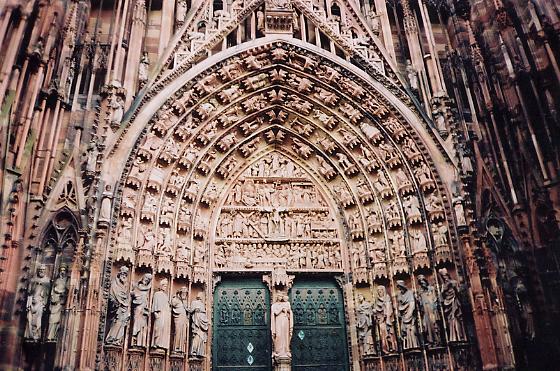
Twice a year, for the Spring and Autumn equinoxes, crowds throng into the Strasbourg cathedral. A mysterious light phenomenon appears at 11:38 on March 20, and September 21, it lasts several days. The patriarch Judah, an ancestor of the Christ, is featured in one of the South triforium windows and will be our guide. He looks towards the sun above his right shoulder whilst his index shows his left foot, thus indicating the sun goes through his green foot at a determined moment and from a certain angle. This stained glass window dates back to 1876 and the sun crosses the nave of the cathedral via this beautiful window on every sunny day and particularly on these dates.
Read more about the mysterious green light in Strasbourg Cathedral

Driving through the marshes, we suddenly reached the skirt of a wood. Here in the meadow was erected a gem of the Romanesque Art in Saintonge. A miraculous fountain where pilgrims used to come on August, 22, gave the church of La Gripperie Saint-Symphorien its reputation. The XIIth century parts and décor really are noteworthy.
The fort was built at the end of the XVIIIth century in order to ensure the protection of the mouth of the Charente, as well as the Royal Fountain. This fountain was erected in 1671 to supply the King’s ships in potable water from a source underneath the river. With those of Brest and Belle-Ile, the Fontaine Lupin remains one of the last three ships watering places of France. The ships built in the Rochefort arsenal all stopped here. The frigate L’Hermione, on which LaFayette set sail to America to help the Insurgents, was also fed here. The fort was built from 1683 to 1686 by the great engineer Vauban (1633-1707)and was listed in 1950. By Francoise Hagnere


|
Ancient Digger Archaeology Copyright © 2015 LKart Theme is Designed by Lasantha


