• Ancient Digger teaches Archaeology and History to all Ages!

Monday, January 21, 2013

Archaeology Event at Campus Martius Museum


I'm a Buckeye at heart so I had to share. It's important to share what's going in the smaller community museums as well as the world.

The Campus Martius Museum was filled on Saturday with people wanting to learn the history of the Mid-Ohio Valley through the "Digging the Past," an archaeology-centric event.

"I am a wannabe archaeologist and I love being part of things like this," said Jerrel Anderson, of Vienna.

The retired research scientist for DuPont worked on a number of research archaeology digs in Wood County for his job and brought a number of artifacts from a couple of sites, including in the Marrtown area and near the Memorial Bridge.

Archaeologists Annette Erickson, director of Archaeology Studies at Hocking College, and Stephen House speak with amateur archaeologist Jerrel Anderson, of Vienna, on Saturday in the main room of Campus Martius Museum during the “Digging the Past” Archaeology Day.

"I will be working this summer doing an archaeological dig on Blennerhassett Island with geophysical surveys and things," Anderson said. "It is exciting and I look forward to looking through the island because I'm sure there is a treasure trove of things yet to be found."

Along with a display of colorful Flint Ridge flint, the museum also hosted flintknappers and an identification clinic from the Ohio Historical Society.

Bill Reynolds, organizer of the event and historian at the museum, said he was pleased with the event.

"We have many ages of history on display here," he said. "We have items from prehistory and objects all the way to the Civil War, which is a long span."

The prehistoric items, such as arrowheads, are as old as 9,500 years while other items include pottery that dates a little more than a century.

"This is a great program that I think we need more of in this area," said Brian Kesterson, of Parkersburg, who had an extensive display of Civil War artifacts related to the local area from his collection.

Many of Kesterson's items came from the Fort Boreman area and included bullets, buttons and other items.

"There are historic items around us every day and people should have a knowledge of what they are looking at and how to find it," Kesterson said. "Living in the Mid-Ohio Valley, many of us could find artifacts in our back yards, if we knew what we were holding in our hands."

During the event, speakers included retired Ohio Department of Transportation archaeologist Wes Clark who spoke about the Temples at Ankor Wat, Cambodia, and in Thailand; Bill Pickard with the OHS who talked about Fort Laurens, Ohio's only Revolutionary War fort; Annette G. Erickson, director of Archaeology Studies at Hocking College, who talked about being an archaeologist and opportunities within the field; and Reynolds discussed the Deming site with a study of the material culture of the New England family from 1796 through 1890.

"Everything in this museum is a part of our history," Reynolds said. "It is all around us and is part of our everyday culture; to know that there were people living here thousands of years before we were even thought of is amazing and through the items they left behind, we can get a glimpse of the daily lives of people long gone."

Tuesday, June 28, 2011

Museum Exhibits: Largest Exhibit On Blacks In Civil War


The African-American Civil War Museum in Washington has been going through a major revamping as 2011 marks the 150th anniversary of the north and south's bitter battle between 1861-1865. To learn about the museum's grand re-opening, which is scheduled for July, and the history of African-Americans in the Civil War, guest host Tony Cox speaks with the museum's founding director Frank Smith.

The African-American Civil War Museum in Washington, D.C. is gearing up for a major festival to mark the 150th anniversary of the Civil War. The museum's interactive exhibits tell of the sacrifices that African-Americans have made for freedom. Many of us have been taught about the history of the Civil War, including the Union's bloody victory at Antietam in September of 1862.

Read More: Largest Exhibit On Blacks In Civil War @NPR

Monday, April 25, 2011

Weapons Used During the Civil War


The middle of the nineteenth century was a time of great change in America. The industrial revolution was in full swing, especially in the North. This brought about rapid change in both manufacturing capacity and in technological development. This would be put to deadly use during the American Civil War, where advances in Civil War guns and cannons would revolutionize centuries-old military tactics. The weapons used during the Civil War were far more accurate than previous weapons and old strategies would lead to countless casualties as generals slowly and painfully learned new ways of fighting in a world of industrial warfare and Civil War weapons.

Smoothbore Musket


Prior to the Civil War, the standard weapon of choice for infantrymen was the smoothbore musket. These guns would fire round balls out of barrels without any grooves inside of them. Due to their design, muskets were generally only accurate for short ranges. This characteristic determined military strategy for the time period, where infantry units were grouped together for maximum firepower. To do this, battles were often fought over open ground in columns. This in turn influenced the development of both artillery and cavalry tactics. For instance, cavalry units could only effectively maneuver over open ground, where they could use their superior speed to overtake enemy positions. And since smoothbore muskets were generally inaccurate at long ranges, cavalrymen could charge without the threat of such fire.

Minie Ball


But the development of a new type of Civil War gun and ammunition, rifled guns and the Minie Ball, changed the weapons used in the Civil War. With this new Civil War gun, bullets would rotate has they moved through the air, greatly increasing their accuracy. Now, infantrymen were far more accurate with their shots, greatly increasing their effectiveness.
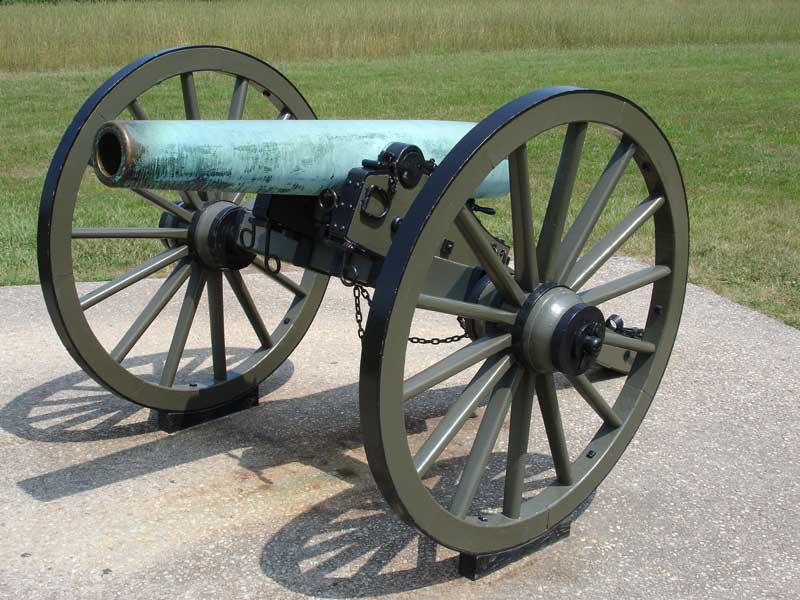
CW Arty Confederate Napoleon

Unfortunately for many of the soldiers at the time, military tactics were still in use based on the assumption of the old, smoothbore muskets and not the new weapons used during the Civil War. With these new Civil War weapons, there was a much greater value for defensive fortifications. Charging a defended position over open ground was essentially a suicide mission, especially if the other side was further protected by cannons. Perhaps most importantly, cavalry units became a lot less useful in this new military world. And as the war progressed, generals slowly but surely began to use their cavalry more for reconnaissance and supply duty than for actual battles.

Civil War Last Photo Of General Robert E Lee Portrait Picture Art PrintBut it was a slow and painful process to adapt to the new weapons used during the Civil War. Time and time again, generals would send their units over open ground to charge entrenched positions with the new Civil War weapons. And the results, predictably, were grim. Perhaps the most notable example of this was Pickett's Charge during the Battle of Gettysburg, where General Robert E. Lee marched his army over a mile of open ground to attack the center of the Union lines. But thanks to those new Civil War weapons, the charge was an epic failure. Indeed, many call that moment the “high tide of the Confederacy” and that the South was never able to fully recover from that tragedy.

Hawkin Rifle


The amazing thing was that this was not the first time General Lee encountered such a situation. During the Seven Days Battle in 1862, the Confederate army was pushing the Union away from the capital of Richmond and towards the James River. Towards the end of the week, the South reached Malvern Hill, where the North had a powerful defensive position in order to protect the flank as they retreated towards the river. General Lee, seeing an opportunity to split the Union army in two, charged across the farm fields into the Union cannons and infantry equipped with a new Civil War gun. They were easily repulsed with much loss of life. Fortunately for Lee, Union General George McClellan did not press the advantage and continued to retreat. But despite this painful loss, General Lee apparently did not learn his lesson when he ordered that famous charge across the fields of southern Pennsylvania. It took him a long time to realize that the new weapons used during the Civil War required a new way of fighting, since these new Civil War weapons were best utilized in different capacities.


As the two sides slowly came to realize how unsuitable the old tactics were with the new weapons used during the Civil War, trench warfare became the standard tactic for protection from the enemy. Combined with the new Civil War weapons and cannons, frontal assaults became even more deadly. But by 1864, the Union was now led by General c. He was determined to use the North's numerical superiority to overwhelm the armies of Lee. And thus he continually attacked well-entrenched Confederate positions using the modern Civil War gun. He did achieve his goal of keeping the pressure on the South, but only at a tragic cost in lives lost. Perhaps the most devastating of these moments was at the battle of Cold Harbor, where an early morning assault on the morning of June 3 led to 7,000 Union casualties in less than a half-hour of fighting.

Napoleon 12-Pound gun

Napoleon 12-Pound gun
(In 1853, France introduced the Canon-obusier de 12, a 12-pounder capable of using either shells, shot or canisters. Napoleon cannon remained in service during the Victorian period seeing action in the American Civil War)

These casualties were further multiplied by the extensive use of cannons during the war. Although advances with cannons were not as far along as they were with the new Civil War gun, they were still extremely effective in countering frontal charges. Unlike the Civil War gun, most cannons used in the Civil War were still smoothbores, not rifled. The most popular of the Civil War artillery was definitely the Napoleon 12-Pound gun, named for the famous French general. These cannons could fire a variety of ammunition, depending upon the situation. Solid shot was a typical ammunition used to batter advancing enemy columns. Cannon shells, on the other hand, were exploding ordinance that was particularly effective against fortified units. But perhaps the most devastating of all artillery ammunition was the canister shot. This type of shell contained hundreds of miniature balls inside of it and could absolutely mow down advancing infantry units at close range. Artillery firing canister shells stopped many infantry charges during the Civil War.

There is no doubt that the weapons used during the Civil War, including the new Civil War gun and other Civil War weapons, led to a far more deadly type of warfare and a complete reevaluation of military tactics. The ultimate consequences was a civil war with 600,000 casualties and a country nearly torn apart in the process.

Sunday, February 20, 2011

Fort Hoskins Reconstruction By Archaeologist David Brauner


Ancient Digger loves a great fort discovery, but how about a fort reconstruction?

For 35 years, archaeologist David Brauner has studied and reconstructed the history of Fort Hoskins, a Civil War-era Army outpost in the Oregon Coast Range that existed for less than a decade before it was decommissioned, dismantled and consigned to the past.

Since 1976, the Oregon State University professor has led five digs at the site 20 miles northwest of Corvallis, unearthing thousands of artifacts from buttons and belt buckles to brandy bottles and chamber pots.

He has mined nuggets of information from official correspondence, military maps, inspectors' reports and soldiers' diaries, patiently piling detail on detail to assemble an ever-clearer picture of the fort in his mind's eye.

With no surviving photographs to compare it to, he thought that mental image was as close as he would ever come to seeing what Fort Hoskins actually looked like - until he saw the painting.

Read the entire story at Gazette Times:  Portrait of the past

Picture © Oregon State

Saturday, June 12, 2010

ECU Maritime Archaeology survey of the "Oriental"


ECU Maritime Archaeology graduate students have been mapping and documenting the Oriental, a Civil War Federal transport vessel that ran aground and sunk in the waters off Pea Island in 1862. Locally known as the "boiler wreck", the engine of the Oriental can been seen above water some 400 yards off the beach of Pea Island in the Outer Banks of North Carolina.

Oriental 1862 (Courtesy of Coastal Guide)

 A Federal transport during the Civil War, the steamship Oriental has been grounded in her present position since 1862. Local rumor has it that some of the area's largest fish make their home in the Oriental's rusty remains. You can sometimes see the exposed boiler and smokestack in the ocean surf off Pea Island National Wildlife Refuge. Directions: Seven miles south of Oregon Inlet campground, or 30 miles north of Buxton. Park at turnout for Pea Island Comfort Station. Board walk leads to wooden remains which are occassionaly exposed on the beach nearby. A wooden bow is located on the beach 1 mile north.

Also Check Out: 

The Mammoth Book of Storms, Shipwrecks and Sea Disasters: Over 70 First-Hand Accounts of Peril on the High Seas, from St. Paul's Shipwreck to the Prestige DisasterGreat Lakes Shipwrecks and SurvivalsNational Geographic - Legendary Shipwrecks

Like Ancient Digger? Why Not Follow Us?


Subscribe Via RSS Feed Follow Ancient Digger on Facebook Follow Ancient Digger on Twitter Subscribe to Ancient Digger Via Email

Get widget

Search


Ancient Digger Archaeology Copyright © 2015 LKart Theme is Designed by Lasantha