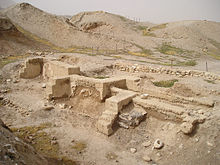
The infamous tale of the Israelites marching into Jericho, bringing forth fire to destroy the "City of Palm Trees”, as the Hebrew Bible professed, has wreaked havoc on the minds of biblical scholars alike. Did it happen? Is there archaeological evidence to prove the
walls of Jericho did in fact succumb to the mighty tribes? Or did the city of Jericho actually exist when the Israelites attempted to conquer Canaan? It’s not a question of whether biblical sites have been discovered, because many in fact have. There’s an issue with chronology. The dates just don’t add up, but the stories do reflect political and social establishments of a century that has been documented. Ernest Wright explains, “There are many people both here and abroad who honestly think and frequently assert that Palestinian and biblical archaeology was conceived and reared by conservative Christians who wished to find support for their faith in the accuracy of the Bible” . This would certainly explain the missing pieces. Could it be that the site of Jericho wasn’t dated to the Biblical account because it just didn’t exist back then? Dr. Israel Finkelstein and his student Nelson Glueck , Professor John Garstang, Kathleen Kenyon, Kay Prag, Albright and many other scholars lend their own insights into the argument as to whether Jericho was present to destroy, times of occupation, when the destruction of Jericho may have occurred and what archaeological evidence has been found to lend credence to their argument.
The Bible states,
Then the LORD said to Joshua, See, I have delivered Jericho into your hands, along with its king and its fighting men. March around the city once with all the armed men. Do this for six days. Have seven priests carry trumpets of rams’ horns in front of the ark. On the seventh day, march around the city seven times, with the priests blowing the trumpets.When you hear them sound a long blast on the trumpets, have the whole army give a loud shout; then the wall of the city will collapse and the army will go up, everyone straight in.”
So what’s the problem? The archaeological evidence for the destruction of Jericho is dated to the Early Bronze Period, which is usually associated with the date 1405 B.C., which is consistent with the Bible record. This means, then, that the Middle Bronze Age Israelites destroyed Jericho at the end of the Early Bronze Age, and thus conquered the Promised Land. I ask again, what’s the problem? The problem is that basing archaeological evidence off of the Bible, which many scholars, myself included believe, is grossly erroneous and scarcely the right approach to substantiating the existence of Jericho, its destruction, or even the time frame it did exist, if it in fact did. However, I do believe the Jericho is an archaeologist’s paradise. The fallen walls, destructions layers, and a city destroyed by fire, is enough archaeological evidence to keep you digging for years. I believe the evidence is present, but the layers of occupation don’t add up to an actual concrete date and time of Jericho’s destruction. In my opinion there’s a chronological issue here. On one end of the spectrum are radicals who date the destruction of Jericho based upon the biblical record. The other alternative belief is that the destruction happened much later. So who’s right? Can there really be a winner when religion is involved?
We have clear textual opinions and biases based on excavations of Jericho concerning chronology, but the evidence which scholars have dissected, wouldn’t be possible without the excavations of Watzinger, Sellin, Garstang and Kenyon. Ernst Sellin and Carl Watzinger conducted the first excavation of Jericho from 1907 to 1909 and again in 1911 . At this time, there was no developed pottery chronology, so their dating of the vessels found was inaccurate. Watzinger later revised the chronology, however, and their carefully drawn plans and sections can still provide valuable information. For example, Ernst Sellin and Carl Watzinger traced the Middle Bronze revetment wall around three-quarters of the base of the tel, although at the time they did not fully understand the complexities of the Middle Bronze fortification system. It was only when Kathleen Kenyon excavated the site in the 1950’s that the nature of the revetment wall was clarified, as we will soon see. After his redating, Watzinger concluded that Jericho was unoccupied (and therefore obviously unfortified) during the Late Bronze period (c. 1550–1200 B.C.E.), the time when the Israelites first appeared in Canaan .
In the 1930’s archaeologist John Garstang concluded that he had matched evidence at Jericho to the stories in the Bible. Like the story of the Pompeii,
Garstang described Jericho as a city frozen in the process of life.
“The main defenses of Jericho at the time of the Late Bronze Period followed the upper brink of the city mound and comprised two parallel walls, the outer six feet and the inner twelve feet thick. Investigations along the west side show signs of destruction and conflagration. The outer wall suffered the most, its remains falling down the slope, and the inner wall remains where it abuts the citadel, to the height of eighteen feet; elseware it is found largely to have fallen, together with the remains of the buildings upon it, into the space between the walls which was filled with ruins and debris.”
Unbaked bread had been left out to serve as leaven for next day’s baking. Provisions of oats, barley, dates, olives, onions and peppercorns were discovered, all charred but unmistakable, in the corner of a house. All evidence that human activity was cut off instantly. “The layers of ash were so thick and the signs of heat so vivid, that it gave the impression of having been contrived, that fuel had been added to the fire.” The archaeological evidence found was, according to Garstang, relevant to the Bible account. However, he then attributed his findings to the Late Bronze Period where Biblical Scholars expected it to be. Here lays the problem once again. The findings are suited to meet the explanation in the Bible and the text has never been substantiated. Therefore, Garstang has taken the facts to suit the theory instead of theory to the facts. Garstang has discovered walls and layers of burned stratigraphy. That’s an archaeological fact, but I contest that the dating is not factual, and he hardly allows for a degree of error in the dating.
Archaeologist Kathleen Kenyon challenged Garstang’s conclusions.
Kenyon explained that when the Israelites attacked Jericho as described in the Bible there were no walls and no city. In fact, Kenyon attested that “we have nowhere been able to prove the survival of walls of the Late Bronze Age, that is to say of the period of Joshua”. Everywhere along the line of walls that Kenyon and her team examined was concluded to be from the Early Bronze Age. “They had just been buried underneath a massive scarp belonging to the Middle Bronze Age.” Kenyon’s evidence, chronologically, was exactly where it ought to be according to Rudolph Cohen. Oddly enough, Kenyon’s later remarks about the site of Jericho fit the biblical record exactly.
In Archaeology in the Holy Land, Kenyon writes:
“The final end of the Early Bronze Age civilization came with catastrophic completeness. The last of the Early Bronze Age walls of Jericho was built in a great hurry, using old and broken bricks, and was probably not completed when it was destroyed by fire. Little or none of the town inside the walls has survived subsequent denudation, but it was probably completely destroyed, for all the finds show that there was an absolute break, and that a new people took the place of the earlier inhabitants. Every town in Palestine that has so far been investigated shows the same break. The newcomers were nomads, not interested in town life, and they so completely drove out or absorbed the old population, perhaps already weakened and decadent, that all traces of the Early Bronze Age civilization disappeared."
In Notes on the Fortifications of the Middle Bronze II Period at Jericho and Shechem, David Ussishkin explains that Kenyon clearly disregarded Middle Bronze domestic structures inside the brick city wall, discovered initially by Sellin and Watzinger. Those buildings are well dated and resemble the contemporary buildings that Kenyon uncovered. Garstang indirectly corroborated those findings in light of his discovery of a Middle Bronze Age "un-disturbed deposit" inside the brick wall. Those buildings prove the impossibility of Kenyon's concept of the fortifications . This oversight is just one of several found in Kenyon’s research. If you remember, Kenyon failed to look for pottery of the Canaanites, looking only for vessels, which represented peoples of higher standing. In my opinion, this is hardly a correct representation of the social organization at Jericho during the supposed destruction.
Kay Prag discusses the occupational remains at Jericho and the three areas with stratified remains, which were examined by Kenyon, Garstang and their students. It seems evident in her assessment that, what one archaeologist may have ignored, one paid more mind to. This essentially means that several layers of strata were completely ignored. Now, seeing as how we are discussing destruction layer evidence along with the occurrences of pottery, this is an enormous blunder.
Prag further discusses the Jericho Tel stating:
“Three Early Bronze-Middle Bronze period occupation areas on the tell are described, although there is some disparity between Kenyon's summaries in earlier works as the final published evidence. Kenyon stressed that a squatter occupation was present on the tell and on the slopes surrounding it at the beginning of the Early Bronze-Middle Bronze period, but she actually published no evidence for it.”
This may have been because Kenyon died too early to report further findings. This is all well and good, but I still need to know what the occupation has to do with the destruction? We can date the charcoal deposits, that’s easy, but we have to determine the layers in which they came. If the cartography has shifted, and the archaeologists have not used 10cm arbitrary levels to examine the burn layers, then how could we possibly arrive at a conclusive date? Those burned levels of occupation hold the clues to the puzzle. This is where the examination of the trenches aids us in this complex mystery. Specifically Trench I examined by Kathleen Kenyon.
Kenyon noted that the destruction of the final Early Bronze III wall and town was succeeded by squatter occupation and a 2.50 m fill in defensive Ditch VI . The ditch fill contained quantities of Early Bronze-Middle Bronze sherds. The Early Bronze level contained a significant amount of sherds compared to the brown pebbly layer overlying this ditch fill, which had only two Early Bronze sherds. The nature of the lower fill suggests tumble and erosion of uncertain duration following the destruction of the town; but, apart from an uncertain length of time, there seems no other evidence for squatter occupation .
Kay Prag further explains the evidence from Trench I and what the occupation levels tell us:
“The sequence in Trench I might have been: a) the destruction of the walled Early Bronze III town; b) a period of erosion of uncertain duration with fill deposited in the lower part of Ditch VI, and unverified squatter occupation; c) terracing under wet conditions for Early Bronze-Middle Bronze houses which may have been sporadically distributed over the tell and its slopes; d) three to four phases of building and repairs of the houses, each separated by erosion and collapse phases, as shown by the; e) final gullying of the houses, which Kenyon suggested was expedited by earthquake; f) abandonment; g) long and heavy erosion right up to the time of construction of the Middle Bronze II ramparts, which contained and protected what remained of the earlier deposits.”
The stratigraphy can tell us a great deal about supposed environmental activities during occupation, but it doesn’t appease the views of many biblical scholars, who have disqualified such complicated findings, which question the validity of the biblical account of Jericho’s destruction. Scholars like Albright, however, never questioned the validity of the Bible, describing vividly the destruction of Jericho and the Israelite conquest. Furthermore, Albright never questioned the supportive evidence from the Jericho defense system, although the dating was founded on very flimsy grounds. Professor Albright believes that the problem of Jericho remains very confounding; owing to the often-emphasized fact that the excavation of the site has been too fragmentary to permit great confidence in any detailed reconstruction of its history . However, after all the work accomplished by Watzinger and Garstang, it can now be regarded as certain that the latest pre-Israelite town on the site is represented by the contents of the "Middle Palace" excavated by Garstang in 1933 .
Albright also explains that:
“The pottery of the Middle Palace at Jericho bears very close affinity to that of the " Thothmes " and " Pre-Amenophis " strata at Beth-shan, as correctly stated by Garstang and Rowe, in their joint statement of 1936. It is also closely related, to that of the middle shrine at Lachish. In other words, it belongs in the main to the fourteenth century B. C., and cannot be pushed backward into the fifteenth century nor forward into the thirteenth.”
This problem of substantiating the existence of Jericho led many scholars, including Israel Finkelstein, to write in opposition of the Biblical narrative. Finkelstein looked at new peoples coming into the country. The same people, who supposedly occupied Canaan at the beginning of the Late Bronze Age, were still occupying the area at the end of this period. In The Bible Unearthed Finkelstein writes, “It is now evident that the many events of biblical history did not take place in either the particular era or the manner described. Some of the most famous events in the Bible clearly never happened at all” . As bold of a statement this is, I have to respectively agree with Finkelstein’s argument. The archaeological evidence, or lack there of, has not only hindered and degraded the field of Biblical Archaeology, but the approach seems to be the subject of mass scrutiny.
Finkelstein also states that Jericho had no trace of settlement during the thirteenth century B.C.E., and the earlier Late Bronze settlement, dating to the fourteenth century B.C.E., was small and poor, almost insignificant, and unfortified . Thus, the question is whether there were walls at Jericho, or a fortification in place, to destroy during the fourteenth century B.C.E., as described in the biblical account and according to biblical scholars like Garstang. I don’t believe so. Fortifications are created as military strongholds designed for defense in warfare. If this is the case at Jericho, whom were they trying to keep out, and would evidence of a military be present? Furthermore, what was the primary function of the fortification if it was in fact present?
All three expeditions studied the Middle Bronze Age fortifications and each excavator understood the same fortifications in an entirely different manner. The questions of concern in the current analysis are first, how those differences in understanding could have happened, and second, what seems to be the most acceptable interpretation of the fortifications in question . Finkelstein goes on to say that there were “no signs of destruction”, and thus, the Israelites who marched across the walled town with the Ark of the Covenant in toe, causing Jericho’s mighty walls to come tumbling down, was a “romantic mirage” . Why you may ask? The fortification wasn’t there to destroy.
Finkelstein’s student, Nelson Glueck, posited that such a center and stronghold as Jericho was definitely occupied during the entire Middle Bronze II period, as were other important sites in the Jordan Valley during all or parts of that period and of the subsequent Late Bronze period . This, of course, would be consistent with the Middle Bronze Age Israelites, whom destroyed Jericho at the end of the Early Bronze Age, and thus conquered the Promised Land, according to the Bible. I agree, there is an alarming amount of evidence, which lends credence to the fact that Jericho was occupied in the Middle Bronze Age. I don’t, however, believe that any such fortification existed. I also believe that a foundation for a structure is present, as we’ve seen from Kenyon’s excavation of the revetment at Jericho, but I don’t believe it was part of a stronghold.
Surprisingly, Wright defends, or rather tries to explain the viewpoint of Glueck, in his journal article Is Glueck's Aim to Prove That the Bible Is True?. Wright explains that Glueck affirms that no one can essentially prove the Bible, for it is a theological manuscript. “Those people are essentially of little faith who seek through archaeological corroboration of historical source materials in the Bible to validate its religious teachings and spiritual insights." So how does this pertain to Jericho? In Glueck’s case, his treatment of Jericho was based on archaeological evidence and empirical practices. It’s true. Glueck loved and respected the Bible, but in scientific writings this side of him is restrained.
Consequently, this is similar with some of Kenyon’s findings at Jericho. She describes the fills she excavated in front of the stone revetment, dating them to the Middle Bronze Age. Kenyon admitted that at least the lower layers of the fills were contemporary with the period of use of the revetment. They include "an accumulation of primary silt" at the bottom, a "kerb wall” about 90 cm high, and an accumulation of "stone chips" and the stone revetment. Above them was a fill of fallen red bricks, which Kenyon believed represented the debris of the disused Middle Bronze brick city wall, and above it a layer of "gravelly wash".
G. Ernest Wright explains that not only is it now difficult to interpret the biblical narrative of the fall of Jericho, but it is impossible to trace the history of the tradition. The main reason for this, as Wright explains in his book Biblical Archaeology, is because “virtually nothing remains at the site between 1500 and 1200 B.C." This is a strong statement and I have to argue the that the word “nothing” is much too strong, as it deduces the significance of any burned stratigraphy layers, pottery, burned food stuffs and tools. There is something present, albeit it may fall into an entirely different range of dates. G. Ernest Wright addresses his statement concerning Jericho, which was, I believe, prompted by Finkelstein’s opinion of him as a scholar. Finkelstein states that, “the dictates of the new trend, which requires that every contradiction between archaeological evidence and the Biblical text be harmonized to uphold the veracity of Scripture, has apparently driven Dr. Wright-in this case at least-beyond the reach of common sense."
Wright later explains:
“The statement that there was "virtually" no Late Bronze Age occupation recovered means this: in the Early and Middle Bronze Ages Jericho was a fortified city of considerable significance. About 1550 B.C. the Egyptians destroyed it violently along with most other major Palestinian cities, and it was never again a significant city. As far as the evidence goes, it was not even fortified. However, there was indeed subsequent occupation. During the 14th century, at least three Middle Bronze Age tombs were opened and new burials inserted, and some very fragmentary remains of buildings and floors of the same general age were found above the spring. An unfortified Israelite village with what appears to have been a government granary also existed there, beginning about the 10th century. The evidence suggests that the Late Bronze Age occupation was slight, but most of what there was of it was eroded away in the unoccupied centuries which followed, just as happened there much earlier to the villages at the end of the Neolithic period (Kenyon's Neolithic Pottery A) and in the early Chalcolithic period (Kenyon's Neolithic B and Garstang's Jericho VIII), both of which were followed by long periods when the mound was unoccupied.”
Simply put, there is an enormous range of error in the C14 dates pertaining to Jericho in my opinion. Dr. Bryant Woods published C14 dates of 1410 +/- 40 B.C. for charcoal from the destruction level of Jericho. This was later found to be in error and corrected to 1590 or 1527 +/- 110 B.C., depending on how one reads the calibration curve . Additional tests were done on six grain samples resulting in dates between 1640 and 1520 B.C. and 12 charcoal samples resulting in dates between 1690 and 1610 B.C. Woods’ dating of Jericho to ca. 1400 B.C. is primarily based on pottery, which, in turn, is based on Egyptian chronology. “Jericho is just one example of the discrepancy between historical and C14 dates for the second millennium B.C. C14 dates are consistently 100–150 years earlier than historical dates.”
Bryant Woods also explains in the March/April 1990 issue of Biblical Archaeology Review that Garstang was right all along. Woods proposed that the termination of City IV Jericho be redated from ca. 1550 B.C. to ca. 1400 B.C. He argued that a reanalysis of pottery sherds excavated from City IV, stratigraphic considerations, scarab evidence, and a single radiocarbon date all converged "to demonstrate that City IV was destroyed in about 1400 B.C.E., not 1550 B.C.E. as Kenyon maintained.”
Similar with Wood’s assessment, in The Quest For The Historical Israel, it’s explained that at many sites, The Late Bronze Age II cities were destroyed in large conflagrations and were dated to the late thirteenth century B.C.E and associated with the invading Israelites. The dating is associated with conventional chronology of Aegean pottery. This in turn was influenced by Canaan conquest stories in the Bible; another clear case of circular reasoning . Furthermore, archaeological excavations have shown that Jericho was not inhabited in the Late Bronze Age, and even it was, it was far less significant than explained in the Bible .
My principal observation and argument about the chronological dating of Jericho is the fact that every archaeologist involved in the excavations, has approached the site in different ways. This approach had yielded degrees of variation, which is to be expected when differing archaeological methods are used to assess a site. David Ussishkin noted that, recent excavators of Jericho and Shechem, including Kenyon, G. E. Wright, Dever, and their colleagues, have followed the "debris/layer excavation method”, and have tended to interpret constructional differences in monumental structures and different layers of debris associated with them as representing chronologically different phases of construction, settlement, and use . The problem is, this is not always the case. Some construction and debris layers are representative of one continual phase of one structure. It depends on the data collected. Stratigraphy layers can shift, and with that modification of layers, artifacts and building structures move as well. Therefore, dating the site to one particular year or range of years is virtually impossible, since environmental changes yield varying evidence overtime. For example, some individuals might interpret a wall, whose lower part is wider and built in a different style, than the top as having been built and used during two phases of settlement. Subsequently, they might see two overlaid debris surfaces covering the floor space of a building as two separate floors indicating two phases of use .
In conclusion, radicals date Jericho to 15th century and minimalists date it to 13th century. Kenyon dates it to 1550 B.C.E. based on the fact there were no walls at that time. Kathleen Kenyon never found pottery from Cyprus, but she failed to look for pottery of the Canaanites. This is an enormous issue considering she didn’t take into the account the social organization of Jericho at the time of the destruction. Therefore, she would have never found pottery from Cyprus, which represented a richer class of people. Garstang dated the site to 1400 B.C.E. according to biblical accounts and he then attributed his findings to the Late Bronze Period where biblical scholars expected it to be.
Kay Prag posits “
both Trench I and Trench II suggest that the end of the occupation may have been brought about by earthquake and subsequent fire; but the massive and prolonged erosion that followed may have removed evidence for some later phases, and even for earlier phases”.
Wright decidedly believed that no such occupation was observed at Jericho from 1200 to 1500 B.C.E. and Finkelstein is an entirely new discussion. The problem seems to lie in the chronology and the reliability of the biblical narrative. It’s not a question as to whether Jericho existed, because it did. It’s also not a question as to whether people ever occupied the site of Jericho, because they could have, even as far back as the tenth century B.C.E, according to stratigraphic layers and common foodstuffs discovered. The issue seems to be that it’s “virtually” impossible to assess the site of Jericho because the biases of scholars alike cloud the actual archaeological evidence. Furthermore, the chronological dating of specific samples, as Bryant explained prior, gives us too many dates to pinpoint an actual point of destruction at Jericho. Consequently, stratigraphic layers are not always contemporaneous with each other. Sometimes strata in cultural layers are not obvious and sometimes they’re uniform. When you get a shift in cartography, you have to start a new layer. Subsequently, when you get to a cultural level you break it down into 10 cm arbitrary levels. I wonder if archaeologists like Kenyon and Garstang thought to do so?
Sources
- Albright, William F. "The Israelite Conquest of Canaan in the Light of Archaeology." The American Schools of Oriental Research. 74. (1939): 11-23.
- Finkelstein, Israel. The Bible Unearthed. New York: Free Press, 2001.
- Finkelstein, Israel, and AmiHai Mazar. The Quest for the Historical Israel. Atlanta: Society of Biblical Literature, 2007.
- Glueck, Nelson. "Go, View the Land." The American Schools of Oriental Research. No. 122 (1951): 14-18.
- Kenyon, Kathleen. Digging Up Jericho. London: Praeger Ernest Benn, 1957.
- Kenyon, Kathleen, Archaeology in the Holy Land. London: Ernest Benn Limited, 1965.
- Prag, Kay. "The Intermediate Early Bronze-Middle Bronze Age Sequences at Jericho and Tell Iktanu." The American Schools of Oriental Research. No. 264 (1986): 61-72.
- Ussishkin, David. "Notes on the Fortifications of the Middle Bronze II Period at Jericho and Shechem." The American Schools of Oriental Research. 276. (1989): 29-53.
- Wright, G. Ernest. Biblical Archaeology. Louisville: Westminster John Knox Press, 1962.
- Wright, G. Ernest. "Is Glueck's Aim to Prove That the Bible Is True?" The American Schools of Oriental Research. 22. No. 4 (1959): 101-108.
- Wood, Bryant G. Associates for Biblical Research, "Carbon 14 Dating at Jericho." Last modified Aug 07, 2008. Accessed November 1, 2011. http://www.biblearchaeology.org/post/2008/08/07/Carbon-14-Dating-at-Jericho.aspx.
- Wood, Bryant G. "Did the Israelites Conquer Jericho? A New Look at the Archaeological Evidence." Biblical Archaeology Review. 16. No. 2 (1990): 44-58.
- Sellin, Ernst, and Carl Watzinger. Jericho: Die Ergebnisse der Ausgrabungen . Leipzig: J.C. Hinrichs, 1913.


 by David Down is clearly written in an unbiased fashion. Although contemporaries may argue this notion, it seems abundantly clear in the introduction. Down explains that when “Correctly interpreted, the historical records of Egypt and Israel show a remarkable consistency with the Bible records which we can accept as not only inspiring but entirely reliable”. Down uses the statements reliable, significant, clues, does not prove, reference was made, and revealing, throughout the entire book.