• Ancient Digger teaches Archaeology and History to all Ages!

Monday, July 11, 2011

Monday Ground Up: Planes and Weapons used during the Korean War


The Korean War lasted from June 25, 1950 until the signing of an armistice on July 27, 1953. Although the fighting only lasted three years, the events leading up to the war in Korea go back several decades earlier.

The planes used during the Korean War were quite similar to the WWII and World War I planes, as several of the designs were built upon these blueprints.

All of the following footage and photographs were taken at the USAF National Museum, back in May when I visited for several days.

Douglas B-26C (A-26C) Invader

Douglas B-26C (A-26C) InvaderDouglas B-26C (A-26C) Invader aircraft

As seen on many WWI planes, the iconic nose painting on these Korean War planes instantly reminds of us simpler times. This particular plane, the Douglas B-26, played an important part in the U.S. Air Force's interdiction campaign against communist ground forces. Initially, B-26 crews flew during the day, but the introduction of the MiG-15 jet fighter forced them to fly most missions at night.

 Douglas B-26C (A-26C) Invader plane

The actual plane, which arrived at the museum September 1957, is an A-26C, painted to represent a B-26C aircraft used during the Korean War by the 34th Bomb Squadron flying night intruder missions.

B-29 Fuselage

As you can see from the fuselage painting, this bomber "ace" flew 121 Korean War combat missions and dropped 2500 lbs. of bombs. It was named after a popular 1948 film “Command Decision”, regarded by many as being the best World War II film ever made. The film discusses the difficult decisions and heavy casualties of bomber operations over Europe in World War II.

Tour of the B-29 Fuselage


B-45 Tornado


The B-45 Tornado was the first American production jet bomber; the first jet bomber capable of carrying an atomic bomb; and the first multi-jet reconnaissance aircraft to refuel in mid-air.


Although the B-45 was designed during World War II, it didn’t make its first flight until March 1947. The B-45s were used for high-altitude photo reconnaissance and aerial refueling.

T-6D Mosquito


The T-6D on display flew as an early Mosquito with the 6147th Tactical Air Control Group during the first two years of the Korean War. It was then converted into a mosquito spraying aircraft in 1952. Two years later, the USAF transferred it to the fledgling Republic of Korea Air Force (ROKAF).

During the Korean War, the T-6 was chosen as the best available airplane because it could operate from small, rough airstrips, was easy to maintain and was faster and more rugged than the light liaison aircraft they initially flew.
Although the T-6 was designed as a training aircraft, it performed well in its role as an airborne  "Mosquito" , and 15,495 were built between 1938 and 1945.

F-86A Sabre


The first production model of the F-86A Sabre flew in May 1948. In September, an F-86A set a new world speed record of 670.9 mph.  F-86As were day fighters during the Korean War, their primary opponent being the Russian-built MiG-15.
By the end of hostilities, F-86 pilots had shot down 792 MiGs, with a kill ratio of about 8:1.  More than 5,500 F-86 day fighters were built in the U.S. and Canada. Air forces of 20 other nations, including West Germany, Japan, Spain, Great Britain and Australia, also operated the Sabre.
The F-86 Sabre on display at the museum arrived in 1961 and is marked as the 4th Fighter Group F-86A flown by Lt. Col. Bruce Hinton on Dec. 17, 1950, when he became the first F-86 pilot to shoot down a MiG.

Mikoyan-Gurevich MiG-15bis


The Soviets began production of the MiG-15bis in 1950. The MiG-15bis was an upgraded version of the MiG-15 and used a more powerful engine and hydraulically boosted ailerons. During the Korean War, both versions of the MiG-15 operated extensively against United Nations forces.

Mikoyan-Gurevich MiG-15bis A


After a North Korean pilot deserted the MiG-15bis on display at Kimpo Air Base in South Korea on Sept. 21, 1953, the Air Force decided to perform advanced flight testing on the plane. The MiG-15bis provided important intelligence data, especially since it was the advanced version of the MiG-15. In 1957, the plane became the official property of the museum, after the “rightful owners” refused its return.


F-82G Twin Mustang

F-82G Twin MustangF-82G Twin Mustang 2F-82G Twin Mustang Korean War Plane

The F-82 Twin Mustang on display, which appears to have two P-51 Mustang fuselages on one wing, was the last propeller-driven fighter acquired by the USAF. The F-82 was able to carry a pilot and navigator, reducing exhaustion on long-range bomber escort missions. Although production of the F-82 aircraft delayed its introduction into World War II, Air Defense Command was able to fly radar-equipped F-82Gs as replacements for the P-61 night fighter.

Consequently, Japan-based F-82Gs were among the first U.S. Air Force aircraft to operate over Korea. On June 27, 1950, all-weather F-82Gs shot down the first three North Korean aircraft destroyed by U.S. forces.

The aircraft on display is an F-82B, modified and marked as the F-82G crewed by Lts. Charles Moran, pilot, and Fred Larkins, radar observer, 68th F(AW)S, when they shot down a North Korean La-7 on June 27, 1950, near Kimpo Air Base, South Korea.

Sikorsky UH-19B Chickasaw


In November 1949, the first helicopter flew and the  USAF then decided to order the production of 50 H-19As in 1951. The USAF later acquired 270 H-19Bs with increased engine power, and in 1962 designated it the UH-19.

Many of these helicopters were designated for Air Rescue squadrons. During rescue service, the SH-19 carried a 400-pound capacity crank which was fixed above the door. The SH-19 could also transport a peripheral sling capable of holding 2,000 pounds. During the Korean War, SH-19s became the primary USAF rescue and medical evacuation helicopter.

The UH-19B in the photograph is marked as an H-19A known as Hopalong. The Hopalong was one of two H-19s to make the first transatlantic helicopter flight, traveling during the summer of 1952 from Westover Air Force Base, Mass., to Scotland in five phases.


F-84 Thunderjet


F-84 Thunderjet Korean war planeThe F-84 Thunderjet was initially sent to escort B-29s on long-range missions over North Korea. It excelled  as a close air support and daytime interdiction strike aircraft. In Korea, F-84 pilots attacked enemy railroads, dams, bridges, supply depots and troop concentrations with bombs, rockets and napalm.

Early F-84s had several problems, including weak wing spars, excessive weight and shortages of engines and spare parts. The F-84E, however, corrected most of the Thunderjet's shortcomings."

The F-84 Thunderjet  served as a long-range escort fighter, fighter-bomber and was the USAF's first tactical nuclear bomber. The F -84s were also used as test-beds for experiments, including power plant trials and aerodynamic research.

F-84 Col Joseph Davis Four QueensF-84GF-84G Four Queens Plane

The F-84E on display came to the museum in 1963. It is marked to represent the F-84G flown by Col. Joseph Davis Jr., commander of the 58th Fighter-Bomber Wing in 1953. Col. Joseph Davis Jr named this particular Korean war plane the Four Queens, after his wife, Ann, and his three daughters, Scott, Chris, and Jan. As you can see from the picture above, Davis had four queens painted on the side of this F-84G to represent a four-of-a-kind. The right side of the fuselage features a tiger named Olie and represents the 430th Fighter Bomber Squadron, 474th Fighter Bomber Wing.

VB-13 Tarzon Bomb


The VB-13 Tarzon Bomb was based on the VB-3 Razon bomb and it was developed in 1946. The  Tarzon Bomb was originally designed like a British 12,000lb “Tall Boy” bomb.

Tarzons were in short supply during the war, and after a B-29 was lost trying to jettison one, the Tarzon was cancelled in 1951. This particular weapon used during the Korean War dropped thirty bombs, and hit eleven targets, destroying 6 bridges and damaging another.

Sources

All pictures are © Ancient Digger.

Friday, July 8, 2011

Vietnam War


Image Vietnam Memorial

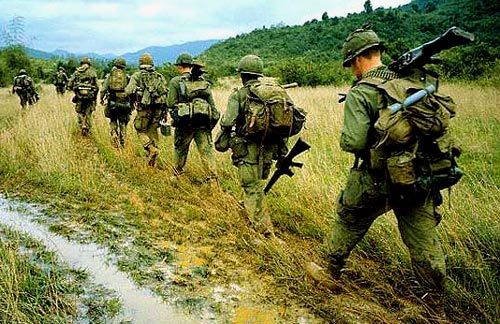
When the United States Congress first allowed the American military to send advisers to Vietnam in Southeast Asia, Americans knew very little about the history of Vietnam. Though Americans soon became acquainted with the history of Vietnam and its culture after the United States escalated its involvement in the country’s affairs, the roots of the Vietnam War began during French occupation several years before American involvement.

The French defeated and colonized Vietnam in the nineteenth century and maintained control of Vietnam’s government for approximately sixty years. When Japan invaded Vietnam in 1940, while Vietnam was still under French occupation, Ho Chi Minh rallied support in the northern part of the country and established the Viet Minh, a communist group dedicated to ending the foreign occupation that had existed for much of the history of Vietnam.


After losing an important battle, the French government pulled out of the conflict and ended its occupation. As part of the agreements that took place at the conference in Geneva, Switzerland, in 1954, Vietnam was divided in half, creating North and South Vietnam, and elections were scheduled to take place to determine who would gain control of the country’s leadership.


Image Forgotten Heroes

In the 1950s, the United States was involved in an extended conflict with communist Soviet Union to prevent communism from spreading to other countries, including Vietnam. The United States feared that if elections were allowed to take place, the communists would gain control of Vietnam and represent a new threat to America. With assistance from America, South Vietnam elected Ngo Dinh Diem. During his eight-year term, tensions in Vietnam grew, and North Vietnam organized the National Liberation Front, also known as the Viet Cong, to establish communism in the south following Diem's assassination.

In 1964, the North Vietnamese and a major American naval vessel engaged in a conflict called the Gulf of Tonkin incident. In response, the United States Congress gave President Lyndon B. Johnson the authority to send American troops to Vietnam. The American military’s goal was to provide enough military support to South Vietnam to stop Viet Cong aggression and prevent the spread of communism in Vietnam during the war.

Though the American military gradually increased its troop presence, the Vietnam War did not progress as the American government anticipated. The Americans chose not to attack the communists in the north during the war in Vietnam. While this policy limited America’s involvement in the Vietnam War, it also allowed the communists in the north to maintain their strength and supply the Viet Cong with weapons and food.


Image Vietnam Memorial

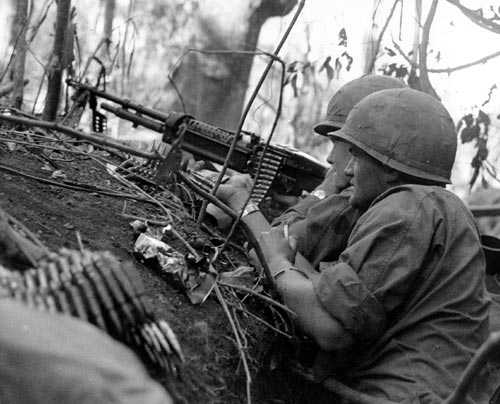
Life in Vietnam during the war was unpredictable and often deadly for the Vietnamese people and American troops. Unlike previous wars, the American army fought in thick jungles against an enemy that was well supplied. Many booby traps were placed around Vietnam during the war, and the American troops, who had difficulty locating the Viet Cong in the jungle, were often captured and fired upon by surprise.

As the war in Vietnam continued through the 1960s, the American public became increasingly uneasy. It was clear to many Americans that Vietnam during the war would not change and neither America nor South Vietnam would win. They argued that a lack of military victories during the war in Vietnam did not justify the large number of American military deaths. While few voiced their discontent when America first entered the war in Vietnam, public protests grew louder and more intense in the late 1960s.

In 1968, the communists carried out one of the most organized military campaigns in the history of Vietnam. In the Tet Offensive, the communists simultaneously attacked the American and South Vietnam forces in about one hundred cities and villages across the south. While the Americans rallied to force the communists’ retreat, Americans were no longer willing to maintain a military presence in Vietnam. Shortly after Richard Nixon became President of the United States, he withdrew troops and ended the Vietnam War even though America did not achieve its goal of halting communist advances.

About the author: She majored in history and international relations in college and loves to travel, read, and learn about other countries.

Tuesday, July 5, 2011

History of the Cold War 1945-1991


Cold War History records a conflict, primarily between the United States and their allies in Western Europe and the Soviet Union and it's allies. The Cold War commenced after World War II and lasted for nearly fifty years. Instead of guns, the weapons used in this “war,” were technology and espionage; however, the threat of Nuclear War from these two super powers impacted life on a global scale, much more than the passive aggression conducted by intelligence services.

The Role of Intelligence Agencies


According to Cold War history, the CIA attempted to obtain control over several intermediary countries, such as Afghanistan, Chad, Grenada, Cuba and Angola, but the major world powers never began an armed conflict against each other. The military units of the two nations participated only rarely in the Cold War. This war was waged primarily by the KGB and the CIA.

Causes of the Cold War


There were many causes of the Cold War, including the following:
  • Political Ideology. The Soviet Union embraced the ideology of communism and wanted to spread this philosophy over the globe. This was a threat to the United States. The United States believed in democracy.
  • America had obtained atomic weapons and this was a threat to the Soviet Union. Both nations were in fear of an attack from the other.
  • The Soviet Union exercised control over Eastern Europe which constituted a threat to the United States.
  • The Russians were afraid America would attack the Soviet Union from Western Europe

Communism


Although history records many causes of the Cold War, one of the primary causes was an argument between the two countries about the political philosophy of communism. While the East embraced Communism, the United States was adamantly opposed to this philosophy of government.


Major Events

McCarthyism and the “Red Hunt”


In 1950, Joseph McCarthy, a Republican senator from Wisconsin, accused over 200 federal workers of being members of the Communist Party. Although Senator McCarthy had no evidence upon which to base these allegations, President Truman initially backed the inquisitions, but eventually distanced himself from the investigations because he felt that they were becoming “witch-hunts.”

The Bay of Pigs Invasion


In 1961, a group of Cuban exiles, supported by the United States, attempted to overthrow the Cuban government headed by dictator, Fidel Castro. The failure of the mission was a huge embarrassment to the Kennedy administration. The Central Intelligence Agency began preparing anti-revolutionary Cuban exiles for a possible invasion of the island several years prior to the Bay of Pigs. The band of soldiers intended to march into Havana. However, within a few hours after the fighting began, it was obvious that the exiles could not win. When the battle ended on April 19, ninety exiles lost their lives and the remainder taken as prisoners.

The Sputnik Crisis


The history of the Cold War is also the history of the beginning of the Space Age.The Space race began in earnest after this, leading up to the Apollo program, and the moon landings in 1969. Sputnik Crises occurred when the Russians launched the Sputnik 1 Satellite. The U.S felt that it was necessary to win the race to space, and so did the Russians. There was serious competition in the race to space, especially between the United States, and the Soviet Union. Sputnik I, the world's first Earth-orbiting artificial satellite, launched on October 4, 1957, and the Space Age emerged. This event gave the impression of a deficit in technological advancement and helped to provide the momentum in spending for technical and scientific projects and educational programs. The United States needed to recover a sense of international respect.

Cuban Missile Crisis


Image Credit

In 1962, the Cuban Missile Crises moved the United States and the Soviet Union close to war. U.S. intelligence services discovered Soviet nuclear-armed missiles in Cuba. During a tense week, President Kennedy imposed a naval quarantine on Cuba and announced that the U.S. would respond to an attack from Cuba as an attack by the Soviet Union. On October 28, Khrushchev backed down and announced to the world that he would dismantle the installations.

The End of the Cold War

The history of the Cold War shows that the conflict began to unravel in the late 1980s during the administration of Soviet leader Mikhail S. Gorbachev. He disassembled the autocratic facets and factions of the Soviet system and tried to integrate the concept of democracy into the political system. The Soviet Union collapsed in late 1991, and 15 newly independent nations emerged, each with a democratically elected, anticommunist leader. Cold War History shows that although no shots were fire, and no physical battles were waged between the two opposing countries, the effects of this conflict brought many changes on both sides.


Effects of the Cold War


  • Both countries created made weapons and missiles
  • NATO and The Warsaw Pact were created
  • The Soviet Union was demolished
  • The Warsaw Pact was eliminated
  • The Baltic States achieved independence
  • Communism was eliminated across the globe
The history of the Cold War ended late in 1991 with the dissolution of the Soviet Union, and the causes of the Cold War are frozen in time. The end of the Cold War opened the door to friendly relations between Russia and the United States and America became a world superpower.

The psychic scars of this period are still felt today. Cold War history shows that during this time, the civilian population in America was encouraged to build personal bomb shelters. Sirens rang out urgently during air raid drills and teachers taught schoolchildren to hide under their desks.

Saturday, July 2, 2011

History of the Korean War


The Korean War lasted from June 25, 1950 until the signing of an armistice on July 27, 1953. Although the fighting only lasted three years, the events leading up to the war in Korea go back several decades earlier.


The history of the Korean War is long and complex, involving several decades of foreign rule prior to the conflict, and the involvement of dozens of nations during the actual fighting.

Some could argue the history of the Korean War began in 1876, when the Japanese first got involved in the region by forcing the Koreans to sign the Treaty of Ganghwa. Japan made Korea its protectorate in 1905, and officially annexed the peninsula in 1910. Japan then officially ruled the Korean peninsula until September 2, 1945, when they were forced to give up rule by the Allied Powers for losing World War II. Korea was then divided into North and South along the 38th parallel. The Soviet Union occupied North Korea after World War II, while the United States occupied South Korea. Under Allied rule, North and South quickly became divided, and the Korean War became imminent soon after.

War in Korea inched closer to reality in 1948, when a failure to hold democratic elections led to the North installing a Communist government. Tension intensified between North and South, even during reunification talks. The 38th parallel increasingly became a political border, as both sides conducted skirmishes and raids on targets just over the border. Finally, the North invaded the South on June 25, 1950, and the Korean War officially began. It was the first armed conflict of the Cold War.

The Korean War was a "war by proxy" between the United States and the Soviet Union, in which both sides backed opposing forces in a war, instead of fighting each other directly. In the history of the Korean War, however, Soviet and American troops did not fire on each other.

South Korea was officially backed by the United Nations, who aided the effort in repelling the North. The United Nations forces backed the North behind the 38th parallel, nearly to the Yalu River, until the Chinese officially entered the war in Korea. With Chinese aid, the U.N. forces were pushed back near the 38th parallel in 1951. From 1951 to 1953, little ground was gained by either side in the Korean War.

United States involvement in the war in Korea occurred primarily because of the American view of Korea as a strategic ally against the communist Chinese and Soviets. President Truman also viewed non-action in Korea as the beginning of the downfall of the United Nations, where Communism would be free to spread unchecked across the globe. Final approval to send US forces came when an intercepted communication from the Soviets stated that it would not act against US ground troops during the war in Korea. The United States officially entered the Korean War in July 1950.

Both sides ceded territory to the other quite often early in the war, until the front stabilized in 1951 near the original border at the 38th parallel. From then, very little ground was gained by either side and casualties kept rising with little to show for it. American officials raced to discuss an armistice with the North, fearing that increasing tensions with China and the Soviet Union would lead into World War III. The Korean War officially ended on July 27, 1953, after more than two long and frustrating years of negotiations.

The war in Korea led to more than 5 million combat and civilian casualties all told. The history of the Korean war is somewhat forgotten in American history, being sandwiched between the two biggest US conflicts-- World War II and Vietnam. However, the Korean War claimed the lives of more than 54,000 American troops, on par with Vietnam although in a much shorter time. Chinese and Korean casualties were nearly 10 times that of the United States. The war in Korea led to tensions between the North and South which persist to this day, although the history of the Korean War is remembered differently by each side. All-out warfare has not occurred between North and South since the end of the original conflict.

Author bio: This history of the Korean War was written by Erik Allermann. Erik lives in Watertown, Wisconsin with his wife and son. He is a 2004 graduate of the University of Wisconsin-Whitewater.

Saturday, June 25, 2011

Early Years of Flight Day 5: Flight Accessories and Bombs


Early years of flight weapons and accessories This is the fifth and final day of our Early years of Flight Series.
 
Our week started with the very early years of flight, along with the Schneider Schulgleiter SG 38 and Halberstadt CL IV and the French built Nieuport 28. We continue our tour of flight’s early years by looking at some of the accessories and bombs used by pilots on aerial attacks.

Before our a short tour, I wanted to share some thoughts about the National Air Force Museum in Dayton, Ohio.

USAF National Museum dates to  around 1923  when the Engineering Division at Dayton's McCook Field first collected technical artifacts for preservation.

In 1927 it moved to then-Wright Field and was housed in a succession of buildings. In 1954 as the Air Force Museum it was housed in its first permanent facility, Building 89 of the former Patterson Field in Fairborn, which had been an engine overhaul hangar, and many of its aircraft were parked outside and exposed to the weather. It remained there until 1971 when the current facility was first opened. Not including its annex on Wright Field proper, the museum has more than tripled in square footage since its inception in 1971.

The museum is completely free, relying on donations from patrons who travel thousands of miles to spend days walking through the history of flight and space. In two days I experienced a fraction of flight’s past, stopping to watch the many videos available, including the Wright Brother’s first flight.

British-Type 20 Pound Cooper Bomb

Bristish type cooper bomb
 
British-Type 20lb Cooper bomb with insignia of 213th Aero Squad. The nose cap was unscrewed from the bomb prior to take off so the small propeller had time to arm the bomb after it was dropped from the airplane.
 

French Roll Map

French metal roll map
This is a French issue metal roll map retrieved from disabled Breguet Bomber, after the plane and pilot were shot down by German planes over Conflans-sur-Jarney, France, September 14, 1918. The pilot was assigned to fly with the Escodrille 131 of French Air Service.

Balloon Attack Authorization

Authorization to attack balloons
 
When scheduled to attack a German Balloon, a United States fighter airplane usually had it’s .30 caliber guns replaced by a .50 caliber gun which fired blunt nose incendiary bullets. This type of dum-dum ammunition violated the rules of humane warfare except for attacking balloons. In this event, the pilot would carry an authorization stating he had illegal ammunition to attack a balloon. The paper would protect the pilot in case he was shot down and captured with the illegal weapons. 
Read the Entire Series:

Thursday, June 23, 2011

Early Years of Flight Day 4: Nieuport 28


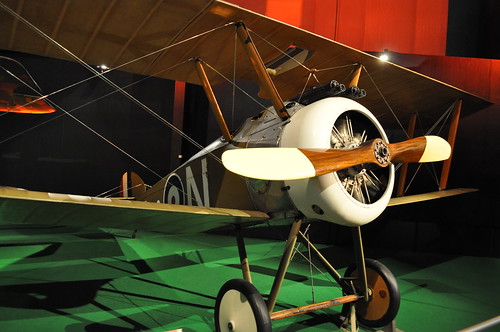
Our week started with the very early years of flight, along with the Schneider Schulgleiter SG 38 and Halberstadt CL IV. We continue our tour of flight's early years with the French built Nieuport 28.

 Nieuport 28 early years airplane

The Nieuport 28 was the first fighter airplane flown in combat by pilots of the American Expeditionary Force (AEF) in World War I. The first flight on April 14, 1918 resulted in two victories by  Lts. Alan Winslow and Douglas Campbell of the 94th Aero Squadron. The first victories by an AEF unit in fact.

Nieuport 28

The creativity and super savvy painted body of the the Nieuport 28 was no match for the aircraft’s terrible reputation to shed it’s upper wing fabric on dives.  In 1918, many considered the Nieuport 28 obsolete. Yet, there were many famous pilots who faired quite well in this early years plane.

WWI 26-victory ace Capt. Eddie Rickenbacker flew the Nieuport 28 several times during his career. The Nieuport was soon replaced by a less maneuverable aircraft in March 1918 called the SPAD XIII.

The aircraft on display at the National Air Force Museum in Dayton, Ohio is a reproduction. Like many of the  planes from the early years hanger, it contains wood and hardware from an original Nieuport 28.
 
The aircraft is painted and marked to represent a Nieuport of the 95th Aero Squadron, Third Flight, as it appeared in July 1918. It was placed on display in May 1994.

Read the Entire Series:

Wednesday, June 22, 2011

Early Years of Flight Day 3: Schneider Schulgleiter SG 38


When we think of the fighters and gliders of the early years of flight, we hardly picture a sloped wooden seat, made purposefully to seat a pilot and used by the Luftwaffe for training in the late 1930s and into the 1940s. The SG 38 was appropriately named Schulgleiter or "school glider" and the year it first flew, 1938.

The Germans were facing strict limitations on powered aircraft after World War I therefore they turned to gliders for studying aerodynamics and training pilots. In 1933, the DFS or German Research Institute for Sailplane Flight was forced by the Germans to make all gliding activity in Germany centralized. Training gliders, such as the Schneider Schulgleiter SG 38, were developed for both the Hitler Youth Flyers and Luftwaffe.

The Luftwaffe made its appearance in 1935 after the Nazis began their attempt at a rapid large-scale rearmament program. The expansion created a need for safe gliders used for student pilots in training. The The DFS worked with Edmund Schneider, who had opened a glider factory in 1927 and was producing some of the world's best gliders, to design the Schneider Schulgleiter SG 38.

It would appear that the design of the SG-38 was overtly simply and a bit dangerous looking, however the aircraft had to compensate for inexperienced student pilots. Would you believe that this training glider was actually launched with bungee cords from the hillsides of Mount Wasserkuppe in central Germany? The glider only remained airborne for a short time in order to prevent heavy-handed students from over steering and stalling the glider. Eventually, 9,000 to 10,000 SG 38s were built.

After World War II, Schneider moved to Australia and continued to build gliders. This Schneider Schulgleiter SG 38 came to the USAF National Museum in 2010.

Read the Entire Series:

Related Posts

Planes used during World War I

Although Kitty Hawk North Carolina would become home to the first manned flight of human kind, the Germans would take these physical parameters into a whole new realm. As the skies offered another battlefield in which to kill and mame, countries that did not embrace this new arena were quickly left behind. During the first world war, the Germans would gain an early edge over most of the Allies as concerned with WWI aircraft. Planes used during World War I became designed around the many German models, which would help the Allies win many later battles of the global war. There are many WWI planes that were important during the war although some played far greater roles than others.

Read more: Planes used during World War I

Strategic missiles at The National Museum of the United States Air Force

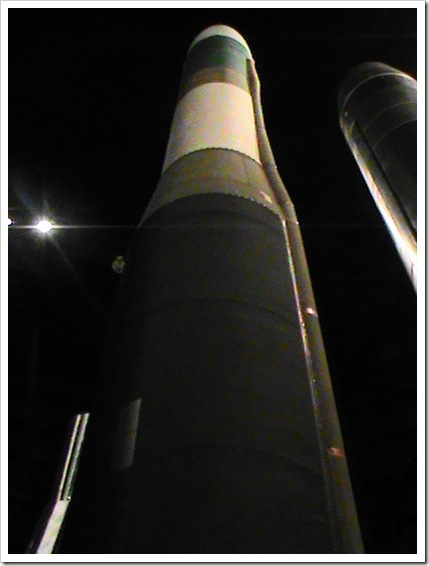
Tourists fly in from all around the world to visit the National Museum of the United States Air Force and who could blame them. The museum is completely free, only taking donations if you’re willing to spare a cent, and all this for a weeks worth of military history. It took me several days to walk the museum, spending most of my time with the Planes from WWI and aircraft from WW2. One of my favorite hangers in the museum is the space gallery, and the focal point is a round room featuring massive strategic missiles.

Read More: Ballistic Missiles at Wright Patterson Air Force Base

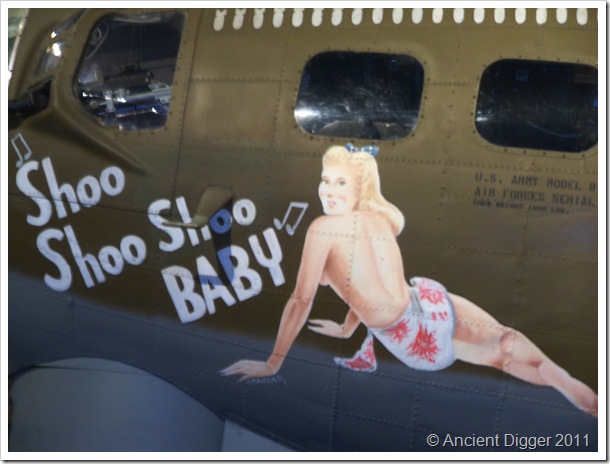
Shoo Shoo Baby: B17G At Wright Patterson Air Force Base

So before I start sharing, I wanted to start off the Wright Patterson Air Force Base Series with the Shoo Shoo Baby B-17G. For those of you plane and aircraft enthusiasts, you already know the B17G Flying Fortress was one of the most famous airplanes ever built. The B17G prototype first flew on June 28, 1935, yet few of the B-17 flying fortresses were flying prior to the United States’ entrance into World War II.

Read more:Shoo Shoo Baby: B17G At Wright Patterson Air Force Base

Tuesday, June 21, 2011

Early Years of Flight Day 2: Halberstadt CL IV


Halberstadt CL IV Under lower wing Halberstadt CL IV view under wing

Halberstadt CL IV wheel

The first thing I noticed, and I’m sure you did as well, is the colorful camouflage on the Halberstadt CL IV. Typically this early years WWI plane had a fuselage and wings painted green, mauve, and brown camouflage. Lozenge camouflage was found on the underside of the wings and tail, as you see in the picture above.

Halberstadt CL IV plane Halberstadt CL IV


World War I saw the emergence of the Halberstadt CL IV in combat during the last great German offensive. Pilots aboard the Halberstadt CL IV aided ground troops by utilizing the fixed and flexible machine guns, grenades and small bombs. Unfortunately, the CL IV lacked the armor necessary for protection against ground fire.

Halberstadt CL IV airplaneHalberstadt CL IV airplane 1

The CL IV was a hunted target of Allied pursuit squadrons and decidedly so. It was versatile and highly maneuverable, which made it a contender in dogfights. The Halberstadt CL IV performed as an interceptor against Allied night bombing raids and served as a night bomber against troop concentrations and airfields near the front lines.

Halberstadt CL IV aircraft

The USAF National Museum acquired the Halberstadt CL IV in 1984. The Halberstadt was in dreadful condition and required extensive restoration efforts.  The Museum fur Verkehr und Technik in Berlin, Germany, the Smithsonian Institution's National Air and Space Museum and the National Museum of the United States Air Force, worked in a joint venture to restore the Halberstadt CL IV to its former glory.

It is marked as the CL IV of the squadron leader of the Schlachtstaffel 21, which is known to have engaged elements of the U.S. Army's 94th and 95th Aero Squadrons in mid-July 1918 during the Chateau Thierry battle.

Read the Entire Series:

Monday, June 20, 2011

Monday Ground Up: Early Years of Flight Week


It’s one of the first hangers most visitors at the National Museum of the Air Force start with. You walk in and the feelings of nostalgia take hold, as you gaze upon the gravity defying aircraft that changed history. The delicate contours of the fabric frame the airplane like a painting and you wonder how perfection could ever be rivaled.

For those of us that weren’t able to experience this time in history, seeing the slew of planes during the early years of flight up close, can be just as inspiring and quite overwhelming.

This week I’ll be featuring some of the world’s earliest airplanes and aircraft. Instead of bombarding your brain with hundreds of fighters, flyers, monoplanes and biplanes, I decided to break it up a bit and let you enjoy all of the early years of flight throughout the week.
 

Wright 1903 Flyer

Wright 1903 Flyer
 
The Wright 1903 Flyer was the first heavier-than-air, manned, and controllable aircraft, which made four successful flights on December 17th, before a gust of wind overturned it and caused extensive damage. Instead of building the same model the Wright Brothers improved upon the design. The 1903 Wright Flyer was sent to the Science Museum in London, England for preservation. After WWII, the Wright Flyer was sent to the United States for permanent exhibition at the Smithsonian Institute.

I was fortunate enough to see a very significant, at least I believe, part of the 1903 Wright Flyer. The fabric preserved by the Wright Family came from the left half of the lower wing. The piece of fabric was presented by the Wright Brother’s Family Members on December 17, 1981, in celebration of their historic flight.
 

Curtiss 1911 Model D

Curtiss 1911 Model D Curtiss 1911 Model D plane
 
It appears it could never fly, built like matchsticks glued together or basal wood used in shop class in high school. This is our perception. In 1911 however the U.S. Army Signal Corps developed the Curtiss Model D Type IV. The Curtiss Model D was based on Glenn Curtiss' aileron using Curtiss Golden Flyer design of 1909, itself derived from his prize winning June Bug of 1908 . A pilot flying the Curtiss Model D operated the ailerons with his shoulders, and the front elevator and rear rudder with the wheel mounted on a column in front of him. Also, rather than sitting next to the pilot, the observer sat behind the pilot.  Like other Curtiss aircraft of the time, the Model D was a pusher, meaning the rear-mounted propeller "pushed" the aircraft. The military used a version which was often transported on Army wagons prior to assemblage.

On April 27, 1911, the Signal Corps Airplane No. 2 was accepted at Fort Same Houston, Texas to be used by the Army. The aircraft on display at the National Air Force Museum is a reproduction, completed in 1987. The original drawings weren’t available therefore details were gathered from an existing factory-built Curtiss pusher and from recent drawings. “Except for the engine, which is made of wood and plastic, all materials used in the reproduction are essentially the same as those used in the original.”
 

Wind Tunnel

Wind Tunnel Wind Tunnel 
Wind Tunnel Airplane wing testerWind Tunnel Airplane wing tester 1
 
Designed at McCook Airfield in 1918, this wind tunnel was designed to recalibrate airspeed instruments and testing airfoils. An item was placed in the choke-throat and the tester would observe through a glass window at the end. Air was drawn into the small area of the wind tunnel and exhausted from the larger area where the fan was located. In the wind tunnel’s 14 inch choke-throat area wind speeds could reach up to 453 miles per hour.
 

Fokker Dr. I Triplane

Fokker Dr. I Fokker Dr. I 2
Fokker Dr. I airplane
Fokker Dr. I plane
The illustrious flying ace of the sky, Fokker Dr. I Triplane, has often been linked with the career of World War I's highest scoring ace, Germany's Rittmeister Manfred von Richthofen (the "Red Baron"). The Fokker Dr. I Triplane was one of the best ”dogfighters” of the war.  The first Fokker Dr. I appeared over the Western Front in August 1917. Pilots, their nature of being competitive, were impressed with the Dr. Is agility, and several scored victories with the highly maneuverable triplane.
Von Richthofen score 19 of his last 21 victories were achieved while he was flying the Dr. I. By May 1918, however, the Dr. I was being replaced by the newer and faster Fokker D. VII. Although Fokker built a total of 320 Dr. Is, none have survived. This reproduction is painted to represent the aircraft flown by Lt. Arthur Rahn in April 1918 when he served with Jagdstaffel 19. Lt. Rahn is credited with six confirmed victories.


Sopwith Camel F-1

Sopwith F-1 Camel
Sopwith Camel F-1
© ksr8s
 
The Sopwith Camel F-1 first went into action in June 1917 with 70 Squadron, Royal Flying Corps, and 4 Squadron, Royal Naval Air Service. The 17th and 148th U.S. Army Air Service squadrons flew the Camel in combat while assigned to British forces in 1918.
 
Such famous U.S. pilots as George Vaughn (America's second-ranking Air Service ace to survive the war), Elliot White Springs, Errol Zistel and Larry Callahan were members of the 17th and 148th. A third U.S. unit, the 185th Aero Squadron, used the Camel as a night fighter on the American Front during the last month of the war. 

The British Sopwith Camel F-1 shot down more enemy aircraft than any other World War I fighter. The Sopwith was difficult to defeat and highly maneuverable, yet it still has substantial drawbacks. More men lost their lives while learning to fly it than died while using it in combat. There are very few Sopwith Camel F-1s in existence today therefore the museum constructed a model from the original WWI factory drawings, completing it in 1974. The aircraft is painted and marked as the Camel flown by Lt. George A. Vaughn Jr., 17th Aero Squadron.

Kettering Aerial Torpedo “Bug”

Kettering Aerial Torpedo “Bug” Kettering Aerial Torpedo “Bug” 1
The Kettering Aerial Torpedo, nicknamed the “Bug”, was invented by Charles F. Kettering of Dayton, Ohio. The “Bug” was launched from a four-wheeled dolly that ran down a portable track. Quite similar to the carnival rollercoasters of today.

The Bug's system of internal pre-set pneumatic and electrical controls stabilized and guided it toward a target. After a predetermined length of time, a control closed an electrical circuit, which shut off the engine.The wings would then be released and the Bug plunged into the earth-- where its 180 pounds of explosive detonated on impact. Although an innovative war weapon, the Bug never saw combat.  The reproduction of the “Bug” on display at the museum went on display in 1964.

G-3 Target Glider

G-3 Glider 
McCook Airfield was not only home to the wind tunnel which was designed to recalibrate airspeed instruments and testing airfoils, but was also the testing site of a series of target gliders in the 1920s like the G-3.   The first model was designed in December 1922 by J.A. Roche, the GL-1, as a target for anti-aircraft gunners of the U.S. Army Coast Artillery. These early targets were the first and only gliders (manned or unmanned) used by the U.S. Army Air Service.
The G-3 operated as “live-fire aerial targets” for fighter and attack aircraft into the early 1930s. Because it could be adjusted to fly a straight, circular or random course, the target glider provided a more effective training tool than the traditional towed target sock. For aerial gunnery training, a pilot carried his target glider aloft. After release, the glider took several minutes to reach the ground. During this time, the pilot could make several gunnery passes against it.


Curtiss P-6E Hawk

Curtiss P-6E Hawk G-3 Target Glider

Curtiss built a long series of fighters starting in 1925. The P-6E remains the best known of the series of fighters carrying the name "Hawk."  Originally designated the Y1P-22, the U.S. Army Air Corps redesignated this aircraft the P-6E because of its similarity to the other P-6s. Curtiss delivered 46 P-6E Hawks, the last biplane fighter built in quantity for the Air Corps.

The Curtiss P-6E Hawk was never used in combat and is considered one of the most beautiful aircraft of the 1930s. The P-6E on display is the only original still in existence. The colors and markings of the airplane assigned to Capt. Ross G. Hoyt, Commanding Officer of the 17th Pursuit Squadron, 1st Pursuit Group, based at Selfridge Field, Mich. in 1933.

Edward S. Perkins of Anniston, Ala., donated it to the museum, and the Department of Aviation Technology at Purdue University restored it in 1963.

Caquot Type R Observation Balloon

Caquot Type R Observation Balloon 1 Caquot Type R Observation Balloon

We’ve seen the balloons at football games or watched video footage of the Hindenburg, but these tethered balloon aircraft used during World War I had a somewhat different purpose.

The Caquot Type R Observation Balloon on display allowed observers to see as far as 40 miles behind enemy lines to spot troop movements, chart trench systems and direct artillery fire. During WWI, American balloon observers directed artillery fire at targets, noted more than 1,000 enemy airplane sightings, 1,000 instances of military traffic on railroads and roads and 400 artillery batteries. Named after French engineer Lt. Albert Caquot and used mostly by Americans, this hydrogen-filled balloon could lift two passengers in its basket to heights of up to 4000 feet on a good weather day.

Nearly 1,000 Caquot balloons were manufactured in the United States in 1918-1919. During World War II, the British produced Caquots but in limited numbers. The Caquot Type R Observation Balloon  displayed at the museum was manufactured in 1944 and is believed to be the only survivor.
The British used it for parachute testing and noncombat aerial observation and photography until 1960. The British Ministry of Defense, Royal Aircraft Establishment, presented the Caquot to the museum after it was located with the aid of American and British WWI balloon veterans in 1975. Assisted by the Goodyear Aerospace Corp. of Akron, Ohio, which had produced these balloons during WWI, museum personnel mended and sealed the balloon fabric and prepared it for inflation. It was placed on display in May 1979.


Boeing P-26A

Boeing P-26ABoeing P-26A
Boeing P-26A 1
The Boeing P-26A Peashooter became the first US Army Air Corps all-metal monoplane in service. Pilots bestowed the name “peashooter” upon the plane which could reach faster speeds in level flight and had a faster landing speed due to the lack of wing flaps. The P-26A Peashooter has an open cockpit, external wing bracing, and fixed landing gear. The Peashooter was the last fighter to have these obsolete features. The first P-26A flew in March 1932. In 1934, Boeing sold an export version to the Chinese who flew it in combat against the Japanese. In 1941, the Philippine government used the P-26 against the Japanese.
 

Douglas O-38F

During World War I, observation aircraft provided ground commanders with vital reconnaissance information, and throughout the interwar years, commanders of U.S. Army ground forces demanded adequate observation support. However, most ground commanders anticipated fighting a static or slow-moving war, and the observation aircraft purchased during the 1920s and early 1930s differed little from those flown over France in 1918.
Douglas O-38F aircraft Douglas O-38F
  
The Douglas O-38F was the last of a series of biplane observation aircraft begun in the early 1920s.  Douglas built 156 O-38s for the Air Corps between 1931-1934, eight of which were O-38Fs. By the 1930’s, the O-38s were obsolete, what with their meager cruising speed of 128mph. Some  remained in service at the time of Pearl Harbor in 1941. The Douglas O-38F on display at the USAF National Museum was the first to land at Ladd Field near Fairbanks, Alaska, in October 1940.
Ladd Field became famous during World War II as the place from where American-built aircraft flew to the Soviet Union under the Lend-Lease program. This aircraft flew various missions until it crashed on June 16, 1941, due to engine failure about 70 miles southeast of Fairbanks. Uninjured, the pilot, Lt. Milton H. Ashkins, and his mechanic, Sgt. R.A. Roberts, hiked to safety after supplies were dropped to them. The abandoned aircraft remained in the Alaskan wilderness until the museum arranged for its recovery by helicopter in June 1968. Despite being exposed to the Alaskan weather for 27 years, the aircraft remained in remarkable condition. Only the wings required extensive restoration.


Martin B-10

Martin B-10
Martin B-10 airplane
The Martin B-10 is the first "modern" all-metal monoplane bomber produced in quantity, featured such innovations as retractable landing gear, a rotating gun turret and enclosed cockpits. The Martin B-10 is powered by two 775-hp Wright R-1820 Cyclone engines, making it 50 percent faster than contemporary biplane bombers and as fast as most of the fighters. The Air Corps ordered 121 B-10s from 1933-1936 making it the “largest procurement of bomber aircraft since World War I”.
Gen. Henry H. "Hap" Arnold, who called the B-10 "the air power wonder of its day," led 10 B-10s on a 8,290-mile flight from Washington, D.C., to Fairbanks, Alaska, and back in 1934. By the late 1930s,  B-17s and B-18s had replaced the Air Corps' B-10s and B-12s, but the Chinese and Dutch air forces flew export versions in combat against Japan at the start of World War II.
This particular Martin B-10 is the last of the B-10 series in existence. It was sold to Argentina in 1938.  In 1970, the Martin B-10 was donated to the U.S. Air Force Museum by the government of Argentina.
 

Northrop A-17A

Northrop A-17A Northrop A-17A plane

Northrop A-17A aircraft
The Northrop A-17A series was a direct descendent of the Northrop "Gamma," made famous by the aerial explorer Lincoln Ellsworth. It was the last of the pre-World War II single-engine attack airplane ordered into production by the Army Air Corps. The A-17 was never fully tested in peacetime exercises or in combat. In 1938 the Army Air Corps determined that all future attack aircraft procured would be multi-engine models therefore its fate was sealed. The A-17's design figured prominently in the success of a distinguished line of Douglas aircraft even considering its handicap. The Northrop was able to carry one ton of bombs on external racks which featured vertical chutes. The chutes held up to 20 30-pound fragmentation bombs. “In addition to the bombs, the A-17A was armed with four forward-firing .30-cal. machine guns for strafing, and one flexible mounted .30-cal. gun in the rear cockpit for self-defense.”

In June 1940, all but 20 A-17As were sold overseas and the remaining Army Air Forces A-17 and A-17As were used as advanced trainers and squadron support aircraft, most ending up as ground maintenance trainers. The last A-17A was written off of Army Air Forces records in early 1945.
The aircraft on display at the USAF National Museum is the only A-17 series aircraft known to exist. It was delivered to the Air Corps and assigned to Barksdale Field, La., on June 25, 1937. Following a brief stay at Kelly Field, San Antonio, Texas, the aircraft was assigned in April 1940 to Bolling Field, Washington, D.C., and also served as a support aircraft for U.S. Military attaches in Honduras, Guatemala and Haiti. The aircraft was dropped from Army Air Forces records in January 1945.

Read the Entire Series:

Also check out:

Although Kitty Hawk North Carolina would become home to the first manned flight of human kind, the Germans would take these physical parameters into a whole new realm. As the skies offered another battlefield in which to kill and mame, countries that did not embrace this new arena were quickly left behind. During the first world war, the Germans would gain an early edge over most of the Allies as concerned with WWI aircraft. Planes used during World War I became designed around the many German models, which would help the Allies win many later battles of the global war. There are many WWI planes that were important during the war although some played far greater roles than others.
Read more: Planes used during World War I

Strategic missiles at The National Museum of the United States Air Force

Tourists fly in from all around the world to visit the National Museum of the United States Air Force and who could blame them. The museum is completely free, only taking donations if you’re willing to spare a cent, and all this for a weeks worth of military history. It took me several days to walk the museum, spending most of my time with the Planes from WWI and aircraft from WW2. One of my favorite hangers in the museum is the space gallery, and the focal point is a round room featuring massive strategic missiles.
Read More: Ballistic Missiles at Wright Patterson Air Force Base

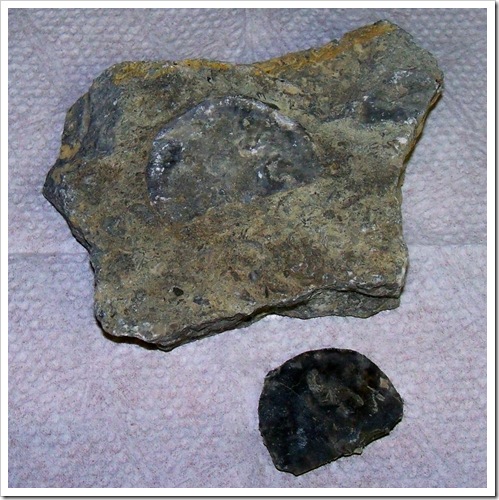
Caesar’s Creek Ordovician Fossil Hunting

When I was a child growing up in Ohio, my class would take yearly fieldtrips to the Caesar’s Creek Spill off to go fossil hunting. As a child, it was hard to stay focused on the task at hand. We would never read the signs stating we had to leave behind the fossils bigger than our palms, and now that I’m older, I can appreciate why the signs were posted.
Read more: Caesar’s Creek Ordovician Fossil Hunting

Shoo Shoo Baby: B17G At Wright Patterson Air Force Base

So before I start sharing, I wanted to start off the Wright Patterson Air Force Base Series with the Shoo Shoo Baby B-17G. For those of you plane and aircraft enthusiasts, you already know the B17G Flying Fortress was one of the most famous airplanes ever built. The B17G prototype first flew on June 28, 1935, yet few of the B-17 flying fortresses were flying prior to the United States’ entrance into World War II.
Read more:Shoo Shoo Baby: B17G At Wright Patterson Air Force Base
Resources
All quotes are courtesy and © of the National Museum of United States Air Force in Dayton, Ohio.

Like Ancient Digger? Why Not Follow Us?


Subscribe Via RSS Feed Follow Ancient Digger on Facebook Follow Ancient Digger on Twitter Subscribe to Ancient Digger Via Email

Get widget

Search


Ancient Digger Archaeology Copyright © 2015 LKart Theme is Designed by Lasantha