• Ancient Digger teaches Archaeology and History to all Ages!

Sunday, December 23, 2012

Interview with the Founder of Dig-It Games and Creator of Mayan Mysteries


I had the immense pleasure of interviewing Suzi Wilczynski, the founder of Dig-It Games. Suzi is a former archaeologist and teacher who has bridged the gap between entertainment and education. Her games were created for people who crave the challenge of a puzzle and who seek knowledge by solving the complexities of a mysterious ancient society through critical thinking.

Her latest creation, Mayan Mysteries, incorporates archaeology techniques with an exhilarating adventure and journey, which leads players into a Maya world of intrigue and mystery. One aspect, and the most important I believe, which makes this game unique, is the fact that it allows the player to use their prior knowledge to break apart information and make sense of it using a combination of science, math,  reading, and geographical knowledge and skills.


Interview with Suzi Wilczynski: Mayan Mysteries


I read that you are a former archaeologist. What was your area of expertise and did you ever discover anything exciting on digs?

I am a Mediterranean archaeologist, with a focus on Bronze Age Greece and cultural interactions. I studied Roman Archaeology in college and spent many seasons at Roman and Byzantine sites in Greece and the Middle East. In my first season, I found the most unusual artifacts: Roman curse tablets. They were thin sheets of lead that people inscribed curses on, then folded up and threw in a well. It was fascinating. We also found a number of complete pottery and glass vessels in that well. It was pretty exciting.

When you started creating archaeology games, did you have the intention of integrating real archaeology terms into the game play like: superposition, carbon dating, trowel, etc?

Absolutely. My games are designed to teach archaeology and terminology plays a huge part. Roman Town included a number of vocabulary-related games. Mayan Mysteries focuses more on concepts such as stratigraphy, recording, context, dating and proper excavation methodology. We incorporate real archaeological tools and techniques as well. My games are authentic archaeological experiences.

How long did it take you to conceptualize this game? Did you employ others’ knowledge while creating it?

For Mayan Mysteries, it took approximately a year from preliminary research to launch. It was a bit more for Roman Town since I had a lot to learn about game design as well. For the content in Mayan Mysteries I worked with Dr. Robert J. Sharer from the University of Pennsylvania, an expert in the field. My process for game design is iterative rather than top down, which means that the design changes during development. So everyone involved in development (programmers, artists, writers, testers) had an impact on the final product.

What was your real motivation behind Mayan Mysteries? Was it for educational purposes or pure pleasure?

Mayan Mysteries was designed as an educational tool. Content was built around National Standards and the Teacher Management System was part of the original design. The mission of Dig-It! Games is to make interactive, educational products that seamlessly blend fun and learning. It is impossible to play one of our games without learning something. Having said that, I won’t release a game unless it’s fun, so we worked hard to make sure that we ended up with an educational tool that is enjoyable outside the classroom. Based on feedback from casual users, we’ve succeeded in making a fun game that happens to be educational.

What age group did you have in mind when you began creating this game?

Mayan Mysteries was created specifically for middle school students. When my own children were ages 11 through14, there were very few products designed specifically for them. Unfortunately, that’s still the case. Middle school students are an underserved group when it comes to games and fun educational products. As an educator, I also believe strongly that middle school education needs to include an emphasis on analytical and critical thinking skills. As a scientist, I feel that middle school is the time when kids need to learn the basic scientific and logical thinking that will enable them to be successful in STEM subjects down the road. I also happen to just like this age group, so it’s enjoyable for me to create products for them, and I love to watch them play my games: you can see the moments when things just start to click for them and the history, science and math suddenly make sense in their lives.

The processes of archaeology can be difficult to understand for a novice. Will Mayan Mysteries be difficult to understand and navigate for younger children?

Mayan Mysteries is an in-depth, immersive historical experience for anyone ages 11 and older. Younger children will struggle with some of the puzzles, but can play with help from a parent or older child. Additionally, Mayan Mysteries is a historically accurate depiction of the Maya culture; some topics such as warfare and sacrifices may not be appropriate for children younger than 11. There is no violence or graphic images in Mayan Mysteries, but some younger children may be disturbed by the concepts discussed. As far as the archaeological content, my goal is to make archaeology accessible to young people. As you say, it can be difficult to understand, and archaeologists often have trouble explaining what they do in simple terms. Dig-It! Games is changing that by creating immersive experiences that turn players into archaeologists. We blend archaeological concepts and methodology with fun, intuitive game play. Players walk away from our games with a true understanding of the fundamentals and importance of archaeology.

Mayan history is very complex with the symbology, culture, architecture, etc. How accurate really is the content in the game, especially if it’s geared towards a younger player who has no prior knowledge of Mayan culture?

The content in Mayan Mysteries was developed with the assistance of Dr. Robert J. Sharer, a world-renowned Maya expert. All the content is 100 percent historically accurate. Additionally, our sites are real places, our artifacts are completely authentic, and we use real Mayan glyphs and terms throughout the game. We incorporate real archaeological tools and techniques as well. Mayan Mysteries is an authentic and historically accurate representation of the Maya, incorporating detailed factual information about the ancient civilization. Our in-game encyclopedia includes more than 300 factual entries, each one paired with photos of actual Maya sites and artifacts as well as artists’ renderings of people, places, artifacts and glyphs. It was important to both Dr. Sharer and me that we create a game that was enjoyable while remaining true to history. I think we did that very well.

I’m a TESOL teacher, how do you think speakers of other languages would be able to navigate with Mayan Mysteries?

Mayan Mysteries was designed for English speakers with at least a 5th grade reading level. Some of the vocabulary may be tricky for non-English speakers, but most difficult terms are connected to links to definitions within the in-game encyclopedia. There are some Spanish terms used in the game, and much of the culture will be familiar to native Spanish speakers from Mexico and Central America. One of my goals with Mayan Mysteries was to create a game that would be successful for all different types of learners. For that reason, every part of the game includes voice-overs reading the text, which should help non-English speakers as well as auditory learners and kids who are not strong readers. The concepts of the game are universal and not reliant on any previous knowledge and game play is intuitive, so the original language of the user is not a factor in understanding and enjoying Mayan Mysteries.

What is it that you hope players will gain from playing Mayan Mysteries?

From playing Mayan Mysteries, players will have a deep understanding of: the fundamentals and importance of archaeology, methods of historical study including the use of primary sources, Maya history and culture, the Maya number system, the Maya calendar, the Mayan language, and Central American Geography.

Players will also gain an understanding of how beliefs are transmitted in societies, what culture is and how it is expressed, the methods by which governments and institutions develop and exercise authority, economic concepts such as trade, markets and production and distribution of goods, and how culture, government and belief systems influence and are influenced by scientific achievements. Finally, players will develop an understanding of why it is important to study the past and how past cultures influence modern life through interaction with Maya artifacts and an examination of Maya culture.

In addition, Mayan Mysteries uses puzzles and problem-solving exercises to develop and enrich kids’ analytical thinking, creative thinking, and independent learning skills. Puzzles about the Maya calendar, number system, and daily life assess reading comprehension, geographical knowledge, spatial reasoning, and science and math skills. Game play also requires players to test fact retention and knowledge in fun challenges.

Do you have intentions of creating archaeology games with the expert archaeologist or grad student, like myself, in mind?

My focus is on introducing elementary and middle school students to ancient civilizations in a way that is meaningful and understandable within their lives. I believe that archaeology is a powerful teaching tool for social studies: it brings history to life while encouraging students to use skills from multiple disciplines such as math, science and language arts. My goal is to create entertaining, interactive games that can be played at school or at home to truly engage children in the science of archaeology and educate them about civilizations and cultures in an immersive way that goes beyond what they can experience from a textbook or film.

Will Mayan Mysteries eventually be offered on more game systems in the future?

Mayan Mysteries can be played on Mac, PC, and tablet devices. We’re also happy to announce Mayan Mysteries is now available as an iPad app so it can be downloaded and played anytime, anywhere!


Are you still immersed in teaching and archaeology or are you spending more time creating new games?

Dig-It! Games is a full-time job, but I also follow the latest developments in education and archaeology.

Monday, December 10, 2012

Archaeologists find Maya ceramics and mural paintings in three underwater caves in Mexico


Helena Barba. INAH-SAS.
Underwater archaeologists of the National Institute of Anthropology and History (INAH – Conaculta), recently explored three spaces, all abundant with Mayan culture materials: two semidry caves in Campeche and a cenote [A water-filled limestone sink hole] in Yucatan.

The cenote stands out since it contains particularly stylish ceramic that is calculated to have been elaborated about 2,300 years ago. This is unique in its type since it’s the only one that has been found in a cenote.

To Helena Barba Meinecke, responsible for all the underwater archaeology of the Yucatan peninsula, the detailed registry of the caves and the cenote, as well as the archaeological elements found in them, confirm the speculation that these places were used for rituals in the pre Hispanic era.

Cenote San Manuel

The distinct characteristics of the pieces, located in the cenote San Miguel, make them stand out among the other discoveries. Access to this 20 meter (65.61 feet) deep body of water, is through the town well by rappel. The divers must not be in the water longer than 20 minutes, which is why a change of divers was required. At least six hours of meticulous planning was needed to retrieve two Mayan pots, possibly dating back to 300 AD or 200 AD (during the Late Postclassic period).

The cenote has an entry of about a meter in diameter. One of the pots is globe shaped and has a braided handle. It contains an anthropomorphic face and a phytomorphic body. The other pot shows a Mayan face with a diadem detailed in a red and blue pigment.

“Up till now, there had not been such stylish ceramic elements found in the peninsula’s underwater spaces, nor had they found ceramic elements as well preserved as these. They are unique materials that could have been stolen if we had not extracted them”, said Helena Barba Meinecke, expert of the Underwater Archaeology Section (SAS) of INAH.

Huachabi Cave 

The explorations of the Underwater Archaeology Atlas project, carried out during the first half of last November, continued in the semidry cave of Huachabi, Campeche, where the findings were of no less in importance. This cave – with more than 500 meters (1640.41 feet) in length at its widest part, also has two slopes – is found inside the Miramar archaeological site, still unexplored in the Chenes region. Inside the cave, which one must rappel 20 meters (65.61 feet) to get through, there are nearly 50 spaces with offerings of distinct proportions. Carbon samples were taken to estimated the approximate date while archaeologist Eunice Uc, investigator of the INAH Center – Yucatan, works on defining the ceramic types to provide an appropriate timeline; the context of the ceramic elements has been preliminarily supposed to date back to the Classic Mayan period (600 – 900 AD).

Also, next to these materials, fragments of mural paintings were detected in different chambers of the cave. The small symmetry between their designs (anthropomorphic as well as representations of vegetables and insects that inhabit the subterranean environment), and the fact that they were elaborated with red clay, taken from inside the cave, could mean these were older than the rest of the elements found.

Aktun aam Cave 

The cave was baptized as Aktun aam because of the great quantity of violinist spiders [also known as the “brown recluse”] (Loxosceles laeta) found in its corners. The cave is also located in Campeche and it’s accessed by rappel at a 15º angle. It is possible that initiation ceremonies or purification ceremonies were performed in the cave given the disposition of the objects that were discovered. Also, several strewn materials around the cave suggest the objects were elaborated inside the cave.

Archaeologist Barba Meinecke explained that in each branch of the cavern – 200 meters (656.16 feet) -, were placed, generally in ensembles, decorated black colored pots and metates [ a stone block with a shallow concave surface, used for minor grinding], intentionally broken, and that were elaborated with the same limestone from within the cave.

Source: Art Daily

Wednesday, November 28, 2012

The apocalypse or the crock-alypse?


Edwin Barnhart, an archaeologist and expert on Mayan civilization, will speak on the prediction that end of the world is coming Dec. 21 on Dec. 10 at 6 p.m. in the Robert B. Moore Theatre.
The lecture is free and open to the public. The program is presented by OCC Staff Development and the OCC Foundation.

The Mayan calendar ends on Dec. 21and it has been predicted by some that the world will end on that day. Barnhart, an archaeologist, is one of the world’s leading authorities on Mayan civilization. He is director of the Maya Exploration Center, a Fellow of the Explorer Club, and regular contributor to broadcasts airing on The Discovery Channel, The History Channel, and public television worldwide.

A widely recognized authority on ancient Maya astronomy, mathematics and calendar systems, Barnhart spent more than 20 years exploring Maya archaeology.


Source: Coast Report

Monday, August 13, 2012

Archaeologists discover largest Maya dam at Tikal


Archaeologists have long known that the Maya were sophisticated engineers, but new excavations at Tikal, Guatemala show the amazing extent to which they were able to manipulate the environment to their advantage, including construction of 260-foot dam that stored up to 20 million gallons of water.

That dam – constructed from cut stone, rubble and earth – stood about 33 feet high and held about 20 million gallons of water in a man-made reservoir. The research, conducted by a multi-university team led by the University of Cincinnati, helps explain how the Maya conserved and used their natural resources to support a populous, highly complex society for over 1,500 years despite environmental challenges, including periodic drought. Studying the Maya may offer some lessons for modern resource management, said lead author Vernon Scarborough, a professor of anthropology at the University of Cincinnati.

“Water management in the ancient context can be dismissed as less relevant to our current water crisis because of its lack of technological sophistication. Nevertheless, in many areas of the world today, the energy requirements for even simple pumping and filtering devices – to say nothing about replacement-part acquisition – challenges access to potable sources,” Scarborough said. “Tropical settings can be especially difficult regions because of high infectious disease loads borne by unfiltered water schemes,” he said.

“The ancient Maya, however, developed a clever rainwater catchment and delivery system based on elevated, seasonally charged reservoirs positioned in immediate proximity to the grand pavements and pyramidal architecture of their urban cores. Allocation and potability were developmental concerns from the outset of colonization. Perhaps the past can fundamentally inform the present, if we, too, can be clever.”

Starting in 2009, the UC team was the first North American group permitted to work at the Tikal site core in more than 40 years.

Detailed in the latest findings by the UC-led efforts are The largest ancient dam built by the ancient Maya of Central America Discussion on how reservoir waters were likely released Details on the construction of a cofferdam needed by the Maya to dredge one of the largest reservoirs at Tikal.

The presence of ancient springs linked to the initial colonization of Tikal Use of sand filtration to cleanse water entering reservoirs A “switching station” that accommodated seasonal filling and release of water Finding of the deepest, rock-cut canal segment in the Maya lowlands “The overall goal of the UC research is to better understand how the ancient Maya supported a population at Tikal of perhaps 60,000 to 80,000 inhabitants and an estimated population of five million in the overall Maya lowlands by AD 700,” Scarborough explained.

“That is a much higher number than is supported by the current environment. So, they managed to sustain a populous, highly complex society for well over 1,500 years in a tropical ecology. Their resource needs were great, but they used only stone-age tools and technology to develop a sophisticated, long-lasting management system in order to thrive,” he said.

The latest research adds to the understanding of how the Maya carefully integrated the built environment – expansive plazas, roadways, buildings and canals – into a water-collection and management system. At Tikal, they collected literally all the water that fell onto these paved and plastered surfaces and sluiced it into man-made reservoirs. The city’s plastered plaza and courtyard surfaces and canals were canted in order to direct and retain rainwater runoff into these tanks. The study also discovered that, to help purify water as it sluiced into the reservoir tanks via catchment runoff and canals, the Maya employed deliberately positioned “sand boxes” that served to filter the water as it entered into the reservoirs.

“These filtration beds consisted of quartz sand, which is not naturally found in the greater Tikal area. The Maya of Tikal traveled at least 20 miles (about 30 kilometers) to obtain the quartz sand to create their water filters. It was a fairly laborious transportation effort. That speaks to the value they placed on water and water management,” said UC’s Nicholas Dunning. “It’s likely that the overall system of reservoirs and early water-diversion features, which were highly adaptable and resilient over a long stretch, helped Tikal and some other centers survive periodic droughts when many other settlement sites had to be abandoned due to lack of rainfall,” said UC’s Ken Tankersley.

Maya water management had implications for the availability of food, fuel, medicinal plants and other necessities.

“Water management by the Maya included irrigation, which directly impacted how many people could be fed and overall population growth,” said UC paleoethnobotanist David Lentz. “Accordingly, it is essential to understand the array of canals and reservoirs at Tikal, which conserved water during the annual dry season and controlled floodwaters during the rainy months,” he said.

“These practices allowed the Tikal Maya to sustain relatively high population densities for several centuries. As it evolved, this system of reservoirs was largely dependent on rainfall for recharging. With the onset of the 9th century droughts however, water supplies dwindled, causing the resource base and social fabric of the Tikal Maya to come under considerable stress. These developments may well have contributed to the abandonment of the city.”

The findings were published this month in the Proceedings of the National Academy of Sciences.

Source: Summit County Voice

Saturday, August 11, 2012

Ancient Maya Domesticated Wild Turkey 2300 Years Ago


Published online in the journal PLoS ONE, the discovery of the turkey bones at an ancient Mayan archaeological site in Guatemala provides evidence of domestication, usually a significant mark of civilization, and the earliest evidence of the Mexican turkey, Meleagris gallopavo, in the Maya world.

“The discovery of the turkey bones is significant because the Maya did not use a lot of domesticated animals. While they cultivated domesticated plants, most of their animal protein came mostly from wild resources,” said lead author Dr Erin Thornton, a research associate at the Florida Museum of Natural History.

“We might have gotten the timing of the introduction of this species to the ancient Maya wrong by a significant chunk of time,” Dr Thornton said. “The species originates from central Mexico, outside the Maya cultural area. This is the species the Europeans brought back with them to Europe – all domestic turkeys originated from Mexico.”

Using archaeological evidence, comparisons of bone structure and ancient DNA analysis, the scientists determined the turkey fossils belonged to the non-local species Meleagris gallopavo gallopavo, which is native to central and northern Mexico.

The Mexican turkey is the ancestor of all domestic turkeys consumed in the world today and Mesoamerica’s only indigenous domesticated animal. The discovery of the bones south of the turkey’s natural range shows animal exchange occurred from northern Mesoamerica to the Maya cultural region during the Late Preclassic period from 300 BC to 100 CE.

“This research has consequences for understanding Maya subsistence because they would have had access to a controlled, managed resource,” Dr Thornton said. “The turkey bones came from right within the ceremonial precinct of the site, so these are probably the remains of some sort of elite sacrifice, meal or feast.”

The bones were recovered from the El Mirador archaeological site, one of the largest and most developed Preclassic locations found in the Maya lowlands. The site contains massive temple complexes, some of the largest Maya architecture ever constructed.

“Plant and animal domestication suggests a much more complex relationship between humans and the environment – you’re intentionally modifying it and controlling it,” Dr Thornton said.

“Researchers assumed turkey bones previously recovered from Maya sites belonged to the native ocellated turkey, Meleagris ocellata. The new evidence means researchers may need to re-examine previously recovered bones,” said Prof Mary Pohl of Florida State University.

“This study is extremely significant and I think it opens up a whole new perspective on the Maya and animal domestication,” Prof Pohl said. “I find it especially interesting that these turkey bones are in this very special pyramid context because people often think of turkeys as something to eat, but they were probably making some sort of special offerings of them, which would go along with the fact that they brought them in from a long distance.”

Source: Sci News

_______

Bibliographic information: Thornton et al. 2012. Earliest Mexican Turkeys (Meleagris gallopavo) in the Maya Region: Implications for Pre-Hispanic Animal Trade and the Timing of Turkey Domestication. PLoS ONE 7(8): e42630; doi: 10.1371/journal.pone.0042630


Thursday, August 2, 2012

Mayas may have used chocolate as spice


Archaeologists say they have found traces of 2,500-year-old chocolate on a plate in the Yucatan peninsula, the first time they have found ancient chocolate residue on a plate rather than a cup, suggesting it may have been used as a condiment or sauce with solid food.

Experts have long thought cacao beans and pods were mainly used in pre-Hispanic cultures as a beverage, made either by crushing the beans and mixing them with liquids or fermenting the pulp that surrounds the beans in the pod. Such a drink was believed to have been reserved for the elite. But the discovery announced this week by Mexico's National Institute of Anthropology and History expands the envelope of how chocolate may have been used in ancient Mexico. It would also suggest that there may be ancient roots for traditional dishes eaten in today's Mexico, such as mole, the chocolate-based sauce often served with meats.

"This is the first time it has been found on a plate used for serving food," archaeologist Tomas Gallareta said. "It is unlikely that it was ground there (on the plate), because for that they probably used metates (grinding stones)." The traces of chemical substances considered "markers" for chocolate were found on fragments of plates uncovered at the Paso del Macho archaeological site in Yucatan in 2001.

The fragments were later subjected to tests with the help of experts at Millsaps College in Jackson, Mississippi, as part of a joint project. The tests revealed a "ratio of theobromine and caffeine compounds that provide a strong indicator of cacao usage," according to a statement by the university.

"These are certainly interesting results," John S. Henderson, a Cornell University professor of Anthropology and one of the foremost experts on ancient chocolate, said in an email Thursday.

Henderson, who was not involved in the Paso del Macho project, wrote that "the presence of cacao residues on plates is even more interesting ... the important thing is that it was on flat serving vessels and so presented or served in some other way than as a beverage." "I think their inference that cacao was being used in a sauce is likely correct, though I can imagine other possibilities," he added, citing possibilities like "addition to a beverage (cacao-based or other) as a condiment or garnish.”

The plate fragments date to about 500 B.C., and are not the oldest chocolate traces found in Mexico. Beverage vessels found in excavations of Gulf coast sites of the Olmec culture, to the west of the Yucatan, and other sites in Chiapas, to the south, have yielded traces around 1,000 years older. But it does extend the roots of Mexican cuisine, and the importance of chocolate, further back into the past. "This indicates that the pre-Hispanic Maya may have eaten foods with cacao sauce, similar to mole," the anthropology institute said in a statement.

 (Source: Seattle Times)

Friday, November 11, 2011

Archaeology Fieldwork Opportunity: Ancient Maya Site of Blue Creek


The Maya Research Program is a U.S.-based non-profit organization (501C3) that sponsors archaeological and ethnographic research in Middle America. Each summer since 1992, we have sponsored archaeological fieldwork at the ancient Maya site of Blue Creek in northwestern Belize. In 2012 we again offer opportunities to participate in our field program and learn about the Maya of the past and today.

The Blue Creek project is open to student and non-student participants, regardless of experience. The field school is certified by the Register of Professional Archaeologists and participants will receive training in archaeological field and laboratory techniques.

Academic credit and scholarships are available.
(http://www.mayaresearchprogram.org)

We invite students and volunteers to participate in the Maya Research
Program’s 21st year of our Blue Creek archaeological project in
Belize.

2012 Field Season Dates:
Session 1: Monday May 28 - Sunday June 10;
Session 2: Monday June 11 - Sunday June 24 ;
Session 3: Monday July 2 - Sunday July 15;
Session 4: Monday July 16 - Sunday July 29

For additional information please contact the Maya Research Program:
www.mayaresearchprogram.org
1910 East Southeast Loop 323 #296
Tyler, Texas 75701
817-831-9011
mrpinquiries@gmail.com

Saturday, June 12, 2010

Maya People Knew about Prehistory


For Palenque inhabitants, marine fossils were the convincing proof of the land being covered by the sea long time ago, and parting from this fact they created their idea of the origin of the world.

MEXICO CITY.- Recent interdisciplinary investigations regarding 31 marine fossils found at Palenque Archaeological Zone, in Chiapas, reveal that Maya people conceived their beliefs parting from this kind of vestiges, so their idea of the underworld was associated to water.

For Palenque inhabitants, marine fossils were the convincing proof of the land being covered by the sea long time ago, and parting from this fact they created their idea of the origin of the world, declared archaeologist Martha Cuevas, responsible, with geologist Jesus Alvarado, of research conducted by the National Institute of Anthropology and History (INAH) and the National Autonomous University of Mexico (UNAM).

Read more about the Maya and their knowledge of Prehistory

Interesting Fact:

La UNAM fue fundada in 1551 en la ciudad de Mexico y es la segunda universidad mas grande en America de Norte.

The Universidad Nacional Autonomo de Mexico was founded in 1551 in Mexico City and is the second largest university in North America.

Tuesday, April 13, 2010

Quirigua Archeological Park in Guatemala


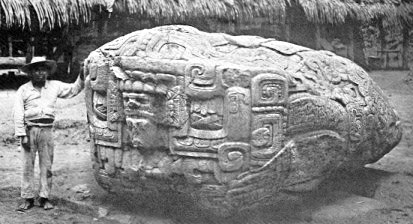
Quirigua Archeological Park in Izabel, Guatemala was abandoned around the 10th century. The rulers of Quirigua's rulers were rich beyond imagination on the areas natural resources, the most lucrative being jade. The earliest of the ruins date back to 550, although archeologists believe the site was inhabited before that time.

Quirigua's stonework shares many of the same characteristics as the Copan Ruins in Honduras. The civilization was much smaller, and therefore considered less important in the Mayan world.It wasn't until the ruler of Quirigua captured Copan's leader, that Quirigua earned its independence. The civilization of Copan at that time lost all dominance over Quirigua.

The site itself wasn't rediscovered by Europeans until the 18th century.  By the 20th century, however, the United States-owned the United Fruit Company. As a result, the ruins, including the world's best pre-Columbian stelae, are surrounded by fruit plantations.

There are nine ornately carved stelae, the tallest being 36 feet high. Nearby, there is a ruined pyramid and several stone carvings. Like many pre-Columbian sites, there are altars and stelae decorated with images portraying humans with unusual features and several different species of animals. Oddly, Quirigua is most famous for its zoomorphs, which are depictions of creatures that are half man and half animal.


Click on the images to see the civilization of Copan in Honduras.

Picture Sources

Tuesday, December 29, 2009

Xcaret Theme Park in The Riviera Maya


Xcaret Theme Park is a unique and interesting underground geological formation that includes pools, lagoons, fresh water sink holes, and let’s not forget, a beach to bask in the sun and rest your tired body after a long snorkel through the crystal clean waters of the Riviera Maya.

The soft currents make for an easy swim through the caves so you don’t have to worry about being an avid snorkeler or diver. Along the way, you’ll observe prehistoric marine fossils on the cavern walls as well as stalagmites and stalactites. At the tops of the limestone cavern there are small sky light openings that allow for an ample amount of light to guide you along your journey. The entire underground river adventure takes approximately 20 minutes, however in some cases; it can feel a bit longer. If you feel yourself getting tired there are many exit areas to rest so you can catch your bearings before continuing down the river.

Read more about Xcaret Theme Park in The Riviera Maya

Monday, July 20, 2009

Monday Ground Up: Mayan Civilizations-the Evolution


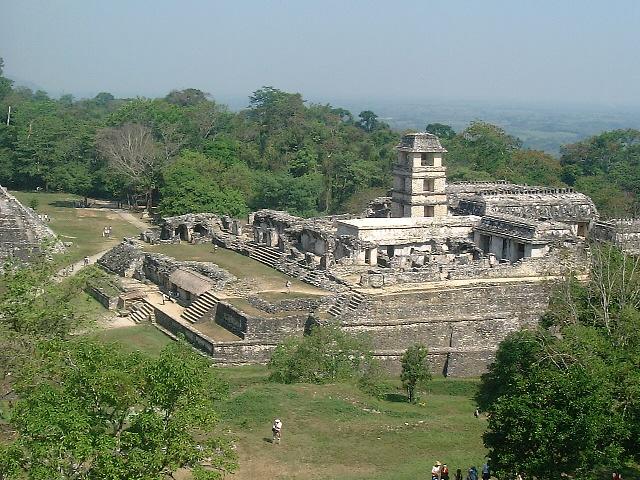
The ruins of Palenque.

The Mayan culture may just be one of the most dynamic representations of rich cultural heritage the world has ever seen. With the civilization came invention, and although advances such as writing, epigraphy, and the calendar did not originate with the Maya, their civilization fully developed them.

The customs maintained are a result of the unification of pre-Columbian and post-Conquest philosophies-structured by the almost total adoption of Roman Catholicism.

According to "accepted history" the first “Maya” settlements were established in around 1800 BC in the Soconusco region of the Pacific Coast. This point in time, known as the Early Preclassic, was characterized by sedentary communities and the introduction of pottery and fired clay figurines.


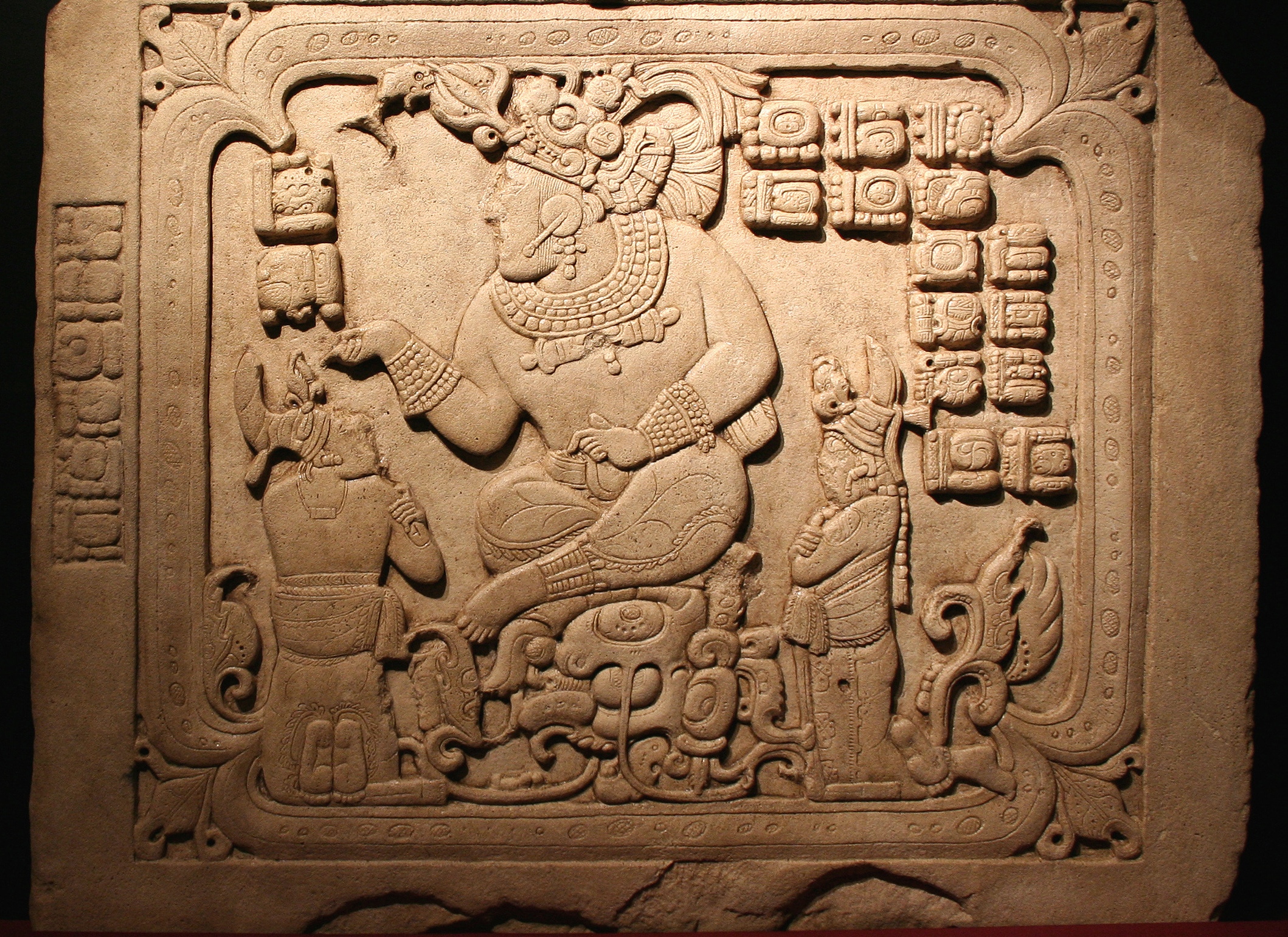
Panel from Cancuén portraying the ruler T’ah 'ak' Cha’an.


During the Classic period, the most monumental of creations took life in the form of stepped pyramids. The Mayan's built pyramids in their religious centers and the accompanying palaces of their rulers. The palace at Cancuen is the largest in the Maya area, though the site lacks pyramids.


The Collapse of Mayan Civilization


The end of the Mayan civilization is arguably one of the most researched collapses in archaeological history. During the 8th and 9th centuries, the surrounding areas were abandoned due to over population, drought, disease, and war.

Ecological hypotheses include environmental disaster, epidemic disease, and climate change. There is evidence that the Maya population surpassed carrying capacity of the environment including exhaustion of agricultural potential and overhunting of megafauna.[3] Some scholars have recently theorized that an intense 200 year drought led to the collapse of Maya civilization.[4] The drought theory originated from research performed by physical scientists studying lake beds,[5] ancient pollen, and other data, not from the archaeological community.

Related Articles

shares his incredible experience in Peru, where romance blossomed in an ancient civilization.

When I heard about the program I was kind of skeptical of my chances. I had never been to Peru. But the grant specifically called for a professor of Archeology willing to teach a course in Ancient Incan construction and then it culminated in a month long work program where the professor and students would act as tour guides and have access for academic study to all parts of the glorious city. More about Machu Picchu


Athena Goodlight from Rizal, Philippines, takes us on an amazingly picturesque journey through the country side. A perspective from an open mind and appreciative traveler.

Athena
presents Exploring the Wonders of the Maya Route posted at trifter, saying, "Stretching from Southern Mexico into Belize and Guatemala, the Maya Route is a region where you can scale jungle-entwined temples by day, then dress up for a sparkling night on the town in seaside resorts or charming cities."
Athena presents Why the Ancient Mayan Culture is So Mesmerizing posted at Trifter, saying, "What makes the ancient Maya culture so mesmerizing today? For some, it’s the beauty: From the graceful pyramids of Palenque, in Mexico, to Guatemala’s Tikal, rising above a green canopy of rain forest, the Maya left behind a stunning artistic architectural legacy."

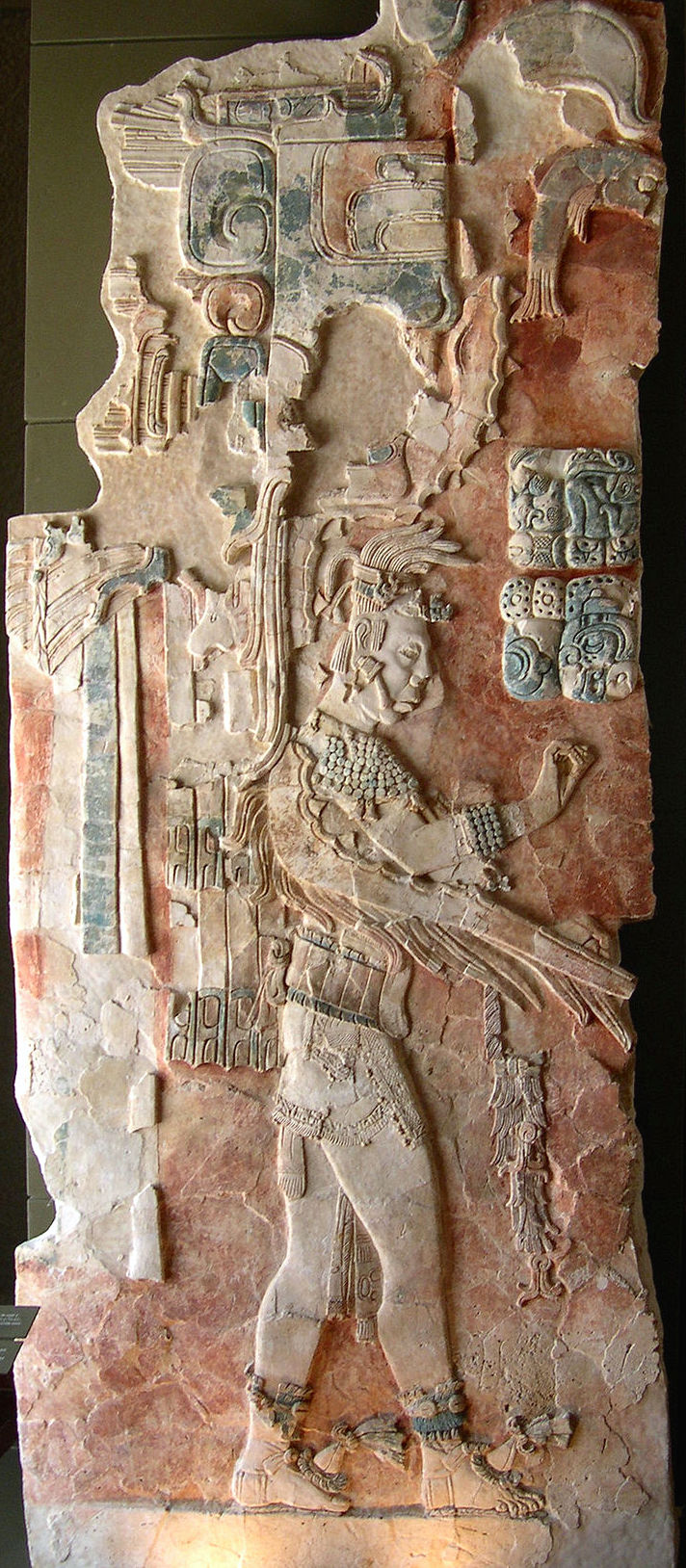
A stucco relief from Palenque depicting Upakal K'inich.


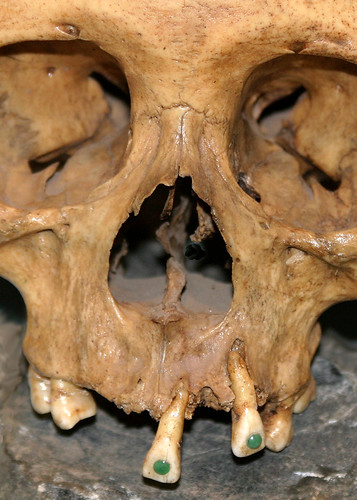
This is on display at the Jade Museum in Antigua, Guatemala. Today, some Mayans decorate their teeth with gold inlays, hundreds of years ago they seem to have used jade. By DavidDennisPhotos.com

Jade Mayan Mask


A jade mask that metaphorically represents the Rain God Chaac, and the Creator God Kukulkan.


A Middle Preclassic palace structure at Nakbé, the Mirador Basin.

Tulum


Tulum is just across the water from Cozumel, Mexico. Postcard type photo...
HDR. Gauss on a bit. Comes across as one of those old colored BW postcards. by joiseyshowaa

Pyramid of Kukulcan


View from the Great Ball Court towards the Pyramid of Kukulcan (El Castillo) and the Temple of the Warriors (to the left). By the time I took this photo there were ever-growing hordes of visitors that made taking a clean shot difficult. In this photo I was able to use this Mayan wall (bottom foreground) to shield out all the gringos. by Rob Shenk

Mayan House


This is a photo of a Mayan house. Most of it's walls have fallen down but you can still see the front stops. Most houses in the Mayan culture look similar to this. By amber.kennedy


National Geographic: Palenque Prized for Unlocking Maya Mysteries

The first published account of this lost city was in 1567, from a Spaniard, Father Pedro Lorenzo de la Nada.Exploring near the Usumacinta River, located in the modern Mexican state of Chiapas, Lorenzo came upon its stone temples and plazas, originally decorated with blue- and red-painted stucco but by then long abandoned by the Maya who built it. Lorenzo gave the grand structure the name Palenque, a Spanish word meaning "fortification."
Read More

By Kelly Hearn


Technorati tags: , .

References
  1. Drew (2004), p.6.
  2. Coe, Michael D. (2002). The Maya (6th ed.). Thames & Hudson. pp. 47.
  3. University of Florida study: Maya politics likely played role in ancient large-game decline, Nov. 2007
  4. Gill, R. (2000). The Great Maya Droughts. Albuquerque: University of New Mexico Press. ISBN 0826321941.
  5. Hodell, David A.; Curtis, Jason H.; Brenner, Mark (1995). "Possible role of climate in the collapse of Classic Maya civilization". Nature 375 (6530): 391–394. doi:10.1038/375391a0.
Edited by Ancient Digger

Like Ancient Digger? Why Not Follow Us?


Subscribe Via RSS Feed Follow Ancient Digger on Facebook Follow Ancient Digger on Twitter Subscribe to Ancient Digger Via Email

Get widget

Search


Ancient Digger Archaeology Copyright © 2015 LKart Theme is Designed by Lasantha