• Ancient Digger teaches Archaeology and History to all Ages!

Saturday, April 2, 2016

The Greeks: Agamemnon to Alexander the Great Exhibit at Field Museum


The most comprehensive exhibition of Greek art and artifacts ever to tour outside Greece opened at the Field Museum of Chicago on November 25. This highly recommended show will be on view until April 10. From Chicago, it will move to the National Geographic Museum in Washington, D.C. and be on display from May 26 through October 9.

The Greeks were a diverse group of peoples inhabiting mainland Greece and the Greek islands, and, in ancient times, the coast of what is now Turkey. They shared a common language and religion, and many of the same political institutions.

Over the course of the several millennia of their ascendancy, the Greeks passed through a variety of social formations: from early class societies on the basis of the “Neolithic Revolution” in agriculture that began some 10,000 years ago in western Asia to the societies, based to a large degree on slave labor, which provided the material basis for a flowering of Greek culture and politics.

“Classical beauty,” wrote Hegel in his Aesthetics, “with its infinite range of content, material, and form is the gift vouchsafed to the Greek people, and we must honour this people for having produced art in its supreme vitality.”

The Greeks is organized by the Canadian Museum of History and the Hellenic Ministry of Culture and Sports in partnership with National Geographic Society and The Field Museum. The exhibition is co-presented in Chicago by The Field Museum and the National Hellenic Museum. The exhibition is developed by the Hellenic Republic – Ministry of Culture and Sports – Directorate General of Antiquities and Cultural Heritage (Athens, Greece), The Field Museum (Chicago, USA), the Canadian Museum of History (Gatineau, Canada), the National Geographic Museum (Washington, DC, USA) and Pointe-à-Callière, Montréal Archeology and History Complex (Montréal, Canada).

The Field Museum gratefully acknowledges the support of the Chicago Park District on behalf of the people of Chicago.

Check out the full story on World Socialist  and the exhibit on the Field Museum website.

Monday, November 7, 2011

History 101: Herodotus’ Account of Greek Victory Over The Persians


Greek culture, society, and politics were a measure of Greek identity. The idea was, essentially, that Herodotus wrote his historical account from the view of a Greek citizen, therefore his biased account embraced the idea that all non-Greeks were inferior. Herodotus’ concept of the Greek’s view of Persians served as a model from which the Greeks could assess their own society. Greek victory over the Persians symbolized the bravery and the supremacy of Greek society over the sand dwelling Persians, therefore reinforcing their concept of cultural identity and political excellence. Herodotus’ depiction of the Greeks as a community of peoples, clinging to their identity, culture, and politics created on the basis of equality, was the perspective we are presented in order to understand the Persian defeat by a more simple minded people.

The Persian Wars, according to the Histories of Herodotus, were significant to the Greeks because they preserved Greek identity. In Book One of Herodotus, a Lydian named Sandanis gives Croesus advice, prior to his campaign into Cappadocia where he would destroy Cyrus. Sandanis explains that these men who where leather don’t eat what they want, but what they have. They don’t use wine, but are water drinkers, and they don’t have exotic fruits to nibble on such as figs . Essentially, the Persians are seen as having nothing, so defeating them in battle will not result in any spoils. This contrived image of Greek superiority reigns throughout Herodotus, and when the Persians were defeated, the image of what a non-Greek represented, was destroyed.

It’s true. The Persians were poor prior to the Lydian invasion, so in affect, Herodotus’ view of their efforts against the Greeks may have been different if their economic status had not changed. Since Persian wealth and luxury were used as a characterization of the barbarians, it’s of no consequence that Herodotus viewed their acquisition of an empire, along with the immense wealth and foreign luxury that this brought them, as an erosion of their former toughness and it made them soft. “Just as Cyrus had been defeated by the Massagetae and Darius by the Scythians, the Persians were once again worsted by a hardier and simpler people.”

In the case of warfare, Grecian hoplites were armed with long spears fitted with iron tips, which were significantly longer than Persian spears, and a sword. The heavy armour consisted of a bronze breastplate, helmet with plume and opening in the center, and a shield measuring one meter across. Essentially the longer spears made them superior in hand-to-hand combat. Yet, this was the first time the Athenians warriors encountered the Median garb and the men who wore it. Herodotus says that the Persians borrowed the attire of the Medes because it was more beautiful than their own . Later on Aristagoras of Miletus ridicules men who fought
'wearing trousers and turbans'; and at Plataea it is their clothing that causes them the most harm and which the Greeks totally disregard as booty once the battle is over . Even considering the Persian’s fanciful garments, confidence in numbers, and their belief that most inferior peoples are the ones who live the farthest from them, they still essentially failed at Marathon.

The historical account of the Battle of Marathon may be entirely different than what Herodotus had proposed. Since the Greeks relied heavily on the opinions of the gods, it’s of no surprise that Herodotus hints at their involvement, or rather their assistance, at defeating the Persians. Herodotus states “if the gods be but impartial, that either the enemy shall not attack you at all, or, if they do, shall be greatly to their own detriment.” Interestingly enough, after this statement, Philippedes has a vision. Philippedes has met Pan on Mount Parthenium where Pan shouts to him, “Why do you pay no heed to Pan, who is a good friend to the people of Athens, has been many time serviceable to you, and will be so again?” Till then the Greeks were terrified even to hear the names of the Medes, but Philippedes vision may have prevented panic among the Athenians, allowing them to move forward through the sea of Persian arrows at Marathon.

Herodotus’ criterion of a historical cause of the Greek’s triumph during the Persian wars is primarily political. Herodotus’ culturally biased depiction of Persian politics reinforces the Greek’s lack of knowledge of Persian society. What they did know was that a non-Greek system of politics, or a non-democratic government, was far inferior to their political organization. Herodotus explains that the monarchy, an ideal championed by Persian powers, and represented by Darius, was by far less predominate than Greek democracy . In Herodotus, democracy represented freedom and a monarchy represented slavery. The idea put forth by Herodotus was that when all of the democratic city-states united against invaders from a Persian monarchy, they would prevail.

Finally, according to Herodotus the Greeks had more motivation. Flowers explains that Herodotus was not entirely uninformed of the biases of his own culture, and even if he were the plot line demanded that the Greeks be the defenders of liberty against Persian aggression. This essentially explains why the fault, or lines of historical causation, runs though the Histories of Herodotus . Persian kings may have sought retribution for the capture of Sardis by Athenian and Eretrian forces and the Greeks were determined to defend their homeland because they were inherently tied to equality. Regardless of motivations of both sides, Herodotus attributed the Greek victory to virtue. Their meek and unpretentious existence was entirely relative to the Persians, who were dripping in riches. In Book 8.26 of Herodorus’ Histories, the Arcadians explain that the Greeks are at present celebrating the Olympic games. Tigranes burst out with the words words, “What, Mardonius! What sort of men have you led us to fight against, who contend, not for money, put purely for the sake of excellence?” Clearly, it was part of the Greek’s strength, Herodotus believed, to be victorious in battle because of their wisdom, laws and customs. Ideas in which were foreign in the eyes of the Persians, concerned with the spoils of war and their own personal ideals of wealth.

Herodotus, often called the “Father of History”, appears to have drawn on the Ionian tradition of story telling to write the action filled trials of the Persian wars. The stories contain folk like stories of action and adventure and war and politics, but even so, there’s a substantial amount of facts relating to geography, anthropology and history, all compiled by Herodotus in an entertaining style and format . The Greek cities, according to Herodotus, refused to bow down before the barbarians. The Greeks were skillful in battle and resourceful and they utilized their relationship with the gods to defeat the enemy. One might say the armies of Persia and Greek were equally matched and either side could have prevailed, but Herodotus clearly represents the Greeks as undefeatable.

Also check out:


Resources

  1. Grene, David. Herodotus: The Histories. Chicago: University of Chicago Press, 1987.
  2. Flowers, Michael. Herodotus and Persia. The Cambridge Companion to Herodotus. Edited by Carolyn Dewald and John Marincola . New York: Cambridge University Press, 2006.
  3. Murray, Oswyn, J.Boardman, J.Griffin. The Oxford History of the Classical World. New York: Oxford University Press, 1986.


Wednesday, October 19, 2011

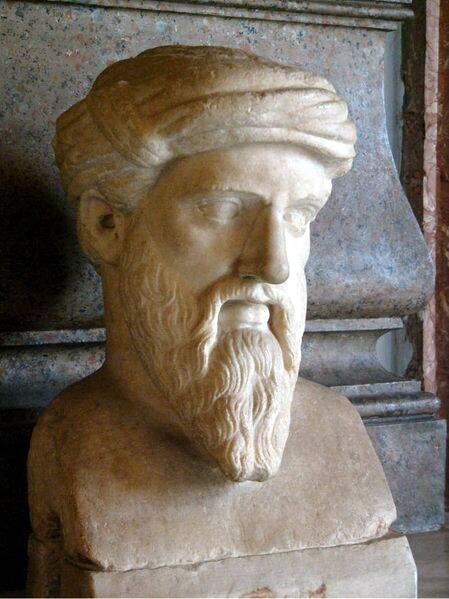
Greek Week: Who Was Pythagoras?


Pythagoras was born on the island of Samos in 580 BCE. At the age of fifty, he left the island and settled in southern Italy. He formed a religious community known as the Pythagoreans, who were a pious and moral people living by strict rules governing every aspect of life. He believed in the process of transmigration. The soul was eternal and recycled, thus it entered another human, animal, or even a plant . There was great order in what Pythagoras believed and studied. He posited that the universe is organized by diabolically opposing pairs like odd and even, good and evil, day and night, statics and dynamics, and even male and female. In the case of male and female, however, the female principle (matter) is evil, whereas the male principle (form) is good .

A. N. Whitehead has described Pythagoras as “the first theorist to look at the function of mathematical ideas in abstract thought. Pythagoras focused on the generalities in reasoning, and he divined the importance of numbers as an aid to the conditions involved in the order of nature” . Pythagoras also believed that the essence of the universe could be found in music. He experimented with the lyre and noticed that different string lengths resulted in different pitches of sound. Additionally, he was deeply influenced by the Pythagorean’ principle of justice, which they regarded as the basis of all virtue.

Monday, July 27, 2009

Monday Ground Up: Greek Architecture


Initially, there was a borrowing of Asian ideals which evoked structures that were both wholly and represented simplicity; moreover, the specific design spread from Sicily to India, making the Greeks cultural exporters.


The Gift of Geology

The Greeks were gifted, being situated in an area with the highest quality stone. Of course the buildings that were derived from these stones were free of bronzed sculptures, polished monuments, and shrines painted with vivid colors.

The simplicity and austerity is what sets these structures apart today, being worshiped as magnificent relics of history.

Over time, weathering has stripped away stone, allowing for the beauty of form to be unrivaled, still standing vividly among the superficial experience of modern building.

What we do know is that the artistic greatness and skill that outlined these massive feats can never be replicated, although many have tried.


The Colony of Carthage


Compliments of Livius.org

The Colony of Carthage is located in Tunisia and was founded by Phoenicians in 817 BCE. The colony competed against other Greek colonies, some of which became Carthaginian strongholds. It was later raised by the Romans in 2 BCE. The ruins are all that remain.


Parthenon


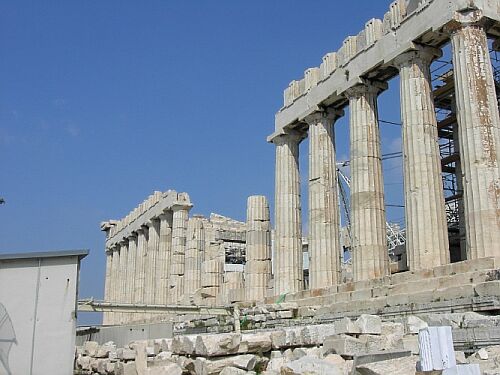
The Parthenon was constructed from 447 to 432 BE. The left proplylaea entrance to the acropolis was added by Mnesikles from 437 to 432 BCE. The Parthenon is the most important surviving building of Classical Greece, generally considered to be the culmination of the development of the Doric order.  


The Doric order was three orders or organizational systems of Ancient Greek or classical architecture; the other two canonical orders were the Ionic and the Corinthian.


Temple of Athena Nike


by Serendigity

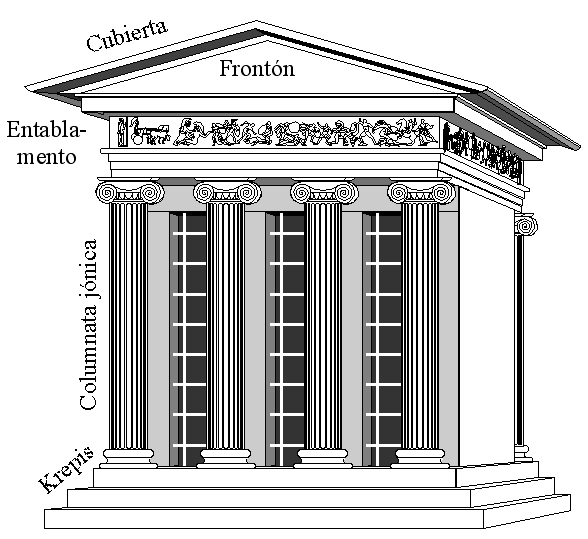
The Temple of Athena Nike is located in front of the proplylaea, tiny in comparison to the Acropolis. Citizens worshiped the goddess in hope of a prosperous outcome in the war against the Spartans and their allies. 


The Temple of Athena Nike was an expression of Athens' ambition to be the leading Greek city state in the Peloponnese.

Temple of Apollo Delphi


The ruins, as well as the foundation , are located in Delphi. The altar was originally in front of the "restored columns". The Great God of Apollo, a deity who lived there and protected the navel of the Earth, was consulted within. 


His sacred precinct in Delphi was a panhellenic sanctuary, where every four years athletes from all over the Greek world competed in the Pythian Games, one of the four panhellenic (or stephanitic) games, precursors to the Modern Olympics.


Acrocorinth


Acrocorinth is by far the best example of Greek Military architecture. This structure was built when the demise of the Polis suggested that outer defenses were necessary. Connection to the city of Corinth, as well as long walls, were added in 4th century BCE.


Sanctuary of Pergamum


Pergamum was the main sanctuary dedicated to Asclepius, the Greek god that healed the sick. People with health problems could bathe in the water of the sacred spring, and in the patients' dreams Asclepius would appear in a vision to tell them how to cure their illness.


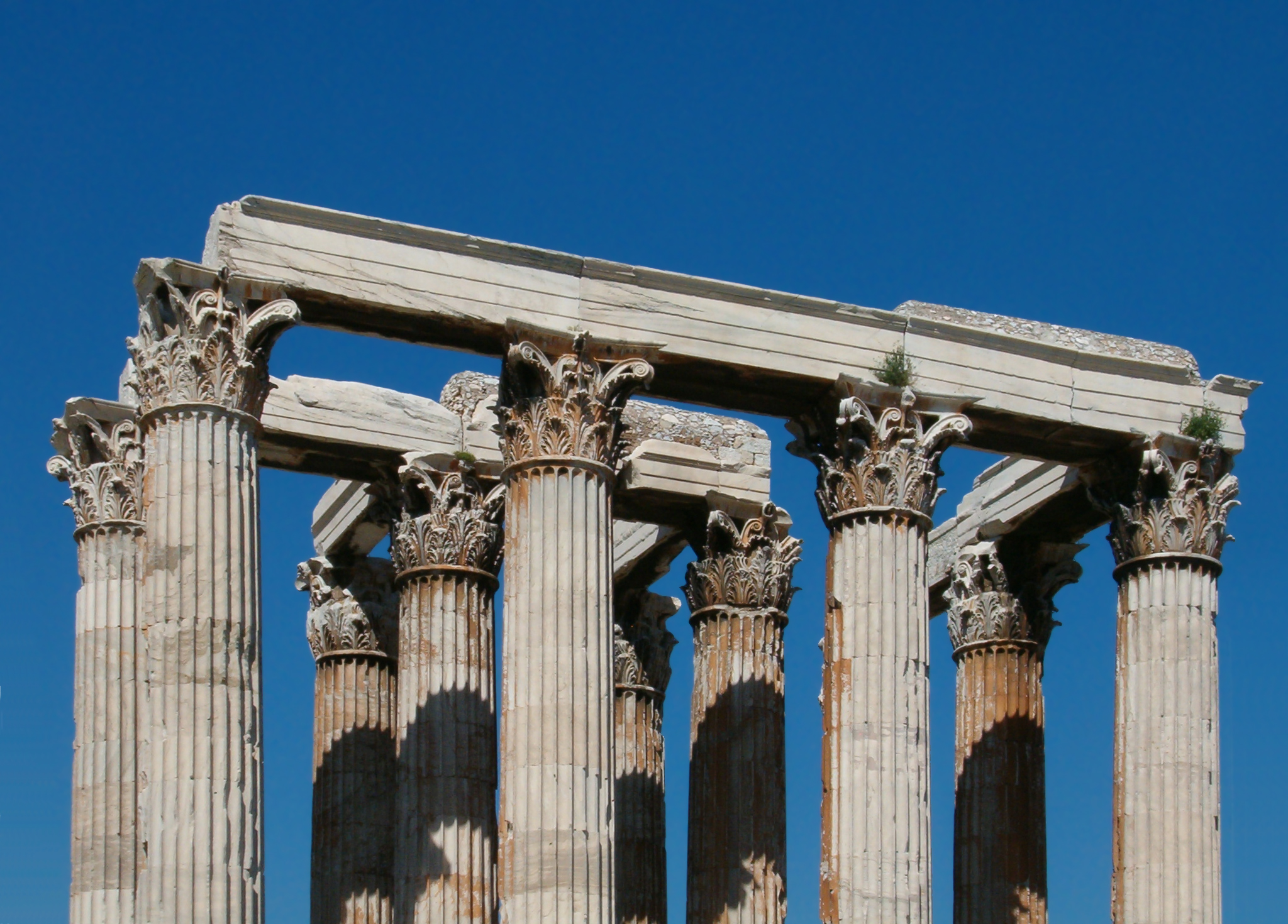
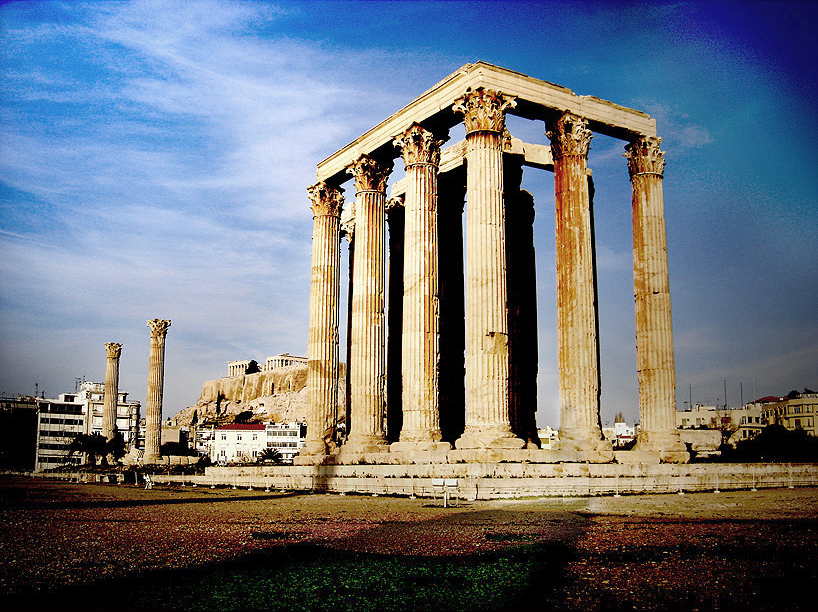
Temple of Olympian Zeus


The temple was started in 174 BCE and completed under Hadrian in 2nd century CE. This temple originally had 8 columns on the facade, three rows deep and 20 columns on each side.

Resources


Roberts, J. (2004). Ancient History: From the First Civilizations to the Renaissance. Oxford University Press.

Saturday, March 14, 2009

Greek Statues: The Classic Forms of Kourous, Kritios Boy, and Discobolus


Susan Parker has written a comparative discussion of three famous Greek statues, providing not only beauty, but insight into the culture of the time in which they were created.Thousands of years after they were carved and fashioned, careful attention to the figures of ancient Greek statues continue to provide clues about the culture existent during the time period of their creation.

Three particular works of art, “Kouros”, “Kritios Boy” and “Discobolos”, believed to have been carved over a time span of approximately 150 years, give an indication of changes in not only the skills of artisans, but also the values of the societies for which the artworks were created.

Like Ancient Digger? Why Not Follow Us?


Subscribe Via RSS Feed Follow Ancient Digger on Facebook Follow Ancient Digger on Twitter Subscribe to Ancient Digger Via Email

Get widget

Search


Ancient Digger Archaeology Copyright © 2015 LKart Theme is Designed by Lasantha