Hunter Gatherers: Brief Beginning
 Hunter Gatherers
 are traditionally described as being highly nomadic individuals that traveled with very few possessions in a marginal environment. Of course, the factors of the environment directly influenced the ability to be mobile. However, up until the Last Age, we can agree hunter gatherers were highly mobile.
Subsistence
Hunter gatherers were either practicing a
specialized or generalized subsistence system. In case you don’t know the difference, specialized diets depended on one or a small number of resources, an example being corn or acorns. Generalized diets consisted of any resources available. Both approaches were efficient depending on resources readily available.
Formation of Complex Society
Hunter gather societies were egalitarian, with very limited authority or inequality, others were highly unequal. For instance, slavery was a historically-documented practice of some Northwest Coast and Alaskan hunter-gatherers.
Technologies of Hunter Gatherers
Hunter gatherers are responsible for some of the most widely known technologies, those being ceramics, fired pottery, and domesticated dogs and plants.
Domestication
Complex societies are directly affected by their agricultural subsistence systems, and highly complex societies always rely on domesticated plants and animals.
New World chronologies of domesticated species are poorly understood. The dating problems are due in part to the humid environments of Mesoamerica, where preservation is generally poor compared to the arid Levant. In addition, New World research is at least a generation “younger” than Old World research on domestication. Scholarly attention on plant domestication in the New World did not begin until the 1960s, compared with the 1940s in Southwest Asia.
[1]
Domestication occurred all over the world, with no animals to speak of in the Americas, major reliance on domesticated animals and highly productive grasses in the Old World, and
tubers, legumes, and fruits in much of the Americas.
Hunter Gathering During the Pleistocene
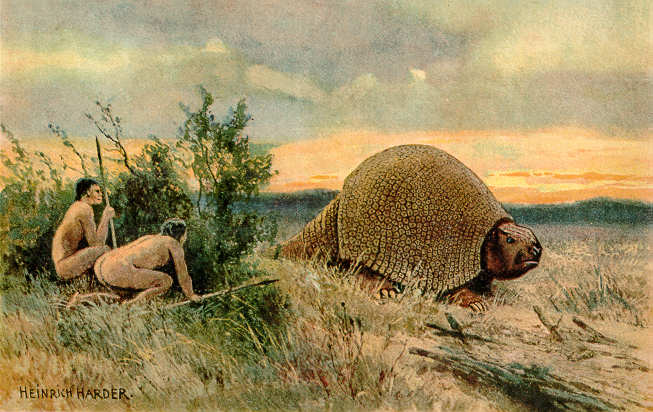 During the Pleistocene most of the world’s water was locked in ice
. Globally, the climate was windier and dryer even nearest to the ice sheets. Hunter gatherers saw the first flora and fauna communities with the climatic shift.
Tropical forests like the Amazon or in Florida were once savannah environments, with spaced trees and shrubs in an open grassland. Even with the abundance of plant life, hunter gathers still preferred meat, as it provided them the most calories with the lest energy output.
Tropical forest hunter gathers had to work much harder than hunter gathers in other environments. Why? Although there was an abundance of plant resources in tropical forests, the plants were scattered, thus taking more time to collect what was needed.
Hunting was just as difficult. Tropical forests yielded smaller species of animals, and usually they were found in the trees due to the lack of ground cover. Hunter gatherers would exert much more energy traveling longer distances to procure plant and animal stuffs as opposed to hunter gatherers living on the savannah.
For example, the tropical Americas had an abundance of large terrestrial animals on the savannah. There’s no evidence for Pleistocene occupations of tropical forest environments.
Most archaeologists now believe that Pleistocene Americans were specialists who emphasized the hunting of terrestrial herd animals like horses, mammoths, and giant bison. This is not to say that early Americans did not eat smaller mammals and plants, but that their lifeway and technology were focused on acquiring an abundant meat resource.[
1]
Temperature Changes in the Pleistocene Tropics
Roughly 20,000 years ago global warming caused a shift in ocean currents, wind patterns, and rainfall. Forests started to expand as well as the plant resources already growing there. Large terrestrial animals started to die out. Hunter gatherers had to adjust their techniques of gathering resources. Specialized communities turned towards a more generalized subsistence system in order to survive.
Hunter-gatherers all over the world made this transition in the early Holocene; it is sometimes called the “broad-spectrum revolution.”
Horticulture to Agriculture
There’s been a debate about the transition to agriculture. Some assume agriculture happened at the exact same time all over the world and others hardly agree with this coincidence.
Archaeologically there was a disappearance of spear heads for hunting and an appearance of grinding technologies. Slash and burn like methods were used to clear forests to encourage the growth of fruits and tubers. Areas were manipulated to create islands of plant resources which hunter gathers returned to periodically to take advantage of the foods growing there.
Over time, individuals spent much more time near the garden plots and started to build semi and permanent settlements nearby. Wild foods started to grow and manipulated plants started to become more dependent on human intervention (ie squashes, sweet potatoes, and several kinds of fruit tree).
Hunter gatherers eventually decreased their mobility and started settling near rivers where they domesticated wild plants and fished. They practiced
swidden agriculture; a temporary agricultural plot formed by cutting back and burning off vegetative cover. Forest farmers’ fields could only be used for a few seasons before it was necessary to move to a new plot of land.
Almost all explanations for the shift from hunting-gathering to farming rely on climate change in some way, even
Childe's Oasis Hypothesis.
The Oasis Theory (or Propinquity Theory) is a core concept in archaeology, referring to one of the main hypotheses about the origins of agriculture. First put forward by V.G. Childe in his 1928 book, "The Most Ancient Near-East", the oasis theory argues that the reason people starting living in settlements was because during a dry spell, the only livable place was near oases. .
[4]
Agriculture developed in most temperate or sub-tropical parts of the world at the beginning of the Holocene, leading scholars to infer that climate change must have influenced the process.
If people living in many environments, with access to very different resources all began domesticating plants at about the same time, was agriculture inevitable? [1][3]
Modern Hunter gatherers - Tribe – BBC
The
Babongo of Gabon used to be known, derogatively, as pygmies. They're still treated as second-class citizens by their neighbours. But their expertise and knowledge of the forests is unique and their use of Iboga, a powerful hallucinogenic which lies at the heart of Babongo culture, makes them famous throughout Gabon.
Is global warming in some way responsible for the development of complex societies?
At the end of the late glacial conditions, as mentioned in the article
Was Agriculture Impossible during the Pleistocene but Mandatory during the Holocene? A Climate Change Hypothesis., agriculture was impossible. [
2]
However, following the conditions, plant intensive resource use was immediately utilized, leading me to believe an action forward approach was instigated by the hierarchical powers that be.
Since intense agriculture is a characteristic of complex societies, and agriculture is indeed sensitive to severe weather conditions, evolution like subsistence characteristic of complex systems could not take place during the Pleistocene. Consequently, in warmer and wetter conditions during the Holocene, evolution of agriculture was made easy, with due access to irrigation.
Population is set,
due to the environment and societies with the abilities to obtain resources to acquire and
maintain intensive subsistence strategies. Those having the key resources to outmaneuver the smaller societies with less intensive agricultural systems in place will out-compete the weaker of the two.
So was global warming in some way responsible? Evolution of subsistence systems in complex societies was relatively slow during the Pleistocene because of the impeding climatic conditions. However, glacial advances and retreats are not directly relevant to the origins of agriculture because population size grows faster and is able to adapt to cultural evolution. This is not to say global warming didn’t have any effect on complex societies.
Due to the extreme variations in climatic temperatures, evolution of plant use would have been extremely difficult. Consequently, hunting and farming communities would have been able to cope with catastrophic climate events. Complex systems seen within Pleistocene hunter gatherer societies didn’t rely on one resource and remained diversified in the event conservation had to take place.
Pleistocene America saw a rapid change in the environment when global warming altered rainfall amounts, wind, and ocean currents, thus leading to terrestrial animals dying out in masses. Americans were forced to adjust their lifestyles in order to survive. South Americans dealt with the climate change by becoming generalists, thus following all hunter gathers in what was called the “
broad spectrum revolution”.
In an essence, although global warming did cause ocean levels to rise resulting in less arid land, complex societies turned to alternative methods of subsistence.
If global warming can cause such incredible changes in human social organization, will the present era of global warming bring about equally massive changes in human society?

As the human population continues to grow, so does the addition of carbon, causing the Earth’s climate to warm further. As we’ve seen from history, life has found a way and survived even the harshest of climatic changes. However, there have been some major re-distributions of species and extinctions associated with this climate shift as well.
Most of the world’s population is concentrated in coaster cities, as opposed to small nomadic tribes, and if sea levels were to rise even a few meters, the geographic landscape would be completely altered, and many cases, destroyed.
Years ago, if sea levels rose a few meters, it would have had very little effect. Consequently, such a sudden change in climate is hard to prepare for.
“Equally, it seems likely that as warming continues some areas may experience less precipitation leading to drought. With both rising seas and increasing drought, pressure for human migration could result on a large scale”.
[3]
Also check out:
For decades, anthropologists have debated “The Eve Theory” – the theory that world cultures migrated and evolved from a single source – Eve, a reference to Adam and Eve mentioned in the Bible’s
Book of Genesis as the first man and woman and the progenitors of all human life.
Sources
- Dr. Sarah Barber. UCF. Anthropology of Complex Societies
- Robert Boyd, Robert L. Bettinger, Peter J. Richerson
2001 Was Agriculture Impossible during the Pleistocene but Mandatory during the Holocene? A Climate Change Hypothesis. American Antiquity Vol. 66, No. 3, 2001j, pp. 387-411. Society of American Archaeology.
- "Climate change: evidence from the geological record ." The Geological Society. The Geological Society of London , November 2010. Web. 30 Jan 2011.
- Oasis Theory
- Picture Cro Magnon
- Hunter Gatherer picture
- Global Warming GIF


