• Ancient Digger teaches Archaeology and History to all Ages!

Monday, May 16, 2016

Field School Opportunity: Jersey, Channel Islands on Ice Age Island


Morning Ancient Diggers. I was contacted about a wonderful opportunity for those of you interested in digs pertaining to prehistory. The archaeological fieldschool in Jersey, Channel Islands is located at Les Varines, a Magdalenian settlement site approximately 15,000 years old. To date, the site has yielded over 5,000 stone artefacts, preserved animal bone, paved areas and, most exceptionally, engraved stones which have recently gained international media coverage and was featured in BBC2’s Digging for Britain.

© Jersey Heritage
This year the field school is available to students from external universities. They have five placements available for the 2016 season, and the deadline is right around the corner, May 25th.

Accommodation is camping but there are modern, clean, indoor WC/showering facilities, dining and socialising spaces. Meals are catered for by their project cook and pick up/ delivery to the airport is included. The total fee is $1,450* (excluding travel costs) covering two weeks of time.

If you are interested in joining the dig on Ice Age Island this summer, please send a brief email providing a bit of information about yourself, your relevant interest/experience and/or a CV to:

Dr Matt Pope (UCL Institute of Archaeology) email: m.pope@ucl.ac.uk.

In your email please specify whether you are interested in Field Season 1 (July 10 – July 23) or Field Season 2 (July 24th – August 6th) or whether you are able to do both.

The application deadline is June 25, 2016).

For more information or to sign up, visit the Project Page for La Mancha Prehistoric

Thursday, June 6, 2013

40 Years of Discovery: Cotsen Institute of Archaeology at UCLA


From humble beginnings in 1973, the Institute has grown to one of the world's largest consortia of working archaeologists, including some 30 UCLA professors from 11 different disciplines who work alongside roughly 60 research associates affiliated with nearby colleges and universities.

In 1998, Lloyd Cotsen, a successful businessman who had fallen in love with Greek archaeology as a graduate student in the 1950s, endowed the institute with a $7 million gift.

An additional $10 million gift pledged in 2006 by Cotsen gave the institute the largest de facto endowment in the world for the study of archaeology.

In its latest survey, the prestigious National Research Council ranked the Cotsen's affiliated Archaeology Program first in the nation among doctoral programs in the field.

Learn more about the Cotsen Institute and its achievements: http://ucla.in/13Juaq3.

Thursday, February 7, 2013

4 Mesoamerican Digs for 2013


With the hype of 2012 and bad interpretations of Mayan dating techniques finally behind us, it's time to get down to the real work that is archaeology in Mesoamerica, allowing us to better understand the real history of the Mayans, Incas, and Aztecs in that part of the world.

From exciting sites that offer a glimpse of the relatively simple lives lead by America's ancient peoples, to the honor of finding yourself in the midst of of large and magnificent ruins, volunteer opportunities abound where South and Central American archaeological digs are concerned. Here is a look at four of the prime volunteer and student-friendly Mesoamerican digs that will be taking place in 2013:

1. Belize Valley Archaeological Projects

Over two sessions that will take place in June and August of 2013, the Belize Valley Archaeological Reconnaissance Project will be conducting work at the site known as Baking Pot, an area rich in camping remains, and playing host to two groups of monumental architecture.

This summer's research will focus narrowly on one area in particular: the monumental center at a palace complex known to those working at the site as Group B. Those on site will be working towards clearing sections of the structures and courtyards in an effort to uncover new artifacts and develop a more thorough understanding of the chronology and heritage of the site.

And those who strive for more fun than ancient civilizations offer, can use car rental services of companies like Cheapcarrental.net and dig for a little more action at Mexico's world renown resorts such as Cancun, which is less than 300 miles away from Belize!

2. Blue Creek Project

If the past few years of silliness surrounding the Mayan people and their dating methods have lead you to a natural curiosity about the facts behind their works and lives, the Maya Research Program and its Blue Creek Project is the place for you.

For the 21st year in a row, this American group will sponsor extensive fieldwork at the Mayan site called Blue Creek, located in northwestern Belize, offering everyone involved the opportunity to discover the fascinating reality of Mayan existence.

The project will be open to students and non-students alike, and experience - or lack thereof - is not a concern in the application process. With academic credit and even scholarships available, this project is well-worth checking out for anyone with a working interest in archaeology.

3. Oaxaca, Mexico

For the third straight year, Indiana University will be playing host to anthropology faculty members, students, and outside volunteers for their field program based in Oaxaca, Mexico. With a focus on archaeology that often finds itself embracing modern anthropology, this course will introduce students to the wide range of diversity in this region, ranging from the ancient Maya to the current inhabitants.

While some of the course's planned activity will involve active time at dig sites, you'll also have the opportunity to attend local festivals and learn about the modern issues, both economic and ecological, facing Oaxaca's people.

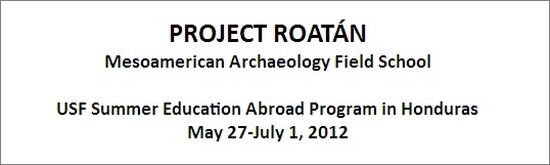
4. Project Roatan, Honduras

The University of South Florida is set to host a fantastic learning opportunity for burgeoning archaeologists with a passion for Mesoamerica with its Mesoamerican Archaeology Field School. Taking students on a five-week journey through the history of the pirates and puritans who dominated the Caribbean in the 16th and 17th centuries, the course will focus its attention on the excavation of the English and Pech settlements located at New Port Royal and Camp Bay Village.

Students attending this once-in-a-lifetime course will learn to use archaeological methods to answer the questions that face us in exploring the history of those who came before us, offering a strong base for any historian and archaeologist.

Guest Post Contributor: Jessie Troy

Friday, November 11, 2011

Archaeology Fieldwork Opportunity: Ancient Maya Site of Blue Creek


The Maya Research Program is a U.S.-based non-profit organization (501C3) that sponsors archaeological and ethnographic research in Middle America. Each summer since 1992, we have sponsored archaeological fieldwork at the ancient Maya site of Blue Creek in northwestern Belize. In 2012 we again offer opportunities to participate in our field program and learn about the Maya of the past and today.

The Blue Creek project is open to student and non-student participants, regardless of experience. The field school is certified by the Register of Professional Archaeologists and participants will receive training in archaeological field and laboratory techniques.

Academic credit and scholarships are available.
(http://www.mayaresearchprogram.org)

We invite students and volunteers to participate in the Maya Research
Program’s 21st year of our Blue Creek archaeological project in
Belize.

2012 Field Season Dates:
Session 1: Monday May 28 - Sunday June 10;
Session 2: Monday June 11 - Sunday June 24 ;
Session 3: Monday July 2 - Sunday July 15;
Session 4: Monday July 16 - Sunday July 29

For additional information please contact the Maya Research Program:
www.mayaresearchprogram.org
1910 East Southeast Loop 323 #296
Tyler, Texas 75701
817-831-9011
mrpinquiries@gmail.com

Tuesday, December 28, 2010

Odd Radioactive Readings At Bosnian Pyramids in the Ravne Tunnels


As innocent as the Bosnian Pyramids appear, something odd has appeared in radioactive readings. During the summer of 2010, more than 500 volunteers and 45 archaeologists from 30 countries embarked on one of the world's most impressive archaeological projects.

 The footage in this video takes you deep into the Ravne Tunnels. Some of the tunnels themselves are bizarre to say the least. Barely big enough for a child to slip through the hole. Who were the people taking refuge done here? How and what did they use to navigate this labyrinth of tunnels?

Friday, July 10, 2009

Field Work Opportunities, Jobs, and Summer School


Page in Progress-forgive the mess

Announcements: Field Schools 2015-2016


Archaeology Fieldwork By Country, Region, or Continent

Marine Archaeology Field Schools

Biblical Archaeology

REU Dig Sites

Archaeological Institute of America

Past Horizons World Projects

    Archaeology Education For Kids


    Short Courses @ About.com

    Miscellaneous Resources for Field School


    Like Ancient Digger? Why Not Follow Us?


    Subscribe Via RSS Feed Follow Ancient Digger on Facebook Follow Ancient Digger on Twitter Subscribe to Ancient Digger Via Email

    Get widget

    Search


    Ancient Digger Archaeology Copyright © 2015 LKart Theme is Designed by Lasantha