Ancient Egyptian jewelry represents a long history of divine craftsmanship by a people we continue to be intrigued by. Egyptian art and jewelry was never just art, but represented a deeper meaning, which even today baffles archaeologists.
The rarity and exquisite nature of Egyptian jewelry was not only reserved for women, but men as well. Both men and women wore the Ancient Egyptian jewelry, and these personal adornments were not just limited to beaded necklaces and finger rings.
Jewelry such as anklets, collars, bracelets, fillets and earrings embodied everyday Egyptian dress, so much so, that even in death the poorest of individuals would still be found wearing a string of beads or a simple bracelet.
Excavations and grave robbing in the Saqqara Necropolis has turned up loose beads and trinkets from the mass graves and tombs of the ancient Egyptians.
In fact, these loose beads are often picked up by local merchants and sold to gullible tourists.
The Ancient Egyptians wore the ornamental jewelry for many reasons, however the more fundamental reason and purpose was to guard them from mysterious hostile forces. For many of us, we sometimes require the assistance of a necklace with a teardrop crystal, a tiger’s eye, a rabbit’s foot, a hemp bracelet, or a type of precious stone to make us feel safe. The Ancient Egyptians did the same, only most of the adornments worn were crafted out of stone. Such talismans might consist of turquoise and lapis lazuli and carnelian, all representing a facet of nature such as the green of spring, the blue of the sky, or the orange or beige of the desert.

The use of gold in Ancient Egyptian Jewelry simply represented the flesh of the gods, the fire and glory of the sun, and the very idea that the luster of the gold was never lost, therefore an eternal sense of being.

The shells of fresh water sea life were used to craft bracelets and necklaces for both men and women. The cowrie shell, which has an indented lip, looks like the slit of an eye. Egyptians believed this shell to be a prophylactic against the evil eye. This belief is still head true in parts of Africa and the Mediterranean. In fact, in recent times the Nilotic women wear the cowrie shell around their pelvic area to risk aborting a child.

www.metmuseum.org
This is a Middle Kingdom Dynasty 12 Funerary Collar of Wah from the Early reign of Amenemhat I. According to the Metropolitan Museum of Art in New York City, Wah's faience broad collar (40.3.2), anklets and bracelets (40.3–.10) were made as funerary ornaments for the burial and were found in the layer of wrappings closest to the body. The broad collar is one of the finest examples of its type from the early Middle Kingdom. Although a few areas needed reinforcing with modern thread, the stringing is almost entirely original.

http://blog.ivman.com
This piece of Egyptian jewelry is from the tomb of Tut-ankh-amun (Tutankhamun).
A scarab of lapis lazuli with falcon wings, supporting a red disk of the new-born sun.
This piece of Ancient Egyptian jewelry is a rebus pectoral scarab worn by King Tut-ankh-amun from Thebes. It symbolizes the birth of the moon and the sun and was part of the king's coronation regalia.
This piece of Egyptian jewelry is a faience floral collar of the late XVIIIth Dynasty. This piece is typical of the Amarna Period and was made with cheaper materials including flowers, leaves, and ephemeral papyrus. Since they were less expensive and less time consuming to create, many times they were gifted to guests at parties, banquets, and weddings.
The crown of Sit-Hathor Yunet was used as a wig ornament and adorned with gold and inlaid gold with carnelian, lapis lazuli and green faience. The original piece sits in Cairo, along with the golden tubes that were woven into her hair.
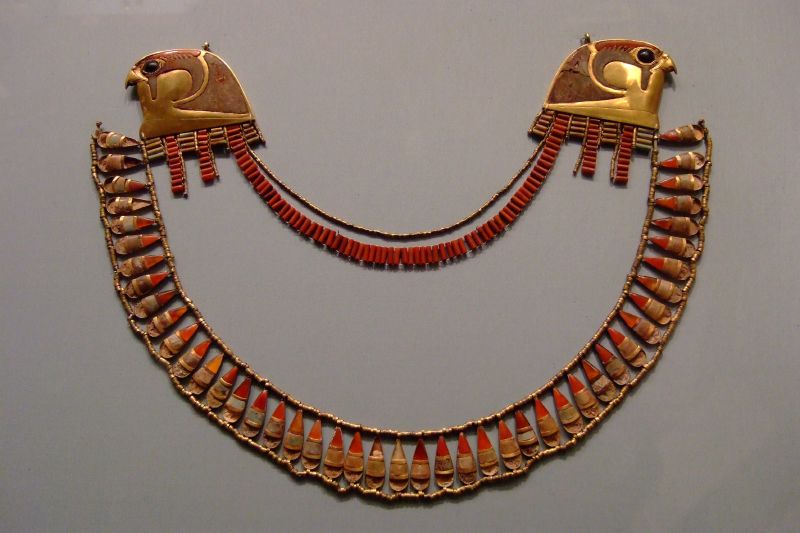
This is a Broad Collar from Dynasty 18 worn during the reign of Thutmose III 1479-1425 BCE. It is gold inlaid with carnelian glass, from the tomb of the three minor wives of Thutmose III, Thebes. The king's name is inscribed on the backs of the falcon-headed terminals indicating that it was a gift from him to his wife By the New Kingdom, broad collar necklaces were the most frequently worn pieces of jewelry among the royalty and elite in ancient Egypt (Met Museum, 2013)
Author Note: This article was published on a partner site Knoji several years ago by Ancient Digger, but I felt like it should have a place on this site as well. Enjoy!
The rarity and exquisite nature of Egyptian jewelry was not only reserved for women, but men as well. Both men and women wore the Ancient Egyptian jewelry, and these personal adornments were not just limited to beaded necklaces and finger rings.
Jewelry such as anklets, collars, bracelets, fillets and earrings embodied everyday Egyptian dress, so much so, that even in death the poorest of individuals would still be found wearing a string of beads or a simple bracelet.
Excavations and grave robbing in the Saqqara Necropolis has turned up loose beads and trinkets from the mass graves and tombs of the ancient Egyptians.
In fact, these loose beads are often picked up by local merchants and sold to gullible tourists.
Why the Ancient Egyptians Wore Jewelry?
The Ancient Egyptians wore the ornamental jewelry for many reasons, however the more fundamental reason and purpose was to guard them from mysterious hostile forces. For many of us, we sometimes require the assistance of a necklace with a teardrop crystal, a tiger’s eye, a rabbit’s foot, a hemp bracelet, or a type of precious stone to make us feel safe. The Ancient Egyptians did the same, only most of the adornments worn were crafted out of stone. Such talismans might consist of turquoise and lapis lazuli and carnelian, all representing a facet of nature such as the green of spring, the blue of the sky, or the orange or beige of the desert.
The Meaning of Gold in Ancient Egyptian Jewelry
The use of gold in Ancient Egyptian Jewelry simply represented the flesh of the gods, the fire and glory of the sun, and the very idea that the luster of the gold was never lost, therefore an eternal sense of being.
The Meaning of Shells in Ancient Egyptian Jewelry
The shells of fresh water sea life were used to craft bracelets and necklaces for both men and women. The cowrie shell, which has an indented lip, looks like the slit of an eye. Egyptians believed this shell to be a prophylactic against the evil eye. This belief is still head true in parts of Africa and the Mediterranean. In fact, in recent times the Nilotic women wear the cowrie shell around their pelvic area to risk aborting a child.
Funerary Collar of Wah
www.metmuseum.org
This is a Middle Kingdom Dynasty 12 Funerary Collar of Wah from the Early reign of Amenemhat I. According to the Metropolitan Museum of Art in New York City, Wah's faience broad collar (40.3.2), anklets and bracelets (40.3–.10) were made as funerary ornaments for the burial and were found in the layer of wrappings closest to the body. The broad collar is one of the finest examples of its type from the early Middle Kingdom. Although a few areas needed reinforcing with modern thread, the stringing is almost entirely original.
Tutankhamun's Scarab of Lapis Lazuli
http://blog.ivman.com
This piece of Egyptian jewelry is from the tomb of Tut-ankh-amun (Tutankhamun).
A scarab of lapis lazuli with falcon wings, supporting a red disk of the new-born sun.
Pectoral scarab worn by King Tut-ankh-amun
 |
| http://www.ancient-egypt.co.uk |
Faience floral collar of the late XVIIIth Dynasty
 |
| Source |
This piece of Egyptian jewelry is a faience floral collar of the late XVIIIth Dynasty. This piece is typical of the Amarna Period and was made with cheaper materials including flowers, leaves, and ephemeral papyrus. Since they were less expensive and less time consuming to create, many times they were gifted to guests at parties, banquets, and weddings.
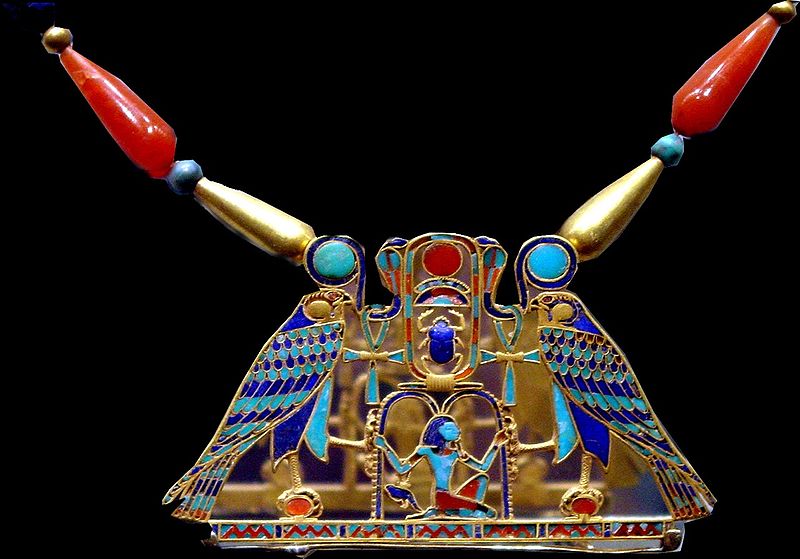
Pectoral of King Senusret II from the tomb of Sit-Hathor Yunet
 |
| Source |
This piece of jewelry is a pectoral of King Senusret II from the tomb of Sit-Hathor Yunet, daughter of Senusret II.
Crown of Sit-Hathor Yunet
.jpg) |
| Source |
The crown of Sit-Hathor Yunet was used as a wig ornament and adorned with gold and inlaid gold with carnelian, lapis lazuli and green faience. The original piece sits in Cairo, along with the golden tubes that were woven into her hair.
Broad Collar from Dynasty 18 worn during the reign of Thutmose III
 |
| Source |
Author Note: This article was published on a partner site Knoji several years ago by Ancient Digger, but I felt like it should have a place on this site as well. Enjoy!


