You may be wondering,
what exactly is a crypt?
Why were crypts used instead of cemeteries? They have such a foreboding reputation, and in most cases, they may have, however there was reasoning behind this. You and I perceive them as creepy. A room breathing and speaking death. A dungeon in the pits of the abyss we’d rather avoid at night. For those that reside in the crypts, they mean something entirely different.
What is a Crypt?
According to Wikipedia, “In architecture,
a crypt (from the Latin crypta and the Greek κρύπτη, kryptē; meaning concealed, private)
is a stone chamber or vault beneath the floor of a church usually used as a chapel or burial vault possibly containing sarcophagi, coffins or relics.”
The keyword in this definition is possibly containing, meaning
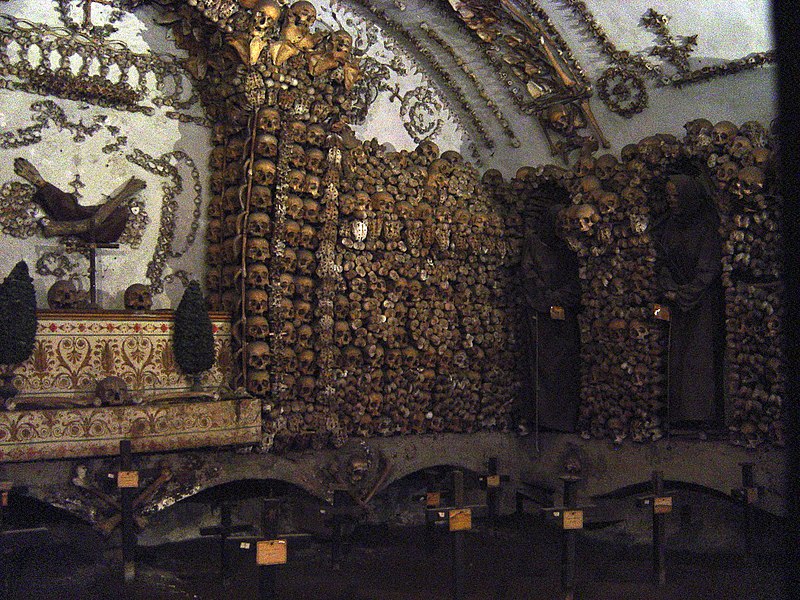
many of the crypts around the world have mummified bodies completely uncovered and in pieces. Hanging on walls. Framing an altar. In some cases, the bones were used for a bannister or staircase. Is this a new form of design? Not exactly.
I believe the bones, and you can tell me if you agree with this, represent the afterlife. They have been left behind, as they served their purpose.
Why Crypts Were Used as Opposed to Cemeteries?
In a practical sense,
crypts were used much like cemeteries. To bury the dead. Associations with vampires over the years, however, have cause mixed opinions. This is, of course, because of mainstream media and the Hollywood horror genre in movies and television.
Crypts have been used for centuries for the following reasons:
- To combat the issue of cemetery crowding, crypts were used.
- To stop looters or vandals from stealing precious artifacts.
- To protect the dead from the harsh environment.
- To preserve a person of significant importance.
- To furnish an altar only accessible to certain people.
- To honor the dead.
- To evoke fear and the possibility of evil, crypts were used.
Personally, I’m a bit fearful of small spaces.
Crypts represent the discomfort people feel in the presence of the dead and in small spaces. This proves to you and me, whether we believe spirits are present in these crypts, our human connection with this idea makes us uncomfortable. It’s this idea keeping people away from the crypts. The spirits.
The dead. An atmosphere built on a person’s greatest fear.
Where Can Crypts Be Found?
Crypts can be found all over the world in places like:
- Poland
- Italy
- Germany
- France
- Switzerland
- Portugal
- The Netherlands
- England
- Turkey
- North Africa
- Romania
Are There Different Types of Crypts?
The answer to the question is yes. There are several
types of crypts, those being:
- Catacombs- are ancient, human-made subterranean passageways for burial or protection. The word “catacomb” is most commonly associated with the Roman Empire.
- Tombs- a storehouse for the remains of the dead. It’s generally any structurally enclosed interment space or burial chamber, of varying sizes. The word is used in a broad sense to encompass a number of such types of places including: sarcophagi, vaults, rock cut tombs, crypts, monuments, sepulchres.
- Ossuary-a chest, building, well, or site made to serve as the final resting place of human skeletal remains. They are frequently used where burial space is scarce. A body is first buried in a temporary grave, then after some years the skeletal remains are removed and placed in an ossuary. The greatly reduced space taken up by an ossuary means it’s possible to store the remains of many more people in a single tomb than if the original coffins were left as is.
- Mausoleum-are above ground, free standing buildings, often concrete structures holding family members or one person. A tomb can be found inside a mausoleum.
Four Examples of Crypts Found In Portugal, France, Poland, and Italy
Catacombs of Paris
You may be familiar with the
Catacombs in Paris, which is a series of tunnels, the remnants of France's stone mines, lined with over six million bodies from around the 12th century from the overcrowding of cemeteries during the rise of Christianity. The
Catacombs is a form of ossuary, meaning it holds the skeletal remains of humans.
Capela Dos Ossos in Evora, Portugal
The
Capela Dos Ossos crypt in Evora, Portugal was constructed around the 16th century. The
Capela Dos Ossos is a macabre chapel built by Franciscan monks whom believed life could change in a moment, and they urged others to share in this contemplation during prayer.
Read this post about the Capela Dos Ossos
Capuchin Church
The
Capuchin Church is a Baroque inspired church built in
Bryno in 1604.
Capuchin is famed for its crypt, which contained more than 150 friars buried here between 1658 and 1787 during the reign of
Emperor Joseph II. Today, there are 24 friars lying on the floor. The friars are fully clothed and their heads rest on bricks. Oddly, their facial expressions remain, as do the religious objects, which have been placed on their chests.
An inscription in the crypt reads:
“What we are, they once were; what they are, we will be.”
What do you suppose it means?
Wola Gułowska
The
Wola Gułowska , built in 1782, is most famous for its miraculous image of the Virgin Mary, recognised in 1982 by the Archbishop Józef Glemp, and a copy of the image of Madonna. Under the church, a small brick lined crypt was built, which contains a coffin and two skulls. In October 1939, Polish soldiers fought the Nazi invaders in the Wola district of Gułowskiej, culminating in the
Battle of Kock near the village. A shrine and Museum was erected in the village after the war to remember the fighting.
A Humorous Side To Crypts
Is there a funny side to crypts you may be asking? Well, Dr. Kara Cooney certainly gives her own amusing take on the matter. Dr. Kara Cooney just recently gave a lecture at Tulsa's Philbrook Museum of Art. Cooney is an expert when it comes to all of those ancient Egyptian crypts that fascinate us. Dr. Cooney has appeared on The Craig Ferguson Show and is on The Discovery Channel presently as well. Video By:
Jerrys_Menu
Conclusion
Crypts represent many facets of life, as well as death. Over the centuries, they’ve been
used to combat overcrowding of cemeteries, as well as repository units for royal families, monks, priests, and other significant persons.
For you and me, they appear to be small spaces encompassing a part of life we’d like to avoid. For those that reside in the crypts, they may represent completion of a life lived well. With honor. Without malice. A place we should respect.
In your opinion, what is the significance of a crypt as opposed to being buried in a cemetery? I believe they invoke a sense of spirit. You?
Also Check Out:

The Skull Tower archaeological site dates back to around 1809 during the first revolt in Serbia, and was an Ottoman monument intended to mark the empire's success in defeating the Serbian rebels close to Nis in May 1809.
Read This Piece About Skull Tower In Serbia




 Cachtice Castle
 when the graves of Indians appeared out of the wet, rainy mud. Totally freaky at the time! Of course, what can you expect when you build your abode over an ancient Indian burial site. So where did Miami’s mega-developer Jorge Perez build his largest project? Exactly where he shouldn’t have: atop an ancient Indian burial site.


 The
The  A road trip to Ripley's Believe It or Not and the bizarre and
  In 1998, paleontologist/anatomist Scott Sampson from the New York College found a


