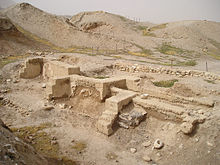
The Arab line following the creation of the state of Israel was that Israel was a colonialist foreign entity plopped down in the Arab Middle East. Nothing exposes the fallacy of such an argument as powerfully as archaeological finds that literally lay bare the Jewish presence here from ancient times. It must have been thrilling for the early Zionists who made their way to Israel in the late 19th century and early 20th to see newly uncovered archaeological finds attesting to Jewish life here 1,500 to 2,000 years earlier.
One of my favorite spots is the ancient mosaic synagogue floor at Beit Alfa in the north. A miniature replica of the mosaic is embedded in the floor of the lobby of the Maltz Museum of Jewish Heritage in Beachwood. The synagogue is located in the Beit She’an region, which is twinned with the Cleveland Jewish community.
The splendid mosaic, which features biblical motifs along with Hebrew inscriptions, was discovered in the late 1920s, when members of the kibbutz on the site were digging irrigation infrastructure and hit a layer that turned out to be the floor of the synagogue. It is not hard to imagine the elation that the Jews in the 1920s must have felt, not only over their discovery, but over this tangible link with Jews from ancient times.
Archaeological finds regularly make the news here, not only over the discovery of Jewish artifacts, but also Muslim and Christian ones. Just this week, the press reported a stash of gold coins found at the ruins of a Crusader-era Apollonia fortress on cliffs overlooking the Mediterranean about 15 minutes from where I live. The coins were found in a broken pottery vessel, and archaeologists think they were hidden there hastily while the spot was being captured by invading Muslims in the year 1265.
One of the most contentious archeological digs in the country is in Jerusalem’s City of David, south of the Temple Mount, in the area of the Arab village of Silwan. This is thought to be where Jewish Jerusalem was initially established about 3,000 years ago. The authorities are interested in expanding the archaeological site, but Arab residents in the area have objected to the expanded Jewish presence there and to an urban renewal plan involving demolition of some Arab homes.
For Jews, however, the site holds the promise of finding the oldest remnants of a Jewish presence in Jerusalem. Eilat Mazar, an archaeologist working in the area, claims to have found structural remains from the time of King Solomon that she says prove the grandeur of the city at the time. Other experts remain skeptical.
Development of the City of David site remains a cause of friction between Jews and Arabs, but the earth itself in Israel has no political agenda. It yields up evidence of Jewish, Christian and Muslim artifacts and leaves it to the people living above ground to figure out how to coexist.
Source: Cleveland Jewish News
One of my favorite spots is the ancient mosaic synagogue floor at Beit Alfa in the north. A miniature replica of the mosaic is embedded in the floor of the lobby of the Maltz Museum of Jewish Heritage in Beachwood. The synagogue is located in the Beit She’an region, which is twinned with the Cleveland Jewish community.
The splendid mosaic, which features biblical motifs along with Hebrew inscriptions, was discovered in the late 1920s, when members of the kibbutz on the site were digging irrigation infrastructure and hit a layer that turned out to be the floor of the synagogue. It is not hard to imagine the elation that the Jews in the 1920s must have felt, not only over their discovery, but over this tangible link with Jews from ancient times.
Archaeological finds regularly make the news here, not only over the discovery of Jewish artifacts, but also Muslim and Christian ones. Just this week, the press reported a stash of gold coins found at the ruins of a Crusader-era Apollonia fortress on cliffs overlooking the Mediterranean about 15 minutes from where I live. The coins were found in a broken pottery vessel, and archaeologists think they were hidden there hastily while the spot was being captured by invading Muslims in the year 1265.
One of the most contentious archeological digs in the country is in Jerusalem’s City of David, south of the Temple Mount, in the area of the Arab village of Silwan. This is thought to be where Jewish Jerusalem was initially established about 3,000 years ago. The authorities are interested in expanding the archaeological site, but Arab residents in the area have objected to the expanded Jewish presence there and to an urban renewal plan involving demolition of some Arab homes.
For Jews, however, the site holds the promise of finding the oldest remnants of a Jewish presence in Jerusalem. Eilat Mazar, an archaeologist working in the area, claims to have found structural remains from the time of King Solomon that she says prove the grandeur of the city at the time. Other experts remain skeptical.
Development of the City of David site remains a cause of friction between Jews and Arabs, but the earth itself in Israel has no political agenda. It yields up evidence of Jewish, Christian and Muslim artifacts and leaves it to the people living above ground to figure out how to coexist.
Source: Cleveland Jewish News