• Ancient Digger teaches Archaeology and History to all Ages!

Monday, May 16, 2016

Field School Opportunity: Jersey, Channel Islands on Ice Age Island


Morning Ancient Diggers. I was contacted about a wonderful opportunity for those of you interested in digs pertaining to prehistory. The archaeological fieldschool in Jersey, Channel Islands is located at Les Varines, a Magdalenian settlement site approximately 15,000 years old. To date, the site has yielded over 5,000 stone artefacts, preserved animal bone, paved areas and, most exceptionally, engraved stones which have recently gained international media coverage and was featured in BBC2’s Digging for Britain.

© Jersey Heritage
This year the field school is available to students from external universities. They have five placements available for the 2016 season, and the deadline is right around the corner, May 25th.

Accommodation is camping but there are modern, clean, indoor WC/showering facilities, dining and socialising spaces. Meals are catered for by their project cook and pick up/ delivery to the airport is included. The total fee is $1,450* (excluding travel costs) covering two weeks of time.

If you are interested in joining the dig on Ice Age Island this summer, please send a brief email providing a bit of information about yourself, your relevant interest/experience and/or a CV to:

Dr Matt Pope (UCL Institute of Archaeology) email: m.pope@ucl.ac.uk.

In your email please specify whether you are interested in Field Season 1 (July 10 – July 23) or Field Season 2 (July 24th – August 6th) or whether you are able to do both.

The application deadline is June 25, 2016).

For more information or to sign up, visit the Project Page for La Mancha Prehistoric

Monday, July 6, 2015

1920's scenes of workers at various Egyptian archaeology excavations


We read about the excavations in class, I know I once did in my Ancient Egyptian History class,  however the words of our textbooks describing Howard Carter and his discoveries can hardly paint as vivid a picture of history like this silent documentary does.

Today, 6000 years of collections are being assembled in the Met Museum in order for researchers to further their study and knowledge of the grand civilization in the Valley of the Nile.

As you can see by the video above, the process of removing the earth from the site in the 1920's is not so far removed from the way in which we approach it today. There's an assembly line of workmen, who are in charge of a native foreman and sub-foreman, who ensure the line continues to move in an orderly fashion.

The turieh, or Egyptian hoe, is used to dislodge the material and to fill the small, light baskets in which it is carried to the cars.

Instead of using our trusty water bottles or canteens, women bring jars of water, and mules would carry in water in goatskin.

While the workers weren't finding treasures like Egyptian jewelry, they were finding hoards of jars filled with salt, linen, and powders in the process of mummification. They also uncovered a 3000 year old coffin, which is waxed to preserve its surface decoration.

Watch the entire silent documentary above to see how the process of uncovering archaeological artifacts has changed.

Thursday, February 7, 2013

4 Mesoamerican Digs for 2013


With the hype of 2012 and bad interpretations of Mayan dating techniques finally behind us, it's time to get down to the real work that is archaeology in Mesoamerica, allowing us to better understand the real history of the Mayans, Incas, and Aztecs in that part of the world.

From exciting sites that offer a glimpse of the relatively simple lives lead by America's ancient peoples, to the honor of finding yourself in the midst of of large and magnificent ruins, volunteer opportunities abound where South and Central American archaeological digs are concerned. Here is a look at four of the prime volunteer and student-friendly Mesoamerican digs that will be taking place in 2013:

1. Belize Valley Archaeological Projects

Over two sessions that will take place in June and August of 2013, the Belize Valley Archaeological Reconnaissance Project will be conducting work at the site known as Baking Pot, an area rich in camping remains, and playing host to two groups of monumental architecture.

This summer's research will focus narrowly on one area in particular: the monumental center at a palace complex known to those working at the site as Group B. Those on site will be working towards clearing sections of the structures and courtyards in an effort to uncover new artifacts and develop a more thorough understanding of the chronology and heritage of the site.

And those who strive for more fun than ancient civilizations offer, can use car rental services of companies like Cheapcarrental.net and dig for a little more action at Mexico's world renown resorts such as Cancun, which is less than 300 miles away from Belize!

2. Blue Creek Project

If the past few years of silliness surrounding the Mayan people and their dating methods have lead you to a natural curiosity about the facts behind their works and lives, the Maya Research Program and its Blue Creek Project is the place for you.

For the 21st year in a row, this American group will sponsor extensive fieldwork at the Mayan site called Blue Creek, located in northwestern Belize, offering everyone involved the opportunity to discover the fascinating reality of Mayan existence.

The project will be open to students and non-students alike, and experience - or lack thereof - is not a concern in the application process. With academic credit and even scholarships available, this project is well-worth checking out for anyone with a working interest in archaeology.

3. Oaxaca, Mexico

For the third straight year, Indiana University will be playing host to anthropology faculty members, students, and outside volunteers for their field program based in Oaxaca, Mexico. With a focus on archaeology that often finds itself embracing modern anthropology, this course will introduce students to the wide range of diversity in this region, ranging from the ancient Maya to the current inhabitants.

While some of the course's planned activity will involve active time at dig sites, you'll also have the opportunity to attend local festivals and learn about the modern issues, both economic and ecological, facing Oaxaca's people.

4. Project Roatan, Honduras

The University of South Florida is set to host a fantastic learning opportunity for burgeoning archaeologists with a passion for Mesoamerica with its Mesoamerican Archaeology Field School. Taking students on a five-week journey through the history of the pirates and puritans who dominated the Caribbean in the 16th and 17th centuries, the course will focus its attention on the excavation of the English and Pech settlements located at New Port Royal and Camp Bay Village.

Students attending this once-in-a-lifetime course will learn to use archaeological methods to answer the questions that face us in exploring the history of those who came before us, offering a strong base for any historian and archaeologist.

Guest Post Contributor: Jessie Troy

Thursday, August 4, 2011

Archaeology News: August 4, 2011


The Last 3 Million Years at a Snail's Pace: A Tiny Trapdoor Opens a New Way to Date the Past

Scientists at the University of York, using an 'amino acid time capsule', have led the largest ever programme to date the British Quaternary period, stretching back nearly three million years.


England's western-most Roman town uncovered

The discovery of 100 Roman coins by local men using metal detectors has led archaeologists to England’s western-most Roman town. “It is the beginning of a process that promises to transform our understanding of the Roman invasion and occupation of Devon,” said Sam Moorhead of the British Museum.


E. Africa grasslands influenced human evolution: study

A new study suggests that open grasslands dominated East Africa for six million years, influencing the evolution of human ancestors. It had been thought that the region was forested up until two million years ago. “This study shows that during the development of bipedalism – about four million years ago – open conditions were present and even predominant,” said Thure Cerling of the University of Utah.


University to uncover cistern below campus

The Cibali Cistern is located near Istanbul’s Golden Horn, beneath the campus of Kadir Has University. The university wants to restore the cistern, which was built in the eleventh century with columns taken from other structures.


Capt. Morgan's lost fleet found?

Archaeologists and divers from Texas State University have found a seventeenth-century wooden ship, or what could be traces of privateer Captain Henry Morgan’s five lost vessels at the mouth of Panama’s Chagres River.


Archaeologists Use a Hacked Kinect To Create 3-D Scans of Dig Sites

Archaeological digs are a painstaking process even after the earth has been excavated — artifacts must be carefully catalogued so researchers know exactly where they were found, which tells information about their past. On an upcoming dig in Jordan, a modified Kinect could serve as a 3-D scanner, making this process simpler — and decidedly more high-tech.


Beer and wine archaeologist studies ancient, revealing stains

Archaeologist Patrick McGovern discovers details about ancient cultures -- their trade routes, agricultural practices and more -- by chemically analyzing stains on pot shards, a specialty he innovated, according to a recent Smithsonian profile.


UDOT Archaeologists Transport the Public Through the Past and the Future

The Utah Department of Transportation (UDOT) is nearing successful completion of archaeological fieldwork on a portion of Southern Utah’s newest road following a rare firsthand view of archaeology-in-action by the public two months ago.


DORCHESTER: Builders working with local archaeologist

The town's heritage is extremely important and due to the potential archaeological sensitivities of the site, Cowlin has appointed Wessex Archaeology to ensure this important development receives the specialist attention it needs.


Museum, archaeological site looks for volunteers

The Deer Valley Rock Art Center, an archaeology museum in northwest Phoenix, is inviting individuals to a new volunteer orientation 9 to 11 a.m. Saturday, Sept. 17. Learn about Phoenix's rock art site, and explore opportunities to meet new people, share talents, and engage the community in the preservation of the past.


Dagestan archaeologists share their recent successes

Dagestan Scientific Center of the Russian Academy of Sciences held a meeting with participation of journalists and archaeologists, devoted to the Archaeologists’ Day, celebrated on August 15. The event was attended by the deputy director for research work of the Institute of History, Archaeology and Ethnography DSC RAS, Doctor of Historical Sciences Omar Davudov and the leading researcher DSC RAS ​​Ludmila Hmyrya.


WEYMOUTH: Visitors are 'Diggin' the Museum'

VISITORS had a chance to join a garden “excavation” when Portland Museum held a hands-on archaeology day. Diggin' the Museum included a series of holes being dug in the garden to see what archaeology could be found in the museum's own grounds.


Spain Arrests 12 for Looting Archaeological Sites

Spain’s Guardia Civil seized more than 9,000 antiquities and arrested in the Mediterranean region of Valencia 12 people who dedicated themselves to looting archaeological sites using metal detectors.


Thursday, July 21, 2011

Archaeology News: July 21, 2011


Ahead of Their Time: Neandertals and the First Grandparents

Today people routinely live long enough to become grandparents. But analyses of fossil teeth conducted by Caspari and her colleagues indicate that this is a relatively recent development.

For most of human evolution, our ancestors mostly lived fast and died young. Reaching grandparent age, they show, did not become common until the Upper Paleolithic, and it may explain the sudden and dramatic shift in behaviors between the Middle and Upper Paleolithic.


Daily TWiP – Get acquainted with the history of the lollipop on National Lollipop Day

Archaeologists have discovered that people in ancient China, Egypt and the Middle East ate sticky candies made from fruit, nuts and honey, and that sticks were inserted so people could enjoy them without the indignity of sticky hands. We wonder how the archaeologists figured this out – perhaps they uncovered records from an ancient dental office.

Digital Archaeologists Excavate Chips, Not Dirt

Rather than pick and trowel, digital archaeology tools are successive acid baths, which strip away one layer after another of a chip, revealing the guts of the microprocessors that launched the personal computing revolution.

From anthropologists come new amateur archaeologists

Using shovels, square sifting boxes and their hands, University of Minnesota anthropology students slowly dug through the dirt on the banks of Spring Lake outside of Hastings, Minn.

The Game Archaeologist and the What Ifs: Mythica

I remember when Microsoft first announced Mythica, because I thought "This is gonna be cool." Vikings, Norse mythology, gods made flesh, and a big-name studio funding limitless adventures. In the pre-World of Warcraft era, the field was wide open for a company to come up and rival Sony Online Entertainment for the crown, so why not this one? But... cold water, skittish toes, and another MMO kicked the bucket before it saw the light of its first day.

Tomb of a lord of the Lambayeque

Archaeologist Carlos Wester of the Bruning Museum in Lambayeque, and his team have unearthed the tomb of a lord of the Lambayeque culture at the temple complex of Chotuna Chornancap, Peru. Copper machetes and human offerings suggest that he had been an executioner.

The Pearl Harbor Skull

A skull has been found at the bottom of Pearl Harbor. Jeff Fong of the Naval Facilities Engineering Command Pacific thinks it may belong to one of the 55 Japanese pilots who died during the attack on December 7, 1941.

Theater at Hieropolis

The stage at the ancient theater at Hieropolis in Turkey will be restored.

Richard Engel visits ancient city of Cyrene

NBC reporter Richard Engel visits Libya and the ancient city of Cyrene in this Today Show video.

Friday, May 13, 2011

Seminole War Military Artifacts Discovered in Fort Lauderdale


The first United States stockade named Fort Lauderdale was built in 1838, and subsequently was a site of fighting during the Second Seminole War. The fort was abandoned in 1842, after the end of the war.

Today, archaeologists discovered a huge of chunk of South Florida history in Fort Lauderdale. Military artifacts dating to 150 years ago have been excavated by Robert S. Carr, executive director of Archaeological and Historical Conservancy Inc. of Davie, w isho leading a team digging the site.

As many Floridians already know, there are dozens of forts in Florida that have never been found, so the discovery of Lead musket balls, a kaolin clay pipe fragment and buttons from soldiers' and sailors' uniforms, is pretty exciting for Florida Heritage.

Carr noted:

"We really didn't expect to necessarily find anything because this park has been so developed over the last 50 or 60 years with parking lots and bathrooms". One the location of the fort has been conformed it may be eligible for listing in the National Register of Historic Places. 

"It is exciting, during the 100th anniversary of the city, to find its namesake," said Carr, who hopes to dig up wooden remains of the fort's foundation. "It's the most significant find in Broward County and Fort Lauderdale, and one of the most significant finds in the Seminole Wars era."

Sunday, April 10, 2011

Dolmens at Shankarpur discovered by Archaeologists


PUNE April 10, 2011: Archaeologists of the Deccan college post-graduate and research institute have found four dolmens of the Megalithic Age (Third century B C) or the Iron Age at the Shankarpur village near Chandrapur, about 150 km from Nagpur. The discovery holds importance as such burial methods are rare in the state and also because one of the dolmens is being claimed to be the largest in the state and India.

Dolmen is an ancient stone structure consisting of a large flat stone on top of two or more upright ones, built above the place where humans were buried. These were usually erected in the memory of the dead.

In India, such structures are mainly found in the southern states of Karnataka and Kerala.

Kanti Pawar led the excavation for Deccan College. He was assisted by students Kim Yong Jun, Akash Srinivas and Pankaj Kahalekar.

Edited from the Times of India: Dolmens at Shankarpur discovered by Archaeologists

Thursday, March 3, 2011

Geoglyphology, A New Tool for the Archaeologist


Contributed By Arthur D. Faram

Over the past several years The Faram Foundation has been involved in the research and development of a new and emerging science. That science has been named Geoglyphology. Research has shown that this science has the power to rewrite history as we know it. During our research it was discovered that civilizations have secretly passed down a legacy of geoglyphs on the shores and highlands of land masses around the world. A well known example of this is the Nazca Lines in Peru. The reason the Nazca lines and other Geoglyphs were not discovered until recently is that they are too large to be seen from the ground. And so it is with most geoglyphs.

Until now the majority of the information available to the Archeologist is gleaned from the information recovered at the dig site. We discovered that a great majority of the ancient architectural, monolithic and geoglyphic structures built around the world had something in common. That commonality is that the structures were aligned in such a manner that the study of their linear alignment unveils a much larger story and immensely expands the data available to the archeologist and the related disciplines.

Extensive research on these geoglyphs, which exist on every continent and many islands around the world, have shown that, no matter when or where they were constructed, they all tie into a worldwide network of civilizations that have progressed, prospered and suffered setbacks for millennia. These glyphs range in age from the 10,000 year old Yonaguni Pyramid in Japan, to the 250 year old streets of Washington, DC USA.

Data recovered from these studies includes obtaining the geographical range of the culture being studied, the level of sophistication that existed in relation to their understanding of mathematics and geometry, their knowledge of world geography, the discovery of other archeological sites that were unknown prior to the studies, and the dating of the culture itself by the data collected at the offsite locations and the sophistication of the geoglyphs identified at the other dig sites.

It is our mission to assist the Archaeologist, and the related disciplines, in identifying any collateral data related to the dig site that might assist the Archaeologist in understanding the culture, or in expanding the search area.

More information can be obtained at: http://www.thefaramfoundation.com .

Arthur Faram's Biography


Arthur Faram was born in Fort Worth, Texas and moved with his parents, at the age of 13, to California. He later graduated from high school in Anaheim California. After graduation he joined the Marine Corps, serving 9 years and receiving the Purple Heart in Vietnam. When discharged from the military he was employed as a Computer Analyst and Certified Cartographer by the US Government. Upon retirement Arthur finished College and attended Law School to prepare himself for starting his own business.
Now that Arthur is retired he has the time to research the stories that his grandfather told him about the Faram family when they lived in England. He not only found out that the stories were true but was led into a family history that is more amazing than anything he could have imagined. It was while compiling and verifying his family history that he discovered the Geoglyphs which now form the nucleus of his research.

Monday, February 21, 2011

Sorry this post has been removed March 14, 2013


Sorry this post has been removed March 14, 2013

Tuesday, February 1, 2011

Excavation of Sutton Hoo Yields Unseem 1939 Photographs


Over 700 new pictures of the hugely important 1939 archaeological dig in Suffolk were dropped off at the National Trust visitor centre by a mystery donor.  When experts opened the albums they were stunned by the colour images of the excavation of the grave believed to be that of the Anglo Saxon king Raedwald.

The pictures were taken by two female teachers who were amateur photographers and were on holiday in the area. Mercie Lack and Barabara Wagstaff's visit to the early 7th century burial was known of but the collection of the unseen photos has proved invaluable to archaeologists.

Their equipment included German colour film and their photos are one of the first excavations in the country captured in colour. Personalities are also shown and they include the famous archaeologist Basil Brown and Queen Victoria's granddaughter, Princess Marie Louise, who turned up for a tour.

The pictures also include details such as the archaeologists working with a turkey baster and kitchen bellows.
These were possibly taken from the kitchen of Edith Pretty, the landowner who believed there were treasures on her land and organised the dig.

Prior to these photos emerging there were just 29 known pictures of the excavation of one of the most important discoveries ever in the UK. When the ship was dug, experts from the Science Museum were there to take measurements - but their data were lost during the war.

So these pictures have enabled experts to help piece together the missing information.

Edited From The Telegraph

Tuesday, January 18, 2011

Following Johns Hopkins Egyptologist Betsy Bryan at Mut Temple


Johns Hopkins Egyptologist Betsy Bryan and her team of students, artists, conservators and photographers have returned to their investigation of Mut Temple, focusing their attention on the area south of the temple’s Sacred Lake. Bryan and her crew are resuming their excavation in Luxor, Egypt, and are sharing their work via “Hopkins in Egypt Today,” their popular digital diary offering a virtual window into day-to-day life on an archaeological dig. New posts will appear through the end of January at www.jhu.edu/egypttoday.

In January 2011 Dr. Betsy Bryan returned to the Temple of Mut precinct in Luxor, Egypt with nine Johns Hopkins students. For the past four years excavation has focused within the temple itself and around the perimeter of the sacred lake, called the Isheru. This year Dr. Bryan and her team returns to the area behind (south of) the lake where between 2002 and 2006 industrial areas for baking, brewing, faience and ceramic production, were discovered. The area behind the lake contains a large open area without standing buildings. At the far south where the mud brick temenos wall separated the precinct from the secular city of ancient Thebes an area was investigated in 2004-05. In 2005 Dr. Elaine Sullivan identified a 25th Dynasty storage building of mud brick in the vicinity. This year work continues to the east of this area, beginning where a slight rise in ground level exists. Likewise excavation squares are placed directly south of the industrial area excavated earlier.~Hopkins in Egypt Today

Edited from The JHU Gazette

New Colonial Fort Discovered in St. Augustine


Only miles form where I live, there's always archaeological digs going on in St. Augustine, one of my favorite cities on earth. Of course, the greatest attractions for tourists, historians, and archaeologists alike in St. Augustine are the Castillo De San Marco and Fort Matanzas. Imagine my surprise to hear that a new colonial fort may be uncovered in the next few weeks, as archaeologist Carl Halbirt and a team of volunteers is uncovering the remains.

Wednesday, December 1, 2010

Dinosaur Exbibits in America


One of my first recollections of a dinosaur exhibit has to be the American Museum of Natural History when I was a child. Of course, you can never forget the large whale floating above your head as you peruse the natural history that surrounds you on every side, but something just draws you in to the dinosaur exhibit. I think this is the case with many natural history museums. It's a childlike fantasy to come face to face with one of these dinosaurs, and as adults, we can still understand the fascination, as we peer into the eyes bones of these massive creatures.

1. Museum of the Rockies T-Rex Dinosaur Exhibit


Source

Located in Bozeman, Montana, the Museum of the Rockies hosts an impressive dinosaur fossil collection, found in the mountains of Montana from the Jurassic and Cretaceous periods. Jack Horner, a paleontologist and curator who served as the science advisor for the Jurassic Park films, leads the area dinosaur digs and restoration process at the museum. The exhibit has on display a T-Rex, Triceratops, and Deinonychus, among others.

2. Natural Museum of Los Angeles County Saber-Toothed Tiger Exhibit


Source

Currently, the Natural Museum of Los Angeles County hosts a well-regarded dinosaur collection, but it will soon expand its exhibit when its Dinosaur Hall opens this coming summer. According to a Business Wire article, the new Hall will make the Los Angeles museum a world leader in dinosaur exhibits, featuring over 300 fossils and 20 full-body specimens. The museum endeavors to make the public more aware of the process of excavation and preparation, as well as to shed light on how dinosaurs lived, by way of interactive media. Especially notable is its T-Rex adult, Thomas, one of the most complete specimens on the planet.

3. Cincinnati Museum Center A View From The Front


source

Although only on display until January, Cincinnati Museum Center debuted an awe-inspiring collection of dinosaur fossils found in the north-central region of China by Chinese paleontologists in 2006. The most exciting part of the exhibit is a rare nest of fossilized dinosaur eggs. For more information, check out this Washington Post article

4. Utah Museum of Natural History Dinosaur Exhibit


source

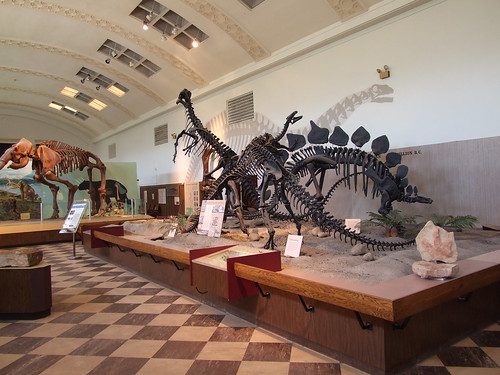
UMNH has a wonderfully diverse range of dinosaur specimens, mostly from the Late Jurassic period. Many of its fossils were found in the Cleveland Lloyd Dinosaur Quarry in Emery County, Utah, which possesses the densest concentration of Jurassic fossils in the world. The latest additions to its stunning collection are two new species of iguanadonts—a Hippodraco and an Iguanacolossus. Iguanadonts are large, beaked, herbivorous dinosaurs from the Cretaceous period. The skull of the Hippodraco will be on display at UMNH early next year.

5. Smithsonian Institution National Museum of Natural History


The Smithsonian is the veritable granddaddy of American dinosaur exhibits. It dinosaur collection was begun way back in the 1850s. Some of the museum's more interesting and complete dinosaur fossils are its Triceratops, which was for a long time one of the most complete fossils of its kind in the world, its tyrannosaur Gorgosaurus, and a saurapod, Diplodocus.

By-line:

This guest post is contributed by Alvina Lopez. She welcomes your comments at her email Id: alvina.lopez @gmail.com.

Saturday, November 20, 2010

Heritage Trust of Lincolnshire's Roman Archaeological Dig


During 1500BC the area of Lincolnshire, soon to become a nature preserve, was flooded by the sea. During the Iron Age the area dried out and was commanded during the Roman period, where herding of cattle and production of salt took precedence.

"Archaeologists from the Heritage Trust of Lincolnshire got the chance to re-visit an area of rich roman history to scour the land for artifacts and treasures from the Roman period before the area was to be turned in to a nature reserve. Tom Hughes went along to join the team and see what they found."

Video is copyright Taken from Lincolnshire Living on Channel 7 (Virgin Media 879/ (www.channel7tv.co.uk)

Friday, November 12, 2010

Petra In Under 3 Minutes


It's one of my favorite archaeological sites on earth. The mysterious city of Petra was carved into the steep cliffs, lining Arabah, a valley that runs from the Dead Sea to the Gulf of Aqaba. Most remember Petra from Indiana Jones and the Last Crusade, however they probably never knew the history behind it.

Archaeological Cities of Syria


Guest Article By Ron Siojo (Expert in Societies, Culture, and Religion)

The environs west and southwest of Aleppo in northern Syria are home to the "Dead Cities" — abandoned ruins of some 700 Byzantine towns, villages and monastic settlements. These ruins are among the greatest treasuries of Byzantine architecture to be found anywhere in the ancient world.

Today, very little of Antioch survives but the Dead Cities still litter the landscape with astonishingly well-preserved basilicas, monasteries, villas and baths. Indeed, the Dead Cities of Syria provide "one of the best pictures of the world of Late Antiquity to be found anywhere." Below is the list of the Dead Cities, all of which have notable ruins of Byzantine churches.

Read More about the Dead Cities of Syria 

Picture @ Sacred Destinations

Thursday, October 28, 2010

Archaeology News: Thursday October 28, 2010


Paleontologists have revealed the earliest known African anthropoids found to date - three previously unknown kinds of the primates from Dur At-Talah in central Libya that apparently date back 38 million to 39 million years ago. The diversity and timing of the new anthropoids raises two scenarios. Anthropoids might simply have emerged in Africa much earlier than thought, and gone undiscovered by modern paleontologists. Or they could have crossed over from Asia, where evidence suggests that anthropoids lived 55 million years ago, flourishing and diversifying in the wide-open ecological niches of an anthropoid-free Africa.

Niah Caves Should Be A World Heritage Site. The Niah Caves, located some 120 kilometres from Miri city, should be another world heritage site in Sarawak for its uniqueness, Chief Minister, Tan Sri Abdul Taib Mahmud said here.

Italy: DNA tests may reveal true fate of Sicilian 'Robin Hood'. - The tomb of one of Italy's most legendary bandits was due to be opened on Thursday in Sicily to gather forensic evidence that will either fuel or put to rest suspicion that the body inside doesn't match the name on the sarcophagus: Salvatore Giuliano.

Archaeologists solve mystery of Silbury Hill (maybe) It is one of England's most mysterious monuments. Just a short walk from the massive stone circle complex of Avebury, Silbury Hill is a giant, flat-topped mound rising 120 feet above the surrounding countryside. Researchers have proposed dozens of theories over the years to explain its purpose, suggesting everything from a giant burial mound to a platform for religious music. 

Archaeologists find pre-historic migrants "This is of great regional significance, and it will generate national interest", said Edward Biddulph, senior project manager with Oxford Archaeology which conducted the dig.

Cornell Archaeologist Makes Neolithic Era Discovery. A project led by a Cornell professor is helping to re-write the early prehistory of Cyprus, the island nation in the eastern Mediterranean Sea. By taking a new approach to examining human civilization, Prof. Sturt Manning, classics, and his team of undergraduate and graduate students from Cornell, the University of Toronto and the University of Cyprus, have uncovered new evidence that agricultural settlements had been formed up to half a millennium earlier than previously believed. 

Ayodhya verdict based on ASI report: Archaeologist. The Lucknow bench of the Allahabad High Court relied heavily on  the ASI report  in its verdict on the Ram Janmabhoomi-Babri Masjid dispute, says Dr AK Mishra, one of the three observer-archaeologists appointed by the high court for their vigil during the excavation by ASI at the disputed site in Ayodhya.

Tuesday, October 26, 2010

Top Archaeology News: Tuesday October 26, 2010


An Armenian archaeologist says that scientists have discovered a skirt that could be 5,900-year-old. Pavel Avetisian, the head of the Institute of Archeology and Ethnography in Yerevan, said a fragment of skirt made of reed was found during recent digging in the Areni-1 cave in southeastern Armenia.

Learn what archaeologists found under and around the 263-year-old house of the Rev. John Hancock in a program to be held Sunday afternoon at Buckman Tavern in Lexington.

Silbury Hill mysteries are unravelled in new book.

Egyptian pyramids are one of the seven wonders of the world. However, a study conducted by UK’s Truprint Photo Company, a digital photo printing service, has also revealed that Egypt’s Giza Pyramids are photographed the most by British tourists.

The mausoleum was created about 2,200 year ago and served as a tomb for Qin Shi Huang – the first emperor of China. While the emperor’s tomb is largely unexcavated, archaeologists have found thousands of life-size terracotta figures nearby. It’s believed that this army was created to serve the emperor in the afterlife.

The Shakers were known for their simple, economical ways. But as archaeologists discovered Monday, even their dirt was clean. 

Click on the links for more information and the full story. Have a wonderful week from Ancient Digger!

Saturday, October 23, 2010

Top Archaeology News: Saturday October 23, 2010


A team of Chinese archaeologists dedicated to the excavation and study of the world famous terracotta warriors in northwest China's Xi'an City on Friday received the Prince of Asturias Award for Social Sciences in Spain.

Archaeologists have found remains of five females who may have been ritually sacrificed in a 1,400-year-old flat-topped pyramid in the Lamayaeque region's southern Jequetepeque Valley.

Her life has been celebrated in song, story and a Disney cartoon, but no one knew where Pocahontas tied the knot with a tobacco farmer—until now.

Archaeologists unearth 10,000 year old camp site along US/Canada border. A team of archaeologists has spent the last several weeks gathering and collecting artifacts along the banks of the Saint Croix River on property owned by the federal government behind the U.S. Customs Port of Entry in Forest City.

Hundreds gathered for the annual meeting of the North American Sea Glass Association, to celebrate a hobby that seems an odd mix of amateur archaeology, environmental monitoring and antique collecting, with a little chemistry thrown in. 

The discovery of starch remnants on stone tools indicates that our ancestors were making flour out of starchy roots 30,0000 years ago. Karen Hopkin reports.

Russian Submarine SC-213 discovered by divers from Black Sea Wreck Divers near the coast of Constanta, Romania (Black Sea)

A group of archaeologists from Queensland University have discovered the oldest known high altitude human settlement.

Click on the links for more information and the full story. Have a wonderful weekend from Ancient Digger!

Friday, October 22, 2010

Top Archaeology News: Friday October 21, 2010


Groton's rolling hills are vestiges from ice-age glaciers of long ago. Life was non-existent until the age of glaciations ended and five-thousand feet of ice in our region slowly melted, approximately 15,000 years ago.

Magdeburg, Germany - Hundreds of Germans paid their last respects Friday to an English queen born 1,100 years ago, during a reburial ceremony in the cathedral of the eastern city of Magdeburg.

Peruvian archaeologists have unearthed four perfectly preserved mummies at an ancient burial site in the capital city, Lima.

More skeletal remains been uncovered at the Gisborne District Court extension site.

A 400-year-old village of 10 longhouses has been uncovered in Ontario, on the banks of Strasburg Creek. Some artifacts from the site are even older, dating back 4,500 and 9,000 years. “The descendants of the people from that site are now among the Six Nations today,” said contract archaeologist Paul Racher. ~Archaeology News


After yesterday's site visit, archaeology team says passageway is around three centuries old; blueprint of GPO building may be available at British Library in the UK

Many ancient artifacts have been curated at the Sunshine Coast Museum, but very little information exists around the meaning and function of these items.

Like Ancient Digger? Why Not Follow Us?


Subscribe Via RSS Feed Follow Ancient Digger on Facebook Follow Ancient Digger on Twitter Subscribe to Ancient Digger Via Email

Get widget

Search


Ancient Digger Archaeology Copyright © 2015 LKart Theme is Designed by Lasantha