• Ancient Digger teaches Archaeology and History to all Ages!

Monday, April 1, 2013

Neanderthal fossils discovered in a cave in Greece


Neanderthal fossils including bones of children and adults, have been discovered in a cave in Greece, hinting the area may have been a key crossroad for ancient humans, researchers say.

The timing of the fossils suggests Neanderthals and humans may have at least had the opportunity to interact, or cross paths, there, the researchers added.

Neanderthals are the closest extinct relatives of modern humans, apparently even occasionally interbreeding with our ancestors. Neanderthals entered Europe before modern humans did, and may have lasted there until about 35,000 years ago, although recent findings have called this date into question.

To learn more about the history of ancient humans, scientists have recently focused on Greece.

"Greece lies directly on the most likely route of dispersals of early modern humans and earlier hominins into Europe from Africa via the Near East," paleoanthropologist Katerina Harvati at the University of Tübingen in Germany told LiveScience. "It also lies at the heart of one of the three Mediterranean peninsulae of Europe, which acted as refugia for plant and animal species, including human populations, during glacial times — that is, areas where species and populations were able to survive during the worst climatic deteriorations."

"Until recently, very little was known about deep prehistory in Greece, chiefly because the archaeological research focus in the country has been on classical and other more recent periods," Harvati added.

Harvati and colleagues from Greece and France analyzed remains from a site known as Kalamakia, a cave stretching about 65 feet (20 meters) deep into limestone cliffs on the western coast of the Mani Peninsula on the mainland of Greece. They excavated the cave over the course of 13 years. [Amazing Caves: Photos Reveal Earth's Innards]

The archaeological deposits of the cave date back to between about 39,000 and 100,000 years ago to the Middle Paleolithic period. During the height of the ice age, the area still possessed a mild climate and supported a wide range of wildlife, including deer, wild boar, rabbits, elephants, weasels, foxes, wolves, leopards, bears, falcons, toads, vipers and tortoises.

In the cave, the researchers found tools such as scrapers made of flint, quartz and seashells. The stone tools were all shaped, or knapped, in a way typical of Neanderthal artifacts.

Now, the scientists reveal they discovered 14 specimens of child and adult human remains in the cave, including teeth, a small fragment of skull, a vertebra, and leg and foot bones with bite and gnaw marks on them. The teeth strongly appear to be Neanderthal, and judging by marks on the teeth, the ancient people apparently had a diet of meat and diverse plants.

"Kalamakia, together with the single human tooth from the nearby cave site of Lakonis, are the first Neanderthal remains to be identified from Greece," Harvati said. The discoveries are "confirmation of a thriving and long-standing Neanderthal population in the region."

These findings suggest "the fossil record from Greece potentially holds answers about the earliest dispersal of modern humans and earlier hominins into Europe, about possible late survival of Neanderthals and about one of the first instances where the two might have had the opportunity to interact," Harvati said.

In the future, Harvati and her colleagues will conduct new fieldwork in other areas in Greece to address mysteries such as potential coexistence and interactions between Neanderthals and modern humans, the spread of modern and extinct humans into Europe and possible seafaring capabilities of ancient humans.

"We look forward to exciting discoveries in the coming years," Harvati said.
The scientists detailed their findings online March 13 in the Journal of Human Evolution.

Source: Live Science

Monday, March 11, 2013

Excavations continue at Despotikon


The important excavation that has been going on during the last few years on the little island Despotikon and the islet Tsimindiri, just outside Antiparos, will continue. The excavation is conducted by the 21st Ephorate of Prehistoric and Classical Antiquities and is directed by archaeologist Giannos Kouragios.

It is a five-year project that has already obtained grants from the Kanellopoulos and Latsis Foundations, and has the approval of the Central Archaeological Council.

This excavation program will enable the discovery of new parts of a significant Archaic sanctuary dedicated to the cult of Apollo and Artemis. The inhabitants of Paros island built this temple on Despotikon as a sign of their predominance in the Aegean.

According to Archaeology News Network, during the excavations the tower and the two rectangular buildings, which haven’t been excavated yet., will also be examined. In addition, the numerous rooms of the southern complex on Despotikon will be examined. The archaeological surveys will also include the five buildings revealed on Tsimindiri.

So far, 12 buildings have been located on the uninhabited islet of Depotikon, which in the past were connected by an isthmus to Despotikon. Among other finds in the sanctuary, archaeologists have as well revealed 20 marble bases of Archaic statues, 65 parts of Kouroi, the head of a Kore, and part of a marble Archaic life-sized Kouros, which was revealed this year on the island.

Archaeologists are also planning a small scale restoration of the sanctuary –namely the elevation of some columns, so that the third dimension of the temple can be recovered, which at some point in the past reached eight meters high. However, before proceeding to any such actions, the Central Archaeological Council should first give them the green light. According to archaeologist Giannos Kouragios, the creation of an archaeological park on Despotikon remains for now unfulfilled, due to the peculiar ownership situation of the islet.

[source: Greek Reporter]

Sunday, December 23, 2012

Interview with the Founder of Dig-It Games and Creator of Mayan Mysteries


I had the immense pleasure of interviewing Suzi Wilczynski, the founder of Dig-It Games. Suzi is a former archaeologist and teacher who has bridged the gap between entertainment and education. Her games were created for people who crave the challenge of a puzzle and who seek knowledge by solving the complexities of a mysterious ancient society through critical thinking.

Her latest creation, Mayan Mysteries, incorporates archaeology techniques with an exhilarating adventure and journey, which leads players into a Maya world of intrigue and mystery. One aspect, and the most important I believe, which makes this game unique, is the fact that it allows the player to use their prior knowledge to break apart information and make sense of it using a combination of science, math,  reading, and geographical knowledge and skills.


Interview with Suzi Wilczynski: Mayan Mysteries


I read that you are a former archaeologist. What was your area of expertise and did you ever discover anything exciting on digs?

I am a Mediterranean archaeologist, with a focus on Bronze Age Greece and cultural interactions. I studied Roman Archaeology in college and spent many seasons at Roman and Byzantine sites in Greece and the Middle East. In my first season, I found the most unusual artifacts: Roman curse tablets. They were thin sheets of lead that people inscribed curses on, then folded up and threw in a well. It was fascinating. We also found a number of complete pottery and glass vessels in that well. It was pretty exciting.

When you started creating archaeology games, did you have the intention of integrating real archaeology terms into the game play like: superposition, carbon dating, trowel, etc?

Absolutely. My games are designed to teach archaeology and terminology plays a huge part. Roman Town included a number of vocabulary-related games. Mayan Mysteries focuses more on concepts such as stratigraphy, recording, context, dating and proper excavation methodology. We incorporate real archaeological tools and techniques as well. My games are authentic archaeological experiences.

How long did it take you to conceptualize this game? Did you employ others’ knowledge while creating it?

For Mayan Mysteries, it took approximately a year from preliminary research to launch. It was a bit more for Roman Town since I had a lot to learn about game design as well. For the content in Mayan Mysteries I worked with Dr. Robert J. Sharer from the University of Pennsylvania, an expert in the field. My process for game design is iterative rather than top down, which means that the design changes during development. So everyone involved in development (programmers, artists, writers, testers) had an impact on the final product.

What was your real motivation behind Mayan Mysteries? Was it for educational purposes or pure pleasure?

Mayan Mysteries was designed as an educational tool. Content was built around National Standards and the Teacher Management System was part of the original design. The mission of Dig-It! Games is to make interactive, educational products that seamlessly blend fun and learning. It is impossible to play one of our games without learning something. Having said that, I won’t release a game unless it’s fun, so we worked hard to make sure that we ended up with an educational tool that is enjoyable outside the classroom. Based on feedback from casual users, we’ve succeeded in making a fun game that happens to be educational.

What age group did you have in mind when you began creating this game?

Mayan Mysteries was created specifically for middle school students. When my own children were ages 11 through14, there were very few products designed specifically for them. Unfortunately, that’s still the case. Middle school students are an underserved group when it comes to games and fun educational products. As an educator, I also believe strongly that middle school education needs to include an emphasis on analytical and critical thinking skills. As a scientist, I feel that middle school is the time when kids need to learn the basic scientific and logical thinking that will enable them to be successful in STEM subjects down the road. I also happen to just like this age group, so it’s enjoyable for me to create products for them, and I love to watch them play my games: you can see the moments when things just start to click for them and the history, science and math suddenly make sense in their lives.

The processes of archaeology can be difficult to understand for a novice. Will Mayan Mysteries be difficult to understand and navigate for younger children?

Mayan Mysteries is an in-depth, immersive historical experience for anyone ages 11 and older. Younger children will struggle with some of the puzzles, but can play with help from a parent or older child. Additionally, Mayan Mysteries is a historically accurate depiction of the Maya culture; some topics such as warfare and sacrifices may not be appropriate for children younger than 11. There is no violence or graphic images in Mayan Mysteries, but some younger children may be disturbed by the concepts discussed. As far as the archaeological content, my goal is to make archaeology accessible to young people. As you say, it can be difficult to understand, and archaeologists often have trouble explaining what they do in simple terms. Dig-It! Games is changing that by creating immersive experiences that turn players into archaeologists. We blend archaeological concepts and methodology with fun, intuitive game play. Players walk away from our games with a true understanding of the fundamentals and importance of archaeology.

Mayan history is very complex with the symbology, culture, architecture, etc. How accurate really is the content in the game, especially if it’s geared towards a younger player who has no prior knowledge of Mayan culture?

The content in Mayan Mysteries was developed with the assistance of Dr. Robert J. Sharer, a world-renowned Maya expert. All the content is 100 percent historically accurate. Additionally, our sites are real places, our artifacts are completely authentic, and we use real Mayan glyphs and terms throughout the game. We incorporate real archaeological tools and techniques as well. Mayan Mysteries is an authentic and historically accurate representation of the Maya, incorporating detailed factual information about the ancient civilization. Our in-game encyclopedia includes more than 300 factual entries, each one paired with photos of actual Maya sites and artifacts as well as artists’ renderings of people, places, artifacts and glyphs. It was important to both Dr. Sharer and me that we create a game that was enjoyable while remaining true to history. I think we did that very well.

I’m a TESOL teacher, how do you think speakers of other languages would be able to navigate with Mayan Mysteries?

Mayan Mysteries was designed for English speakers with at least a 5th grade reading level. Some of the vocabulary may be tricky for non-English speakers, but most difficult terms are connected to links to definitions within the in-game encyclopedia. There are some Spanish terms used in the game, and much of the culture will be familiar to native Spanish speakers from Mexico and Central America. One of my goals with Mayan Mysteries was to create a game that would be successful for all different types of learners. For that reason, every part of the game includes voice-overs reading the text, which should help non-English speakers as well as auditory learners and kids who are not strong readers. The concepts of the game are universal and not reliant on any previous knowledge and game play is intuitive, so the original language of the user is not a factor in understanding and enjoying Mayan Mysteries.

What is it that you hope players will gain from playing Mayan Mysteries?

From playing Mayan Mysteries, players will have a deep understanding of: the fundamentals and importance of archaeology, methods of historical study including the use of primary sources, Maya history and culture, the Maya number system, the Maya calendar, the Mayan language, and Central American Geography.

Players will also gain an understanding of how beliefs are transmitted in societies, what culture is and how it is expressed, the methods by which governments and institutions develop and exercise authority, economic concepts such as trade, markets and production and distribution of goods, and how culture, government and belief systems influence and are influenced by scientific achievements. Finally, players will develop an understanding of why it is important to study the past and how past cultures influence modern life through interaction with Maya artifacts and an examination of Maya culture.

In addition, Mayan Mysteries uses puzzles and problem-solving exercises to develop and enrich kids’ analytical thinking, creative thinking, and independent learning skills. Puzzles about the Maya calendar, number system, and daily life assess reading comprehension, geographical knowledge, spatial reasoning, and science and math skills. Game play also requires players to test fact retention and knowledge in fun challenges.

Do you have intentions of creating archaeology games with the expert archaeologist or grad student, like myself, in mind?

My focus is on introducing elementary and middle school students to ancient civilizations in a way that is meaningful and understandable within their lives. I believe that archaeology is a powerful teaching tool for social studies: it brings history to life while encouraging students to use skills from multiple disciplines such as math, science and language arts. My goal is to create entertaining, interactive games that can be played at school or at home to truly engage children in the science of archaeology and educate them about civilizations and cultures in an immersive way that goes beyond what they can experience from a textbook or film.

Will Mayan Mysteries eventually be offered on more game systems in the future?

Mayan Mysteries can be played on Mac, PC, and tablet devices. We’re also happy to announce Mayan Mysteries is now available as an iPad app so it can be downloaded and played anytime, anywhere!


Are you still immersed in teaching and archaeology or are you spending more time creating new games?

Dig-It! Games is a full-time job, but I also follow the latest developments in education and archaeology.

Tuesday, November 13, 2012

Construction Underway at Ephesus


A reconstruction plan for the protection of the ancient Greek city of Ephesus, lying 3 kilometers southwest of the town of Selçuk, has been approved during the town’s Municipality Assembly’s November meeting. Turks are expecting that Ephesus will be included to UNESCO’s World Heritage list. The plan has also been submitted to the İzmir General Directorate of Cultural and Natural Heritage for approval.

Ephesus is a declared 1st degree archaeological site. In the framework of the reconstruction plan, new entrances, retail stores and new walking lanes will be constructed within the ancient city. Areas of touristic interest, agricultural fields and parking lots will be clearly separated, and unplanned urbanization around the site prevented. “Also, transportation, trade, displays and other functions will be to modern standards. When the plan is put into effect, there will also be a field for camel wrestling and new entrance gates from the side of the Yedi Uyuyanlar Inn,” according to Selçuk Mayor Vefa Ülgür. On Mount Bülbül a terrace view is planned, which will be reached through a tunnel.

Turkish authorities further wish to underline the commercial character of the ancient city. In Antiquity Ephesus was an important center of commerce. The project the İzmir Culture and Tourism Provincial Director Abdülaziz Ediz announced is called “Ephesus Reunion with the Sea”, and aims to reviving history. The transportation from Ephesus Harbor to the Pamucak Coast will be possible by boats, says Ediz, adding that they want to make Ephesus more attractive to tourists.

Ephesus is currently on the Tentative List of UNESCO – an inventory of properties which are cultural heritage of outstanding universal value and will be considered for nomination to the World’s Heritage List at some point. To be included on the World Heritage List, sites must be of outstanding universal value and meet at least one out of ten selection criteria.

Famed for the Temple of Artemis (completed around 550 BC), one of the Seven Wonders of the World, Ephesus was one of the twelve cities of the Ionian League during the Classical Greek period, and later, in the Roman era, became the capital of proconsular Asia (which covered western Asia Minor) instead of Pergamum, entering an era of prosperity.

Source: Archaiologia

Tuesday, October 9, 2012

Tomb of Wife and Son Maybe Related to Alexander the Great


Αrchaeologists from the 28th Ephorate of Antiquities unearthed a tomb in the city of Amphipolis, near Serres, northern Greece, which they believe could belong to the wife and son of Alexander the Great, Roxane and Alexander IV.

The circular precinct is three meters, or nearly 10 feet high and its perimeter is about 500 metes, or 1,640 feet surrounding the tomb located in an urban area close to the small city of Amphipolis. The head of the team, Katerina Peristeri noted that it is too soon to talk with certainty about the identities of the discovery.

“Of course this precinct is one we have never seen before, neither in Vergina nor anywhere else in Greece. There is no doubt about this. However, any further associations with historic figures or presumptions cannot be yet made because of the severe lack of evidence and finances that will not allow to continue the excavations at least for the time being,” she added.

The area has since 1965 been known as Kasta Tom, but these are the first excavations to take place there. The project began without any secured funds, which resulted in only parts of the impressive site coming to light. Analysts suggested that conclusions about the owners of the tomb cannot be drawn without first unearthing the tombs and discovering evidence about their identities.

Nevertheless, local authorities and media rushed into claiming and believing that the tomb belongs to Alexander’s wife and son, who, according to legend, had been ostracized to Macedonia after Alexander’s death. There the 12-year-old Alexander the IV and his mother Roxane were murdered. Tradition has it that the two victims were buried in Amphipolis but no evidence so far has proved this.

Source: Greek Reporter

Wednesday, October 19, 2011

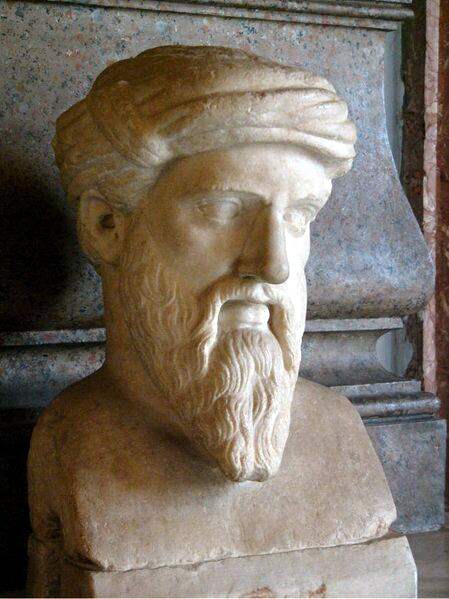
Greek Week: Who Was Pythagoras?


Pythagoras was born on the island of Samos in 580 BCE. At the age of fifty, he left the island and settled in southern Italy. He formed a religious community known as the Pythagoreans, who were a pious and moral people living by strict rules governing every aspect of life. He believed in the process of transmigration. The soul was eternal and recycled, thus it entered another human, animal, or even a plant . There was great order in what Pythagoras believed and studied. He posited that the universe is organized by diabolically opposing pairs like odd and even, good and evil, day and night, statics and dynamics, and even male and female. In the case of male and female, however, the female principle (matter) is evil, whereas the male principle (form) is good .

A. N. Whitehead has described Pythagoras as “the first theorist to look at the function of mathematical ideas in abstract thought. Pythagoras focused on the generalities in reasoning, and he divined the importance of numbers as an aid to the conditions involved in the order of nature” . Pythagoras also believed that the essence of the universe could be found in music. He experimented with the lyre and noticed that different string lengths resulted in different pitches of sound. Additionally, he was deeply influenced by the Pythagorean’ principle of justice, which they regarded as the basis of all virtue.

Sunday, October 17, 2010

Could Akrotiri Be The Lost City of Atlantis?


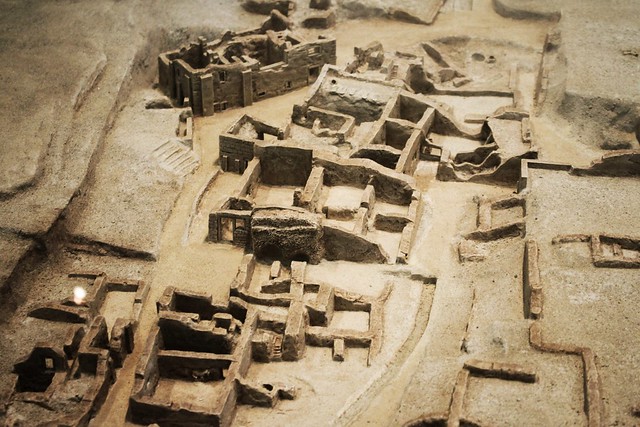
Akrotiri lies on 49 acres on the Cycladic island of Thera. During the Bronze Age, Akrotiri was quite impressive with its elaborate construction. The town was occupied in the Late Neolithic period, but evolved into a major town in 2000BC. Like Pompeii, Akrotiri was the site of a volcanic disaster. The island, with its center hollowed out, left a crescent moon shape.

Archaeological Evidence

The dates of the volcanic eruption and disaster are a bit fuzzy. Archaeologists have dated the disaster to around 1550 B.C.E, however scientific evidence places the event a century earlier in 1650 B.C.E.
During the Late Neolithic period hydraulic systems were paving the way for new states, as is evident in the elaborate drainage system at Akrotiri. There were also streets, squares, and houses built up to a height of 26 feet. The town was the epitome of a state society with blocks of houses, freestanding monuments, and elaborate buildings constructed entirely out of stone. Typical of the Neolithic period, food stores were discovered as well as preparation areas and crafting rooms.


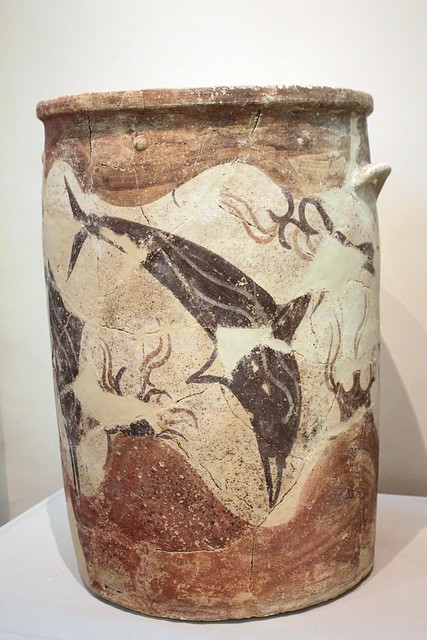
The material culture, consisting of vast quantities of pottery and metalware, indicates a connection with the Near East, Cyprus, Dodecanese, the Greek mainland, and Crete. The frescoes at Akrotiri are exquisitely preserved, many depicting ritual scenes of women gathering saffron, boxing men, fisherman, decorative rosettes, and blue monkeys.

Gold Ibex


Via wikipedia
Further excavation turned up a single gold artifact. The Gold Ibex found in 2007, on display at the Museum of Prehistoric Thera. Also featured at the museum are firedogs, a volcanic ash cast of a wooden table, ewers, animal figurines, and a Marble schematic figurine.

Mystery of Akrotiri


Interestingly enough, no skeletal remains were ever discovered at Akrotiri, leading experts to believe there was an evacuation prior to the volcanic eruption. The question is where did everyone go?

The Atlantis Myth

Like many other locations in Greece, Akrotiri was believed to be the site of the fabled city of Atlantis. Atlantis was first mentioned by the Greek philosopher Plato, and although his stories invoke true skepticism by scholars, others believe there’s some truth and may have been inspired by true events in Akrotiri.

Akrotiri today

The site is unfortunately not open to the public, although the hope is it will reopen in 2010. The main reason for this delay is because in 2005, the roof structure protecting the site, collapsed just prior to its completion in 2005, killing one patron.

All pictures courtesy of Klearchos Kapoutsis

Wednesday, June 9, 2010

The Elgin Marbles Argument


The New Acropolis Museum is receiving tons of slack from many archaeologists and residents. The main argument, of course, is about the Elgin Marbles which have been in Great Britain for over 200 years. Dimitrios Pandermalis explains why the marbles should be returned to their homeland.

Dimitrios Pandermalis has been professor of Classical Archaeology at the Aristotle University of Thessaloniki since 1979. Since 1973 he has been Director of the University's archaeological excavations at Dion and conducted extensive programs converting the excavated area into an expansive archaeological and environmental park. From September 1996 to March 2000 he served as National Member of the Greek Parliament and since May 2000 he is the President of the Organization for the Construction of the New Acropolis Museum. 

Visit The Agenda with Steve Paikin for More Information 

Monday, April 26, 2010

Monday Ground Up: The Cave of the Apocalypse


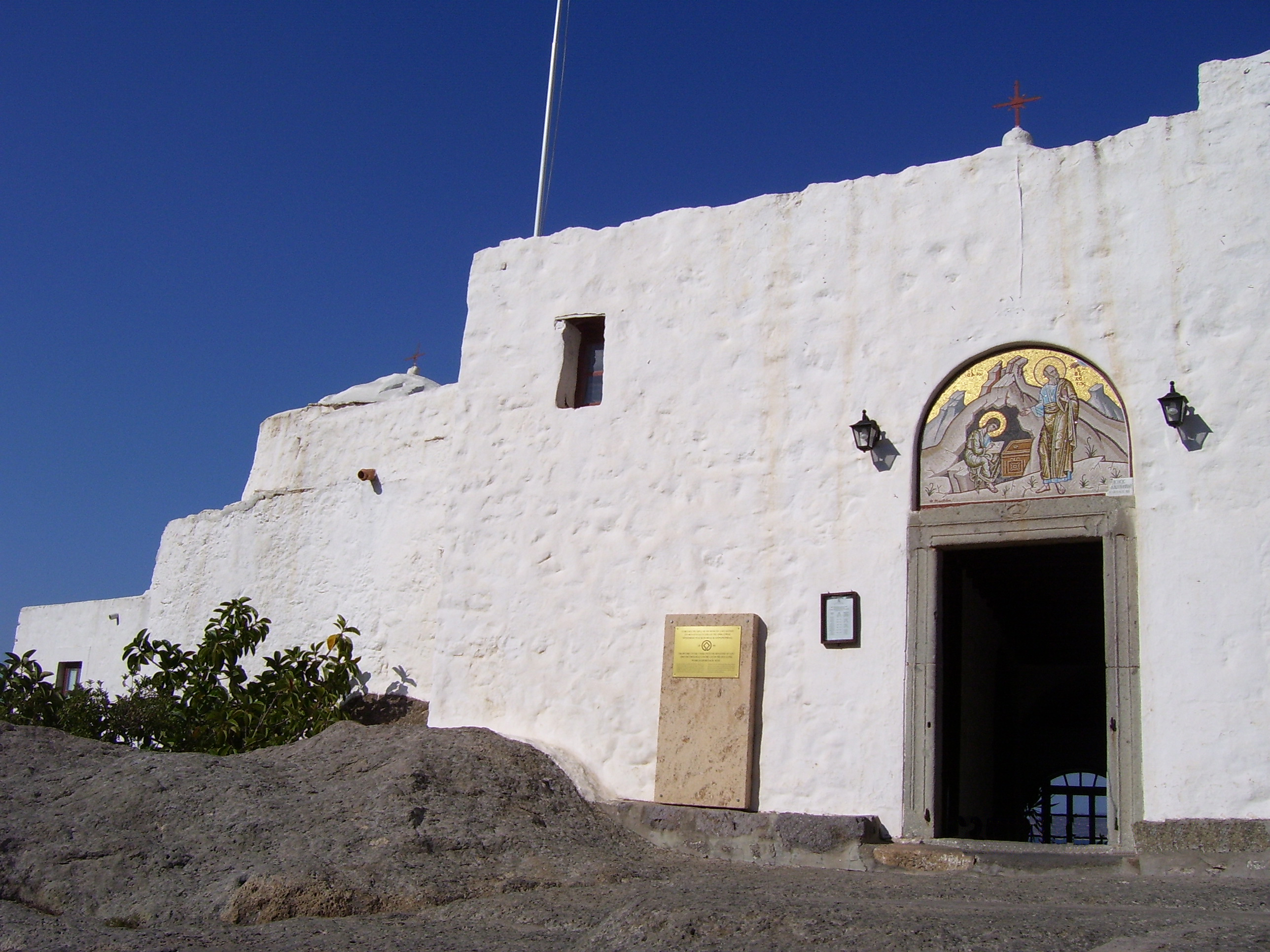
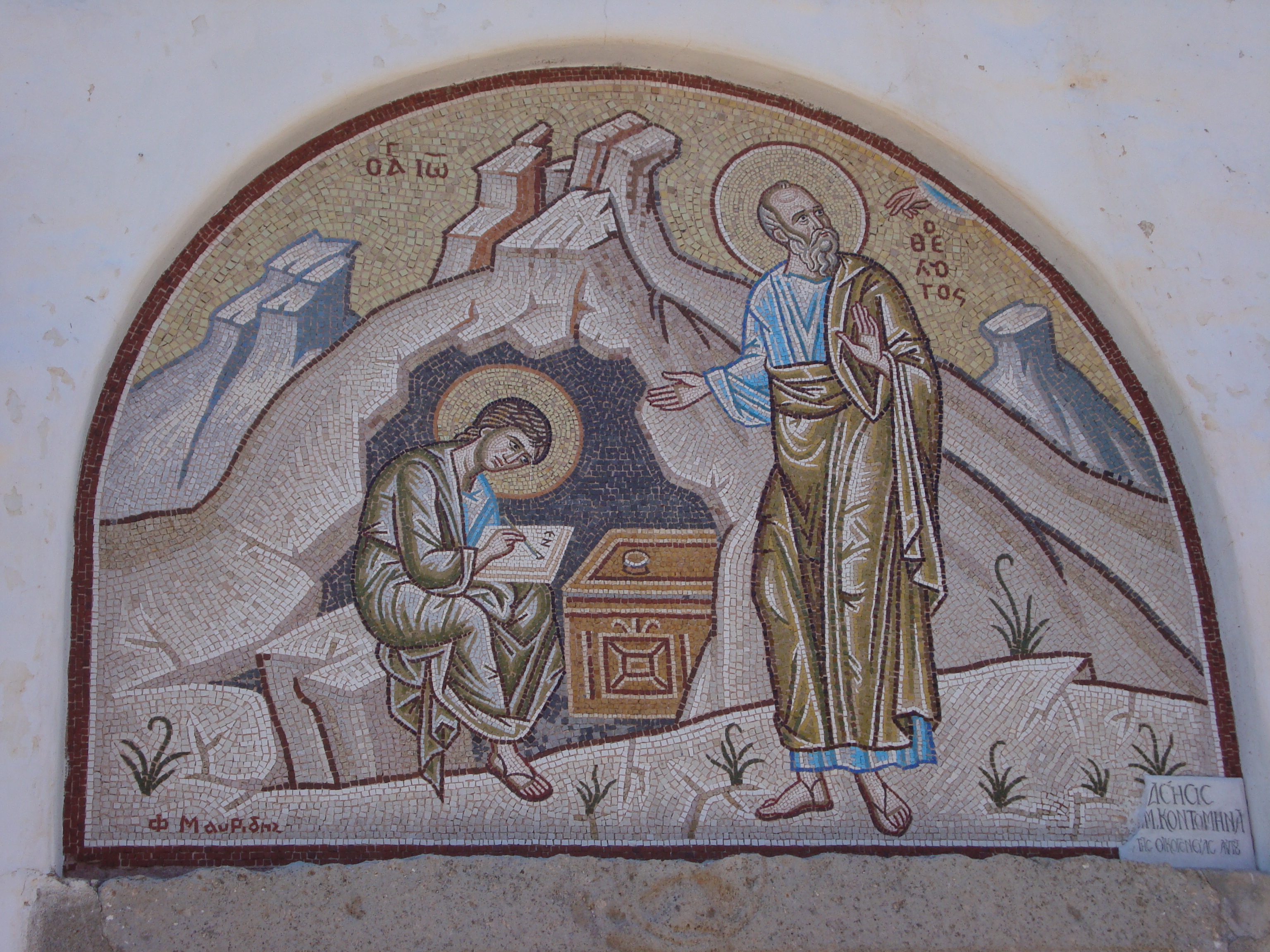
The Cave of the Apocalypse can be found on the rocky island of Patmos, deep within the monastery that surrounds it. Patmos is located north of the Greek Islands, off the southwest coast of Turkey. Many believe that St. John or John the Apostle as most people know him, lived here between Chora and Skala.

John the Apostle was exiled to Patmos in 95 CE and was there until 97 CE. It was said that he inhabited this cave where he dictated his Gospel and Apocalypse to Prochorus, his disciple. Prochorus later became Bishop of Nicomedia. The Apocalypse, along with its peculiar revelations, was the last book of the Bible to be written.

During the 10th century, the cave became enclosed by a Greek Orthodox monastery to guard its spiritual importance, and of course, to ensure its overall condition and protection. The Cave of the Apocalypse is now a center for Christian pilgrimages.

From an archaeological standpoint, there are indentations in the rock where John may have laid his head. These indentations are now the home of seven silver lights, one which hangs over where he slept. The entrance to the cave boasts an extraordinary mosaic depicting the visions John had seen while in the cave.

Evidence about the history of the Cave of Apocalypse is not, however, conclusive. It is a place that amasses a strong sense of spiritual worship and a feeling that some say is unshakable.

The Cave of the Apocalypse was recognized in 1999 as a UNESCO World Heritage site, and it remains one of the most historically important sites of the Christian world.

Photography and Video of the Cave of the Apocalypse


Picture Sources

Wikipedia

Monday, April 5, 2010

Oldest Man-Made Structure Discovered in Greek Cave near Kalambaka


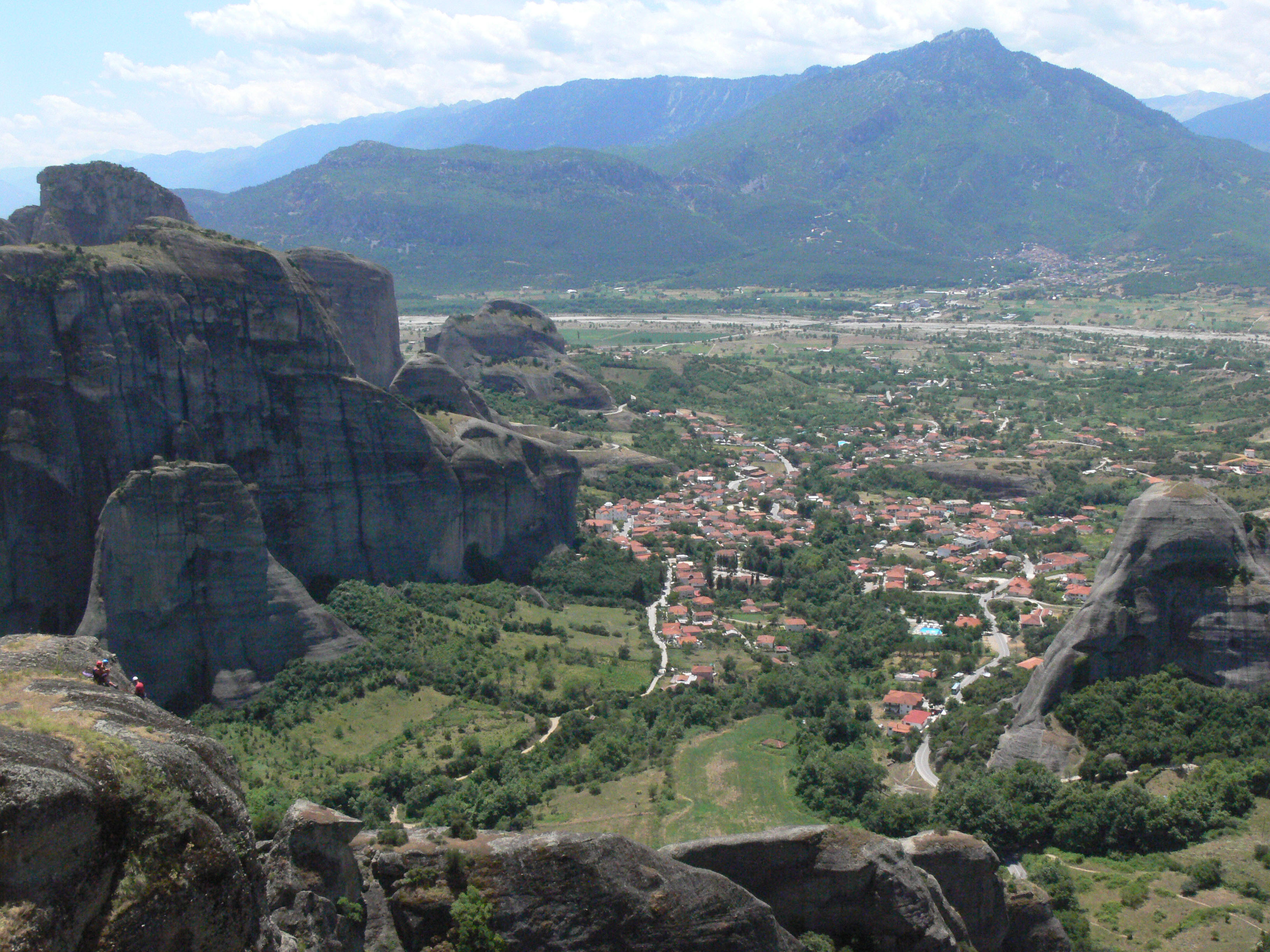
The structure is a stone wall that blocked two-thirds of the entrance to the Theopetra cave near Kalambaka on the north edge of the Thessalian plain. It was constructed 23,000 years ago, probably as a barrier to cold winds.

“An optical dating test, known as Optically Stimulated Luminescence, was applied on quartz grains nested within the stones. We dated four different samples from the sediment and soil materials, and all provided identical dates,” Nikolaos Zacharias, director of the laboratory of archaeometry at the University of Peloponnese, told Discovery News.

Read the entire story of the oldest man-made structure discovered on Discovery News

Like Ancient Digger? Why Not Follow Us?


Subscribe Via RSS Feed Follow Ancient Digger on Facebook Follow Ancient Digger on Twitter Subscribe to Ancient Digger Via Email

Get widget

Search


Ancient Digger Archaeology Copyright © 2015 LKart Theme is Designed by Lasantha