• Ancient Digger teaches Archaeology and History to all Ages!

Monday, July 6, 2015

1920's scenes of workers at various Egyptian archaeology excavations


We read about the excavations in class, I know I once did in my Ancient Egyptian History class,  however the words of our textbooks describing Howard Carter and his discoveries can hardly paint as vivid a picture of history like this silent documentary does.

Today, 6000 years of collections are being assembled in the Met Museum in order for researchers to further their study and knowledge of the grand civilization in the Valley of the Nile.

As you can see by the video above, the process of removing the earth from the site in the 1920's is not so far removed from the way in which we approach it today. There's an assembly line of workmen, who are in charge of a native foreman and sub-foreman, who ensure the line continues to move in an orderly fashion.

The turieh, or Egyptian hoe, is used to dislodge the material and to fill the small, light baskets in which it is carried to the cars.

Instead of using our trusty water bottles or canteens, women bring jars of water, and mules would carry in water in goatskin.

While the workers weren't finding treasures like Egyptian jewelry, they were finding hoards of jars filled with salt, linen, and powders in the process of mummification. They also uncovered a 3000 year old coffin, which is waxed to preserve its surface decoration.

Watch the entire silent documentary above to see how the process of uncovering archaeological artifacts has changed.

Thursday, February 14, 2013

The History and Meaning of Ancient Egyptian Jewelry


Ancient Egyptian jewelry represents a long history of divine craftsmanship by a people we continue to be intrigued by.  Egyptian art and jewelry was never just art, but represented a deeper meaning, which even today baffles archaeologists.

The rarity and exquisite nature of Egyptian jewelry was not only reserved for women, but men as well. Both men and women wore the Ancient Egyptian jewelry, and these personal adornments were not just limited to beaded necklaces and finger rings.

Jewelry such as anklets, collars, bracelets, fillets and earrings embodied everyday Egyptian dress, so much so, that even in death the poorest of individuals would still be found wearing a string of beads or a simple bracelet.

Excavations and grave robbing in the Saqqara Necropolis has turned up loose beads and trinkets from the mass graves and tombs of the ancient Egyptians.

In fact, these loose beads are often picked up by local merchants and sold to gullible tourists.

Why the Ancient Egyptians Wore Jewelry?


The Ancient Egyptians wore the ornamental jewelry for many reasons, however the more fundamental reason and purpose was to guard them from mysterious hostile forces. For many of us, we sometimes require the assistance of a necklace with a teardrop crystal, a tiger’s eye, a rabbit’s foot, a hemp bracelet, or a type of precious stone to make us feel safe. The Ancient Egyptians did the same, only most of the adornments worn were crafted out of stone. Such talismans might consist of turquoise and lapis lazuli and carnelian, all representing a facet of nature such as the green of spring, the blue of the sky, or the orange or beige of the desert.

The Meaning of Gold in Ancient Egyptian Jewelry


The use of gold in Ancient Egyptian Jewelry simply represented the flesh of the gods, the fire and glory of the sun, and the very idea that the luster of the gold was never lost, therefore an eternal sense of being.

The Meaning of Shells in Ancient Egyptian Jewelry


The shells of fresh water sea life were used to craft bracelets and necklaces for both men and women. The cowrie shell, which has an indented lip, looks like the slit of an eye. Egyptians believed this shell to be a prophylactic against the evil eye. This belief is still head true in parts of Africa and the Mediterranean. In fact, in recent times the Nilotic women wear the cowrie shell around their pelvic area to risk aborting a child.

Funerary Collar of Wah


www.metmuseum.org


This is a Middle Kingdom Dynasty 12 Funerary Collar of Wah from the Early reign of Amenemhat I. According to the Metropolitan Museum of Art in New York City, Wah's faience broad collar (40.3.2), anklets and bracelets (40.3–.10) were made as funerary ornaments for the burial and were found in the layer of wrappings closest to the body. The broad collar is one of the finest examples of its type from the early Middle Kingdom. Although a few areas needed reinforcing with modern thread, the stringing is almost entirely original.


Tutankhamun's Scarab of Lapis Lazuli


http://blog.ivman.com


This piece of Egyptian jewelry is from the tomb of Tut-ankh-amun (Tutankhamun).

A scarab of lapis lazuli with falcon wings, supporting a red disk of the new-born sun.

Pectoral scarab worn by King Tut-ankh-amun


http://www.ancient-egypt.co.uk
This piece of Ancient Egyptian jewelry is a rebus pectoral scarab worn by King Tut-ankh-amun from Thebes. It symbolizes the birth of the moon and the sun and was part of the king's coronation regalia.

Faience floral collar of the late XVIIIth Dynasty


Source

This piece of Egyptian jewelry is a faience floral collar of the late XVIIIth Dynasty. This piece is typical of the Amarna Period and was made with cheaper materials including flowers, leaves, and ephemeral papyrus. Since they were less expensive and less time consuming to create, many times they were gifted to guests at parties, banquets, and weddings.

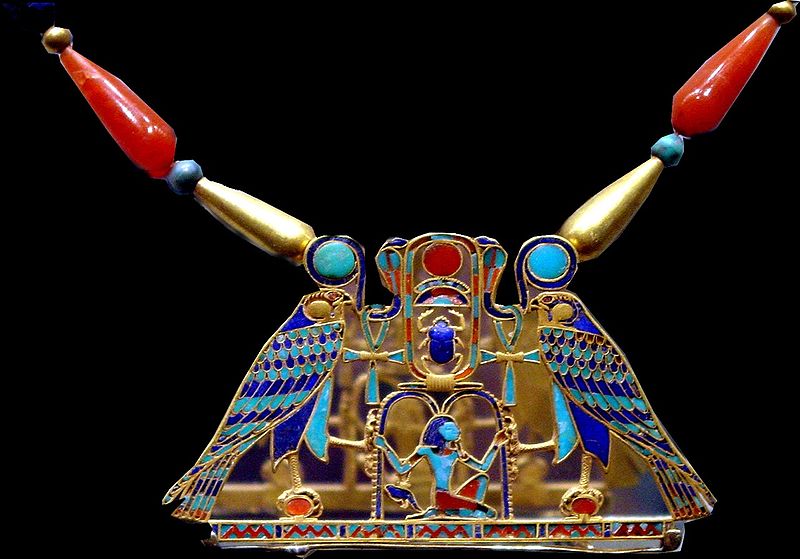
Pectoral of King Senusret II from the tomb of Sit-Hathor Yunet


Source

This piece of jewelry is a pectoral of King Senusret II from the tomb of Sit-Hathor Yunet, daughter of Senusret II.

Crown of Sit-Hathor Yunet


Source

The crown of Sit-Hathor Yunet was used as a wig ornament and adorned with gold and inlaid gold with carnelian, lapis lazuli and green faience. The original piece sits in Cairo, along with the golden tubes that were woven into her hair.

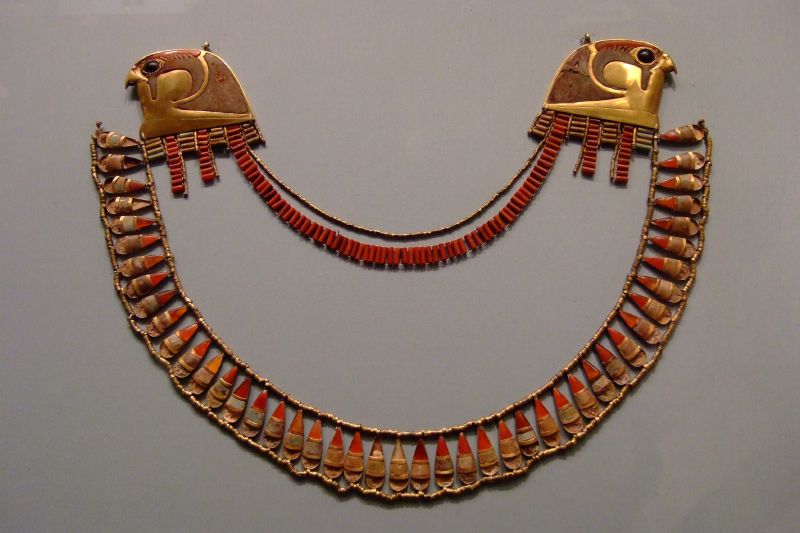
Broad Collar from  Dynasty 18 worn during the reign of Thutmose III


Source
This is a Broad Collar from  Dynasty 18 worn during the reign of Thutmose III 1479-1425 BCE. It is gold inlaid with carnelian glass, from the tomb of the three minor wives of Thutmose III, Thebes. The king's name is inscribed on the backs of the falcon-headed terminals indicating that it was a gift from him to his wife By the New Kingdom, broad collar necklaces were the most frequently worn pieces of jewelry among the royalty and elite in ancient Egypt (Met Museum, 2013)


Author Note: This article was published on a partner site Knoji several years ago by Ancient Digger, but I felt like it should have a place on this site as well. Enjoy!

Wednesday, August 8, 2012

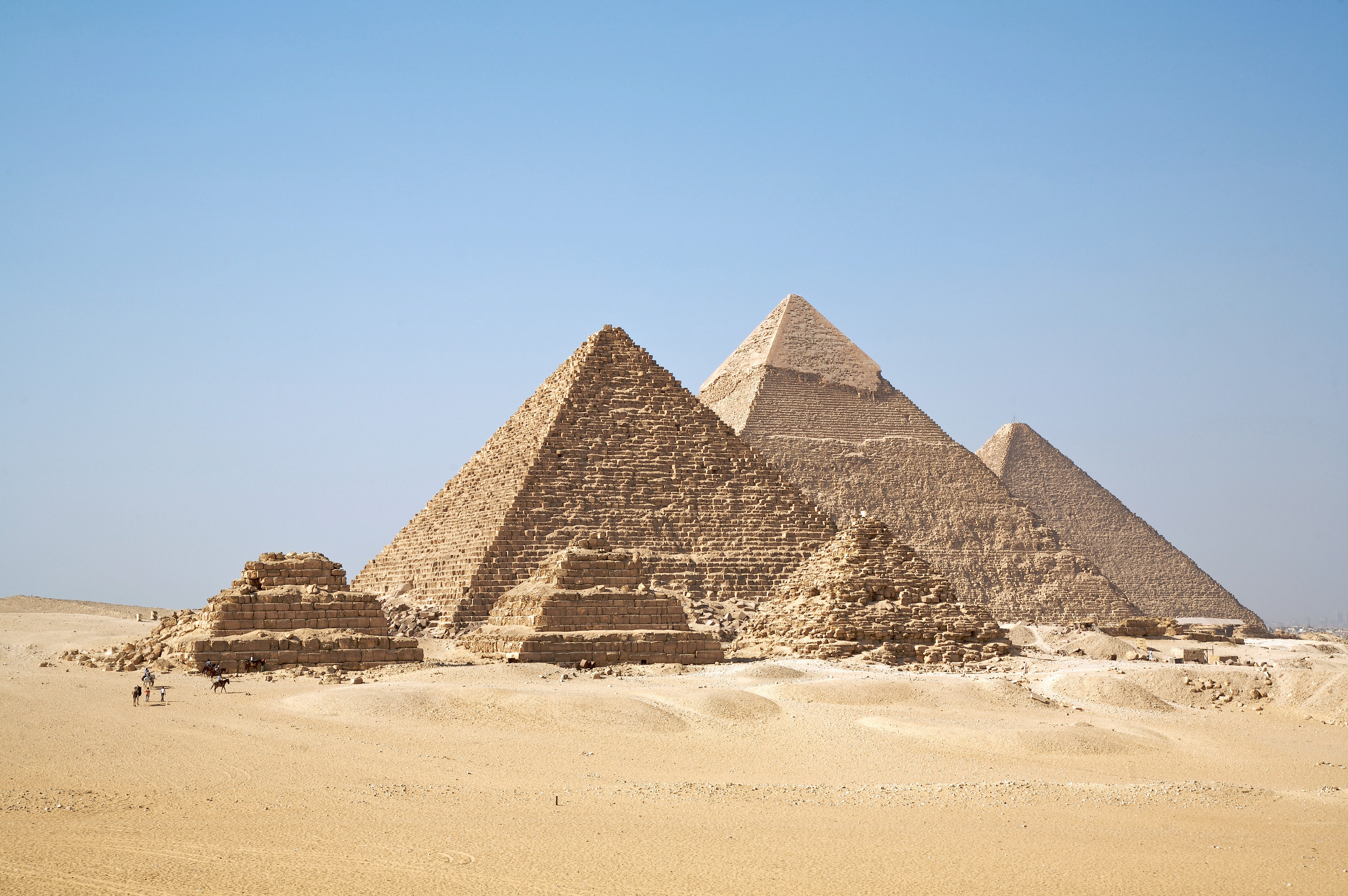
New Pyramid Complexes Discovered in Egypt


Two unidentified, possible pyramid complexes have been located with satellite imagery from Google Earth.

One of the complex sites contains a distinct, four-sided, truncated, pyramidal shape that is approximately 140 feet in width. This site contains three smaller mounds in a very clear formation, similar to the diagonal alignment of the Giza Plateau pyramids.

The second possible site contains four mounds with a larger, triangular-shaped plateau. The two larger mounds at this site are approximately 250 feet in width, with two smaller mounds approximately 100 feet in width. This site complex is arranged in a very clear formation with the large plateau, or butte, nearby in a triangular shape with a width of approximately 600 feet.

The sites have been documented and discovered by satellite archaeology researcher Angela Micol of Maiden, North Carolina. Angela has been conducting satellite archaeology research for over ten years, searching for ancient sites from space using Google Earth. Angela is a UNC Charlotte alumnus and has studied archaeology since childhood. Google Earth has allowed her to document many possible archaeological sites, including a potential underwater city off the coast of the Yucatan peninsula that has sparked the interest of scientists, researchers and archaeologists. Angela is also a board member of the APEX Institute, founded by archaeologist William Donato, who is pioneering underwater archaeological research in the Bahamas. Angela has been assisted by Don J. Long, fellow APEX researcher and colleague.

The sites have been verified as undiscovered by Egyptologist and pyramid expert Nabil Selim. Nabil’s discoveries include the pyramid called Sinki at Abydos and the Dry Moat surrounding the Step pyramid Complex at Saqqara. Nabil has stated the smaller 100 foot “mounds”, at one of the proposed complex sites, are a similar size as the 13th Dynasty Egyptian pyramids, if a square base can be discovered.
Next Steps

The Egyptian sites have been sent to Egyptologists and researchers for further investigation and “ground truthing”. Angela has stated, “The images speak for themselves. It’s very obvious what the sites may contain but field research is needed to verify they are, in fact, pyramids and evidence should be gathered to determine their origins. It is my hunch there is much more to these sites and with the use of Infrared imagery, we can see the extent of the proposed complexes in greater detail.” This is just one site of many Angela has identified that may contain ancient ruins. "My dream is to work with archaeologists to release sites that I have identified over the past ten years of research. This research is the frontier of discovery and it's just beginning to advance views of our ancient past", states Angela.

Many of the documented areas will remain undisclosed until proper officials are notified and the sites can be protected. Angela and the APEX Institute are raising funds for a documentary that will include many of the undiscovered sites that have been identified using Google Earth. Angela is also forming a non-profit organization to promote satellite archaeology and remote sensing. A select, small portion of the sites can be viewed online with Google Earth by visiting Angela's "anomaly collection" at http://www.googleearthanomalies.com.

Source: Press King


Friday, May 18, 2012

Egyptologist Gustave Jéquier


For many of us Egyptology enthusiasts we are often intrigued by the normalcies of architecture and pharaohs, and by normal I mean the most widely talked about subjects which make us love everything about ancient Egypt. However, there is life outside of Howard Carter and Zahi Hawass, even though we all have so much respect for both of these gentlemen. My knowledge of Egypt was very watered down prior to my Life and Death in Ancient Egypt class this past semester. I certainly have gained a mush greater respect for those men we rarely speak of, Gustave Jéquier being one of them.

Gustave Jéquier was born in 1868 in Neuchâtel, Switzerland. Jéquier began his career as an Egyptologist under the direction of Gaston Maspero and Jacques de Morgan. His primary focus was on the Predynastic Period, which runs from the earliest human occupation of Egypt to the beginning of the Early Dynastic Period of Egypt, starting with King Menes. Egyptian and temple architecture captivated Jéquier, therefore he focused his attention on the Old and Middle Kingdom pyramids. He later published several books on temple architecture.

Gustave Jéquier participated in major excavations sponsored by the Supreme Council of Antiquities including southern cemeteries of Saqqara, Aba, Dahshur, Lisht, and Mazghuna. In 1901, he joined Jacques de Morgan's Susa expedition, which led to the discovery of the famous Code of Hammurabi. Hammurabi was the sixth king of Babylonia and he created 282 laws to regulate people’s actions and relationships including work, marriage, crime, land ownership, and sex. One of his most recognizable scaled punishments was "an eye for an eye, a tooth for a tooth", which of course depended upon social status. In 1928, consequently, he discovered the Mastabat Faraoun of Shepseskaf.

Gustave Jéquier worked on the Pyramid Texts, which are dated to the Old Kingdom and believed to be the oldest evidence of religious works in the world. His work with the Texts provided scholars with a better understanding of religion at that time. Gustave Jéquier was also the first Egyptologist to excavate the pyramid complex of Pepi II between 1926 and 1936. Pepi II was pharaoh of the Sixth dynasty in Egypt's Old Kingdom. Jéquier was also the first excavator who found remains from the tomb reliefs, and the first to publish a thorough excavation report on the complex.

Additionally, Jéquier found several food cases within the enclosure wall of Queen Oudjebten’s pyramid complex at South Saqqara, which he dated to the last third reign of Pepi II. This means the food cases were dated to the last year they were used.

Gustave Jéquier died in 1946, but not without leaving an incurable legacy of discoveries.

Photo

© Une mission en Perse, Paris 1997 p. 128.

Monday, May 23, 2011

Monday Ground Up: Travel to the Egyptian Museum in Cairo


Guest Article By Caroline Allen

 clip_image002I was secretly thrilled as I peered upon the embellished commemoration mask of Tutankhamen. It occurred to me that the thrill of the American archaeologist Howard Carter must have been much more when he discovered the mask in the Valley of the Kings back in 1922. Mainly because this mask was found in the place of the czar, intact, in the burial chamber of Pharaoh himself, together with an immeasurable treasure, and many other useful objects and adornment.

The Egyptian Museum in Cairo keeps 1700 pieces from the tomb of Tutankhamen. The mask of Tutankhamen, an impressive piece of headwear made of 11 kilos of gold and decorated with other precious metals, is that which is given a large share of prominence across the Egyptian Museum. The face on the mask has an almost blank stare, almost distant and empty. The man pictured, supposedly, is that of Pharaoh himself. Incidentally, all the Pharaohs followed this trend: their masks crafted and portrayed as accurately their faces, so that in the time of the hereafter, their souls would easily recognize their bodies.

The Egyptian Museum is at the heart of Cairo, very near the Nile in Midan Tahrir Square, where in early 2011 thousands of people marched out in revolution to successfully overthrow the president, in power for 30 years.

The authorities have discussed whether to transfer the museum to a new building that is close to the popular tourist territory of the Pyramids and the Sphinx in Giza. So far research has revealed that it could take up to ten years to be transferred, so for now, the centennial museum remains, which opened in 1902, and has since then seen many major renovations.

The building is clean, though some would regard it as being old-fashioned and inappropriate, compared to what is expected today from such a museum of international standing. It seems like one of those classic museums of the Tintin books, with many exhibits of various sorts on pedestals, in wood cabinets and behind glass doors. Very few of the exhibits have labels or are identified. The exhibition rooms are very high and expansive, dimly lit, with cluttered closets and boxes that randomly showcase many ancient parts and even more antiquities. The guides say that the museum's collection includes over 100,000 pieces of Egyptian art, although only 12,000 of them are on display. This apparent mass stock pile may have contributed to the disappearance of some of the items stored, which were stolen by an isolated gang of opportunist thieves during the revolution of early 2011.

Nevertheless, visitors enjoy a trip to the museum. I explored the huge colossus of Akhenaten, the pharaoh who was the chief wife Nefertiti and the colossus of Amenhotep. Also at the museum are clip_image005statues of the rich Prince Rahotep with his wife Nohet, and the fantastic wooden statue of Ka-Aper. This statue from the old kingdom, was discovered made out of wood, is noted for the expression on his face and the depth of the gaze. The eyes have an outline of copper, while the white of the eye is made of quartz crystal, and the corneas of transparent stone, perforated, having been stuffed inside with putty to mimic the life of an eye.

Moreover, the exhibition holds a host of mummies. Visiting a mummy is an experience that provokes uncommon feelings. There are several exposed mummies, quite a few pharaohs, in all different ranges of conditions, yet still astonishing for their age. Traditionally they have all been dead for over 3000 years. The complex technique of embalming is impressive; it was developed by the ancient Egyptians, who relatively succeeded in allowing for their pharaohs to continue surviving through death for probably more than an additional three millennia. Perhaps the most notable of them is the mummy of Ramses, which was discovered in the late nineteenth century.

The Museum of Egyptian Antiquities, which is more commonly known as the Egyptian Museum, is open from 9am to 6pm, though the guards like to anticipate the closing time activity and allow the visitors a considerable amount of time in advance to vacate. The ticket costs 60 Egyptian pounds, but the visit of the royal mummies in the room requires an additional ticket for an additional 100 Egyptian pounds (which at current is about 10 British Pounds), though international currency conversions fluctuate over time.

Due to recent political activity it is recommended to research the conditions of Cairo and obtain suitable trip holiday insurance.

Related Articles

The Art and History of Ancient Egyptian Jewelry


Egyptian jewelry is among some of the most rare and exquisite pieces of ancient history and archaeology every found. Both men and women wore the Ancient Egyptian jewelry, and these personal adornments were not just limited to beaded necklaces and finger rings. Jewelry such as anklets, collars, bracelets, fillets and earrings embodied everyday Egyptian dress, so much so, that even in death the poorest of individuals would still be found wearing a string of beads or a simple bracelet.

  • Image Credit [http://luxortoday.com/]
  • Image Credit [http://www.vagabonding.com/]

Wednesday, February 23, 2011

Egyptian Museums Reopen after Limited Theft and Damage


After the uprising in Egypt that precipitated the unexpected downfall of the Hosni Mubarak regime, much of the country was left in chaos. Though the protests were generally peaceful, and the world over is celebrating the victory of the Egyptian people's mass protests, many archeologists, anthropologists, and cultural and art enthusiasts feared the worst for what is one of the most established museum sites of ancient history in the world.

After conflict in Iraq in 2003, looters devastated the country's museums and artifact collections, and it would not have been surprising if the same had happened in Egypt. Astonishingly, however, museums suffered little damage, and while some artifacts were stolen, Egyptian Antiquities Minister Zahi Hawass said in an interview with the German newspaper Spiegel International that many items were returned.

Hawass noted:

image-182692-galleryV9-qjmy

(Minister of Antiquities Zahi Hawass during the Feb. 16 press conference. He says that many of the items that were stolen on the night of Jan. 29 have now been recovered.) AFP


"Imagine a city with millions of residents where complete lawlessness reigned for several hours. Where the prisons were opened and there were actually no more police. That is what happened in Cairo on the evening of Jan. 29. A lot more could have been robbed and destroyed in this horror scenario What happened in Cairo could also have happened in New York, in London, in any museum in the world. As I said, considering the circumstances it is a miracle that more was not stolen."

According to an AOL news article, much damage and looting was mitigated because protesters and military both conscientiously joined together to protect Egypt's many museums and historical sites, in one instance forming a human shield around the Egypt Museum. The director of another historical hotspot, the Bibliotheca Alexandrina, sent a special thanks to the country's demonstrating youth, who played a big role in the protection of the library's historical collection.

Hawass reports that only about 18 items were missing from the Egypt Museum, and some objects were found scattered in different places in the city. Tombs at Saqqara and Abusir, as well as storage areas at Cairo University, had also been broken into, although the total accounting of lost or damaged items has not yet been reported. An earlier Washington Post article noted that antiquities experts were working hard to restore the damage done to some 70 items in the Victorian-era Egypt Museum.

According to Hawass, the most important item damaged was a statue of King Tutankhamen standing on a panther. Removed from the panther, the figure of the boy king was also missing its arm.

It will certainly take some time for tourism, among Egypt's most lucrative industries, to pick up to the levels it had experienced before the uprising. However, as of Sunday, February 19th, the Egypt Museum along with many others throughout the country, have officially reopened, with understandably poor attendance.

Thursday, February 11, 2010

BBC Pyramid Builder


For those of you Egyptian pyramid enthusiasts, BBC gives readers the opportunity to take a journey back 4000 years to Egypt. You will take on the daunting task of building the kings pyramid.

At first, as a builder, you will be faced with the kings entourage including the queen, fan bearers, bodyguards, and scribes.

Choose your words and supplies wisely and plan ahead. This is your chance to prove yourself as a master of the pyramids. Trust me, it's more difficult than it seems, especially the trip down the Nile.

Start your journey here

Tuesday, February 2, 2010

Discovery News: King Tut's DNA Revealed


On February 17th, the results of King Tut's DNA will be revealed by noted Archaeologist, Zahi Hawass, chief of Egypt's Supreme Council of Antiquities. The DNA will be tested against several hundred mummies in order to test the theory that Amenhotep III was his father.

The long awaited announcement will be "about the secrets of the family and the affiliation of Tutankhamun, based on the results of the scientific examination of the Tutankhamun mummy following DNA analysis," Hawass said in a statement. Read more about the DNA results of King Tut at Discovery News By Rossella Lorenzi

Like Ancient Digger? Why Not Follow Us?


Subscribe Via RSS Feed Follow Ancient Digger on Facebook Follow Ancient Digger on Twitter Subscribe to Ancient Digger Via Email

Get widget

Search


Ancient Digger Archaeology Copyright © 2015 LKart Theme is Designed by Lasantha