• Ancient Digger teaches Archaeology and History to all Ages!

Wednesday, November 28, 2012

Ancient Necropolis Unearthed Near Marten


Photo by Ruse History Museum
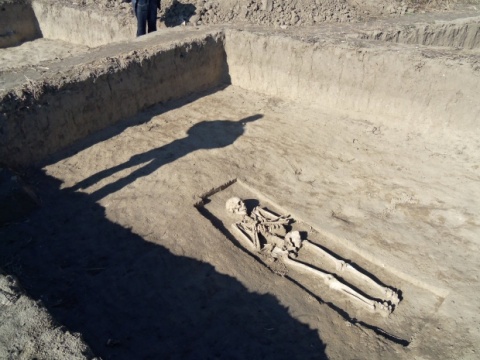
A necropolis with over 100 burials has been unearthed during archaeological excavations near the village of Marten in northern Bulgaria.

The discovery was made by the archaeologist from the Archaeology Museum in the Danube city of Ruse, Deyan Dragoev.

The necropolis is on the path of the future gas connection between Bulgaria and Romania.

The site includes tombs from the Thracian times to the times of the First Bulgarian Kingdom. The oldest ones date from the 5th – 4th centuries B.C. Some reveal very interesting rites such as the tomb of a decapitated soldier, whose head was laid on his lap, while others have been buried with gold and silver jewelry or with their dogs.

Some skeletons have deformed skulls, which have been typical for the First Bulgarian Kingdom as a sign of high position in society and of nobility. Noble children then had their heads tightened with headbands in order to change the form of the skull, experts say.

Remnants include wooden coffins, and ceramics and glass from Roman times.

The two Thracian tombs, according to archaeologists, show that a Thracian settlement, unknown until now, has been located nearby.

On Wednesday, the Ruse archaeologists sent bone material for analysis at the Bulgarian Academy of Sciences.

Source: Novinite

Wednesday, October 31, 2012

Europe's oldest prehistoric town unearthed in Bulgaria


The oldest prehistoric town found to date in Europe has been unearthed by Archaeologists in Bulgaria. The walled fortified settlement, near the modern town of Provadia, is thought to have been an important centre for salt production. Its discovery in north-east Bulgaria may explain the huge gold hoard found nearby 40 years ago.

Archaeologists believe that the town was home to some 350 people and dates back to between 4700 and 4200 BC. That is about 1,500 years before the start of ancient Greek civilisation.

The residents boiled water from a local spring and used it to create salt bricks, which were traded and used to preserve meat.

Salt was a hugely valuable commodity at the time, which experts say could help to explain the huge defensive stone walls which ringed the town.

Excavations at the site, beginning in 2005, have also uncovered the remains of two-storey houses, a series of pits used for rituals, as well as parts of a gate and bastion structures.

A small necropolis, or burial ground, was discovered at the site earlier this year and is still being studied by archaeologists.

"We are not talking about a town like the Greek city-states, ancient Rome or medieval settlements, but about what archaeologists agree constituted a town in the fifth millennium BC," Vasil Nikolov, a researcher with Bulgaria's National Institute of Archaeology, told the AFP news agency.

Archaeologist Krum Bachvarov from the institute said the latest find was "extremely interesting".

"The huge walls around the settlement, which were built very tall and with stone blocks... are also something unseen in excavations of prehistoric sites in south-east Europe so far," he told AFP.

Similar salt mines near Tuzla in Bosnia and Turda in Romania help prove the existence of a series of civilisations which also mined copper and gold in the Carpathian and Balkan mountains during the same period.

BBC Europe correspondent Nick Thorpe says this latest discovery almost certainly explains the treasure found exactly 40 years ago at a cemetery on the outskirts of Varna, 35km (21 miles) away, the oldest hoard of gold objects found anywhere in the world.

Source: BBC

Monday, September 3, 2012

Apollonian Necropolis Discovered in Bulgaria’s Sozopol


(Photo: Clive Leviev-Sawyer)
Archaeologists have found the long sought-after oldest necropolis of ancient Apollonia, the Black Sea town that was the predecessor to today’s Sozopol in Bulgaria.

The discovery was made in the area of the fortress gate and southern wall of the old town. It is a long-awaited sequel to the discovery of part of the necropolis in 1972 by Mihail Lazarov.

The newly-discovered four gravesites were found two metres below the foundations of the church found by archaeologists at the start of this year’s archaeological season near the southern entrance to the stone wall in Sozopol.

There is evidence that the core of the ancient necropolis may be dated to the second half of the sixth century BCE, according to a report on September 3 2012 by public broadcaster Bulgarian National Television. At the gravesites of children, amphorae were found with pottery and balm as burial gifts.

According to the report, it was believed that the ceramics had been imported from Corinth and had been made about 540 BCE. Dimitar Nedev, director of the Historical Museum in Sozopol, said that the ceramics had been very popular items, widely found on the territory of ancient Greece, but were a rare find in this area.

Friday, August 17, 2012

Bulgaria Marks 30 Years of Sensational Archaeological Discovery


Photo by BGNES
Bulgaria marks Friday in the northeastern town of Isperih 30 years of the sensational discovery of the Thracian Sveshtari tomb included in the world cultural-historical heritage of UNESCO.

In occasion of the anniversary, the first volunteer archaeological project is organized at the Sboryanovo site under the motto "Thracian Past – European Future" and the EU Program "Youth in Action." The project includes two volunteers from each Poland, Romania, Italy, Turkey, Azerbaijan, Armenia and Belarus. Outside the program, three volunteers from Japan are joining in with the partnership of the Japanese ICI Foundation.

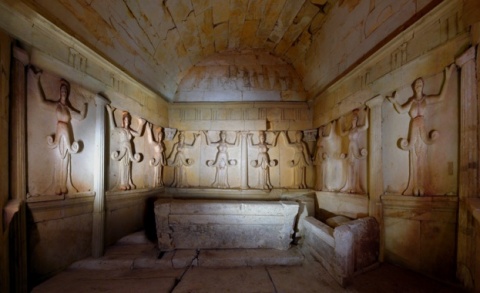
 The Thracian royal tomb near the village of Sveshtari is one of the most sensational archaeological discoveries over the past thirty years in Bulgaria. Perfect as architecture, it amazes both with its wealth of sculptural ornaments as well as its vibrant colors. It is a remarkable monument of Thracian art and one of the biggest sensations of ancient archaeology in recent years. It was included in the UNESCO list over the extraordinary architecture and picturesque ornaments.

The site was unearthed during excavations in the historical-archeological reserve "Sboryanovo," situated between the villages Malak Porovetz and Sveshtari of Isperih municipality, in the river Krapinetz canyon and on the hills around. The tomb consists of a passage (dromos) and three square chambers: ante-chamber, lateral chamber and main burial chamber covered by a semi-cylindrical vault. The plan of the building offers a new interesting example in Thracian building practice. The decoration of the tomb is executed in the spirit of the contemporary Hellenistic architecture.

Its entrance is flanked by two rectangular columns (antae). Above them there is an architrave plate with a frieze in relief, consisting of stylized bovine heads (bucrania), rosettes and garlands. Ten beautiful female figures with hands raised high like caryatids are impressive. The figures are about 1.20 m tall, presented frontally, wearing long sleeveless dresses (chtons) tied with a thin belt below the breasts. Two funeral beds, human bones and grave offerings were discovered in the central chamber. From the scattered stone details it was possible to reconstruct the facade of the tomb aedicule - naiskos, consisting of pilasters, cornice and a pediment, and closed with three stone doors. Being placed in front of the large funerary bed as a symbol of the boundary between life and death, the aedicule isolated the grave of the deified ruler - the most sacral part of the tomb - from the rest of the place. In the center of the composition the goddess is offering a gold wreath to the ruler, rendered as a horseman facing her. On both sides of them there are processions of servants and armor-bearers carrying different gifts in their hands.

The time when the Sveshtari tomb was built (mid-3d century BC) coincided with the period of a great political, economic and cultural upsurge of the Thracian tribe of the Getae. The rich decoration and perfect architecture of the tomb speak for the political power of the ruler. The Sveshtari tomb is part of the historical-archaeology reserve "Sboryanovo" which also includes the Thracian town of "Helis" and the Thracian sanctuary "Demir Baba Teke," along with several smaller Thracian tombs.

Source: Novinite

Friday, October 7, 2011

Roman Mosaics Discovered By Bulgarian Archaeologists


Archaeologists digging in the Bulgarian city of Stara Zagora have discovered an exquisite Roman floor mosaic, after excavating in the pit of a newly constructed block of flats just outside what used to be the northern gate of the ancient Roman settlement of Augusta Trayana in Stara Zagora.

Archaeologist Dimitar Yankov stated, "The figures are very realistic, with the mosaic's tiny tiles varying in all shades of colors to depict their clothing, movements, facial expressions, hair and jewelry".

According to Yankov, the find is dated to late 2nd or early 3rd century A.D. .

Thursday, September 9, 2010

Bronze Hydria Discovered at the Necropolis of Mesambria in Bulgaria


Archaeologists in Bulgaria, digging in the Necropolis of Mesambria in the Black Sea, have unearthed a bronze hydria in a tomb dating back to 4th century BC. The hydria is glorious in coloration and the first of its kind found at the site, making it a significant find for the Bulgarian archaeologists.

According to the scientists, the hydria they found has been used for storing the remains of a dead person who had been cremated first. In their words, the fact that the object is very well preserved and does not need any restoration makes it valuable.

The hydria is the first object of this kind to be found in excavations around Nessebar. It would help archaeologists study the funeral rituals of the ancient people who lived in these places.

"I have to note that these hydrias were a rarity in the ancient world. They have been made by very crafty masters. They usually have applications on them and are owned by the biggest museums in the world. We are very happy that such a hydria would be presented in the museum in Nesebar," said Aneliya Bozhkova, co-head of the archaeology team doing the excavations.

Read about the Hydria discovery in Bulgaria via Novinite

Tuesday, August 31, 2010

The Madara Rider of Bulgaria


The Madara Rider sits 246 feet above ground, on a cliff face in the Madara Plateau of northeastern Bulgaria. The relief is inaccessible, adding to its mystery. How were they able to create it?  Either way, the relief is extraordinary.

Including the inscription in Medieval Greek, the rider covers close to 1400 square feet on a vertical 328 foot cliff face. The horseman is depicted in a hunting scene, spearing a lion. The lion is being trampled by the horse and a dog is trailing behind the rider.

Read this article on the Madara Rider: The Mysterious Stone Horseman of Bulgaria

Friday, August 6, 2010

SVESTARY Thracian Tomb - The Goldens WONDERS of Bulgarian Archaeology


Bulgaria is often overlooked and underrepresented when it comes to its rich heritage. Bulgarian Archaeological Sites are continuously being uncovered, yet many have no idea that these sites will soon fall into the hands of industry, covered by infrastructure and only existent on archived documents.


The Shvestary village is situated in the Sboryanovo Reserve in the north-east of Bulgaria. The Thracian Tomb, dated to 300 BC, was discovered on this territory of an ancient religious centre in 1982. The interior, consisting of three chambers, includes splendid decoration depicting 10 female figures -- caryatids and a polychrome on the walls.


Extensive examinations of the site have focused on the ancient building and art techniques, assessment of the tomb's condition and the selection of the optimum conservation methods. Selected results of these examinations are presented.

The main preservation measure was construction of a permanent air-conditioned protective building over the tomb, securing a controlled environment.The 'minimal intervention' approach was used in the handling of the interior decorations, restricted to cleaning operations and reintegration of the broken fragments. Due to this 'passive' approach the tomb has retained its authentic appearance. So far, the results are positive for the more than twenty years that have passed since the tomb was found.

The Sveshtary Tomb in Sboryanovo Reserve is situated in the north-east of Bulgaria. On this territory there is an ancient religious centre and many Thracian hills with graves and tombs which were organized into a necropolis in the Hellenic period, 300 BC. In this place, the Thracian Tomb has been the most significant discovery of the last 20 years.The tomb is situated in the south east part of the Guinina Mogila. Its outer dimensions are 767cm x 667cm. It consists of a passage (dromos)leading to a building.

In the building there are three chambers: an anteroom, a side chamber and a central tomb chamber). The construction was built of limestone blocks. Three types of limestone were used: a hard, monolithic variety as block stone for structural building work, a medium hard stone for the inner walls and architectural details and reliefs, and a soft, lighter variety for construction of an upper part of the tomb.The interior includes splendid decoration depicting 10 female figures -- caryatids (Figure3).

The central chamber is decorated with a polychrome, a drawn scene on the arched part of the north-west wall. The tomb is a cultural monument which has been placed under the protection of UNESCO.

The Thracian Tomb has survived under the hill mound for 2,300 years. Over the course of time, the fluctuations in temperature and humidity were very slight, and degradation progressed very slowly

Text via bulgad @YouTube

Thursday, February 4, 2010

Rila Monastery in Bulgaria


Rila Monastery is a glorious location that overlooks rivers and the serene mountain scenery. Rila Monastery not only is the largest Eastern Orthodox monastery in Bulgaria, but it boasts a pretty impressive history.

Ivan Rilski, the leader of the monastic colony, was legend to have healing powers. Even after his death, his bones were a precious commodity among medieval rulers. In fact, the bones were moved from Rila to Esztergom in 1183, and then, after the Bulgarian and Byzantine interventions they were returned to Rila Monastery in 1469.

The building themselves have been destroyed and rebuilt over the years. The current monastery dates back to the 1830's, and upon arrival, visitor's will revel in the grandeur and artistry of the structure.


The Nativity Church is the largest in Bulgaria and the walls are superbly decorated with checkered colonnaded balconies, a red tiled roof, and scattered dome impressionistic paintings.

Rila Monastery also contains a double sided crucifix and the Rafail's Cross, which is a wooden cross made from a whole piece of wood (81×43 cm). It was whittled down by a monk named Rafail using fine burins and magnifying lenses to recreate 104 religious scenes and 650 miniature figures.

The frescoes, which were designed by Bansko, Samokov and Razlog, including the famous brothers Zahari Zograf and Dimitar Zograf, are appropriately painted depicting the different saved and sinner's scenes.

Rila was named a national monument by the Bulgarian government in 1976 and included in the World Heritage sites in 1983. Til this day, it still remains a working monastery and guests must stay in sparsely furnished rooms. In 2002, Pope John Paul II made a pilgrimage to Rila Monastery and was greeted by Bishop Ioan, who had been an observer at the Second Vatican Council.

Picture Sources


Monday, January 25, 2010

Monday Ground Up:The Thracian Tomb of Kazanlak in Bulgaria


The Tomb of Kazanlak in Bulgaria holds the most well preserved art of the Hellenistic world.

The Tomb of Kazanlak dates back to the fourth century B.C.E and is that of an important chieftain of the Odrysae Tribe. The Odrysae occupied the southern part of the Thracian territory, now central Bulgaria. It’s located 5 miles from Seuthopolis and was surprisingly discovered by accident. When excavation began in 1944, a tholos-a tomb shaped like beehive was discovered intricately decorated with murals of Hellenistic art.


It’s said that the inspiration for the dome came from the Mycenean tombs in Greece, compared to the Treasury of Atreus, however it was built on a much smaller scale. The main burial chamber measures close to 11 feet high and the entire tomb is divided into three sections-the main chamber, antechamber, and a corridor connecting the two.

The murals, which are by far the most well preserved artworks from the Hellenistic world, are painted with battle scenes, gracefully cantering horses, geometric patterns, and a banquet depicting a man bidding farewell to his wife.


The entire tomb is housed under an enclosure and entrance to the tomb is restricted to scholars. The main objective for these stringent rules is to protect the pristine condition of the paintings, therefore allowing the scholars to study the murals in a safe and protective environment. There is, however, a replica nearby that visitors can examine so the real site is never compromised.

The Tomb of Kazanlak was designated a UNESCO World Heritage Site in 1979.

The Thracian Tomb of Kazanlak in Bulgaria


Resources

The geographical center of Bulgaria – between the Stara Planina and Sredna Gora mountains – is known as the Rose Valley. For centuries the fragrant Bulgarian rose has been grown there and the attar of roses is extracted fro the production of rose oil. There, 40 years ago, in the town of Kazanluk a small Thracian Tomb was found, with murals which are of exceptional interest in the world’s cultural heritage. Check the site Ancient Bulgaria

The World Heritage Site also shares some incites into the Tomb of Kazanlak and there's also some interesting reviews and information. There is one in particular from one of Ancient Digger's readers Rossitza Ohridska-Olson.

Sources

Reproductions Pictures

Like Ancient Digger? Why Not Follow Us?


Subscribe Via RSS Feed Follow Ancient Digger on Facebook Follow Ancient Digger on Twitter Subscribe to Ancient Digger Via Email

Get widget

Search


Ancient Digger Archaeology Copyright © 2015 LKart Theme is Designed by Lasantha