In a recent lecture series, which included the Yanomamo of Brazil and Venezuela, I was posed several questions for a discussion panel.
- The Yanomamo have a reputation as being particularly "fierce." What do the events depicted in "The Ax Fight" suggest about the importance of kinship within tribal societies?
- In your opinion, do the events depicted in "The Ax Fight" portray the Yanomamo accurately or are they merely a sensationalized account of Yanomamo life?
If you’re already an anthropology student, you're more than familiar with the Yanomamo, having studied them in more than a dozen classes. For those readers that are not familiar with this tribe, here’s a brief background of the Yanomamo.
Who are the Yanomamo?
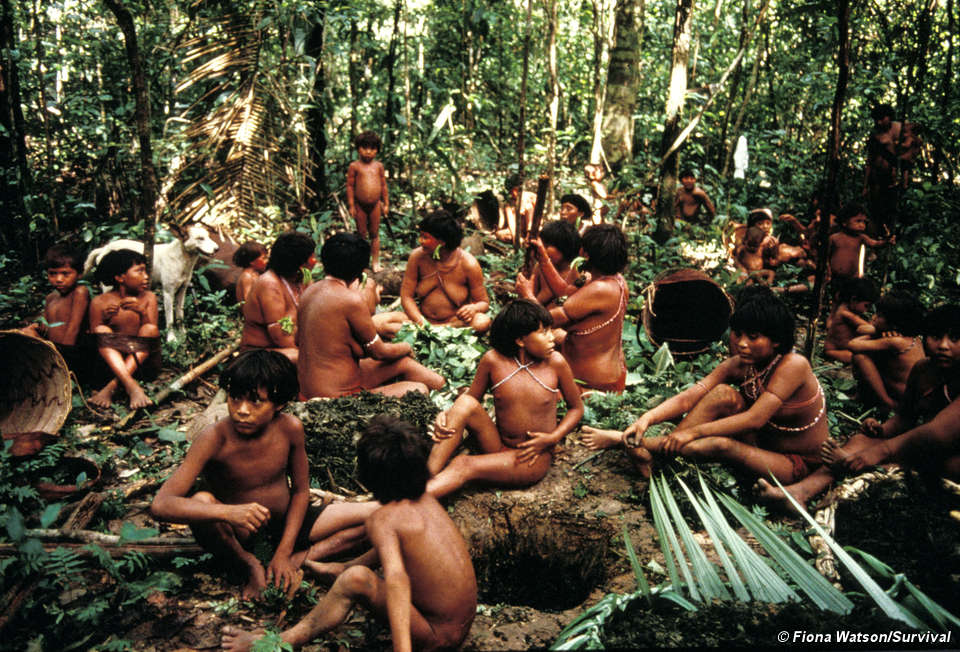
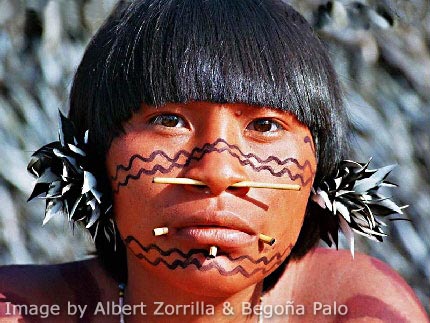
The Yanomamo are a remarkably isolated and undisturbed tribe who live in about 250 widely dispersed villages in Brazil and Venezuela. Peters-Golden noted that the villages are situated at varying distances from one another and have differing degrees of social closeness as well. Those that harbor good relations host frequent visitors, and it is not unusual for individuals to travel several days to pay a visit [3].
The Yanomamo have been influenced by European contact as early as the seventeenth century, when Spanish, Portuguese, and Dutch slave traders entered their territory.The Yanomamo have dealt with missionaries closely even after slave trading times.
The Yanomamo tribe lives in tropical forests where the environment is dense and green. Its thick floor of vines and scrub makes it difficult to traverse; on cloudy days its impenetrable canopy keeps out most light.
Chagnon posited that the Yanomamo didn’t possess the sophistication to be cultivators therefore their no portion of their diet was grown in gardens [3]. This, of course, is hardly the case. Currently, the majority of Yanomamo rely on both foraging and horticulture. The plantain is the most important domesticated crop, along with manioc, taro, and sweet potato. Cane used in arrow manufacture is grown in village gardens, as is tobacco, a crop of central importance.
Although foraging and horticulture account for the majority of subsistence, the Yanomamo still engage in game hunting, which is plentiful. During expeditions they commonly hunt wild pigs, large and small birds, monkeys, deer, rodents, anteaters, and armadillos, which are often smoked out of their burrows.
What is the Ax Fight?
The Ax Fight represents the extreme in grounding cinematic argument with empirical data. Once can achieve no more with a linear and public medium, a medium designed to be viewed collectively. The Ax Fight goes as far as is possible to satisfy the level of curiosity and forbearance that may be attributed to a large and diverse audience. Any more redundancy in the film would have served the slower and more curious viewers, but it would also have alienated the vast majority. Any more detail about protagonists and lineages would have buttressed an argument required by scholars, but would also have pressed most viewers beyond their limits of tolerance [2].
To put it plainly, The Ax Fight displays a conflict in a Yanomamo village called Mishimishimabowei-teri. There are protaganists-Uuwa, Mohesiwa, Kebowa-linked by lineage or kinship. It’s believed that the brawl broke out as a result of an incestuous relationship. This is not the case. The fight is a result of long standing hostility between a faction that lives in the village and a faction that is among a party of visitors.
Watch the Ax Fight
My Opinion on the Fierce Reputation of the Yanomamo
What do the events depicted in "The Ax Fight" suggest about the importance of kinship within tribal societies?
As sides are taken, often along kinship lines, large villages sometimes split into two over confrontations. It’s evident in the short film that many of the members of the tribe stayed clear of the confrontation, often watching like a spectator’s sport. And the others were running in with their spears and clubs to assist the attacker.
Sinabim’s husband and his brother Kebowa decided to continue the fight with Mohesiwa, who had previously attacked Sinabim. Mohesiwa’s kinswomen attempt to capture his weapon so not to aggravate the situation any further. In all actuality, and as Chagnon points out, these Yanomamo men walk around with deep gashes in their heads, even shaving them to display the thick knots they received during club fights. Like their own fight club, brothers and kinsmen walking around with these marks of violence, wear them proudly like a badge of honor. In some way it unites the kinsmen who partake in violence, and it links them to those they have no affiliation with within the community.
In your opinion, do the events depicted in "The Ax Fight" portray the Yanomamo accurately or are they merely a sensationalized account of Yanomamo life?
The 1975 textual narration, told from the perspective of Chignon, is written as if there’s a centrality of violence to the everyday life of the Yanomamo. This is simply a sensationalized account of a culture, who does partake in violent acts, but these acts do not dominate social life for any length of time.
Furthermore, The Ax Fight movie clearly doesn’t paint violence as a central part of the Yanomamo tribal community. It was clearly a sporadic fight that broke out. The Yanomamo, as posited by Chagnon, are believed to be “bloodthirsty fierce people who regularly kill each other”. His ethnographic details haven’t been supported by “anthropologists or anyone who has lived with the Yanomamo for years” [3].
Yet, we don’t really have any other perspective besides Chagnon's to base our objective on when watching the footage, and although I believe his opinion is biased, supporting the idea that violence is an everyday occurrence, I don’t think he described the actual recording out of context.
Controversy surrounding the Ax Fight

The Yanomamo, as posited by Chagnon, are believed to be “bloodthirsty fierce people who regularly kill each other”. His ethnographic details haven’t been supported by “anthropologists or anyone who has lived with the Yanomamo for years”.
The controversy surrounding Yanomamo violence escalated in 2000 when an investigative journalist, Patrick Tierney, published his book, Darkness in El Dorado. Tierney claimed that Napoleon Chagnon and James Neel, a physician and geneticist, knowingly endangered the lives and health of the Yanomamo communities they studied. Second, he asserted that Chagnon not only misrepresented the Yanomamo as "fierce people," but in fact instigated and promoted violence and warfare [1].
Anthropology students weigh in on the Yanomamo and their Fierce Reputation Portrayed in the Ax Fight

© Madzen
“First off, a minute-long video cannot capture an accurate representation of a society, by any means, but it can illustrate the importance's of individuals within a particular incidence by their actions. My study of their actions, coupled with my understanding of the text, speak to me that they hold kinship as a strong and central tie to their daily living. Also, one may notice that the underlying action which spurred this reaction, as recorded by Dr. Chagnon’s accompanying notes, dealt with one man laying hands on another man’s wife in violence”.
~Stephen Ricci-UCF
“I do not believe that “The Ax Fight” necessarily portrays Yanomamo life accurately; though the textbook also describes these club fights over women and other provocations these occurrences are not necessarily a part of daily Yanomamo life. The conflicts seen by Chagnon may have been at a particularly rough time in the Yanomamo lifestyle or could have been incentivated by the attention of an outsider observing them (Chagnon). As other observers have stated simply because these fights do occur does not mean that the Yanomamo are constantly fighting or fierce in natur”.
~Olivia Black-UCF
“The Ax Fight shows just a fraction of time for the Yanomamo. I believe it is more a sensationalized account of their lives. To an outsider not knowing what is going on, the film does make it seem as if they are extremely violent. But because kinship is so important within the tribe, it is not surprising that a fight broke out because a woman was beaten. The desire to retaliate is a natural reaction if someone's family member was hurt by another. The evidence shown in the film of the Yanomamo being "fierce" and violent in everyday life is weakened after knowing why the fight started in the first place. Other researchers suggest that the violent acts are sporadic and are not a part of everyday life”.
~Sharon Ladiero-UCF
So what’s your take?
Sources
- Tierney, Patrick. (2000). Darkness in el dorado: how scientists and journalists devastated the amazon. New York: W. W. Norton & Company.
- Asch, Tim . The Ax Fight. http://www.anth.ucsb.edu/projects/axfight/index2.html
- Peters Golden, Holly. (2009) Cultural Sketches: Case Studies in Anthropology.New York: The Mcgraw-Hill Companies.


