• Ancient Digger teaches Archaeology and History to all Ages!

Sunday, July 11, 2010

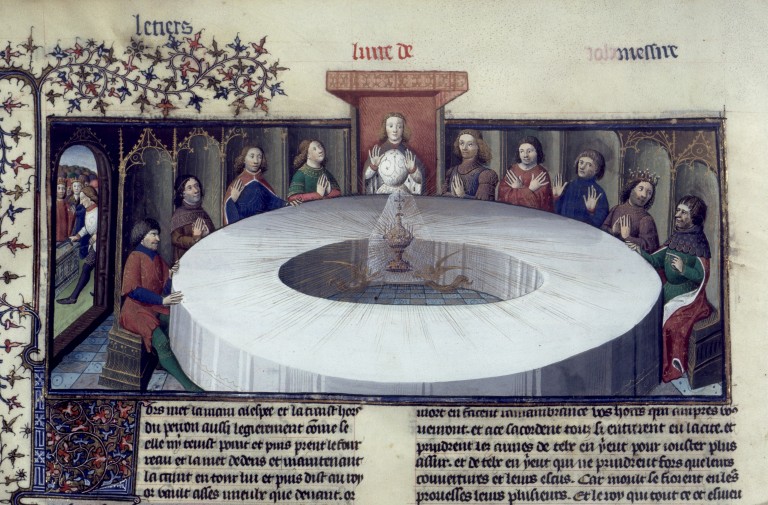
King Arthurs's Camelot and Round Table Have Been Found?


The King Arthur and the Knights of the Round Table is one of the most famous English legends. The Knights of King Arthur would sit at a round table, placing their swords down with the blade facing the middle crest. All were equal at the Round Table in Camelot. The legend, however, speaks of a table and not a structure able to hold close to 1000 people.

Camelot historian Chris Gidlow said: “The first accounts of the Round Table show that it was nothing like a dining table but was a venue for upwards of 1,000 people at a time.

Read the entire story:  Historians locate King Arthur's Round Table

Wednesday, July 7, 2010

Here's a Reason to Stop Building on Burial Grounds


I remember watching the 1982 movie The Poltergeist when the graves of Indians appeared out of the wet, rainy mud. Totally freaky at the time! Of course, what can you expect when you build your abode over an  ancient Indian burial site. So where did Miami’s mega-developer Jorge Perez build his largest project? Exactly where he shouldn’t have: atop an ancient Indian burial site.

The curse of the Miami Circle is unfolding before our eyes. The latest news is that Perez and his partners have been forced to return a majority of the $1 billion ICON Brickell complex to its lenders.

Read More on The Curse of the Ancients  via Biscayne Times

Archaeologist Bob Carr (left) at the Miami Circle site in 1999. Photo courtesy of HistoryMiami

Friday, April 30, 2010

Focus on History: New History Sites and Bloggers


I absolutely love being a history and travel blogger, as it allows me to meet individuals I would never get the chance to on an everyday basis. In the past two days, two very special sites have landed themselves on the Ancient Digger Blogroll.

The first of these special additions is Border Jumpers, which was an idea from the minds of two very special individuals. You can follow Bernard Pollack and Danielle Nierenberg as they travel in Africa to meet with farmers, activists, non-governmental organization (NGOs), the funding and donor communities, and local, regional, and international press. Their goal is educate the masses about workers and residents and their living conditions, as well as the subject of poverty, and how people in Africa are combating that issue.

Here's an excerpt from their latest post:
We’ve taken some long bus rides in Africa. We spent eight bumpy hours on a bus from Nairobi to Arusha and another eight from Arusha to Dar Es Salaam.

The longest so far, though, has been between Kigali, Rwanda and Kampala, Uganda. As usual, we were looking out the window, admiring the crops growing by the side of the road, desperately trying not to think about how we had to pee, and trying not to panic about how fast our bus driver was maneuvering between other buses, cattle, and street vendors hawking roasted corn, bananas, and pineapples on the side of the road. 
Read more about 1000 Words fr4om Rwanda

Our second new addition is Boatswain and Bateremia . This particular site is run by Jared Wasser and focuses on maritime and naval history,with the added addition of medicine, since Jared is a student of medicine. Together, the two subjects merge to create a fascinating and well written site about the history of maritime medicine.

Here's an excerpt from his latest post:

Rice.  One of the most prominent and relied-upon staples, cooked in any variety of dishes the world over, and a vital source of nutrition for millions of people on our planet.  I love it; one of my favorite foods that, at times, it seems I just cannot get enough of.  However, this seemingly innocuous ellipsoid was, at one point, the source of an illness that ravaged a large portion of the Royal Fleet in the 18th and 19th centuries.  One arguably more virulent and more mysterious than that of even the famous scurvy.  The disease I speak of is called beriberi; an illness which killed many sailors in the age of sail, and perplexed physicians and surgeons for around a century.
Read more about the story of Berberi

Wednesday, February 10, 2010

Legends of Africa: The Staff of Oranyan


The Staff of Oranyan is a piece of Ife Art.

Oduduwa was the first king of Ife and brother to the Great God. He was sent to continue creation, and in so doing, he had a son, Oranyan.

Oranyan was a great warrior. At a very old age, he retired into a private grove, however if enemies appeared, he would fight them single-handed.

On one evening, a festival was being held and things got out of hand. Several people had gotten drunk and started to attack villagers, so Oranyan was called into the battle.

Oranyan proceeded to kill his own subjects and the villagers asked him to stop. In a rage, and even shocked, he drove his staff into the ground and vowed to never fight again.

Although, the story was told throughout history as a myth, pieces of the staff were unearthed and pieced back together. The staff measure 20 feet high and it's studded with iron nails in a pattern that can't be deciphered.

The history of Ife is still quite cloudy, as many artifacts are still being unearthed today, including bronze heads of kings. In 1910, the Olokun head was discovered which clearly represents a king, or even more bizarre, a god of the sea whose clay images are still made in the region today.

Like Ancient Digger? Why Not Follow Us?


Subscribe Via RSS Feed Follow Ancient Digger on Facebook Follow Ancient Digger on Twitter Subscribe to Ancient Digger Via Email

Get widget

Search


Ancient Digger Archaeology Copyright © 2015 LKart Theme is Designed by Lasantha