• Ancient Digger teaches Archaeology and History to all Ages!

Saturday, May 30, 2009

Mysterious Scottish Island and Its History


In Scotland's cold sea waters lay several islands with castles, stone circles, ruins, and plenty of folklore.

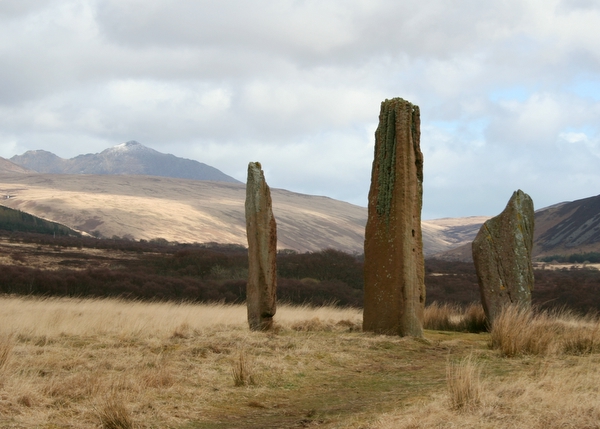
On the Isle of Arran, located off Scotland's southwest coast, travelers can visit Machrie Moor, which boasts several stone circles and some free-standing 18-foot-tall stones. Adding to the island's appeal and mystery is the 16th-century Brodick Castle, which still houses furnishings and art from its many inhabitants; the ruins of Lochranza Castle; and Culzean Castle & Country Park, which features an armory, ruins, and extensive grounds.

Arran is a small island, 20 miles long and 56 miles round, located off the south-west coast of Scotland. Ferries run from the Scottish mainland to the Isle of Arran. Most people reach the island via Ardrossan which has a direct rail service from Glasgow.

History

The first people on Arran to leave visible signs of their life and times here were the Neolithic people, who lived on the island in the period between 4,500BC and 2,000BC. They were farmers, and traces of their field systems have been found on Arran. However, they have left their most distinct legacy on Arran in the form of stone circles, standing stones and cairns. We do not know what these monuments were used for, but it is safe to assume that they had some kind of ceremonial function.


Machrie moor standing stones is a small ancient circle protected by a stone wall. Continue on the footpath and you will reach the main site, three-quarters of a mile across the fields.


Robert Pollock has produced an excellent guide with diagrams which details these and other circles on this site. Two of the circles have recently been excavated, and the amount of peat growth over the original prehistoric ground surface can be seen as a tidemark on the stones. Indeed one of the circles had completely disappeared under the peat.

Druid Stone is likely to be a Neolithic or Bronze age stone, despite its local association with the Iron Age priesthood. A druid was a member of the priestly and learned class in the ancient Celtic societies of Western Europe, Britain and Ireland.
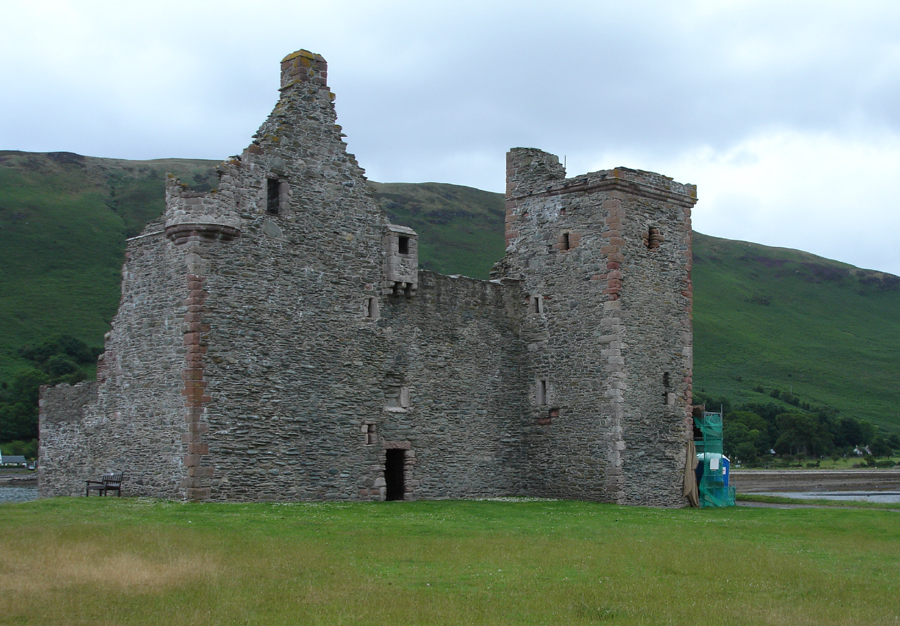
The Ruins of Lochranza Castle are located north of Brodick. The castle was a former hunting lodge of the Scottish Kings. It has been claimed that Lochranza Castle has literary connections, being used as the basis for the castle in the Tintin adventure "The Black Island".


Brodick Castle is made up of red sandstone and it lies at the foot of Goatfell Mountain 1.5 miles out of Brodick; the main port on the Isle of Arran off the west coast of Scotland.

The name Brodick comes from the Norse words, meaning 'broad bay'. Arran means 'peaked island' in Gaelic.


Tuesday, May 26, 2009

The Holy Blood Procession in Bruges


The Procession of the Holy Blood is a large religious procession, dating back to the Middle Ages, which takes place each Ascension Day in Bruges, Belgium.

Patrick Bernauw tells us about the historical tradition of Bruges saying that after the descent from the Cross, Joseph of Arimathea took some of His blood and preserved it. Thierry of Alsace, Count of Flanders, received the relic in the Holy Land and brought it to Bruges. The Precious Blood arrived in Bruges, together with the Count, his wife Sybilla of Anjou and the abbot of Saint Bertin on April 7th 1150. The oldest document however, concerning this Holy Grail of Bruges, dates back to 1256.

Trying Something New: Online Stocks and Trade


My father and I were having a very adult conversation about my future and he went into the subject of stock trading and working with an online broker. Now, don't get me wrong, my father has been doing this for years, online trading with many companies over the years.

For me, this is a bit unknown, so I searched the internet far and wide for reputable companies that would make the right choices for me based on my income and expectations. Several years ago I invested in a small company I worked for, but I never really followed the stocks, perhaps because I never really understood how it worked.

After watching several documentaries on Warren Buffett and seeing what can be accomplished by stock trading, I decided to give it a go. I don't want to divulge all my secrets, but I did find one site that has really made a difference for me. My father had used this company previously, but I still had so many questions up front and I was able to have all of them answered before I ever made any decisions. I only had a modest amount to invest, but with Firstrade, I was able to double my money.

Saturday, May 23, 2009

The Many Faces of Petoskey


Looking for Petoskey Stones? Please read the updated article on Petoskey Stones.

Wednesday, May 20, 2009

The Museum of Turin and Its Special Collection


The Museum of Turin is home to one of the most spectacular collections of Egyptian artifacts in the world.

The Egyptian Museum of Turin (the second in the world after the Cairo Museum) was established in 1824, although the University of Turin already owned an important collection of Egyptian material.

In 1824, King Carlo Felice acquired most of the vast collection collected by the Piedmontese Bernardino Drovetti, French consul general in Egypt. During the same year, Jean-François Champollion used Turin collection of papyruses to test his breakthroughs in deciphering the hieroglyphic writing.

The time Champollion spent in Turin examining the texts is also the origin of a legend about the mysterious disappearance of the "Papiro Regio", that was only later found and of which some portions are still unavailable.

In 1833, the collection of Piedmontese Giuseppe Sossio (over 1,200 pieces) was added to the Egyptian Museum. The collection was complemented by the finds of Egyptologist Ernesto Schiaparelli during his excavation campaigns between 1900 and 1920.

The Tomb of Kha was discovered in 1906 during the excavation campaign carried out by the Italian archaeological mission in Deir el Medina. This particular exhibit is the most impressive in the entire museum. The tomb, which dates back to 3,500 BC held several sarcophagi and statues, as well as furniture, garments and grooming items.

Kha was an important foreman at Deir El-Medina where he had been responsible for projects constructed during the reigns of 3 kings: Amenhotep II, Thutmose IV and Amenhotep III .

"entirely covered in gold leaf, except for the eyes, eye-brows and cosmetic lines, which are inlaid--quartz or rock crystal for the whites of the eyes, black glass or obsidian for the irises, blue glass for the eyebrows and cosmetic lines. The eye sockets themselves are framed with copper or bronze. His arms are crossed over his chest in the pose of Osiris, lord of the dead. He wears a broad collar with falcon-head terminals. Below this is a vulture with outstretched wings grasping two shen-signs in its talons."

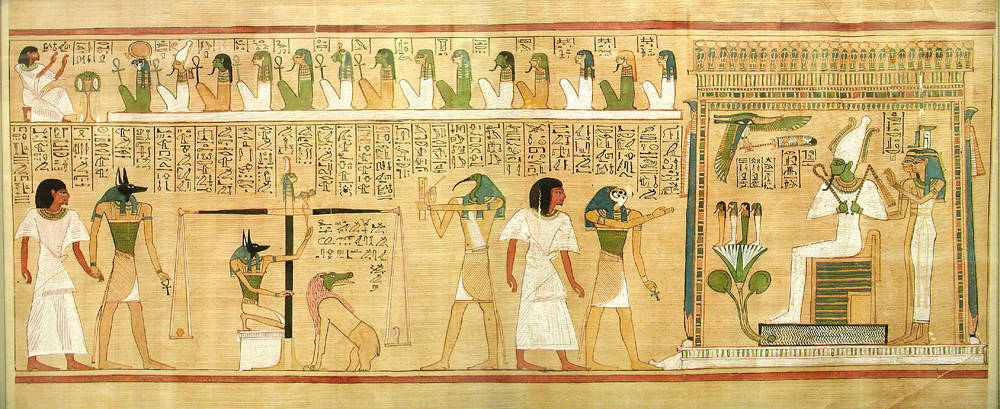
Included in one of Kha's coffins is one of the earliest examples of the Egyptian Book of the Dead.

The Museum of Turin has acquired 3 copies of the Egyptian Book of the Dead including the most ancient copy known. The books were discovered by Schiaparelli in 1906 and til this day they remain displayed in the museum. However, the director has been asked several times to remove them due to their negative energy protruding from the papyrus.

The book of dead was simply the explanation of the afterlife and a collection of hymns, spells, and instructions to allow the deceased to pass through obstacles.

The book of dead was most commonly written on a papyrus scroll and placed in the coffin or burial chamber of the deceased. However, many believe that reading from the scrolls can lead to plague, death, or the end of life as we know it.

Between 1903 and 1920 the Italian Archaeological Mission launched a number of excavations along the Nile, acquiring additional material; new pieces were also added to the museum between 1930 and 1969.

Monday, May 18, 2009

Post Moved


Post removed:

Please check out the updated version of the Wonders of the World. @ this site

Sunday, May 17, 2009

The Validity of Heinrich Schleimann's Findings at Mycenae


Homer’s epic poems Iliad and Odyssey have captivated readers as works of imagination for thousands of years; but what of their true historical pertinence? In 1876, Heinrich Schliemann made claims that suggested a grave at Mycenae was the burial site of King Agamemnon and his family, thus proving the poems’ historical validity. However, his archaeological standpoint was biased, personal issues depreciated his work, and his evidence was not entirely without falsity. Based on this, Schliemann’s claims that the poems were established on historical truths are invalid as archaeological fact.

Thursday, May 14, 2009

930


Incomplete posts are currently being deleted due to site updates. Sorry for the inconvenience.

Wednesday, May 13, 2009

Post Removed 7


Incomplete posts are currently being deleted due to site updates. Sorry for the inconvenience.

Thursday, May 7, 2009

3,000-year-old carving Discovered in the Largest Mud-Brick Temple


Ancient Egyptian pharaoh Ramses II offers gifts to Geb, god of earth, in a 3,000-year-old carving discovered in the largest mud-brick temple yet found on northeastern Egypt's northern Sinai Peninsula (map).

The landmark is among four ancient temples discovered at a site near the Egyptian border near the Suez Canal, the country's archaeology agency announced on April 21.

Post Removed 4


Incomplete posts are currently being deleted. Sorry for the inconvenience.

Wednesday, May 6, 2009

475


Incomplete posts are currently being deleted. Sorry for the inconvenience.

Sunday, May 3, 2009

Course Hero: A Virtual Vault of Educational Materials


Resources for students are readily available for course studies, research papers, and notes from lectures. I was on the lookout for a site that made these items available for future classes. In addition, I wanted to hear from the students themselves about how the courses were outlined by the professors and what were the key points I needed to focus on.

I stumbled up Course Hero, a well organized and helpful site that had every resource I needed for my upcoming classes. There were ESM 206 UCSB Lecture Note's, amongst some other courses I was researching.

Also, I when I was looking for some additional materials for a friend that was attending the University of California, taking the same class, I found these notes UCSB ESM 206 University of California Santa Barbara very helpful.

"Course Hero has millions of student submitted documents similar to the one below including study guides, homework solutions, papers, and exam answer keys. Visit our document archives to see a sample list of documents available on Coursehero"

If you are a student looking to connect with other students, or you're just looking for some simple course outlines, this is the site to check out.


Like Ancient Digger? Why Not Follow Us?


Subscribe Via RSS Feed Follow Ancient Digger on Facebook Follow Ancient Digger on Twitter Subscribe to Ancient Digger Via Email

Get widget

Search


Ancient Digger Archaeology Copyright © 2015 LKart Theme is Designed by Lasantha